forensic anthropology final exam
 Call Kai
 Learn
Learn Practice Test
 Spaced Repetition
 Match
Match Flashcards
 Knowt Play
1/62

There's no tags or description
Looks like no tags are added yet.
Name | Mastery | Learn | Test | Matching | Spaced | Call with Kai |
|---|
No analytics yet
Send a link to your students to track their progress
63 Terms
cause of death
medically - stop breathing and heart stops
forensically - factors leading to above
ex: asphyxiation due to drowning
manner of death
5 categories
natural
accidental
suicide
homicide
undetermined
trauma
injury caused to living tissue by an outside force
ex: fractures
mechanisms of trauma
projectile, blunt, sharp, thermal, misc.
antemortem
before death
shows signs of healing
perimortem
around the time of death
no sign of healing
postmortem
occurred after death
ex: taphonomic effects
fracture causes
pathological weakened bones
stress fractures - overuse
fatigue fractures - intermittent stress over a long period of time
traumatic fractures - due to an outside force
bone mechanics
loading - application of force
stiffness - ability to resist deformation
elastic modulus
stress - load per unit area
strain - change in dimension of a loaded body
wet bone
stiff and elastic
can withstand slow loading strain longer
dry bone
stiff and brittle
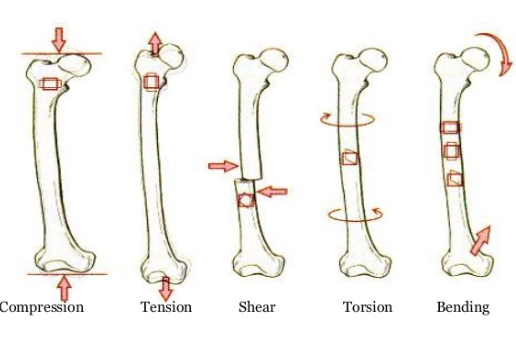
compression
squeeze
normally in spine
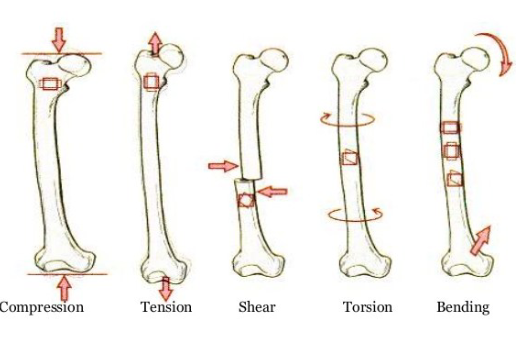
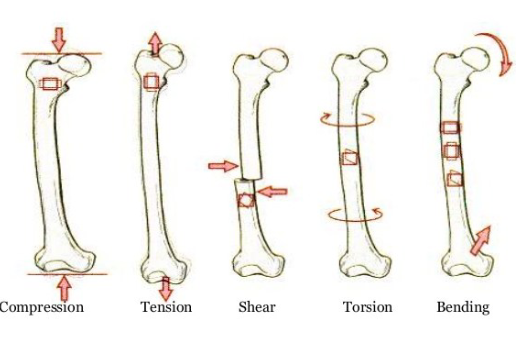
tension
stretch
normally in elbow and knee
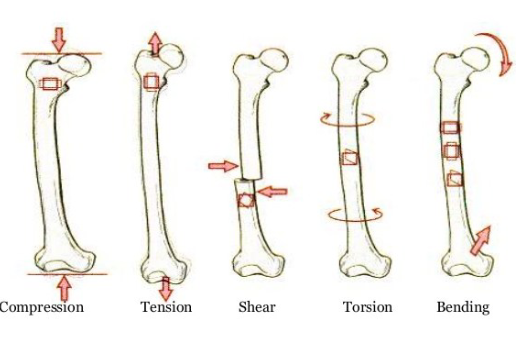
bending
concave side subjected to compression, convex side subjected to tension
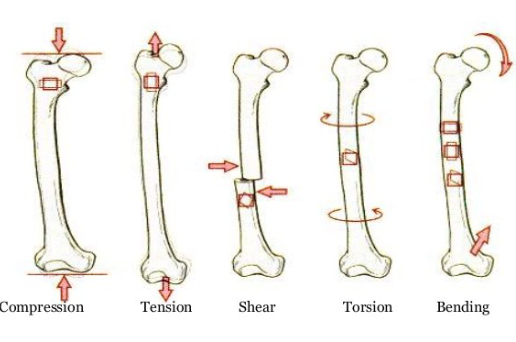
shearing
slide portions of bone relative to one another
torsion
combo of sheer and rotation
fracture repair
hematoma forms
fibrocartilaginous callus forms
bony callus forms
bone remodeling
diastatic
the fracture follows the suture
what age group is more likely to have compression fractures
older adults
>65
what age group is more likely to have bending fractures
children
<10
what age group is more likely to have epiphyseal fractures
adolescents/teenagers
10-18
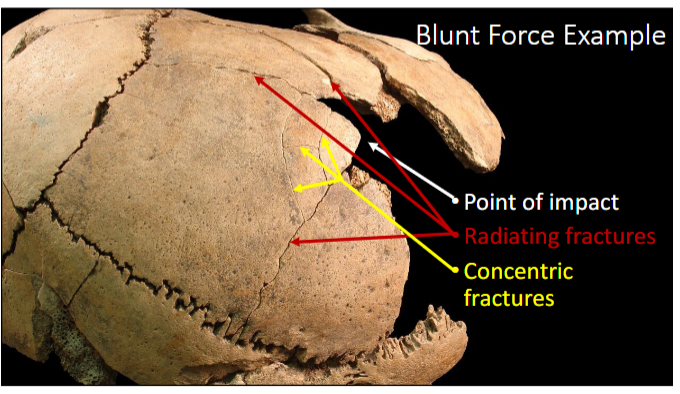
blunt force trauma
slow velocity application of stress over relatively large surface area
fractures follow path of least resistance
ex: club, hammer, fists, falls
delamination
separation of articular cartilage from underlying bone
high velocity trauma
rapid application of force over a small surface area
beveling
angling in direction of projectile
entrance wounds - internally beveled
exit wounds - externally beveled
spall
small flakes of bone broken off when projectile penetrates the other side of bone
sharp force trauma
made by a tool with a point or beveled edge
knife wounds
cuts and stabs
bone alterations - straight line incisions, punctures, gouges, clefts
serrated vs non serrated
stab wound
length on surface less than depth of pentration
slash wounds
longer surface cut that deep
chop wounds
caused by machetes, meat cleavers, swords, axes
extensive soft tissue and bone damage
can be blunt + sharp force trauma
thermal trauma
soft tissues burn and contract, leading to the pugilistic pose
characterized by: charring, delamination, calcification, color change, shrinking, fracture
blast trauma
primary, secondary, tertiary and quaternary
primary blast
soft tissue destruction, bone micro-fractures
traumatic amputation
secondary blast
shrapnel, mines, bomb casing materials
same effect as high velocity trauma
comminuted fractures, loss of periosteal tissue, intrusion into medullary cavity
tertiary injury
displacement or impact
micro fracturing, stress applied perpendicular to bone axis
spinal fractures and blunt force injuries
pathologies
infection, osteoarthritis, dental
bone infection
osteitis - general inflammation of bone tissue
ex: tuberculosis, syphilis, polio
lesion - bone alteration
lytic - bone loss
deformative - change in bone shape
osteomyelitis
bacterial/fungal infection
characterized by pus draining holes called cloaca
osteoarthritis
inflammation of joint surface
caused by: injury, aging, activity, congenital
VERY common in: vertebrae, knee
dental pathologies
caries/cavities - decalcification of enamel and dentine
periodontal disease: inflammation around tooth, abscesses
big 4 of biological profile
sex
age
stature
ancestry
ancestry estimation
cranial non-metric methods
metrics mostly postcranial
most people have mixed traits
ancestry meaning
refers to ancestral geographic region of origin
“population affinity”
craniometric analysis
measure skulls using landmarks
used on ForDisc
shovel-shaped incisors
present in native americans and asian individuals
carabelli’s cusps
found in european individuals
secular changes through time
narrower faces and taller cranial vaults since 1850
overall increases in stature
better nutrition
mass fatality
deaths of more individuals than can be handled by local resources
can be natural (earthquake, pandemic, etc) or manmade (plane crash, traffic collision, terrorist attack)
mass casualty steps
search and recovery
organization and workflow
separation of bone from other materials
human vs nonhuman
individual ids
US mass fatality system
health and human services (HHS) → national disaster medical system (NDMS) → disaster mortuary operational response team (DMORT)
personal identification
process of establishing the id of an individual
positive id
human remains can be associated with one person to the exclusion of all others
probably/presumptive/tentative id
its highly probable decadent is person in records, but requires more investigation
exclusion of assumed id
nutritional deficiencies
porotic hyperostosis, cribra orbitalia - iron deficiency
rickets - vitamin D deficiency
harris lines
interrupted bone growth due to malnutrition in childhood
enamel hypoplasia
interrupted enamel growth due to malnutrition
wormion bones
extra bone pieces that occur within sutures
20-80% of skulls have
sternal foramen
extra holes resulting from non fusion or incomplete fusion during bone formation
~7% of adults have
the “russian” method
uses the musculature of the skull
1st used for paleoanthropology, then adopted by the KGB
the american method
“tissue depth method”
1.tissue depth markers based on cadavers and live tissue punctures
various points on the face while laying down
skull/cast mounted in frankfurt plane
pieces of rubber cut to tissue depth markers and fixed to skull
area between tissue markers filled in with clay
artistic interpretation
anatomical/manchester method
combo of russian + american
uses musculature of skull and tissue depth markers/landmarks
most commonly used today
surgical implements
orthopedic devices, implants, dental hardware
reference and maker numbers that are tied to patient records/medical records
haplotype
sets of DNA variations that tend to be inherited together
haplogroup
group of similar haplotypes that share common ancestor
y-chromosome and mtDNA most used by ancestry sites