exam 4 !
 Call Kai
 Learn
Learn Practice Test
 Spaced Repetition
 Match
Match Flashcards
 Knowt Play
1/94

There's no tags or description
Looks like no tags are added yet.
Name | Mastery | Learn | Test | Matching | Spaced | Call with Kai |
|---|
No analytics yet
Send a link to your students to track their progress
95 Terms
The Jurassic Period
200-146 mya: first birds evolved from small feathered theropods, marine ammonites, and more! Many reptile orders, Nevadan oregony, Morrison Formation.
Which era includes the Jurassic Period?
The Mesozoic Era.
What is the nickname for the Jurassic Period?
The Age of the Dinosaurs.
What was the Triassic-Jurassic Extinction event also known as?
The CAMP (Central Atlantic Magmatic Province) extinction event.
How did the Triassic-Jurassic extinction lead to the rise of dinosaurs?
Caused other archosaurs to vacate terrestrial ecological niches
What is a 'disaster taxon'?
A species that benefits from an extinction event by filling vacant ecological niches.
What is the literal etymological meaning of the word 'dinosaur'?
Terrible lizard.
Are dinosaurs biologically classified as lizards?
nah bruh they evolved from a branch of archosaurs (diapsid reptiles).
What evidence suggests that dinosaurs were warm-blooded?
Growth rates and the discovery of fossils in arctic regions.
key distinguishing feature of dinosaur skeletal stance compared to other reptiles?
Their hind limbs are positioned directly beneath the body, rather than having a sprawling leg posture.
What anatomical feature is commonly found on the feet of many dinosaurs?
Three-toed feet.
How long did dinosaurs dominate the Earth in total?
Approximately 165 million years.
How does the dinosaur pelvis differ from that of other reptiles?
Dinosaurs have a hole in the center of the pelvis (the acetabulum)
the Triassic Period?
251 to 200 mya: Pangea extends almost from pole to pole/ begins to break up. Andest Rocky mt oregony. Relativley high temps, dry climates (deserts, sandstones)
What was the primary continental configuration during the Triassic?
Pangaea
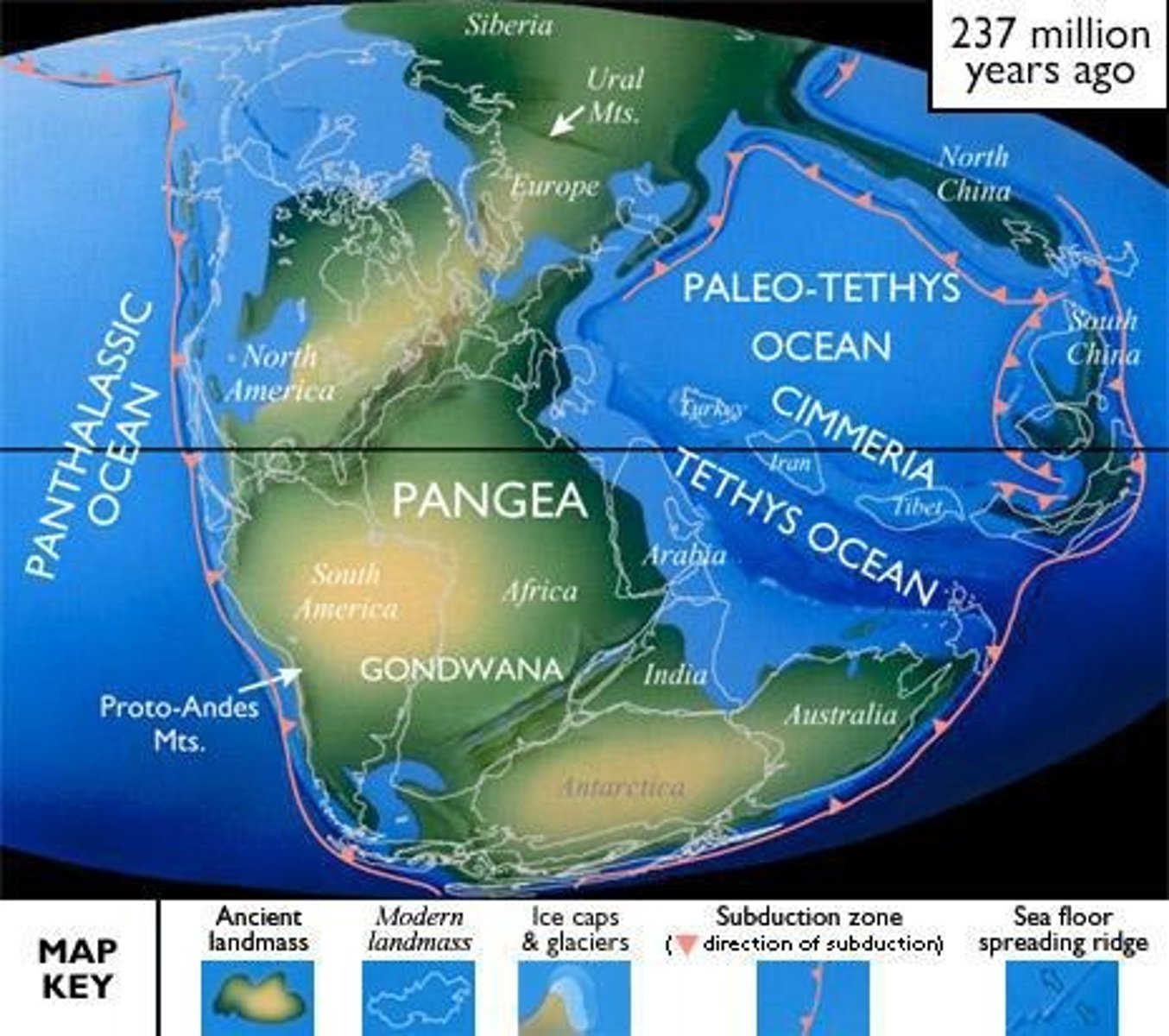
Mezozoic Era
251-66 mya: “age of dinosaurs” —appeared mid-triassic (230mya): beginning of long-term subduction + mountain building in the west.
What occurred in the western US during the Late Permian to Triassic?
The 2nd rocky mt orogeny (Sonoma)
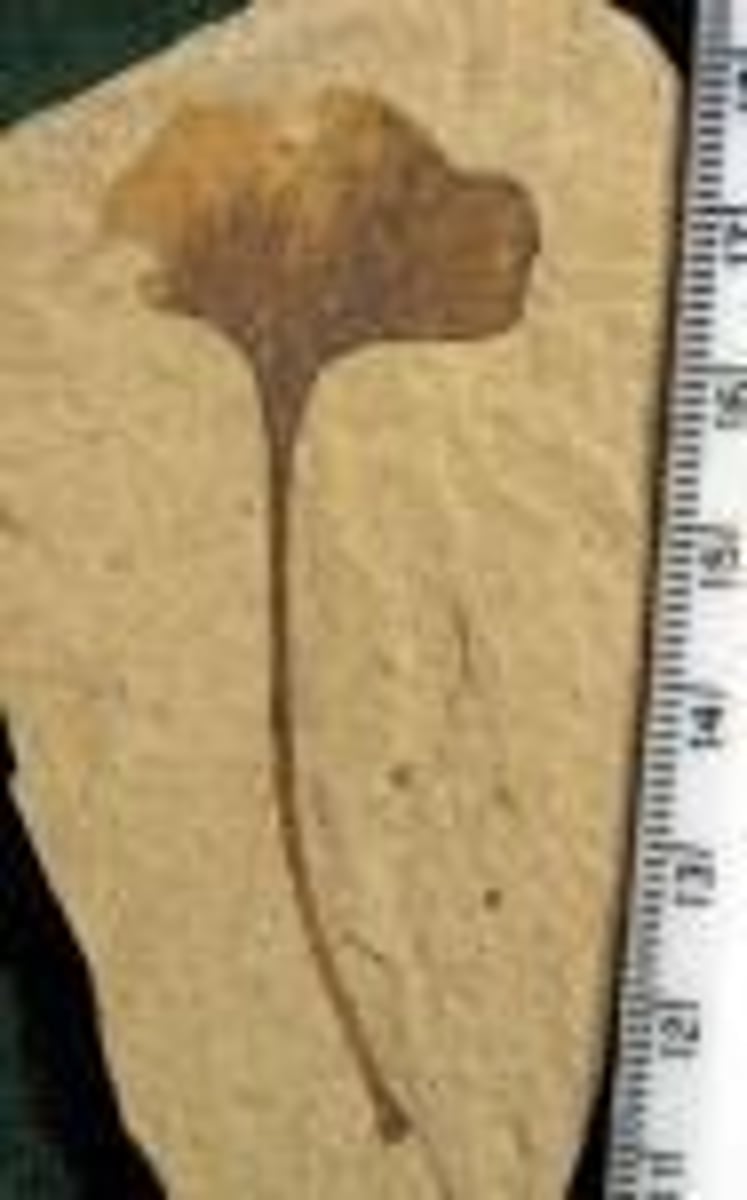
What were the dominant types of vegetation in the Triassic?
Conifers, ginkgos, and cycads
What is a 'disaster taxon'?
A species that survives a mass extinction and subsequently thrives
characteristics of Cynodonts?
Specialized teeth, three ear bones, egg-laying, and potentially fur
Which group of reptiles became the dominant land vertebrates during the Triassic?
Archosaur reptiles
therapsids cynodonts
mammal like features increase during the mid triassic era: teeth, 3 ear bones, laid eggs
what are Archosaur reptiles
diapsid reptiles that emerged in the Early Triassic +++ dinosaurs, pterosaurs, crocodiles, and birds, all descended from a common ancestor.
Diapsid reptiles
not mammal like synopsids @modern snakes, lizards, tuataras, crocodiles, and birds, as well as extinct groups like dinosaurs and pterosaurs.@@@
What is a prosauropod? @
An ancestor of sauropods, typically characterized by 4 legs and long necks
what does CAMP stand for in the context of the End Triassic extinction?
Central Atlantic Magmatic Province
geological process caused the breakup of Pangaea in the Late Triassic?
Rifting (crustal extension)
What environmental factors caused by CAMP volcanism led to the End Triassic extinction?
Climate change and ocean acidification
What is an ecological niche?
The set of environmental conditions in which a species lives
what acts as a pathway for magma during crustal extension?
Normal faults
what does normal faults allow at the top of the crust
extension of rifts and fed volcanoes around the surface
What is a feeder dike ?
vertical intrusion in igneous rock that acts as a volcanic plumbing conduit, transporting magma from a deeper chamber to the surface, where it erupts to form lava flows
what is a sill?
horizontally intrusion between older layers of sedimentary rock, beds of volcanic lava, or along foliation planes in metamorphic rock.
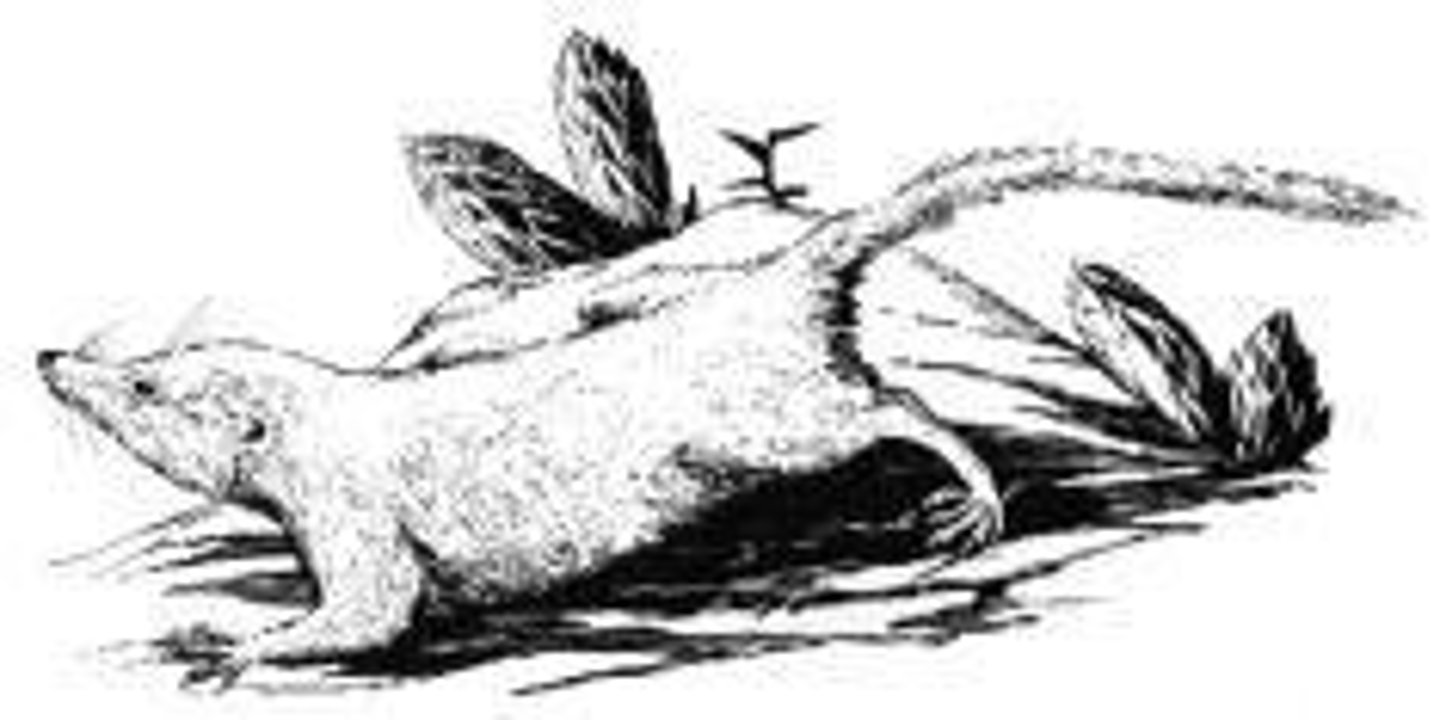
When did true mammals first evolve?
Mid-Triassic
what are the two reptile orders
Saurischia and Ornithischia
what is Saurischia
meat eaters including Therapods and plant eaters including saurapods
what is Ornithischia
diverse groups of herbivorous dinosaurs known for their distinctive "bird-hipped" pelvic structure, and being duck-billed.
what is a ornithopod?
ornithischians: well-developed forelimbs, could walk on all fours including hardrosours@ (duck-billed dinos)
Ceratopsians
ornithischians: herbivores, beecked dinos with parrot-like beaks, cranial frills, and facial horns, thriving in the Late Cretaceous
Pachycephalosaurs
Ornithischians: late creatceous period, bipedal herbivores, thick skulls with done heads.
Ankylosaurs
Ornithichians: Herbivores with backward-pointing pubis, thick armor, and some with spikes
Stegosaurs
Ornithichians: Herbivores: Jurassic + early Cretaceous period, many plates and spines along the back and tail@
what was the 3rd rockies oregony in the jurassic period
the nevadon: subduction of Pacific Ocean crust. Multiple volcanic arc terranes created which lead to huge magma bodies.
what happened to Sauropods in the jurassic@
reached their peak in size and diversity. Largest land animals in Earth's history roaming the landscape
feathers
Fuzz, bristles and complex plumage on >24 dinosaur genera
the cretaceous period
145-66mya: Dinosaurs at their most diverse and abundant, Pangaea finishes in breakup, Sevier and Laramide orogenies, the Zuni transgression
what was the last Rocky mt oregonies in the Cretaceous period ?
Sevier and Laramide
Sevier Oregony
thrust faulting (shallow/flatter faults) + thin-skinned tectonics only in upper sedimentary phanerozoic layers
Laramide oregony
createous: reverse faults (deeper/steeper angles) + thick-skinned tectonics in ancient Archean basement
what are the importance of mines in the mountains
major locations of copper gold and other economically important ore minerals
importance of orogenies and mines
causes migration of hydrothermal (hot water) fluid that carry dissolved minerals and concentrate them.
what happened between orogenies and ore minerals
they heat the crust and produce magma and cause hot water to circulate the crust and dissolve elements. Elements get concentrated in the hot water, then get deposited as ore minerals
Angiosperms
first flowering plants in the Cetaceous period
What are Cretaceous Interior Seaways
Zuni Transgression: shallow epicontinental seas that split North America—- leading to modern day continents!
What caused the end of the Mesisoic Era
66mya: the cretaceous-paleogene extinction
One of the pieces of evidence for the Mesozoic end with the founding of this ore within clay layers (typically found low in Earth’s core, surrounded by iron, as well as concentrated in meteorites)
Iridium
One of the pieces of evidence for the Mesozoic end involving minerals in a clay layer found near an impact crater/nuclear explosion layers due to extremely hot pressures
Shocked Quartz
One of the pieces of evidence for the Mesozoic end involving drops of glass beads and such on Earths rocks melted during impact, thrown in the atmosphere + rain back down
Spherals and Tecktites
One of the pieces of evidence for the mesozoic end involving debris deposits from huge waves
Tsunami deposits
One of the pieces of evidence for the Mesozoic end involving mexico formation in weakened limestone overlaying a crater
Cenotes (sinkholes)
One of the pieces of evidence for the mesozoic end involving the discovery of half of a crater being on land, other half under the gulf of Mexico by an oil company
Chicxulub crater
the last extinction of the mesiosoic era
Many mammals (93%) fish birds lizards insects plants sharks plankton when extinct. Not just dinos, but 75% of ALL species on Earth vanished.
The Cenozoic Era
66 mya-recent: 1.4% of Earths History, period including epoch timeline mostly because of new diversifications. Climate generally decreasing temps + ice accumulation at poles
MEM for Cenozoic Era!
Pancakes (paleocene) Not ( neogene) Quaker oats (quaternary)
Paleocene
66-23mya: Laramide Orogeny ends,himalayan mt oregony begins, crust extends in Basins (range continues today!), climate is warm, sea levels fall, early lizards, snakes, and the largest predators. Rodents still abundant mammal groups but then… mammal radiation + first primates! Rodents are still an abundant mammal group, but then… mammal radiation + first primates!
What are the (surviving) major kinds of mammals?
Monotremes, Marsupials, Placentals
Monotremes
Egg-laying, milk producing (platypus, echidna)
Marsupials
Milk-producing, give birth+ live young at an early state of development, nurture in puchs (opsum, Kangaroos)
Placentals
Milk-producing, give birth to more advanced young (horses, mice, humans) Placenta feeds offspring during preg—90% of mammals
where are the first whales?
paleogene
rise of mammals when?
triassic period
Mammals have what?
Mammary glands (milk for young), hair, 3 middle ear bones, a single-bone lower jaw, and a region of a complex brain called the neocortex
Vestigial feature
usually small and subdued. (evidence for a 4-legged land ancestor + lost original function thru evolution)
primates
paleogene: opposite thumbs, fingernails, hand-like feet, forward looking eyes
horse evolution in mid-paleogene
Dog sized, had toes, woodlands of the norther hemp, low crowned teeth no ridges
Neogene
23-2.6 mya: Major geo processes in the Western U.S continuously happening today! Sea level falls, decreasing temps, drying climate, many forests change to grasslands, earliest hominins (primate human ancestor)
The connection between horse evolution in North America and climate change?
rise of on open grasslands==grew in size w/ longer legs for running. Molars became high-crowned with complex ridges, shifting from browsing to grazing diets. Toes reduced from 4 to 3 and eventually to a single hoof, with vestigial toes remaining today.
Fingers, which indicate adaptation to the 'fine branch niche.'
The lower back.
Forebrain, midbrain, and hindbrain.
Larger, longer legs, and molars evolved from browsers to grazers.
life has changed and species go extinct over time.
More offspring are born than the environment can support, leading to competition.
The process by which the environment selects individuals best adapted to survive and reproduce.
What role do mutations play in evolution?
Create new variations in species, which can lead to evolution.
Humans breed animals and plants to enhance specific traits.
Charles Darwin and Alfred Wallace.
leads to survival inequalities among individuals.
did not understand the role and inheritance in evolution.
What is a germline mutation?
change in a body's reproductive cell (sperm or egg) that becomes incorporated into the DNA of every cell in the body of the offspring
diversity among individuals in a species, which can aid survival.
Through natural selection, where the best-adapted individuals survive and reproduce.
provides fossil evidence that supports the theory of evolution.
independently developed the concept of natural selection alongside Darwin.
environments change, species must adapt and evolve into new forms.