3.1.5 Nucleic Acids
 Call Kai
 Learn
Learn Practice Test
 Spaced Repetition
 Match
Match Flashcards
 Knowt Play
1/37

There's no tags or description
Looks like no tags are added yet.
Name | Mastery | Learn | Test | Matching | Spaced | Call with Kai |
|---|
No analytics yet
Send a link to your students to track their progress
38 Terms
Describe the main functions of DNA and RNA in cells. (2 marks)
- DNA stores genetic information, which codes for the production of polypeptides.
- RNA carries genetic information from DNA to ribosomes for protein synthesis.
State the two main types of molecule that make up a ribosome. (2 marks)
- RNA.
- Proteins.
Describe two structural differences between a DNA nucleotide and an RNA nucleotide. (2 marks)
- DNA nucleotides contain deoxyribose sugar, whereas RNA nucleotides contain ribose sugar.
- DNA nucleotides can have thymine as a base, while RNA nucleotides can have uracil instead.
Draw the general structure of a nucleotide present in DNA and RNA. (3 marks)
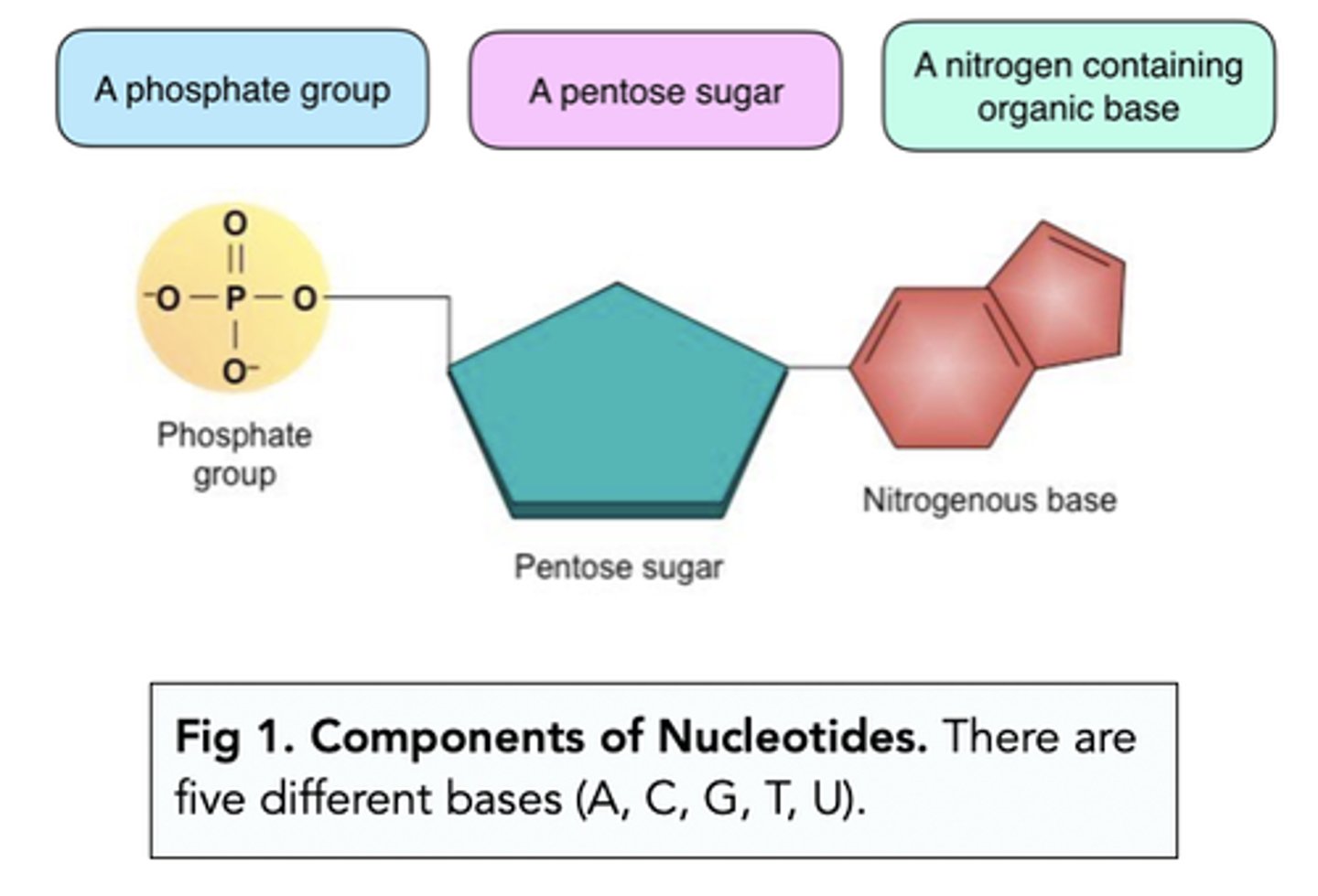
Explain how nucleotides link together to form polynucleotides. (3 marks)
- Nucleotides join via condensation reactions, releasing water.
- The phosphate group of one nucleotide bonds to the sugar of another.
- This forms a phosphodiester bond.
Explain why scientists originally questioned whether DNA carried genetic information. (2 marks)
- DNA was considered too chemically simple.
- With only a few components.
Describe the structure of DNA. (5 marks)
- DNA is a polymer of nucleotides.
- Each nucleotide contains deoxyribose sugar, a phosphate group, and a nitrogen-containing base.
- Phosphodiester bonds link nucleotides in a chain.
- Two chains run in opposite directions (anti-parallel) and are joined by hydrogen bonds between complementary bases (A pairs with T, C pairs with G).
- The molecule forms a double helix.
Describe the structure of messenger RNA. (3 marks)
- mRNA is a single-stranded polynucleotide.
- Each nucleotide contains ribose sugar, a phosphate group, and one of four bases (A, U, C, G).
- Nucleotides are joined by phosphodiester bonds.
Compare and contrast DNA and mRNA structure. (4 marks)
- DNA contains deoxyribose sugar; mRNA contains ribose sugar.
- DNA contains thymine; mRNA contains uracil instead.
- DNA is double-stranded; mRNA is single-stranded.
- DNA is longer and has base pairing; mRNA is shorter and does not have base pairing.
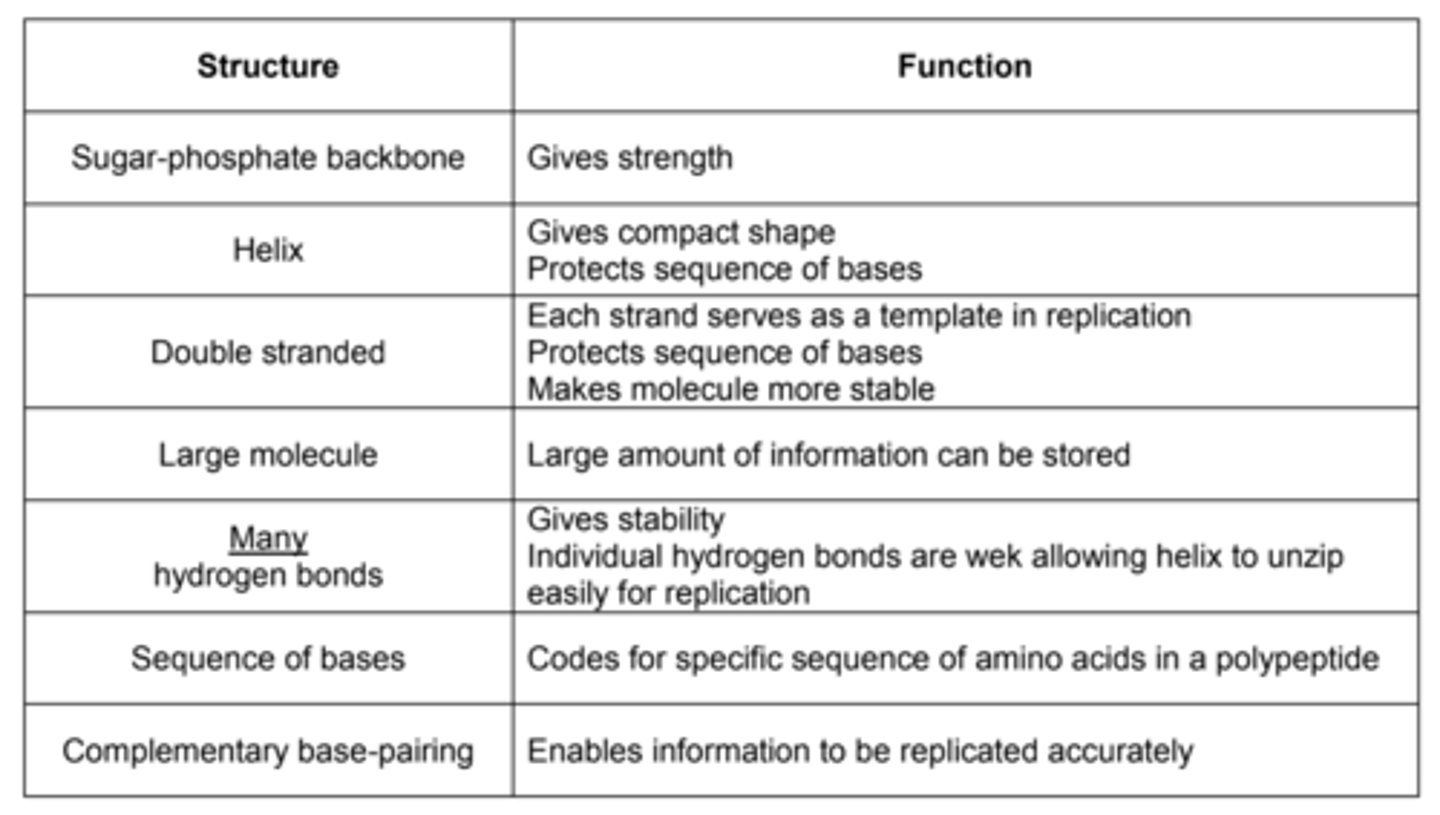
Suggest how DNA's structure is related to its functions. (6 marks)
- Two strands act as templates for semi-conservative replication.
- Weak hydrogen bonds between bases allow strands to separate for replication.
- Complementary base pairing ensures accurate copying.
- Many hydrogen bonds give stability to the molecule.
- The sugar-phosphate backbone protects the sequence of bases.
- Coiled double helix makes DNA compact, allowing large amounts of genetic information to be stored.
Explain how organic bases help to stabilise the structure of DNA. (2 marks)
- Hydrogen bonds between the base pairs holds two strands together.
- Many hydrogen bonds provide strength.
Describe how you could use incomplete information about the occurrence of bases on a DNA strand to find the occurrence of bases on another DNA strand. (3 marks)
- The percentage of adenine in one strand equals the percentage of thymine in the complementary strand, and vice versa.
- The percentage of guanine in one strand equals the percentage of cytosine in the complementary strand, and vice versa.
- This is due to complementary base pairing.
Define semi-conservative replication and state why semi-conservative replication is important. (2 marks)
- Each new DNA molecule contains one original/template strand and one newly synthesised strand.
- It ensures genetic continuity between generations of cells.
Describe the process of semi-conservative DNA replication. (6 marks)
- DNA helicase breaks hydrogen bonds between complementary base pairs, separating the strands and unwinding the double helix.
- Each strand acts as a template for a new strand.
- Free DNA nucleotides are attracted to exposed bases through complementary base pairing.
- Hydrogen bonds form between adenine and thymine, and between guanine and cytosine.
- DNA polymerase joins adjacent nucleotides on the new strand via condensation reactions.
- Phosphodiester bonds are formed between nucleotides to complete the sugar-phosphate backbone.
Explain why DNA polymerase works in opposite directions on the two strands of DNA. (3 marks)
- The two DNA strands run in opposite (antiparallel) directions, so the arrangement of nucleotides at each end is reversed.
- DNA polymerase's active site has a specific shape that fits only one end of the growing strand.
- This means the enzyme can only add nucleotides in the correct orientation on each strand.
Describe how DNA polymerase arranges itself around a new DNA strand. (2 marks)
- The new DNA strands are made from 5' to 3'.
- Because DNA polymerase's active site is only complementary to the 3' end of a DNA strand.
State the names of the two scientists who developed the double helix model and explained DNA replication. (2 marks)
- James Watson.
- Francis Crick.
Outline the experimental approach used by Meselson and Stahl to confirm semi-conservative DNA replication. (5 marks)
1. Bacteria were grown in a medium containing heavy nitrogen (¹⁵N), which was incorporated into the bases of their DNA.
2. DNA was extracted and centrifuged, producing a band low in the tube because it contained only heavy DNA.
3. The bacteria were transferred to a medium containing light nitrogen (¹⁴N) and left to divide once.
4. After centrifugation, DNA appeared as a single band in the middle, showing it contained one heavy strand and one light strand.
5. The bacteria divided again in light nitrogen; centrifugation produced two bands, one in the middle (heavy-light) and one near the top (light-light).
What are nucleotides?
The monomers that make up RNA and DNA
How are ribosomes formed? (1)
RNA and proteins are joined together.
What is the basic function of DNA (1)
Stores genetic information.
What is the basic function of RNA (1)
RNA transfers genetic material from DNA to the ribosomes.
Draw the general structure of a nucleotide present in DNA and RNA (3)
- Phosphate group.
- Pentose sugar
- Nitrogen-containing base.

What are two ways in which the nucleotides in DNA are different from the nucleotides in RNA? (2)
- DNA contains thymine whereas, RNA contains uracil.
- DNA contains deoxyribose whereas, RNA contains ribose.
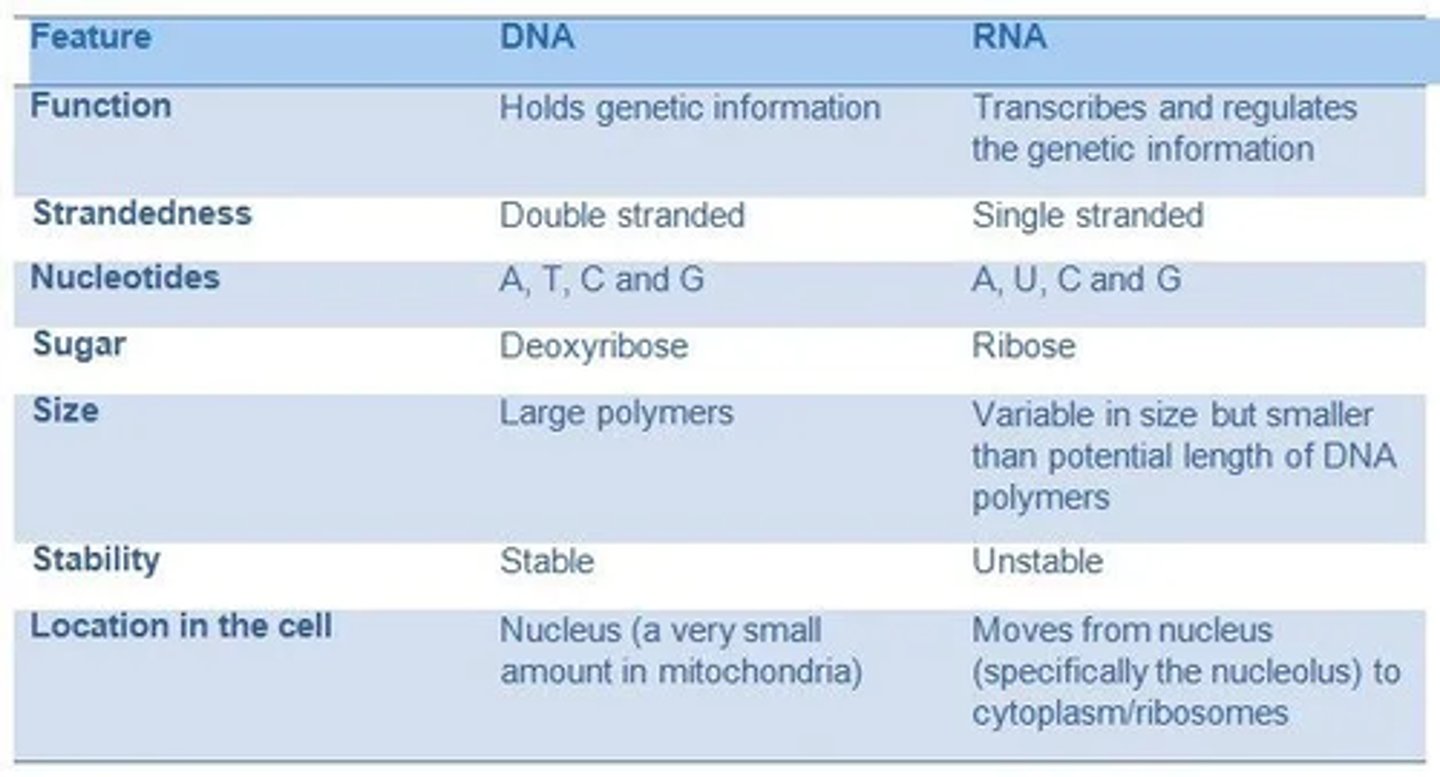
Compare the structure, properties and function of DNA and RNA (7)
NOTE: Please make sure that you use comparative terminology when answering an exam question like this!
Describe the structure of RNA (5)
- Single stranded.
- Short polynucleotide strand.
- Contains a ribose sugar.
- Contains the bases: uracil, guanine, cytosine, adenine.
- Contains phosphodiester bonds between its nucleotides.
Describe the structure of DNA (5)
- DNA is composed of two long polynucleotide strands.
- It has a double helix structure, which is held together by hydrogen bonds.
- Hydrogen bonding occurs between adenine and thymine, and between cytosine and guanine (complementary base pairing).
- Each nucleotide is made up of deoxyribose (a sugar), a phosphate group, and a nitrogenous base.
- Phosphodiester bonds link the nucleotides within each strand.
Explain how the structure of DNA is related to its functions (6)
Explain how organic bases help to stabilise the structure of DNA (2)
- Hydrogen bonds between the base pairs holds two strands together.
- Many hydrogen bonds provide strength.
Name the two scientists who proposed models of the chemical structure of DNA and of DNA replication (2)
Watson and Crick
Describe how a phosphodiester bond is formed between two nucleotides within a DNA molecule (3)
- A condensation reaction occurs.
- Between phosphate group and deoxyribose sugar.
- Which is catalysed by DNA polymerase.
Describe the process of the semi conservative replication of DNA (5)
1. DNA helicase unwinds the double helix and breaks the hydrogen bonds between the complementary bases of the two polynucleotide strands.
2. Each strand acts as a template for the formation of two new complementary strands.
3. Individual DNA nucleotides align and attach by hydrogen bonding to the exposed bases of each template strand according to specific complementary base pairing (A-T and C-G).
4. DNA nucleotides in each new strand are joined together by phosphodiester bonds during a condensation reaction catalysed by DNA polymerase.
5. This process results in the formation of complementary strands to the original DNA molecule.
Describe the function of DNA helicase (2)
- Unwinds DNA
- Breaks the hydrogen bonds between the strands
Describe the function of DNA polymerase (2)
- Joins nucleotides together.
- By forming phosphodiester bonds.
Describe and explain how the structure of DNA results in accurate replication (4)
- Two strands and therefore, replicates semi conservatively.
- Base pairing is held by hydrogen bonding.
- A pairs with T & C pairs with G.
- Hydrogen bonds are weak so can easily be broken allowing the strands to separate.
How does DNA polymerase arrange itself around a new DNA strand? (2)
- New strands are made from 5' to 3'.
- Because DNA polymerase's active site is only complementary to the 3' end of a DNA strand.
What directions do DNA strands run? (2)
- Opposite directions.
- Antiparallel.
Why is the replication of DNA referred to as "semi-conservative"? (1)
Half the strands in each new DNA molecule are from the original DNA molecule.