Ch. 5 Sensorimotor System
 Call Kai
 Learn
Learn Practice Test
 Spaced Repetition
 Match
Match Flashcards
 Knowt Play
1/72

There's no tags or description
Looks like no tags are added yet.
Name | Mastery | Learn | Test | Matching | Spaced | Call with Kai |
|---|
No analytics yet
Send a link to your students to track their progress
73 Terms
sensory transduction
sensory receptors convert
information from the world into electrical signals
Vision
light energy
Hearing
vibration of air
Touch
pressure, temperature
Taste & Smell
chemical
We only are aware of ____ if we have receptor
cells that can ____ them
stimuli, transduce
Sensation
receiving info from the world via sensory transduction
Perception
interpreting info from the world
Attention
plays a role in determining what is sensed versus perceived
The brain recognizes distinct senses because action
potentials travel along separate nerve tracts:
labeled lines.
Generator potentials:
stimulus produces a graded electrical potential
(like EPSP!).
If potential large enough, reaches _____ -> action potential (we have sensed it!).
threshold
5 Aspects of sensory processing:
Coding
patterns of A.P.s
reflect stimulus
5 Aspects of sensory processing:
Adaptation
loss of response when stimulation maintained
Phasic receptors
show adaptation
Tonic receptors
show little or no adaptation
5 Aspects of sensory processing:
Central modulation of sensory information
brain centers suppress sensory inputs
5 Aspects of sensory processing:
4. Pathways:
Each sensory
system has a labeled line.
Most pass through thalamus
on way to cortex.
5 Aspects of sensory processing:
5. Receptive fields
region of
‘space’ that a neuron in the
cortex responds to
As you sit and answer this question, you are receiving
less and less information about the feeling of the seat on
which you are sitting. This is due to the process
underlying your sensory receptors response to the
stimuli called
adaptation
The generator potential produced by a
Pacinian corpuscle (a touch receptor) in
response to mechanical stimulation is
proportional to the stimulus
intensity.
Why can’t we perceive magnetic
fields?
We do not have receptors that can transduce
magnetic fields
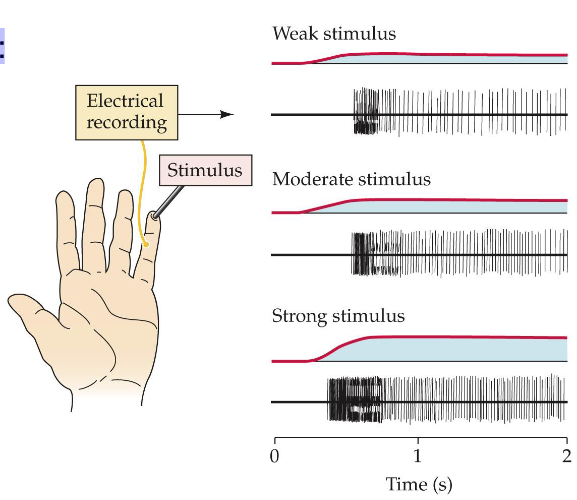
This is an example of a:
Phasic receptor
Pathway from touch receptor
in skin to brain:
Touch receptor axons into dorsal root of spinal cord
Touch receptor axons into
dorsal root of spinal cord ->
medulla
medulla ->
thalamus
thalamus ->
primary somatosensory
cortex
Primary somatosensory cortex in
parietal lobe.
Association areas
show mixture of inputs from different modalities.
Synesthesia
a condition in which a stimulus in one modality creates a perception in another.
If a body region is _____,
the cortical area for adjacent
body regions will expand
removed
If a body region is _____,
the cortical area for that
region will expand.
stimulated
Pain
unpleasant experience
associated with tissue damage
Congenital insensitivity to
pain:
inherited syndrome
where the person does not
experience pain.
Nociceptors
Nociceptors respond to painful stimuli.
Different nociceptors respond to pain or changes in temperature
Touch and pain have different sized axons and myelination
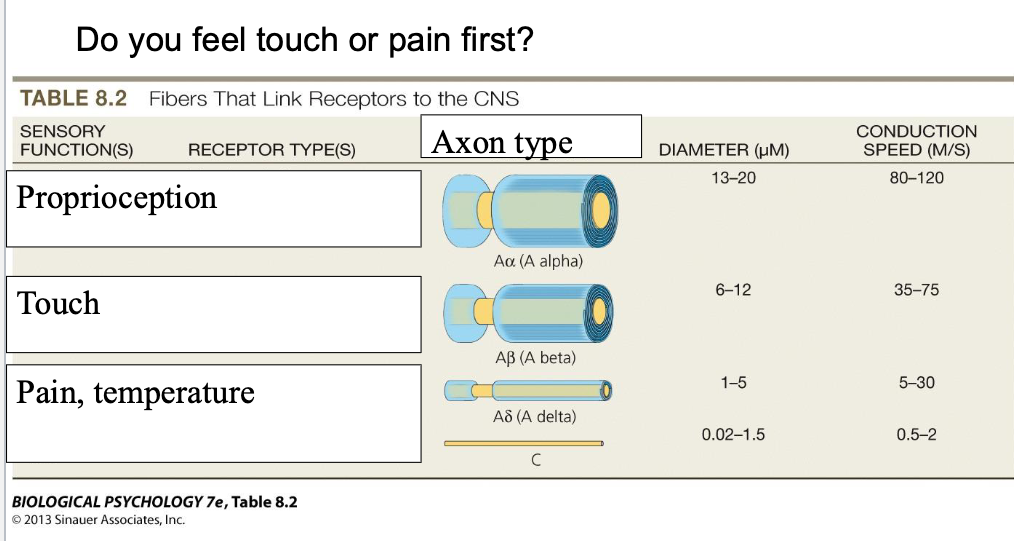
Spinal Pathways transmit pain information:
Free nerve endings
(nociceptors)
Free nerve endings
(nociceptors) ->
spinal neurons
spinal neurons ->
periaqueductal gray and
thalamus
periaqueductal gray and
thalamus →
somatosensory cortex and
cingulate cortex
Pain information integrated in
cingulate cortex
Neuropathic pain
(subtype: phantom limb pain) may be
due to inappropriate signaling of pain by neurons.
Which of the following are not involved
in pain perception?
lateral temporal lobe
Which of the following statements about sensory cortical
maps is true?
a. Cortical maps can change with an animal’s
experience and training.
b. if you lose your hand, the map with reorganize so that
the neurons that responded to hand touch could now
respond to face or arm touch
c. Plasticity may arise from changes in the strength of
existing synapses or the formation or loss of synapses.
Sayra practices the violin many hours each day. What
might occur to the somatosensory cortex representation
of her fingers?
The cortical finger representations will expand
Motor plan:
muscle
commands established
before action.
muscle fibers made up of ____
and ____
myosin, actin
Contraction
myosin and actin slide
past each other.
neuromuscular junction:
A.P. in motor neuron (cell
body in spinal cord/
brainstem) →
release acetylcholine at
neuromuscular junction
(synapse between motor
neuron and muscle)
release acetylcholine at
neuromuscular junction
(synapse between motor
neuron and muscle) →
triggers actin/myosin to
slide past each other =
contraction
Proprioception
information about body movements and positions.
Muscle spindles
monitor muscle stretch
Golgi tendon organs
monitor muscle contraction (strong
stimulation -> reflexive relaxation)
Commands from the brain sent through two major pathways.
Pyramidal system (or corticospinal system), Extrapyramidal system (basal ganglia and
cerebellum)
Many axons in _____ tract have cell bodies in____
pyramidal, primary motor cortex (M1)
Large regions of M1 devoted to body parts involved in ______
complex movement
lesions of M1 produce ______ on the opposite side of body
paralysis
piano players: the ____ the musician started playing, the ____ the hand area
younger, larger
Lesions along the
pyramidal tract
cause _________
paralysis in
the muscle targets
Extrapyramidal Systems regulate/fine
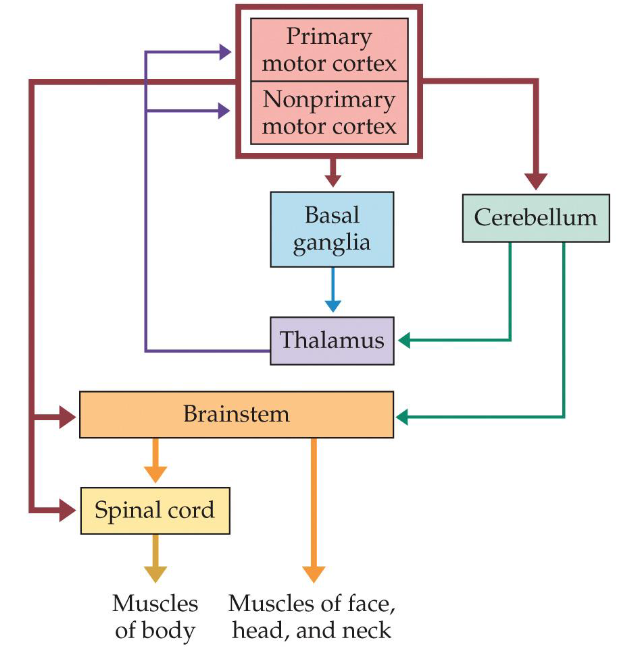
The basal ganglia modulates
movement:
help control amplitude, direction, initiation of movement.
movements guided by memories (“muscle memory” = skill memory)
Cerebellum:
Coordination, balance, fine-tune skilled
movements and classical conditioning
Poliovirus
destroys spinal motor neurons and sometimes cranial motor neurons.
Parkinson’s disease
causes tremors at rest, loss of muscle tone, and difficulty in motor movements.
Degeneration (death) of dopamine-containing cells of the substantia nigra
Huntington’s disease
involves basal ganglia damage, shows
excessive, involuntary movement.
Is responsible for Huntington’s disease. As
progresses, cognitive and emotional changes
A dominant allele of a single
gene (named HTT)
Primary motor cortex (M1) is
sometimes called “executive” because
it appears to control particular kinds of
_______ movements.
voluntary
The basal ganglia is important for
the
amplitude of movement
Omar has one dominant allele and one
recessive allele of the Huntington’s
Disease gene (HTT). What are the
chances that he has the disease?
100%
Allison has been infected with polio.
What may occur?
destruction of motor neurons
A complex set of commands to
muscles that is established before a
behavior starts is called a
motor plan
I hand you a very heavy item. Your muscle
spindles report stretch. You try to hold onto the
item. Now your golgi tendon organs will report
muscle _____, and if too strongly stimulated, this
will occur:
contraction; drop the item
The striped appearance of muscle
fibers is due to the regular
arrangement of thick _______
filaments and thin _______ filaments.
myosin; actin