UW Chemistry Test 8
 Call Kai
 Learn
Learn Practice Test
 Spaced Repetition
 Match
Match Flashcards
 Knowt Play
1/24

There's no tags or description
Looks like no tags are added yet.
Name | Mastery | Learn | Test | Matching | Spaced | Call with Kai |
|---|
No analytics yet
Send a link to your students to track their progress
25 Terms
what does “like dissolves like” mean
polar dissolves polar; nonpolar dissolves nonpolar
miscible liquids
liquids that will mix in all proportions to form a homogenous solution
what factors speed up dissolving rates in gases
higher pressure, lower temperature (allows gas molecules to remain dissolved)
what factors speed up dissolving rates in solids/liquids
crushing/powdering (increases surface area), increasing temperature of solvent, stirring/agitating mixture
molarity (M)
moles of solute/L of solution
mass percent
mass of substance (100)/total solution mass
dissolving
when solid solute particles are pulled apart by the electrostatic forces of a solvent, forming an aqueous solution
when a compound breaks into individual particles
dissociating
when solid solute ions are pulled apart by the electrostatic forces of a solvent, forming a conductive aqueous solution
yields electrolytes, making solutions conductive
when an ionic compound breaks into individual ions
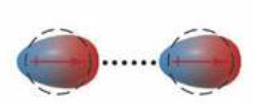
london dispersion
weakest, temporary, transient IMF present in nonpolar atoms and molecules
arise form temporary dipoles formed by the movement of electrons
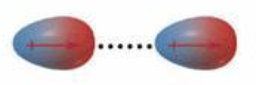
dipole-dipole
occur between positive end of one polar molecule and negative end of another polar molecule
stronger than london dispersion forces
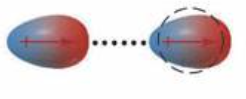
dipole-induced dipole
forces arise between polar and nonpolar molecules
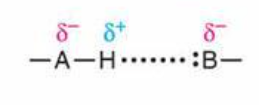
hydrogen bonding
specialized dipole-dipole interaction occurring between a hydrogen atom bonded to a highly electronegative atom (N, O, F) and another electronegative N, O, or F atom in a nearby molecule
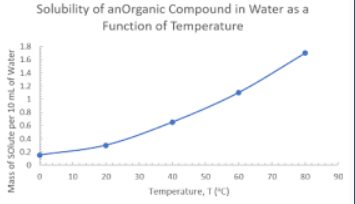
1 gram solute at 40 degrees F
supersaturated
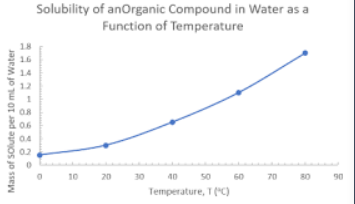
0.69 gram solute at 40 degrees F
saturated
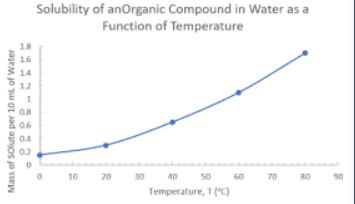
0.4 gram solute at 40 degrees F
unsaturated
strong forces at standard temperature (25 C)
solids, because particles are locked in place
higher boiling point (becomes gas at higher temp)
moderate forces at standard temperature (25 C)
liquids, because particles can move past each other but not escape
moderate boiling point (becomes gas at moderate temp)
weak forces at standard temperature (25 C)
gases, because particles have enough KE to break free and move independently
lower boiling point (becomes a gas at lower temp)
solvent
H2O in H2O + NaCl
solute
NaCl in H2O + NaCl
solution
H2O + NaCl
common types of IMFs strongest to weakest
ionic, hydrogen, dipole-dipole, london dispersion
insoluble salts
low ability as an electrolyte—no ions
slightly soluble salts
moderate ability as an electrolyte—few ions
soluble salts and strong acids/bases
good ability as an electrolyte—many ions