Chapter 7: Skeletal System
 Call Kai
 Learn
Learn Practice Test
 Spaced Repetition
 Match
Match Flashcards
 Knowt Play
1/44

There's no tags or description
Looks like no tags are added yet.
Name | Mastery | Learn | Test | Matching | Spaced | Call with Kai |
|---|
No analytics yet
Send a link to your students to track their progress
45 Terms
The adult human skeleton is composed of ____ bones.
206
The skeletal system ____ body structures an provides shape to the body.
Supports
The skeletal system ____ the soft and delicate internal organs.
protects
The skeletal system allows ____ and ____ of muscles.
movement and attachment
Ligaments
Fibrous bands that connect bones to bones and cartilage and serve as support for muscles.
Tendons
Fibrous cords that connect muscles to bone.
The skeletal system provides ___ storage. Serving as a depot for materials such as calcium and phosphorus.
mineral
The skeletal system is the site for ____, the formation of blood cells. In an adult, the ribs, sternum, and bones of the pelvis contain red marrow.
hematopoiesis
Osteocytes
Mature bone cells that maintain bone tissue.
Bone is made up of ___% organic material and ___% inorganic mineral salts and water.
35%, 65%
The organic portion of the bone is ____, a fibrous material with jellylike material in between the fibers. It gives the bone a certain degree of flexibility.
collagen
The inorganic portion of bone is made from mineral salts such as calcium phosphate, calcium carbonate, sodium oxide, and sodium chloride. These make the bones hard and ____.
Durable
The embryonic skeleton initially consists of collagenous protein secreted by osteoblasts. Later, ____ is deposited between the fibers. ____ is also found at the ends of certain bones in adults, providing a smooth surface for bones to move against each other.
Cartilage
During the 8th week of embryonic development, ___ occurs.
Ossification; Calcium-based material begins to replace the formed cartilage, creating bone. Infant bones are soft and pliable due to incomplete ossification.
Fontanel
Soft spots on a baby’s head where the bone has not yet formed.
Diaphysis
The central shaft of a long bone, a hollow cylinder composed of compact bone. It is what makes a long bone strong and hard yet light enough for movement.
Epiphysis
The end part of a long bone, initially separated from the diaphysis by a layer of cartilage. It contributes to joint articulation and houses red marrow.
Medullary Canal
The central cavity of a long bone that contains mainly yellow bone marrow and is involved in the production of blood cells.
Endosteum
The thin layer of connective tissue that lines the medullary canal and the spaces within spongy bone. It contains osteoblasts and osteoclasts and is involved in bone growth and repair.
Haversian Canals
The microscopic channels in bone that house blood vessels and nerves, facilitating nutrient and waste exchange within the bone matrix. They run vertically through the center of osteons.
Spongy/Cancellous Bone
A type of bone that is characterized by a porous, lattice-like structure, providing strength while reducing weight. It is found mainly at the ends of long bones and within the interior of others, and it houses bone marrow.
Trabeculae
The structural units of spongy bone, consisting of a network of thin plates that create a latticework appearance. They help to support bone strength while minimizing weight and are typically filled with bone marrow.
Periosteum
A dense external membrane that covers bones, serving as an attachment point for ligaments and tendons. Composed of tough, fibrous tissue. It contains blood vessels and nerves, contributing to bone nutrition and growth.
Articular Cartilage
A smooth, slippery tissue that covers the epiphyses in joints, allowing for easy movement and reducing friction between the articulating surfaces. Also acts as a shock absorber.
Bones grow and ossify from the center of the ___ toward the _____ extremities.
diaphysis, epiphyseal
Osteoblasts
Bone-forming cells that synthesize and secrete bone matrix, playing a crucial role in bone growth and repair. As bone girth increases, bone material dissolves from the central part of the diaphysis, forming the medullary canal.
Osteoclasts
Cells that break down bone tissue by secreting enzymes and are for bone remodeling and mineral release into the bloodstream. They digest bony material and split the minerals for use by the body (particularly calcium and phosphorus).
The length of a bone shaft continues to grow until the _____ is ossified.
Epiphyseal cartilage/plate
Bone remodeling
The process by which bone tissue is continuously renewed through the actions of osteoblasts and osteoclasts, allowing bones to adapt to stress and repair microdamage.
Resorption
The process by which osteoclasts break down bone tissue, releasing minerals back into the bloodstream.
Formation
The process by which osteoblasts create new bone tissue, contributing to bone growth and repair.
The average bone growth in females continues to about __ years of age; males grow for approximately 20-21 years.
18
The process of bone repair
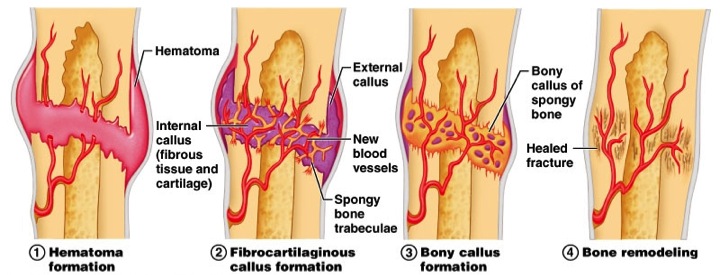
Clot and granulation tissue formation, proliferation of cells at the site (soft bone deposit), remodeling of bone.
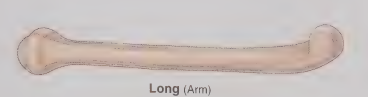
Long Bones
Bones that are longer than they are wide, primarily found in the limbs. They consist of a diaphysis and epiphyses, and are crucial for movement and support. Found in the upper and lower arms and legs.
Flat Bones
Bones that are thin and flat, providing protection to internal organs. Examples include the skull, ribs, and sternum.
Irregular Bones
Bones with complex shapes that do not fit into the other categories. They provide support and protection and include structures like the vertebrae and facial bones.
Short Bones
Bones that are as wide as they are long, mainly found in the wrists and ankles.
The ______ at a joint is determined by bone shape and joint structure.
Degree of movement
Axial Skeleton
The part of the skeleton that consists of the skull, vertebral column, and rib cage, providing central support and protection for the body's organs.
Hyoid Bone
A U-shaped bone located in the neck that supports the tongue and is not directly connected to any other bones.
There are ___ small bones in the ear.
six
Suture
An irregular band of connective tissue that holds cranial bones tightly together.