Chapter8 - Timers
 Call Kai
 Learn
Learn Practice Test
 Spaced Repetition
 Match
Match Flashcards
 Knowt Play
1/83

There's no tags or description
Looks like no tags are added yet.
Name | Mastery | Learn | Test | Matching | Spaced | Call with Kai |
|---|
No analytics yet
Send a link to your students to track their progress
84 Terms
Which of the following statements best describes electronic timing
relays?
A) Electronic timing relays are more economical than pneumatic
timing relays.
B) Electronic timing relays are more accurate than pneumatic timing
relays.
C) Electronic timing relays are more repeatable than pneumatic
timing relays.
D) All of the above
D
Which of the following statements on multifunction timing relays is
NOT true?
A) Multifunction timing relays eliminate need for additional relays in
applications.
B) Since they are electronic they are part of the PLC.
C) They operate with a supply voltage in the 24 to 48 VDC range or
the 24 to 240 VAC range.
D) They have multiple timing functions with variations of the on-
delay and off-delay timed outputs plus some pulsed output
options are available.
B
3) Which of the following statements is NOT correct?
A) The TON, TOF and RTO timers are all output instructions.
B) The accuracy of PLC timers can be affected by short scan time.
C) All AB timers are more accurate than mechanical and electronic
timers.
D) All AB timer instructions operate in nearly an identical fashion.
B
A TON timer rung is active and the ACC value is less than the PRE
value, so the ________ timer bits are true.
A) Both the TT and DN
B) Both the EN and TT
C) Only the TT
D) Only the EN
B
5) A TON timer rung is active and the ACC value is greater than the PRE
value, so the ________ timer bits are true.
A) Both the EN and DN
B) Only the EN
C) Only the TT
D) Both the EN and TT
A
6) A TOF timer rung is false and the ACC value is less than the PRE value,
so the ________ timer bits are true.
A) Only the TT
B) Both the TT and DN
C) Both the EN and TT
D) Only the DN
B
7) An RTO timer rung is false and the ACC value is greater than the PRE
value, so the ________ timer bits are true.
A) Only the TT
B) Both the EN and TT
C) Only the DN
D) Both the TT and DN
C
8) An RTO timer rung is true and the reset instruction rung for the timer is
true, so
A) The ACC is reset to zero and the DN bit is false.
B) All timer bits are false and the ACC is reset to zero.
C) The ACC and PRE are reset to zero and the DN bit is false.
D) The ACC is reset to zero, the DN bit is false, and the EN bit is true.
D
9) An RES used with an RTO timer ________.
A) Will not function if the RTO rung is active
B) Has the same address as the RTO timer
C) Can only be active after the RTO timer has completed the timing
process
D) Must be true for more than one scan for the reset action to occur
B
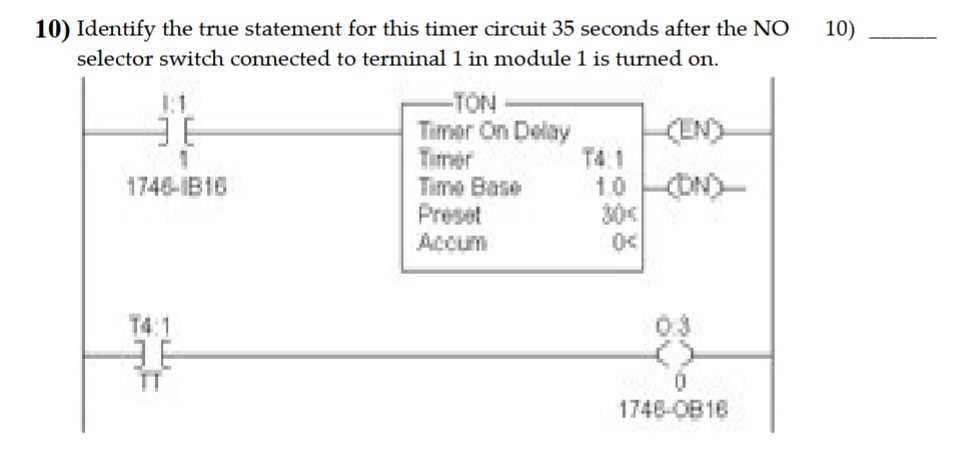
A) O:3/0 is true.
B) TT is true.
C) I:1/1 is false.
D) None of the above
D
1. The Timer Base value for the Fixed SLC500 PLC is _____ seconds.
0.1
2. The Preset value for timer T4:0 is in register _________ .
T4.0.PRE
The Accumulated value for timer T4:0 is in register ________ .
T4.0.ACC
4. You must ______ the ON-Delay timer function to start it.
enable
5. When the Non-retentive timer is de-energized, content of its accumulated register
will ________.
reset to zero
6. The ______ function transfers either a number or content of a register to a
destination register.
MOV
7. In the MOVE function, _______ can be either a number or content of a register.
source
8. The Destination in the MOVE function must be a _______ .
register
9. The timer timing bit for timer function T4:1 is addressed as ______ .
T4:1/TT
10. The timer done bit for timer function T4:1 is addressed as ______ .
T4:1/DN
11. You must use the _______ function to reset a retentive timer function.
RES
12. When the ON-Delay timer function T4:0 is timing, its timer timing coil (T4:0/TT)
is ________.
ON
13. When the ON-Delay timer function T4:0 is finished timing, its timer done coil
(T4:0/DN) is ________.
ON
14. If you de-energize the non-retentive ON-Delay timer function T4:0, its
accumulated register will ______ its content.
reset
15. When the ON-Delay timer function T4:0 is finished timing, its timer timing coil is
________ .
OFF
16. You must _______ the OFF-Delay timer function to start it.
de-energize
17. The OFF-Delay timer function is a ____________ type timer function.
non-retentive
18. When the OFF-Delay timer function T4:0 is finished timing, its timer done coil
(T4:0/DN) will _______ .
de-energize
19. While the OFF-Delay timer function T4:0 is timing, its timer timing coil
(T4:0/TT) is _________
on
20. The time base value for timer OFF-Delay function in Fixed SLC 500 PLC system
is set for _____ seconds.
0.1
21. Data files _____ through ______ can be used for timer functions.
T4:0, T4:255
22. Timer function T4:0 utilizes three 16-bit registers. These timer registers are
_________, __________ and _________ .
preset,accumulated,flag
23. The timer enable coil (T4:0/EN) is _______ when the ON-Delay timer function
t4:0 is timing.
on
24. Usually a ________ type input instruction is closed to start an ON-Delay timer
function.
normally open
25. In a fixed SLC 500 PLC system, when the content of timer preset register is 250,
the timer function preset value is ______ seconds.
25
t/f, 1. Timer functions in Fixed SLC 500 PLC systems have variable time base values.
f
t/f, 2. You can reset an ON-Delay Retentive timer by de-energizing it.
f
t/f, 3. The Timer OFF-Delay function is a Retentive timer function
f
t/f, 4. When the timer ON-Delay function T4:0 is timing, its normally closed timer
timing contact (T4:0/TT) is closed.
f
t/f, 5. When the timer OFF-Delay function T4:0 is timing, its normally closed timer
timing contact (T4:0/TT) is closed.
f
t/f, 6. When the timer OFF-Delay function T4:0 is finished timing, its normally closed
timer done contact (T4:0/DN) is opened.
t
t/f, 7. You must energize an ON-Delay timer function to start it.
t
t/f, 8. You must de-energize an OFF-Delay timer function to start it.
t
t/f, 9. You must use a RESET (RES) function to reset a retentive timer ON-Delay
function
t
t/f, 10. Data files T4:0 through T4:255 are used for timer functions.
t
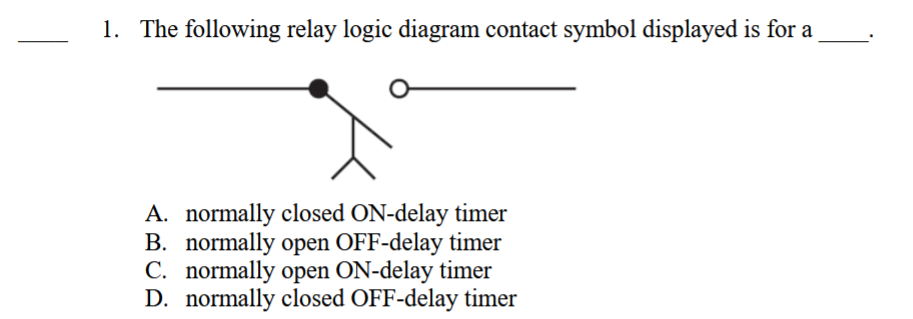
C
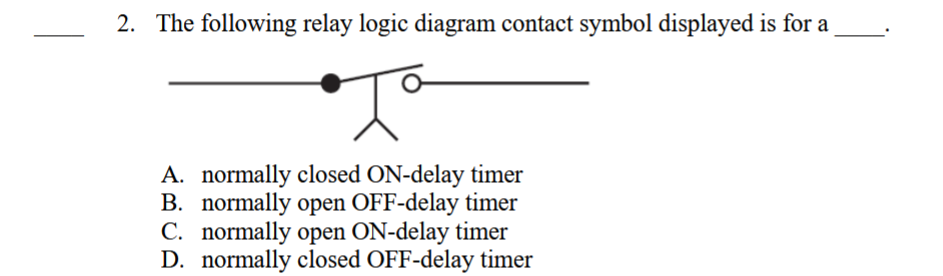
A
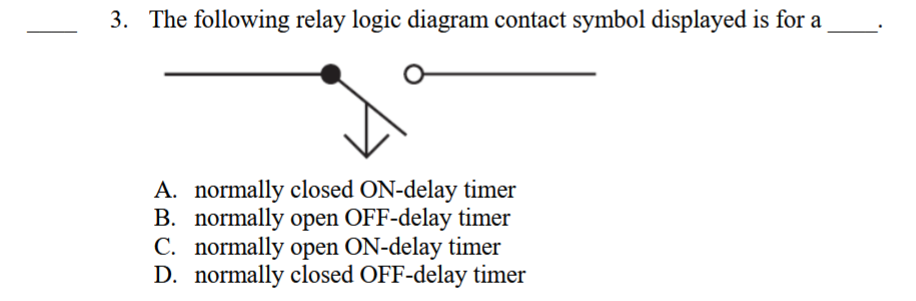
B
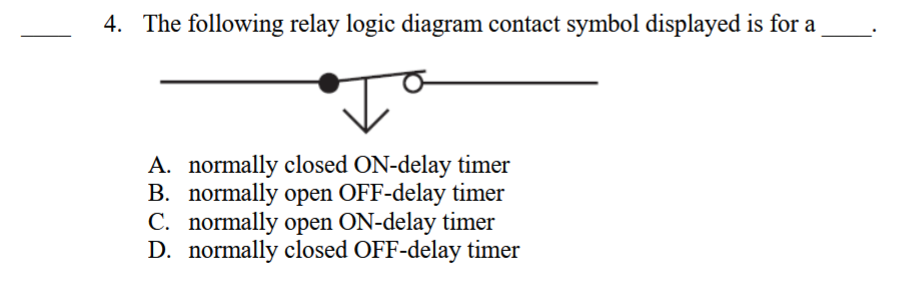
D
___ 5. A ____ timer contact should be selected for the following operation: when the timer is energized, the
normally open contact is closed. When the timer is de-energized, the normally open contact is opened.
A. Retentive ON-delay timer timing contact.
B. Non-retentive ON-delay timer timing contact.
C. Non-retentive OFF-delay timer timing contact.
D. All of the above.
D
____ 6. A ____ should be selected for the following operation: when the timer has completed its preset timing period,
its timer done contact is closed.
A. Timer done ON-delay contact
B. Timer done OFF-delay contact
C. Both A and B.
D. None of the above.
A
___ 7. Which timer contact should be selected for the following operation?
A. Timer done contact for retentive timer ON-delay.
B. Timer done contact for timer OFF-delay.
C. Timer done contact for non-retentive timer ON-delay.
D. All of the above.
C
___ 8. All Allen-Bradley SLC 500 PLCs have the following timers: ____.
A. TON, RTO, TOF, and ROF
B. TOF and ROF
C. TON, TOF, and ROF
D. TON, RTO, and TOF
D
___ 9. What are the registers used for each Allen-Bradley SLC 500 PLC timer?
A. Preset and accumulated registers
B. Preset and status registers
C. Preset, accumulated, and status registers
D. None of the above.
C
___ 10. Name the flag bits for each Allen-Bradley SLC 500 timer.
A. TT and DN
B. TT, EN, and DN
C. TT and EN
D. TT, EN, DN, and Reset
B
____ 11. If the preset register’s value is 1200 and the timer base is 0.01, then the preset time is ____.
A. 1 minute
B. 3 minutes
C. 12 seconds
D. 20 seconds
C
___ 12. How many timers can an Allen-Bradley SLC 500 PLC have?
A. 200
B. 255
C. 256
D. 250
C
___ 13. Which Allen-Bradley SLC 500 PLC timer’s accumulated registers will reset to zero when they are de-
energized?
A. TON and RTO
B. TON, RTO, and TOF
C. TOF and RTF
D. TON and TOF
D
___ 14. If the accumulated register is equal to the preset register in an Allen-Bradley SLC 500 PLC’s timer off-delay
(TOF), which of the following statements is correct?
A. The done status bit (DN) is true.
B. The done and timer timing (DN and TT) bits are true.
C. The done and timer timing (DN and TT) bits are false.
D. The done (DN) bit is true and timer timing (TT) bit is false.
D
____ 15. If the accumulated register on an Allen-Bradley SLC 500 PLC non-retentive timer on-delay (TON) is equal to
the preset register, which of the following statement is correct?
A. The DN bit is true and TT bit is false.
B. The DN bit and TT bit are both true.
C. The DN bit and TT bit are both false.
D. The DN bit and TT bit are both true.
A
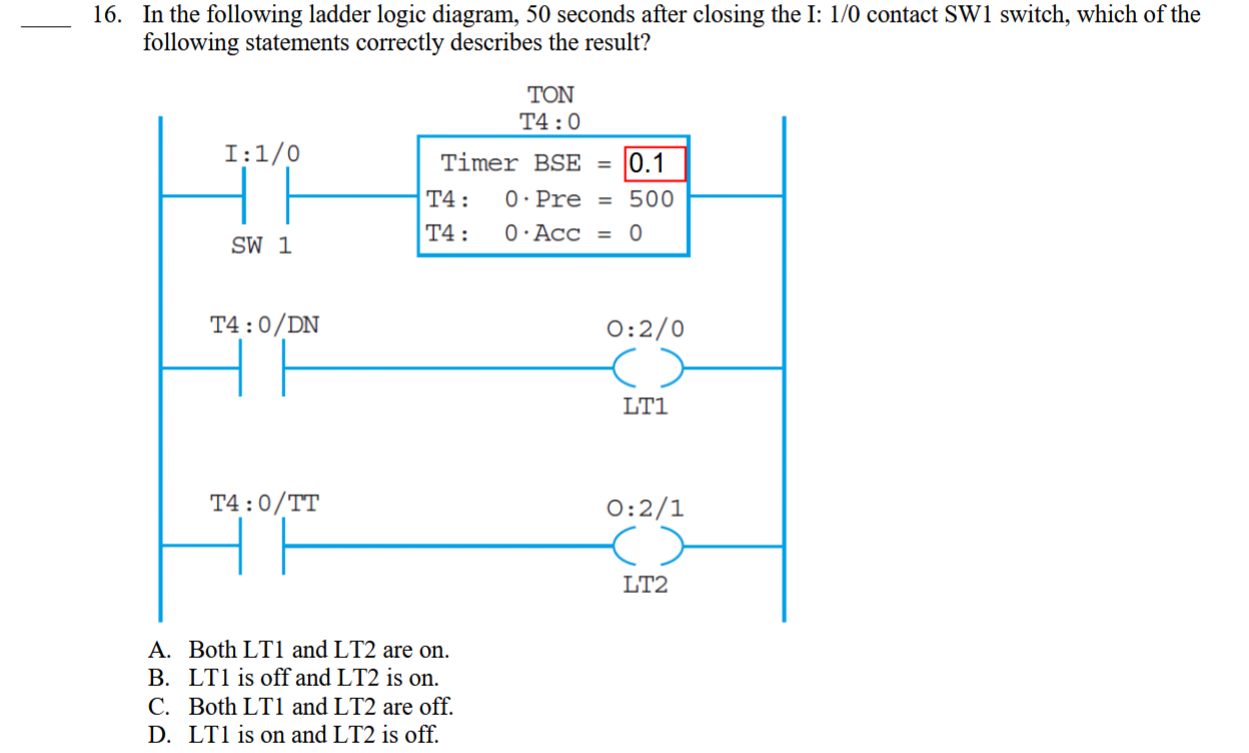
D
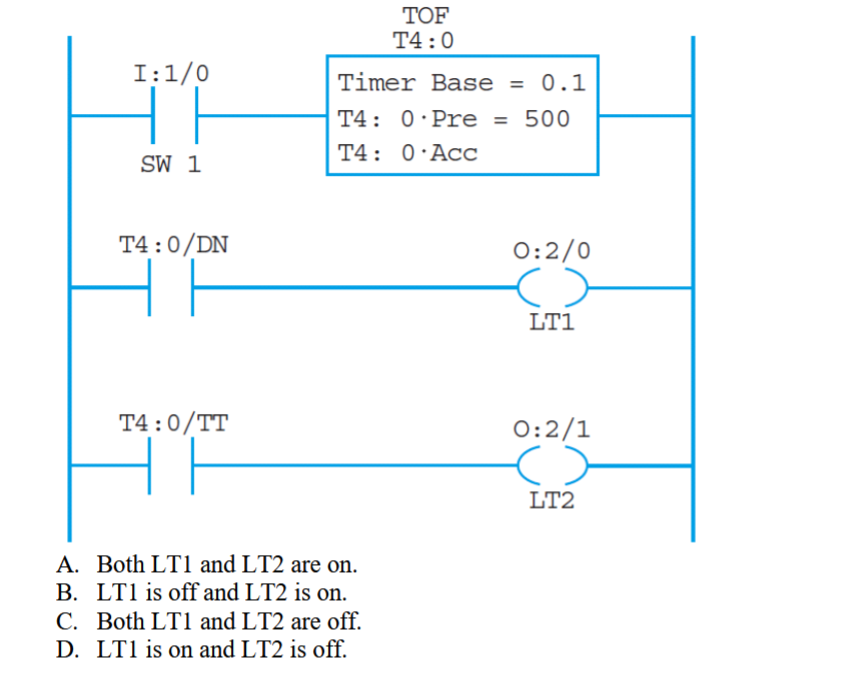
___ 17. In the following ladder logic diagram, 50 seconds after the SW1 switch is opened, which of the following
statements correctly describes the result?
C
____ 18. Which of the following statements is false?
A. TON is an acronym for non-retentive timer on-delay.
B. TOF is an acronym for non-retentive timer off-delay.
C. You must use the RES function to reset the TON.
D. You must use the RES function to reset the retentive timer on-delay.
C
____ 19. Which of the following statements about a TOF timer is correct?
A. TOF stops timing when it is energized.
B. TOF stops timing when it is de-energized.
C. TOF stops timing when its accumulated register is less than its preset register.
D. None of the above.
A
____ 20. A ____ timer has preset value timer instructions.
A. variable
B. discrete
C. fixed
D. system
C
___ 21. The ____ format uses coils to display the timer instruction.
A. coil
B. block
C. timer
D. None of the above.
A
___ 22. The ____ format uses a box shape to display the timer instruction.
A. coil
B. block
C. timer
D. None of the above.
B
____ 23. The content of the ____ register is the preset value that the timer is initialized to hold.
A. accumulated
B. preset
C. status
D. flag
B
____ 24. The time that the timer has been timing is held in the ____ register.
A. accumulated
B. preset
C. status
D. flag
A
t/f, ____ 25. You must use a reset (RES) instruction to reset a retentive timer ON-delay instruction.
t
____ 26. You must energize an ON-delay timer instruction to start it. t/f
t
___ 27. Addresses T4:0 through T4:255 are used for timer instructions.
t
____ 28. Timer instructions in fixed SLC 500 PLC systems have variable time base values.
f
____ 29. You can reset an ON-delay retentive timer by de-energizing it. t/f
f
30. When the timer ON-delay instruction T4:0 is timing, its normally closed timer timing contact (T4:0/TT) is
closed.
t
31. You must de-energize an OFF-delay timer instruction to start it. t/f
t
32. When the timer OFF-delay instruction T4:0 is timing, its normally closed timer timing contact (T4:0/TT) is
closed. t/f
t
33. The timer OFF-delay instruction is a retentive timer instruction. t/f
f
34. When the ON-delay timer instruction T4:0 is finished timing, its timer-timing coil (T4:0/TT) is
______________________________.
off
35. When the ON-delay timer instruction T4:0 is finished timing, its timer done coil (T4:0/DN) is
______________________________.
on
36. When the non-retentive ON-delay timer instruction T4:0 is ______________________________, its
accumulated register will reset its content.
de-energized
37. When the ______________________________ timer is de-energized, content of its accumulated register will
reset to zero
non-retentive
38. The ______________________________ instruction transfers either a number or content of a register to a
destination register.
MOV
39. You must use the ______________________________ instruction to reset a non-retentive timer instruction
RES