PSYC 201: Chapter 13 - Personality
 Call Kai
 Learn
Learn Practice Test
 Spaced Repetition
 Match
Match Flashcards
 Knowt Play
1/23

There's no tags or description
Looks like no tags are added yet.
Name | Mastery | Learn | Test | Matching | Spaced | Call with Kai |
|---|
No analytics yet
Send a link to your students to track their progress
24 Terms
Dispositional Attribution
internal attribution
something that is observed within a person such as their personality
Situational Attribution
external attribution
caused by something on the outside such as a situation
How can Milgram’s study correlate to the attribution theory?
In Milgram’s findings, 65% completed the experiment and gave the highest shock, 35% left at a certain point
Situational attributions account for the 65% of the people
Dispositional attributions account for 35% of the people
everyone had the same situation they were under but people responded differently due to their personality
What is personality?
individual’s unique set of consistent behavioral traits (same as disposition)
it is used to explain the stability in a person’s behavior over time and across situations (consistency)
it is also used to explain the behavioral differences among people reacting to the same situation (distinctiveness)
a personality trait is a durable disposition to behave in a particular way in a variety of situations
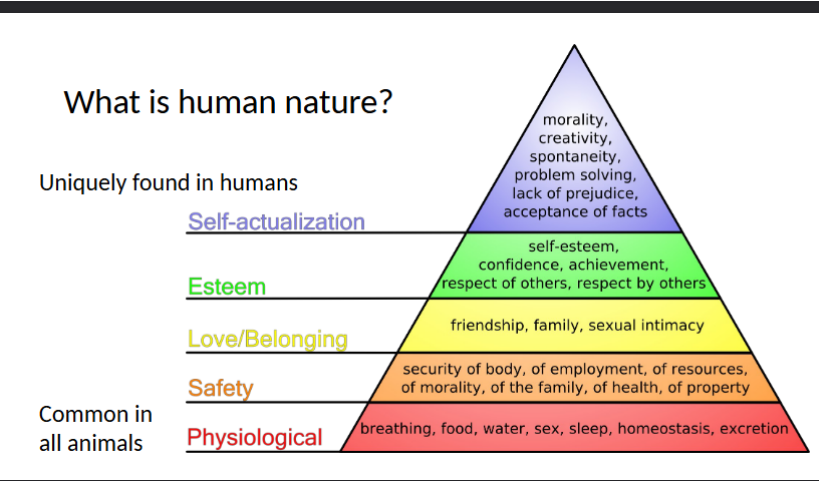
What is human nature?
this includes self-actualization traits such as morality, creativity, problem solving, lack of prejudice etc
What is the 5 factor personality model?
OCEAN
O - Openness to Experience
C - Conscientiousness
E - Extraversion
A - Agreeableness
N - Neuroticism
What is Openness to Experience in the 5 factor model?
creative, intellectual, open-minded, curious, flexible, unconventional, empathetic
High Pole (openness to experience):
imaginative, likes variety, independent
enjoys seeing people with new types, and is open
Low Pole:
simple, shallow, unintelligent, likes routine, down to earth, conforming
prefers to not be exposed to alternative moral systems
What is Conscientiousness in the 5 factor model?
organized, responsible, cautious, diligent, punctual, dependable, self-disciplined
High Pole:
organized, responsible, cautious
never late, hardworking, neat, persevering
Low Pole:
Careless, frivolous, irresponsible, weak willed
prefers spur of the moment action to planning, unreliable, hedonistic
What is Extraversion in the 5 factor model?
Talkative, energetic, assertive, outgoing, sociable, friendly, gregarious, upbeat, assertive
High Pole:
being the life of the party, active, optimistic, fun, loving, affectionate
Low Pole:
preferring a quiet evening reading, sober, aloof, unenthusiastic
reserved, shy, retiring
What is Agreeableness in the 5 factor model?
sympathetic, kind, affectionate, warm, trusting, compassionate, cooperative, modest
High Pole:
agrees with others about politics, good natured, forgiving, gullible, helpful,
Low Pole:
cold, quarrelsome, cruel, quickly asserts own rights, irritable, manipulative, uncooperative, rude
ruthless, sus
What is Neuroticism or emotional stability in the 5 factor model?
anxious, unstable, insecure, hostile, self-conscious, sensitive, vulnerable, impulsive
High Pole:
temperamental
worrying about things, hypochondriacal, feeling inadequate, self-pitying
Low Pole:
stable, calm, contended
not getting irritated by small things, calm, unemotional, hardy, secure, self-satisfied
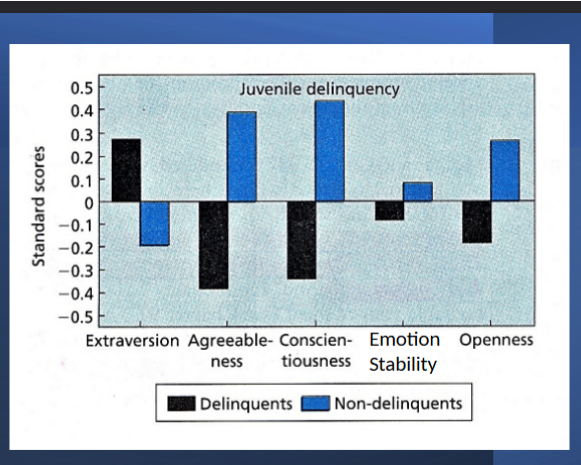
What was the conclusion drawn from the Standard Scores of juvenile delinquency graph?
delinquents were high on extraversion compared to non-delinquents
non-delinquents on everything except extraversion compared to delinquents
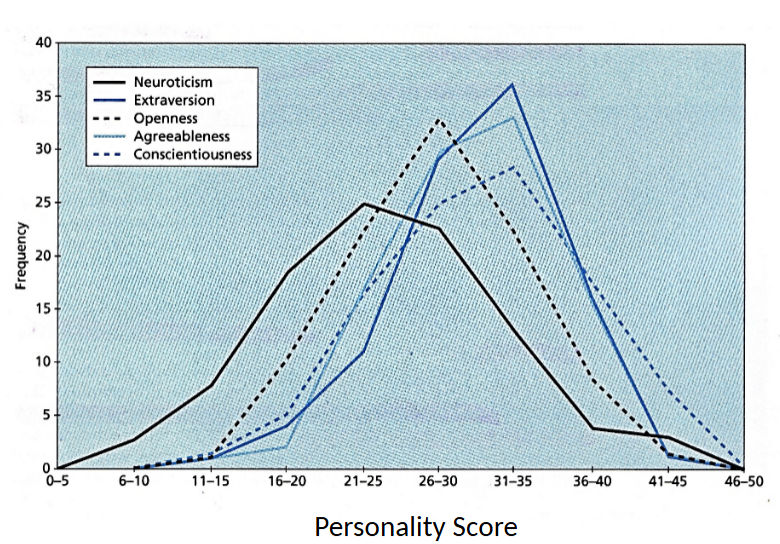
What was the ultimate conclusion of the frequency vs personality score graph?
all 5 personality traits peak somewhere between 16-20 and 36-40, suggesting that very high or very low scores are uncommon
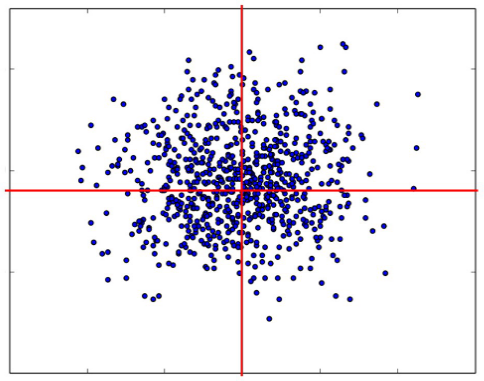
What are orthogonal factors?
factors that have no correlations
this results in even distribution of cases in 4 equal quadrants
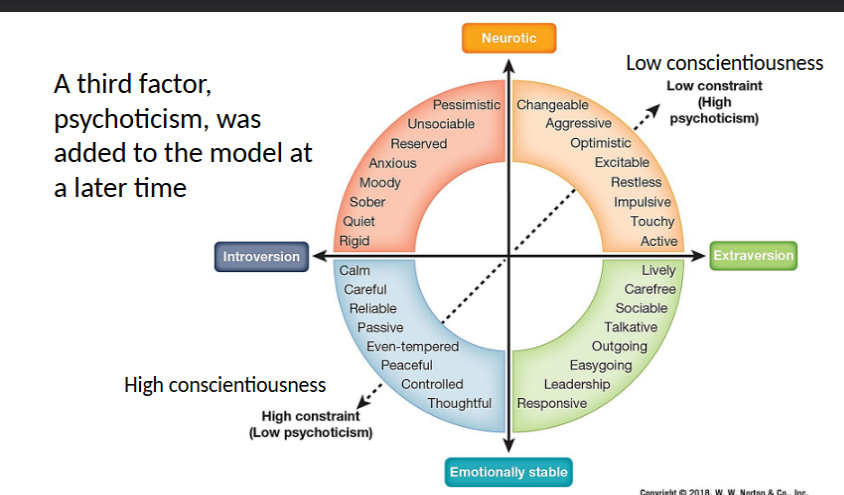
What is Eysenck’s Biological Trait Theory?
the theory suggests that core traits are physiological and rooted in biology
stated that extraversion and neuroticism are orthogonal factors
a third factors was later added: psychoticism
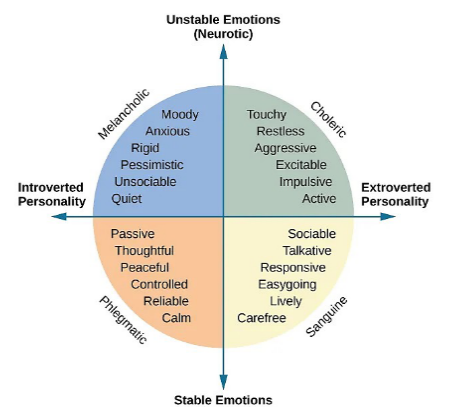
What was the original chart and what were the associated physiological factors?
Sanguine: blood
extroverted personality and stable emotions
Choleric: yellow bile
extroverted personality and unstable emotions (neurotic)
Melancholic: black bile
introverted personality and unstable emotions
Phlegmatic: Phlegm
introverted personality and stable emotions
What was the chart once it was updated?
Left to right: low to high extraversion
Bottom to top: low to high neuroticism
Left diagonal to right diagonal: low to high psychoticism
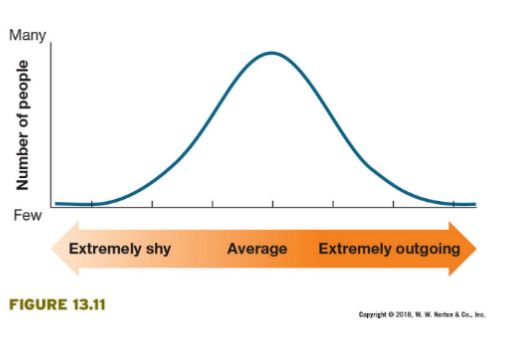
What was the conclusion when plotting number of people vs extraversion continuum?
A trend of stabilizing selection was observed: selection is against the two extremes rather it favors average behaviors
it is equally good to be moderate introvert and extrovert
What is the behavioral view in the formation of personality?
personality is shaped by learning through reinforcement
behaviors that are reinforced are more likely to be happen again
a technique such as negative reinforcement may be used
ex. avoidance behavior is reinforced through negative reinforcement and can lead to traits such as shyness, anxious, withdrawn
How?
something causes discomfort > stress and anxiety > avoidance > short term relief that reinforces this behavior again > long term: more worry > discomfort
personality traits aren’t inborn rather they are patterns of learned behaviors
What is the evolutionary view in the formation of personality?
personality traits exist because at some point they helped humans survive or reproduce
extreme traits often work against humans and can cause issues whereas moderate traits lead to a balance resulting in stabilizing selection
ex. too high aggression > conflict or death
ex. too low aggression > cannot defend yourself
ex. moderate aggression > best balance for survival
What is the biological view in the formation of personality?
personality is inborn and shaped by how your brain and nervous system works
ex. monozygotic twins have a stronger correlation for OCEAN than dizygotic twins
factors such as nervous system reactivity, presence of neurotransmitters and hormones also affect the traits alongside genetics
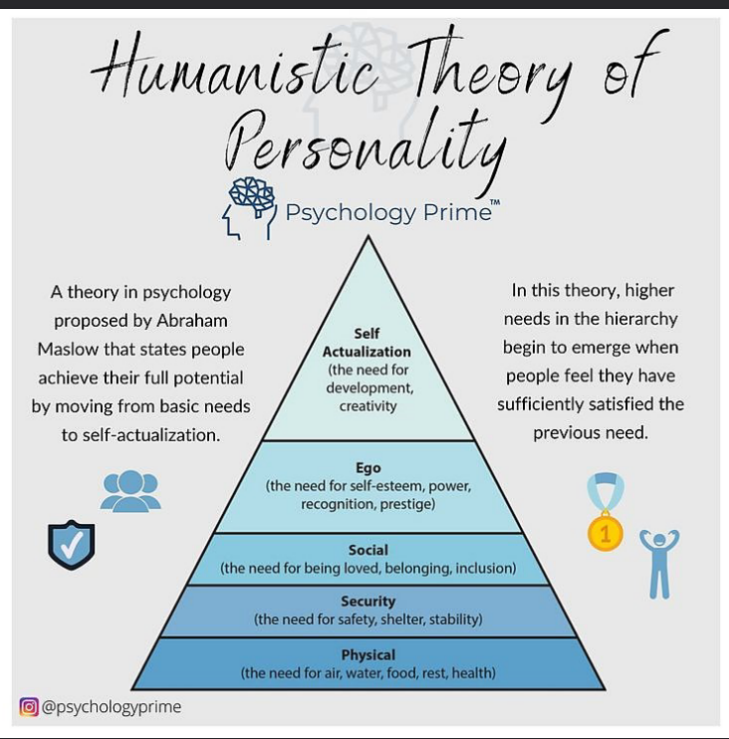
What is the Humanistic Theory of Personality? - Humanistic View in the formation of personality
higher needs in the hierarchy begin to emerge when people feel they have sufficiently satisfied the previous need
A theory proposed by Abraham Maslow that states that people achieve their full potential by moving from basic needs to self-actualization
personality is shaped by your choices, experiences and drive to grow into your best self
What is the psychodynamic view in the formation of personality?
proposed by Freud who is considered as “the third great revolutionist” in human self-awareness after Copernicus and Darwin
Darwin theorized the origin of biological traits
Freud theorized the origin of psychological traits
What were the main three assumptions in the psychodynamic theories?
Existence of psychic energy -
psychic determinism
psychoanalysis