Ancient Greece Flashcards
 Call Kai
 Learn
Learn Practice Test
 Spaced Repetition
 Match
Match Flashcards
 Knowt Play
1/47

Earn XP
Description and Tags
by Jackie Maillet
Name | Mastery | Learn | Test | Matching | Spaced | Call with Kai |
|---|
No analytics yet
Send a link to your students to track their progress
48 Terms
Who was considered the “Father of History,” wrote the history of the Persian Wars also tried to separate fact from legend by asking questions, recording answers, and checking truthfulness?
Herodotus
Who was the historian who saw war and politics as the activities of human beings, not the gods? Also wrote the History of the Peloponnesian Wars and stressed having accurate facts.
Thucydides
Who was the most famous Greek mathematician; wrote about plane geometry - showing how points, lines, angles and surfaces relate to one another?
Euclid
Who was the Greek mathematician? most widely known for his Pythagorean theorem, which states that "in a right triangle, the square on the hypotenuse is equal to the sum of the squares of the other two sides," in other words, a2 + b2=c2
Pythagoras
Who developed the Socratic method, which he asked his students questions to help them gain a deeper understanding of a topic and see things for themselves? Accused of corrupting the youth of Athens and neglecting the gods of ancient Greece, he was sentenced to death by poison (cup of hemlock). Even though offered many opportunities to escape, he chose to remain as he said since he lived in the city, he had to obey by its laws.
Socrates
Who was the student of Socrates who established a school in Athens called the Academy?Philosopher who wrote The Republic which stated his ideal government would be divided into three parts - the top were philosopher-kings who ruled with logic and reason. Next came warriors who protected the city. The last group was everyone else.
Plato
Who was the student of Plato who started his own school called the Lyceum where he taught the “Golden Mean,” where a person should find a balance and do nothing in excess or too little?Believed the best governments would be run by a mixture of the rich (aristocracy/oligarchy) and the majority (democracy) with a constitution. His ideas would help shape the way Europeans and Americans thought about government.
Aristotle
Who added a second actor? This allowed for much more exciting drama between characters (before one character talked to only the audience or chorus) thought to be the first to use scene-decoration and paid attention to costumes
Aeschylus
Who was one of the three great ancient Greek tragedians- best known for writing masterpieces like Oedipus Rex (Oedipus the King) and Antigone, introducing a third actor, and developing characters within tragic plots focused on fate (destiny) and personal choice?
Sophclase
Who changed how plays were written by showing traditional heroes as ordinary people facing big problems? Also focused on what characters felt inside - explored their thoughts and feelings. Characters in his plays often changed their minds or feelings suddenly - made them seem more like real people. He was interested in how people's inner thoughts and feelings, especially their strong emotions, drove the story.
Euripides
Who was around when Athens was an oligarchy with an Assembly that had little power and there was a dispute between the wealthy and poor farmers of Athens? Coming to power, cancelled all farmers’ debt and freed those who became slaves because of their debt. Then, allowed all male citizens to participate in the Assembly, not just the wealthy nobles.
Solon
Who was credited with making Athens a democracy? Made the Assembly the main decision maker in Athenian politics. Debate and vote on laws, head court cases, appoint generals. Special council of 500 to help the Assembly with daily issues. Members who selected from a lottery rather than selection which would favor or the rich.
Cleisthenes
Who helped Athens dominate the Delian League? Made Athens more democratic. Included more Athenians than ever to play a role in government - wanted talent more than social status therefore even poor citizens could participate in government. Began huge architectural programs in Athens and stressed all areas of culture. Called Athens “the school of Greece”
Pericles
Who developed the first two steps of the scientific method? First step = collect information. Second step = form an hypothesis, which is an educated guess/ possible explanation.
Thales
Who was the Most famous of any Hellenistic scientist, worked on solid geometry - the study of spheres and cylinders? Figured out the value of pi - the number used to measure the area of circles. Facing his death, he said, “Don’t disturb my circles!” Inventor as well as a scientist - discovered that levers could lift heavy objects - once said, “Give me a place to stand and I can move the earth.” Other possible inventions: archimedes screw which could bring up water, claw of archimedes, heat ray, and catapult.
Archimedes
Who was considered the “Father of Scientific Medicine,” traveled throughout Greece diagnosing illness and curing the sick? Believed sickness came from natural causes, unlike others who believed it was the result of evil spirits. Developed the Hippocratic Oath which is a list of rules of how doctors should use their skills to treat the sick. Doctors throughout the world today still use this oath.
Hippocrates
What were the two types of plays performed in Ancient Greek theater?
Tragedy and Comedy
Tragedy
Involved love, loss, pride, and the abuse of power and the frantic relationship between men and gods. Usually the protagonist will commit a crime and not realize, then everything crumbles from there. It often ends in disaster for the main character, exploring themes of fate, morality, and the human condition.
Comedy
usually comedy was mocking somebody's weakness or mocking men for foolishness. Typically features humor, satire, and exaggerated characters, often resolving in happy endings. It addresses societal issues through laughter and portrays the complexities of human nature.
What is a fable?
A short story typically features animals that convey a moral lesson, often teaching about virtues and human behaviors.
What are the characteristics of a fable?
Fables are characterized by their simple narrative structure, anthropomorphized animals, and a clear moral lesson at the end. They often highlight human traits and injustices in a compelling way.
Aesop is considered the greatest fable writer of ancient Greece. What are his famous fables and what messages do they tell?
His famous fables are The Tortoise and the Hare, The Lion and the Mouse, and The Boy Who Cried Wolf. The first fable teaches that slow and steady wins the race. The second fable teaches that we can help the strong and kindness is never wasted. The last fable highlights the importance of honesty and that liars are not believed even when telling the truth.
Why did the ancient Greeks believe in a polytheistic faith, just like all the ancient civilizations that were studied this year?
1. Natural Forces
2. Human Activities
Who was considered to be the top god of the ancient Greeks?
Zeus
Where did the gods and goddesses supposedly live
on Mount Olympus, a sacred mountain in Greece.
What are the characteristics of the ancient Greek gods and goddesses (meaning their qualities, relationships with each other)?
They looked and grew like men however did not age. They had passions and human weaknesses and made mistakes. They also had divine powers, were immortal, and could intervene in human affairs.
Did the ancient Olympic Games unify (bring together) or further splinter (break apart) city-states of ancient Greece?
The ancient Olympic Games served to unify the city-states of ancient Greece by providing a common platform for competition and fostering a sense of shared identity, despite ongoing rivalries.
For which god were the ancient Olympic Games held in honor of?
The ancient Olympic Games were held in honor of Zeus, the king of the Greek gods.
What were some of the early sporting events of the ancient Olympic games?
The early sporting events of the ancient Olympic Games included wrestling, boxing, chariot racing, and the pentathlon, which comprised five different disciplines: running, long jump, discus throw, javelin throw, and wrestling.
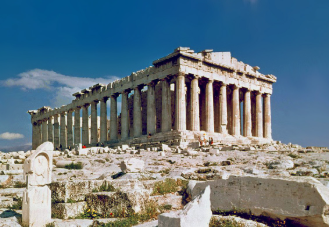
What is the name of this structure?
Parthenon
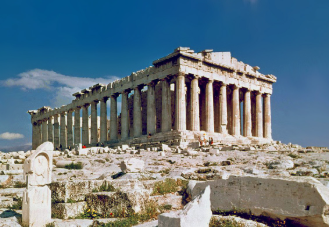
What is the purpose of this structure?
It was built as a temple dedicated to the goddess Athena, the patron deity of Athens. It also served as a treasury for the Delian League.
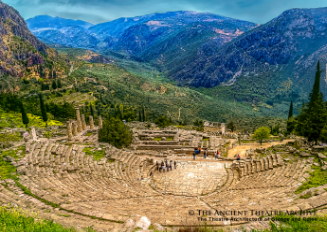
What is the name of this structure?
Ancient Greek Theatre
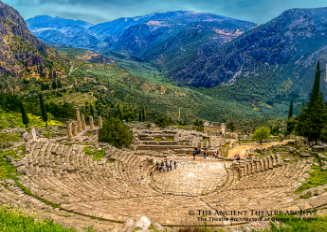
What is the purpose of this structure?
It was used for theatrical performances, including tragedies and comedies, as well as musical competitions and religious festivals in honor of the gods.
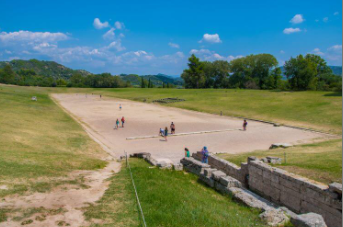
What is the name of this structure?
Ancient Stadium of Olympia
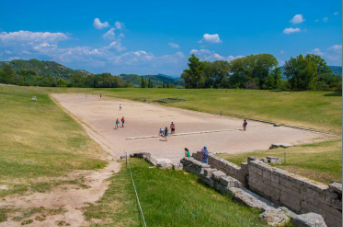
What is the purpose of this structure?
To host athletic competitions, most notably foot races like the stadion, as part of religious festivals honoring the gods, like Zeus. It served as the venue where athletes competed and thousands of spectators gathered on the embankments to watch.
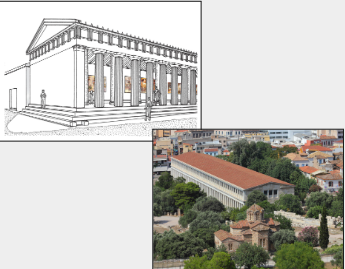
What is the name of these structures?
Stoa
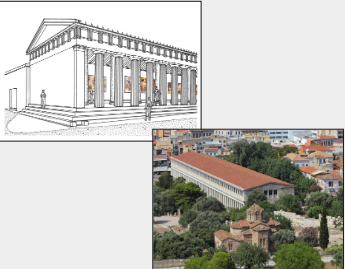
What is the purpose of these structures?
A versatile public building used as a covered walkway or marketplace. It provided shelter from the sun and rain while serving as a place for merchants to sell goods, magistrates to conduct civic business, and philosophers to teach and discuss ideas.
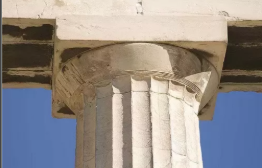
What is the name of this column?
Doric
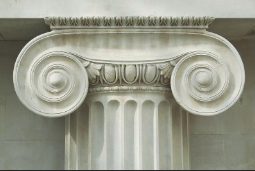
What is the name of this column?
Ionic

What is the name of this column?
Corinthian
Is the United States a direct or indirect democracy?
Indirect democracy
Is Ancient Athens a direct or indirect democracy?
Direct democracy
Under which Macedonian leader were the Macedonians able to sweep down from northern Greece and conquer the mainland of Greece?
Philip II
After the death of Phillip II, who comes to power and is able to fulful Phillip’s dream of conquering the entire Persian Empire.
Alexander the Great
Which term means the blending of Greek cultures with cultures of non-Greek people through Alexander’s conquests
Hellenistic
Which important city in Egypt, that was set up by Alexander, became a cultural and academic center for the ancient world?
Alexandria
What areas of the world/civilizations did Alexander conquer? Which river in India did Alexander’s empire extend too?
Alexander conquered regions of the Mediterranean, Persia, Egypt, and parts of India, extending his empire to the banks of the Indus River.
What areas of the world/civilizations did Alexander conquer? Which river in India did Alexander’s empire extend too?
Diadochi