SG QUIZ 1 FUNDS
 Call Kai
 Learn
Learn Practice Test
 Spaced Repetition
 Match
Match Flashcards
 Knowt Play
1/72

Earn XP
Description and Tags
Prof Mark ;Based on Class 1 Class 2
Name | Mastery | Learn | Test | Matching | Spaced | Call with Kai |
|---|
No analytics yet
Send a link to your students to track their progress
73 Terms
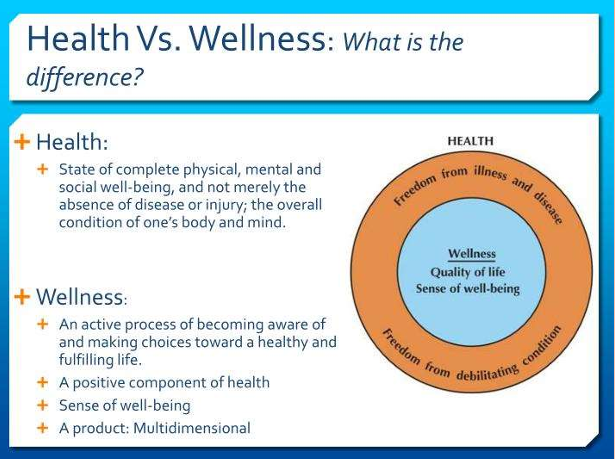
Be able to define & explain Health
Health is complete physical, mental and social well-being and not merely the absence of disease or injury; the overall condition of one’s body and mind
Be able to define and explain the concept of illness
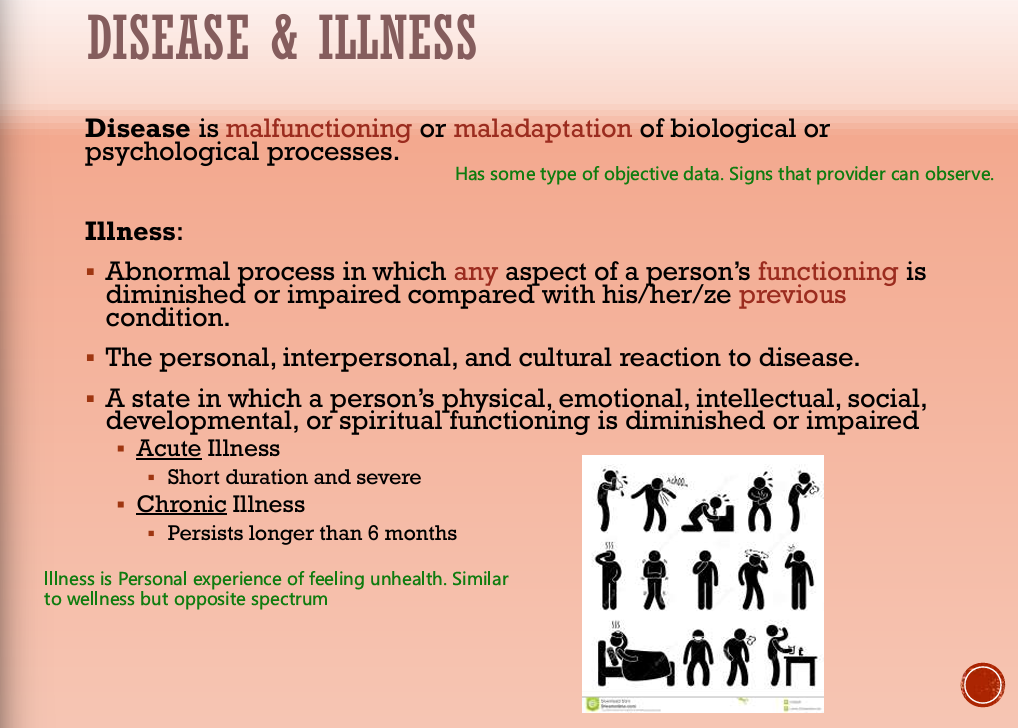
illness
Abnormal process in which any aspect of a person’s functioning is diminished or impaired compared with his previous conditioned
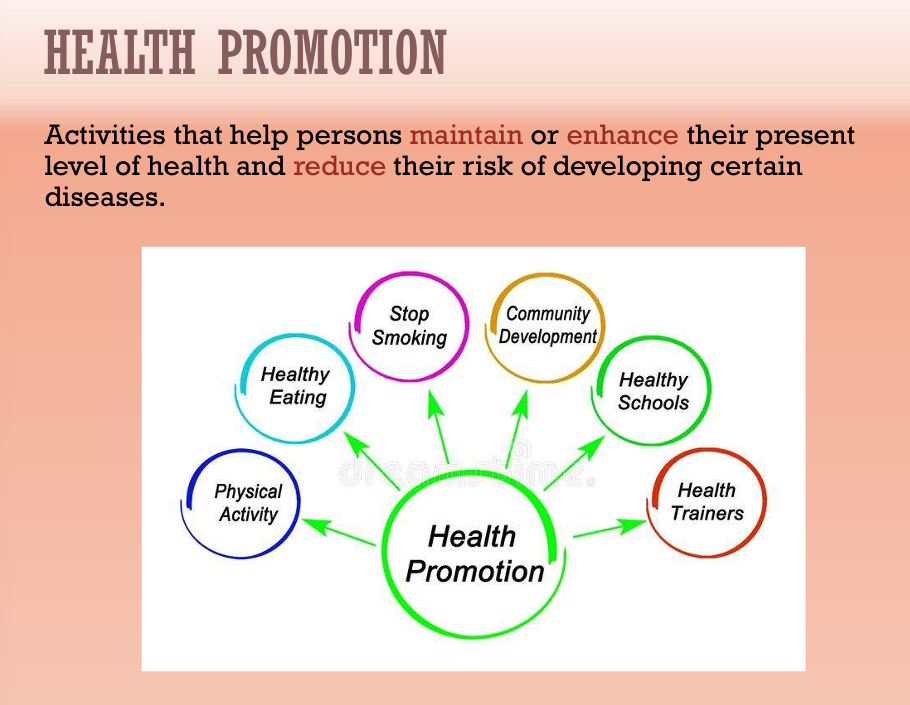
Be able to define and explain the concept of Health Promotion
Activities that help persons maintain or enhance their present level of health and reduce their risk of developing certain diseases
Be able to define and explain the concept of illness prevention
Health education programs or activities directed toward protecting patients from threats or potential threats to health and minimizing risk factors
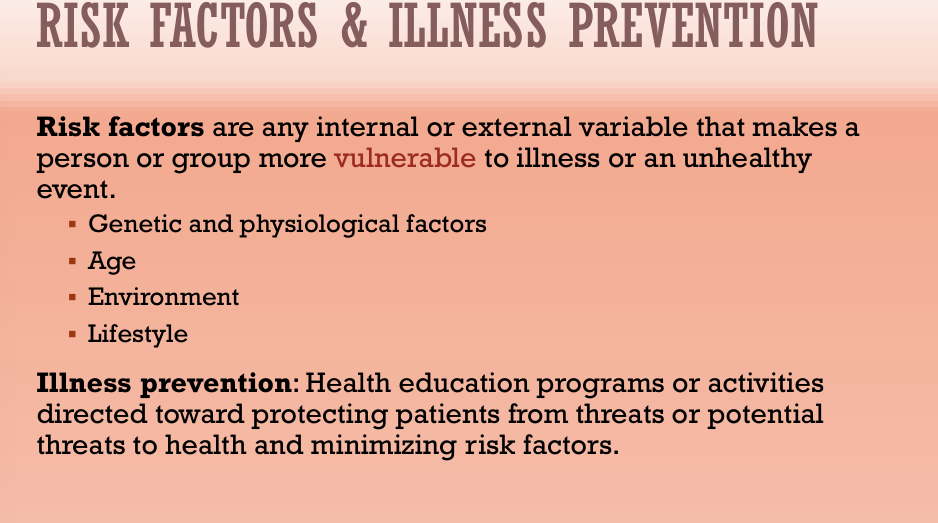
What are risk factors? What are some examples?
Internal or external variable that makes a person or group more vulnerable to illness or an unhealthy event
Genetic and physiological factors
Age
Environment
Lifestyle
What is patient safety and why is it important?
Avoidance and prevention of patient injuries or adverse events resulting from processes of healthcare delivery
Important because nurses should NEVER cause harm to patient
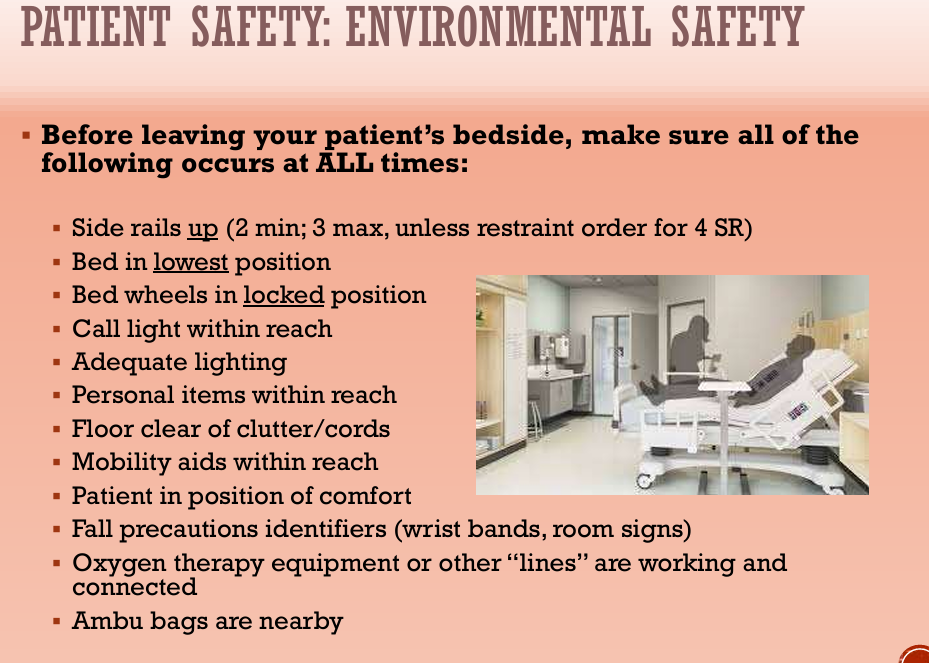
What is the purpose of an environmental safety survey? What are some of the elements contained in doing an environmental safety? When should nurse conduct one?
To identify and intervene with hazards that may cause harm to patient
Entering and Before leaving patient room
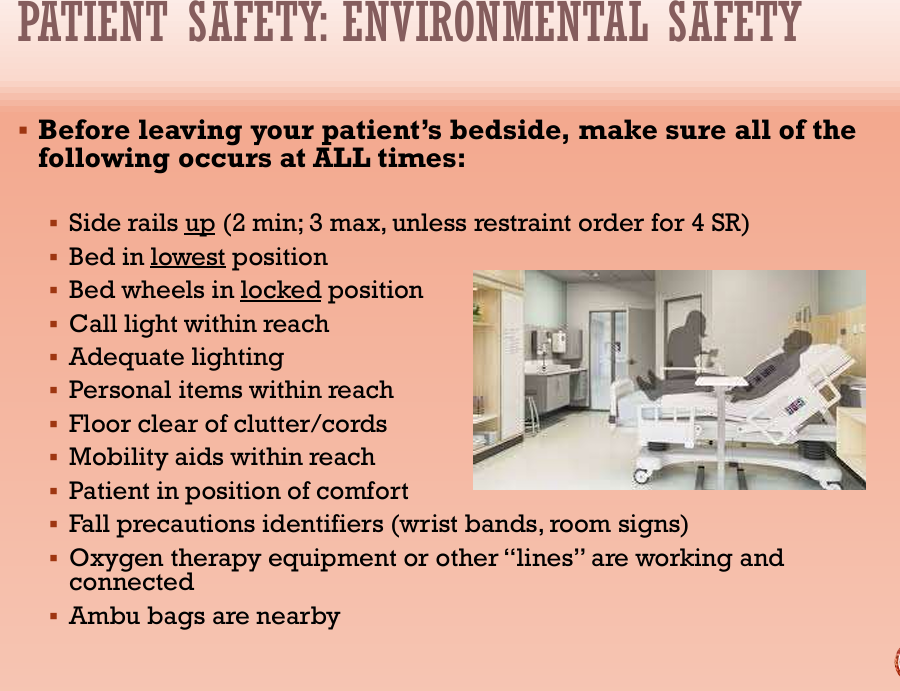
What is the purpose of an environmental safety survey? What are some of the elements contained in doing an environmental safety? When should nurse conduct one?
Side rails UP (2 minimum, 3 max unless restraint order for 4 SRs)
Bed in LOWEST position
Bed wheels in LOCKED position
Call light within reach
Adequate lighting
Personal items within reach
Floor clear of clutter/cords
Mobility aids within reach
Patient in position of comfort
Fall precautions identifiers (wrist bands, room signs)
Oxygen therapy equipment or other lines working and connected
Ambu bags are nearby
What is the difference between subjective and objective data? What are some examples?
Subjective: Patient reports SYMPTOMS. Cannot be measured
Pain
Fatigue
Nausea
Dizziness
Objective: Observable and measurable SIGNS
Vital Signs
Sweating
Rash
Fever
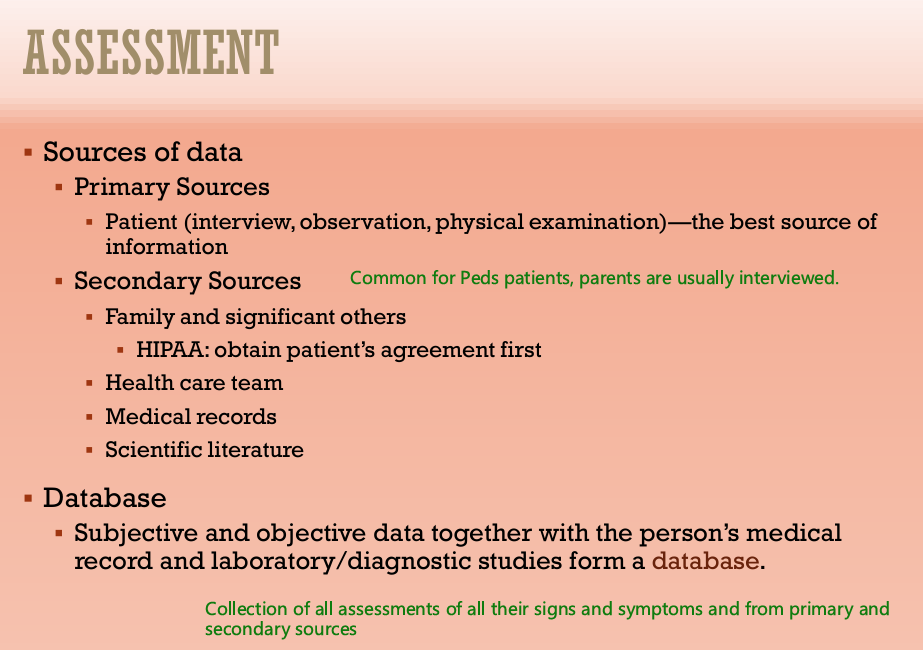
What are the 4 assessment techniques and in what order should we perform them?
Inspection
Palpation
Percussion
Auscultation
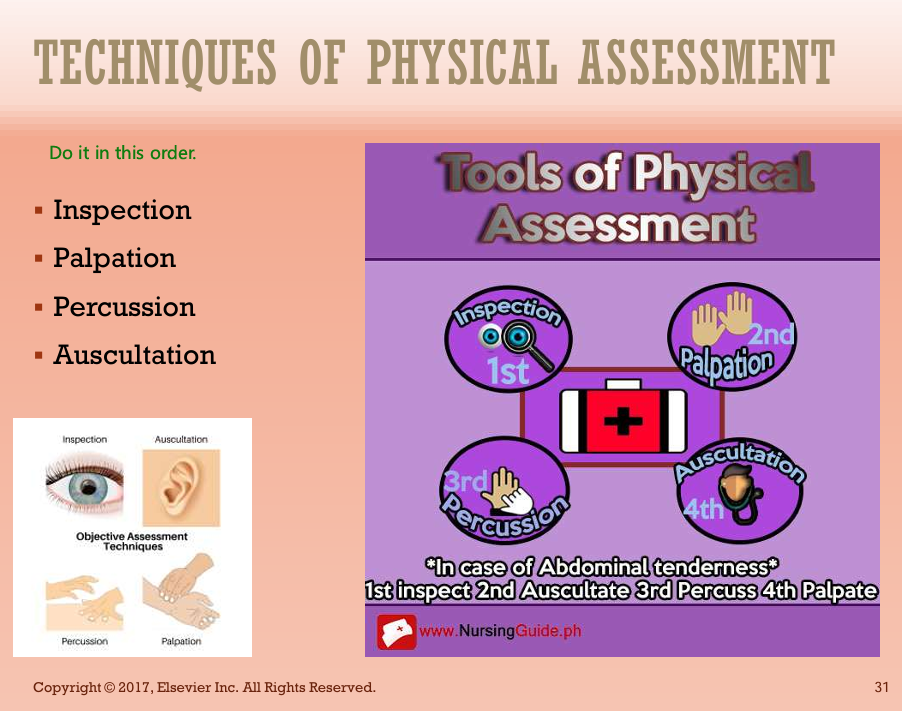
Define each assessment technique and when you would use each one. Are there any special considerations? (INPSECTION)
“Concentrated Watching”
Involves Looking, Listening, Smelling to distinguish expected findings from unexpected findings
Identify degree of distress
Look before you touch
Provide comfortable, private conditions
Provide adequate lighting and exposure
Inspect each area of size, shape, color, symmetry, position, abnormalities
Symmetry on opposite sides of body
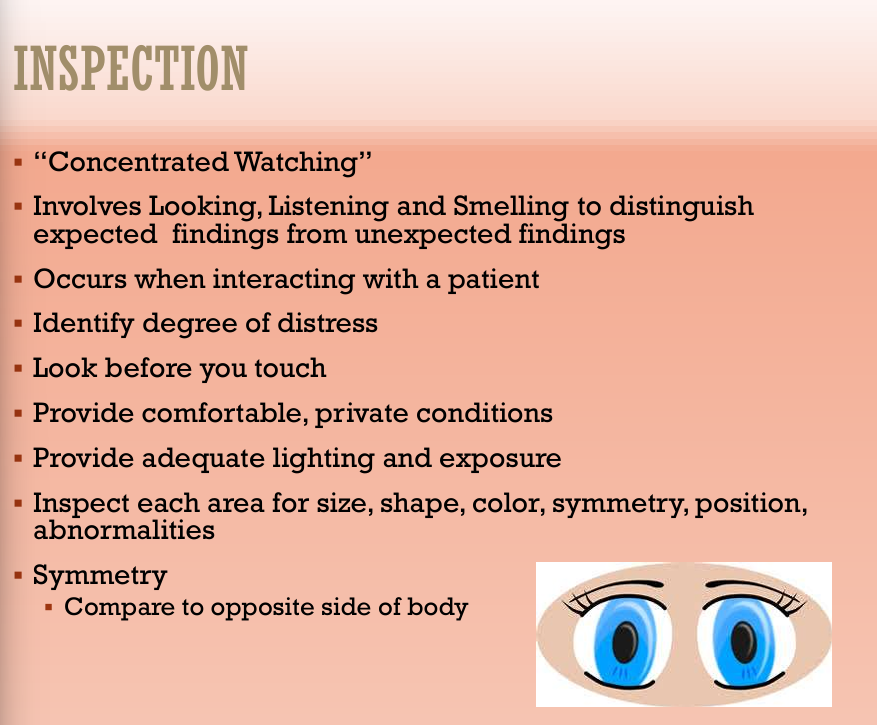
Define each assessment technique and when you would use each one. Are there any special considerations? (PALPATION)
Use touch to gather information
Use different parts of hands to detect different characteristics
Used to assess skin, organs, glands, blood vessels, thorax
Hands should be warm, fingernails short, technique is slow, gentle and systematic
Palpate tender areas last
Start with light palpation; end with deep palpation
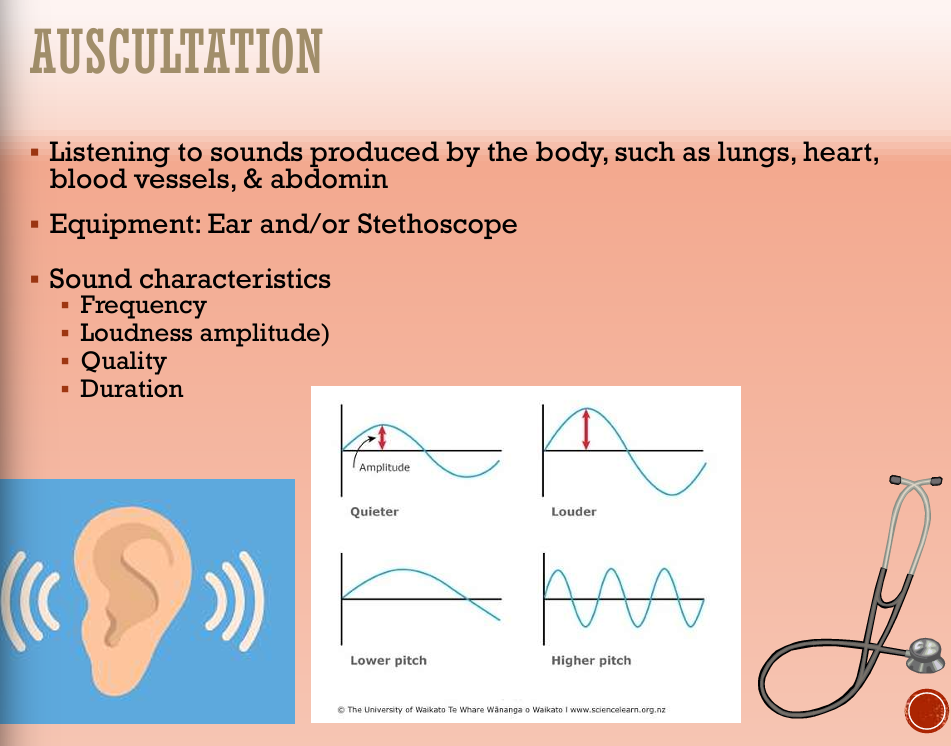
Define each assessment technique and when you would use each one. Are there any special considerations? (AUSCULTATION)
Listening to sounds produced by the body, such as lungs, heart, blood vessels, and abdomen
Equipment: Stethoscope and Ear
Sound characteristics
Frequency
Loudness amplitude
Quality
Duration
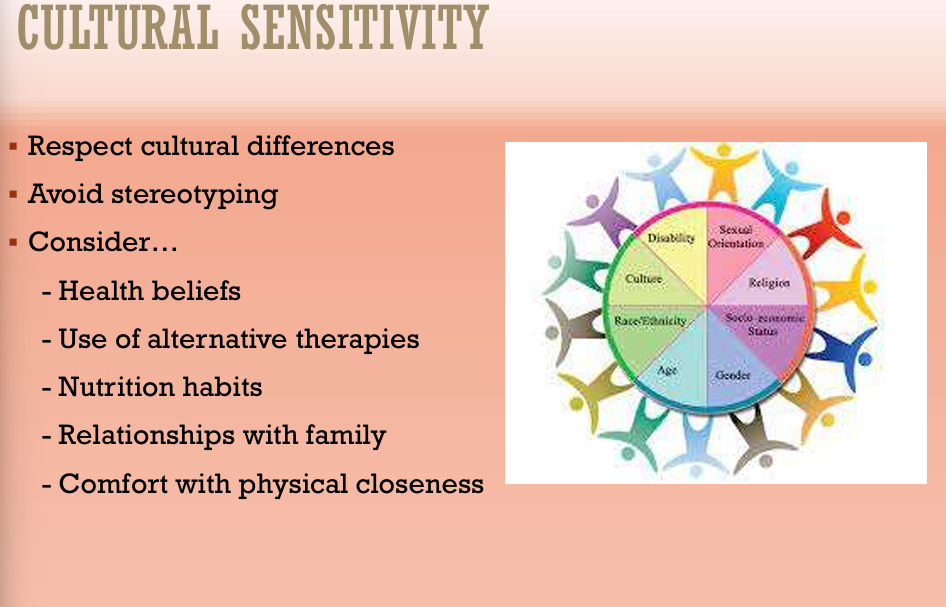
What are the special considerations while assessing patients with cultural differences? How about with older adults?
Consider
Health beliefs
Use of alternative therapies
Nutrition habits
Relationships with family
Comfort with physical closeness
What are the special considerations while assessing patients with cultural differences? How about with older adults?
Sensory and physical limitations may affect ability to respond quickly
Be patient; adjust pace of assessment data gathering to accomodate
Signs and symptoms tend to be subtle
Observe for signs of fatigue, sighing, grimacing, irritability, leaning against objects for support, drooping head and shoulders
Allow pauses or rest periods as needed
What are the different levels of communication and what are some examples of when you would use each type?
Intrapersonal
Interpersonal
Small group
Public
Electronic
What are the phases of the nurse-patient relationship?
Preinteraction
Occurs before meeting the patien
Orientation
Nurse & patient meet and get ton know each other
Working
When the nurse and the patient work together to solve problems accomplish goals
Termination
Occurs at the end of a relationship
When does therapeutic communication occur? What are examples? How/when would you use each one?
During working phase
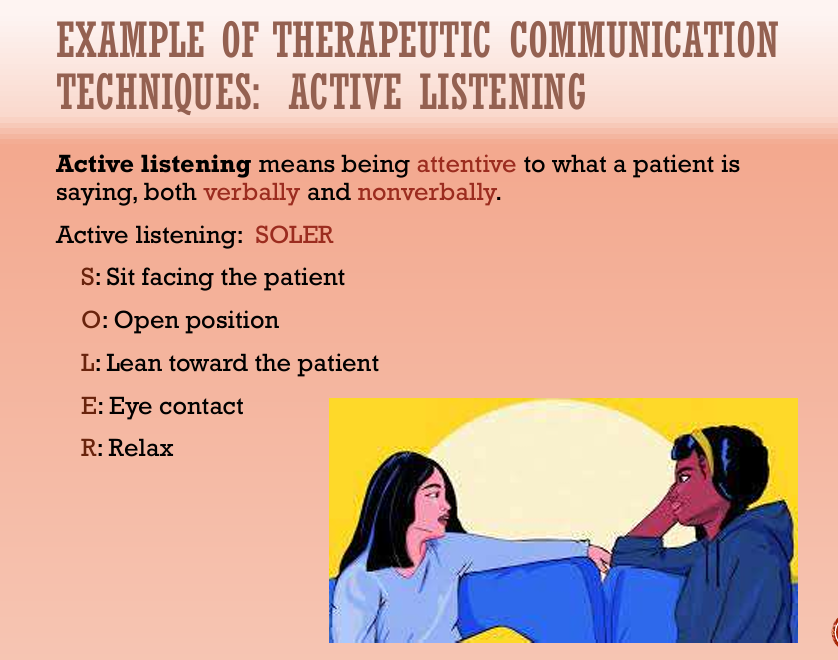
Example: Active listening SOLER
S: Sit facing the patient
O: Open position
L: Lean toward the patient
E: Eye contact
R: Relax
Example: Empathy
Example: Touch
Example: Silence
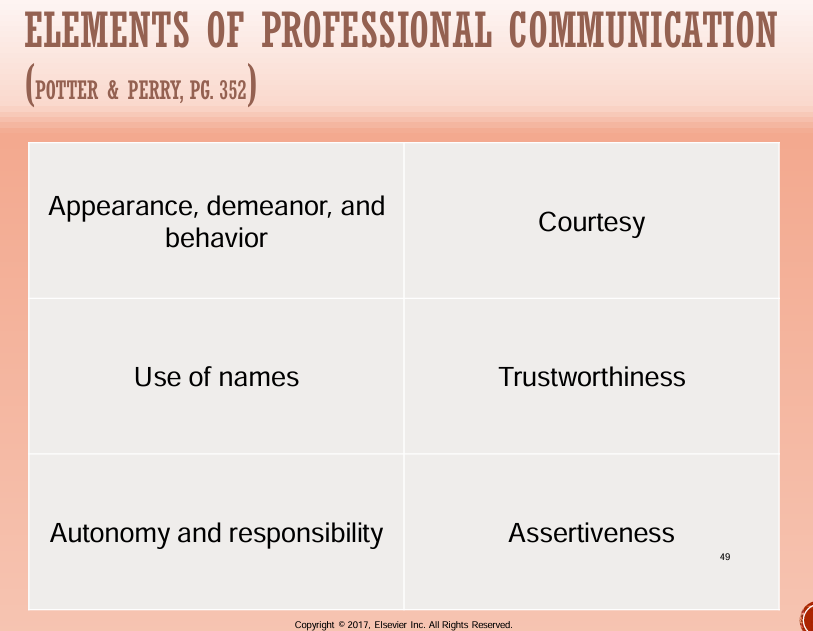
What are the elements of professional communication and what are some examples of each element?
Appearance, demeanor, and behavior
Use of names
Autonomy and responsibility
Courtesy
Trustworthiness
Assertiveness
What are the different forms of communication barriers? How would you provide effective communication to patients with different forms of communication barriers?
Skipped
What is the difference between colonization, infection, and infectious diseases? What are risk factors for infection? How do you decrease the risk of infection?
Colonization
Presence and growth of microorganisms within a host but without tissue invasion or damage
Infection
The invasion of susceptible host by pathogens or microorganisms, resulting in disease
Infectious Disease
Communicable & transmissible
What is the difference between colonization, infection, and infectious diseases? What are risk factors for infection? How do you decrease the risk of infection?
Age
Lifestyle
Occupation
Nutritional Status
Travel History
Stress
Procedures
Disease
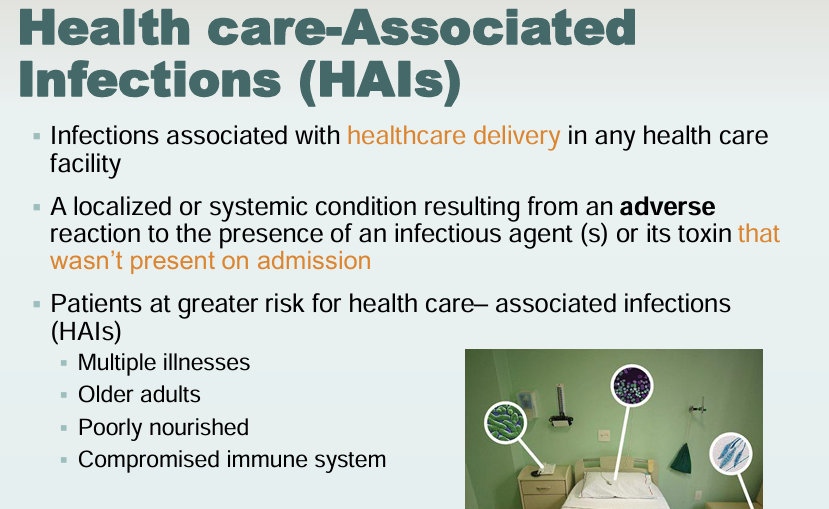
What are healthcare-associated infectious and who is at risk?
Infections associated with healthcare delivery in any health care facility
Patient with higher risk w/ HAIs
Multiple illnessses
Older adults
Poorly nourished
Compromised immune system
Explain the chain of infection
skipped
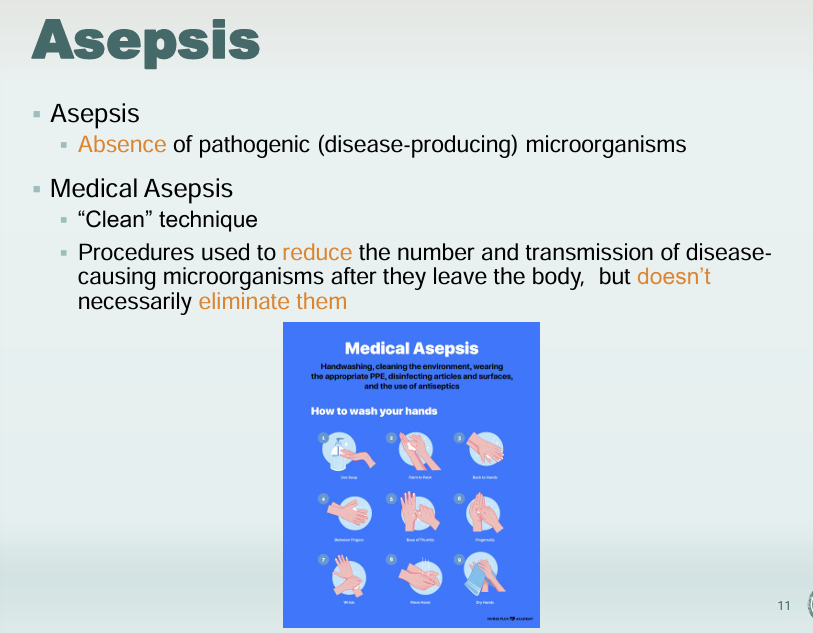
What is medical asepsis and be able to provide examples
Asepsis:
Absence of pathogenic (disease-producing) microorganisms
Medical Asepsis
Clean technique
Procedures used to reduce the number and transmission of disease causing microorganisms after they leave the body, but doesn’t necessarily eliminate them
What is the difference between Universal and Standard precaution?
Universal Precautioin
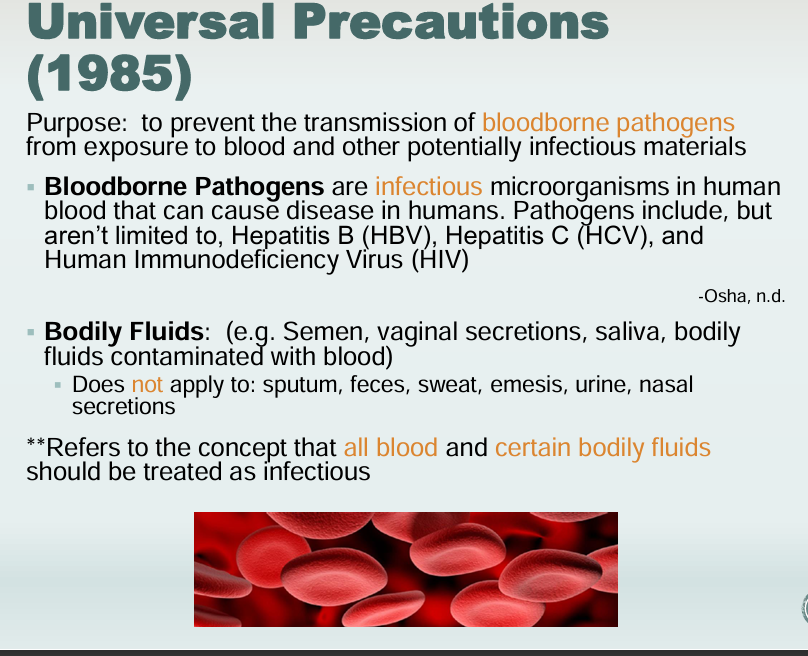
Prevent transmission of bloodborne pathogens and bodily fluids
Bloodborne pathogens
Hepatitis B (HBV)
Hepatitis C (HCV)
Human immunodeficiency Virus (HIV)
Bodily Fluids
Applies to: Semen, Vaginal Secretions, Saliva, Bodily fluids contaminated with blood
Does NOT apply to: Sputum, feces, sweat, emesis, urine, nasal secretions
What is the difference between Universal and Standard precaution?
Prevent and control infection and its spread to all persons
Based on that these may contain transmissible infectious agents
Blood
Body fluids
Secretions
Excretions (except sweat)
Non-intact skin
Mucous membranes
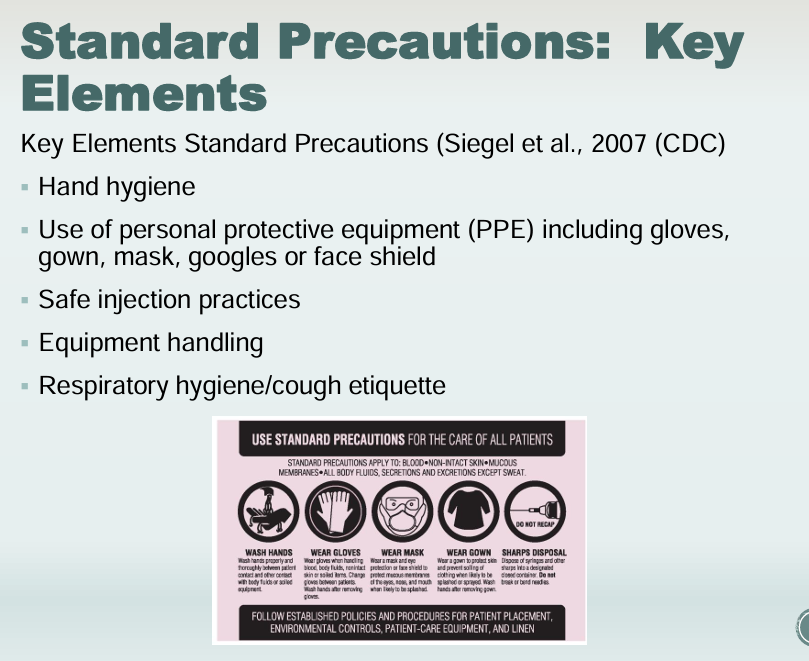
What are the key elements of Standard Precaution? When would you use each element of standard precaution?
Hand hygiene
Use of PPE (Gloves, gown, mask, googles, face shield)
Safe injection practices
Equipment handling
Respiratory hygiene/cough etiquette
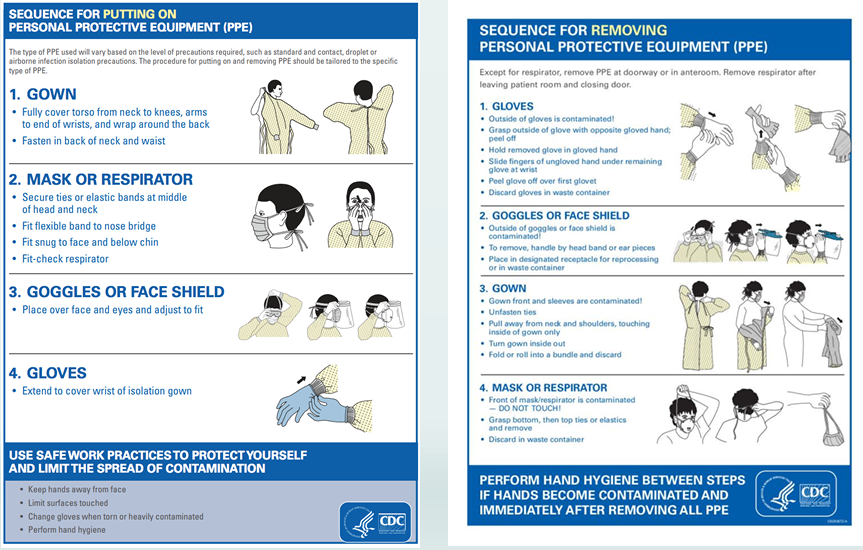
What is the proper technique/procedure and indications for using hand hygiene, alcohol-based hand sanitizer, and PPE. How do you decide when to use each?
Putting On:
Hand Hygiene
Gown
Mask or respirator
Goggles or face shield
Gloves
Removing:
Hand hygiene
Gloves
Hand hygiene
Goggles/Face Shield
Hand Hygiene
Gown
Hand Hygiene
Mask/Respirator
Hand Hygiene
What is the proper technique/procedure and indications for using hand hygiene, alcohol-based hand sanitizer, and PPE. How do you decide when to use each? (GLOVES)
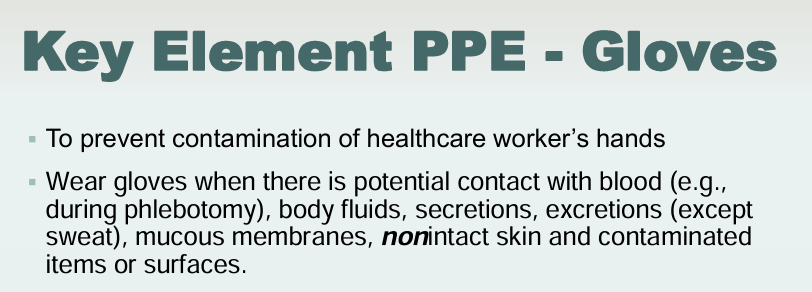
Gloves: Potential Contact with
Blood (during phlebotomy
Body fluids
Secretions
Excretions (except sweat)
Mucous membranes
Non-intact skin
Contaminated items or surfaces
What is the proper technique/procedure and indications for using hand hygiene, alcohol-based hand sanitizer, and PPE. How do you decide when to use each? (ISOLATION GOWN)
Isolation Gown: During procedures or activities where contact with blood or bodily fluids is anticipated
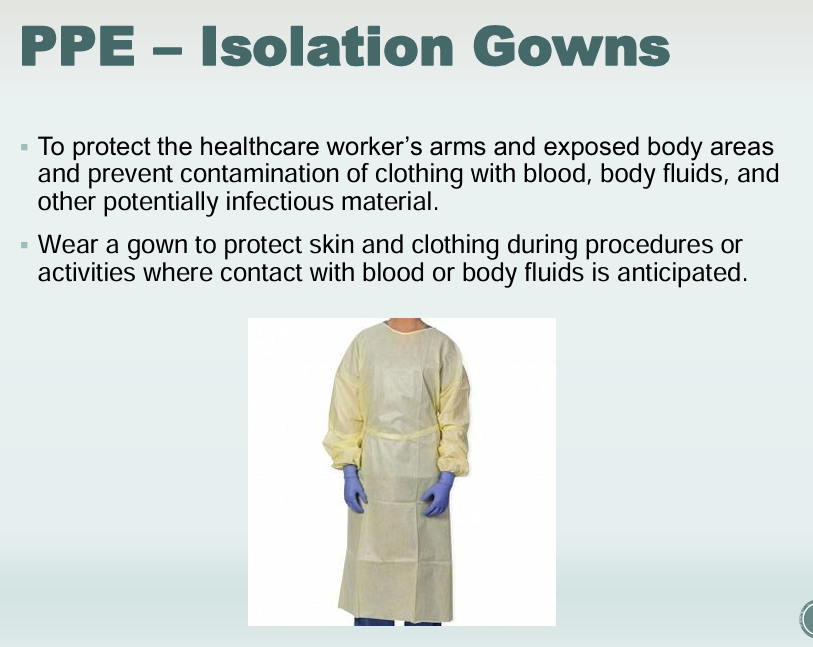
What is the proper technique/procedure and indications for using hand hygiene, alcohol-based hand sanitizer, and PPE. How do you decide when to use each? (Mask/Respirator)
To protect the nose and mouth
Wear a face mask when there is potential contact with RESPIRATORY secretions and sprays of blood or body fluids
May be in combination with goggles or face shield to protect the eyes in addition to the nose and mouth
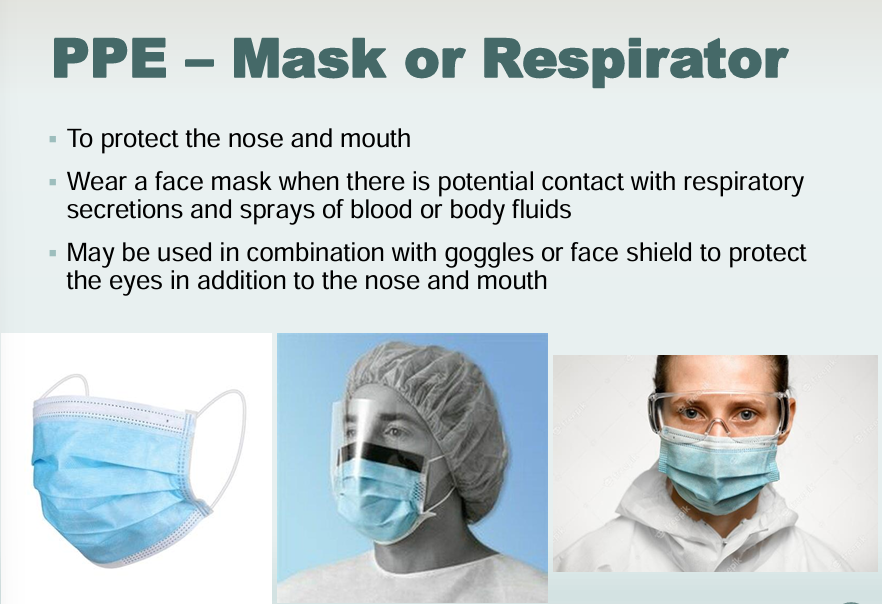
What is the proper technique/procedure and indications for using hand hygiene, alcohol-based hand sanitizer, and PPE. How do you decide when to use each? (Goggles)
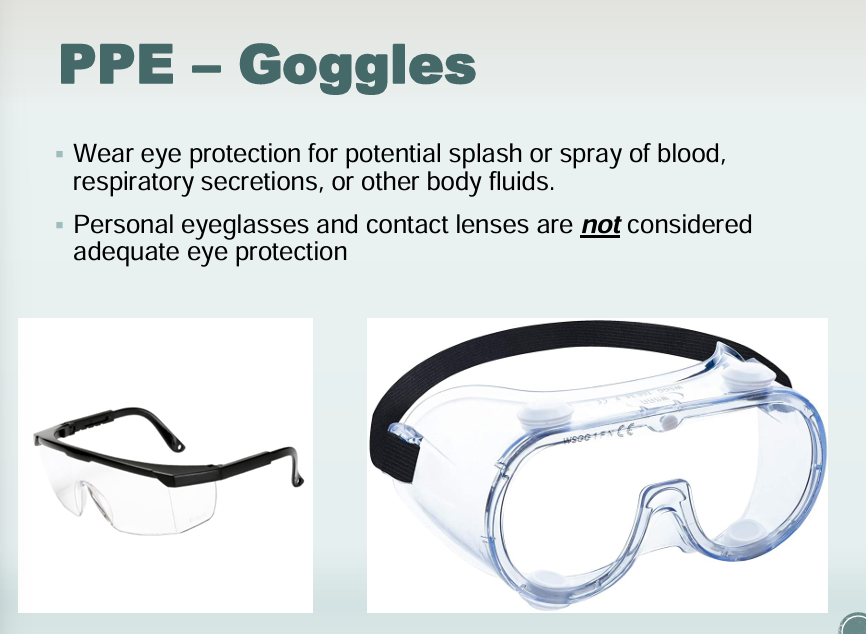
Goggles
Wear eye protection for potential for splash or spray of blood, respiratory secretions or other body fluids
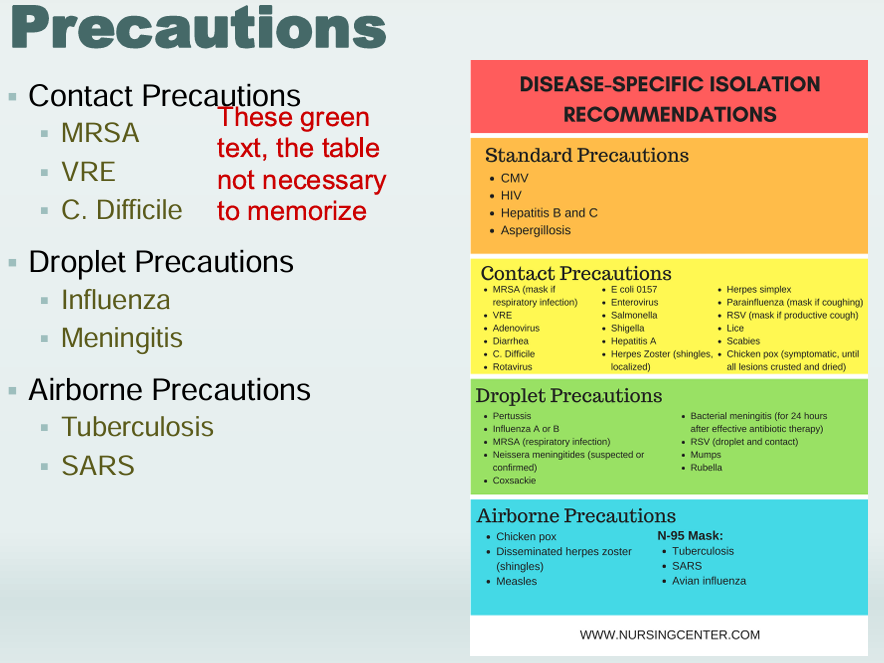
What is the difference between contact, droplet, airborne and protective environment precautions? When would you use each type of isolation? What PPE would you use for each one? How are they different than standard precautions?
Contact precautions: Direct patient or environmental contact
Droplet precautions: Respiratory tract transmission over short distances
Airborne precaution: remains in the air, infective over time and distance
Protective environment:": limited patient population
Why is hygiene important? What role do nurses play?
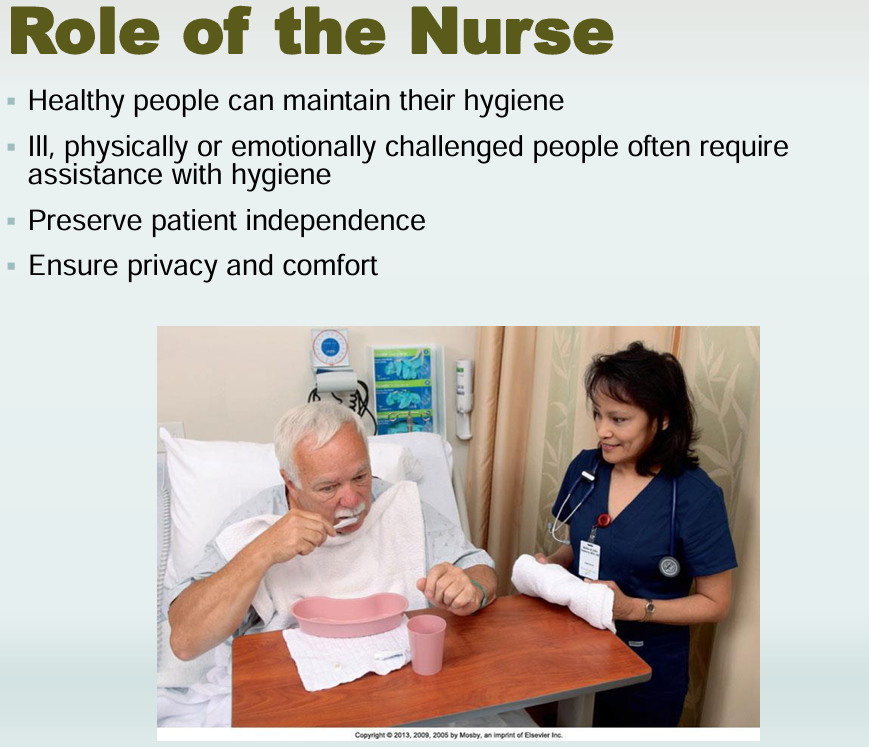
Role of nurses
Healthy people can maintain their hygiene
Ill, physically or emotionally challenged people often require assistance with hygiene
Preserve patient independence
Ensure privacy and comfort
What are the factors that influence hygiene
Personal preferences
Factors influencing hygiene practices
Social practices
Personal preferences
Body image
Socioeconomic status
Health beliefs and motivation
Cultural variables
Physical condition
Patient care should be individualized
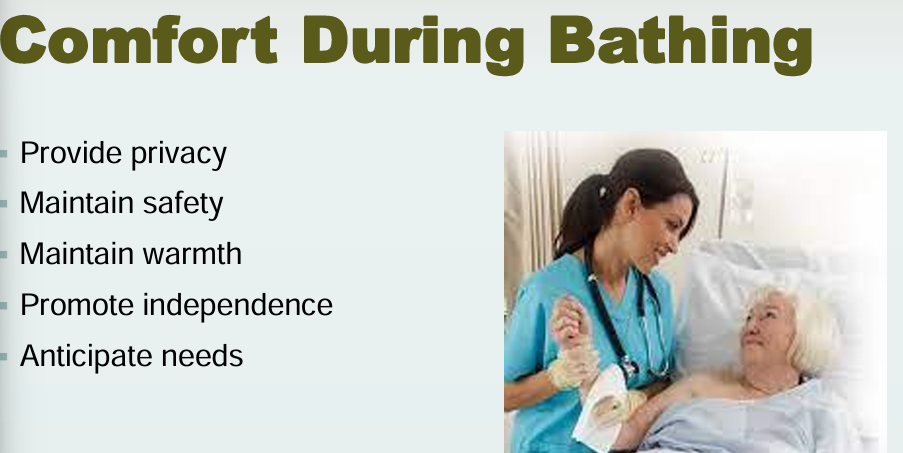
What is the process of bathing a patient comfortably
Provide privacy
Maintain warmth
Promote independence
Anticipate needs
What are vital signs and when you should measure vital signs?
Blood pressure
Temperature
Oxygen saturatioin
Respiration rate
Pulse
Pain
What are vital signs and when you should measure vital signs?
On admission
Hospital routine schedule
Before, during and after medication and treatments or procedures
Before, during and after nursing interventions
When a patient’s general physical condition changes
When a patient reports nonspecific symptoms of physical distress
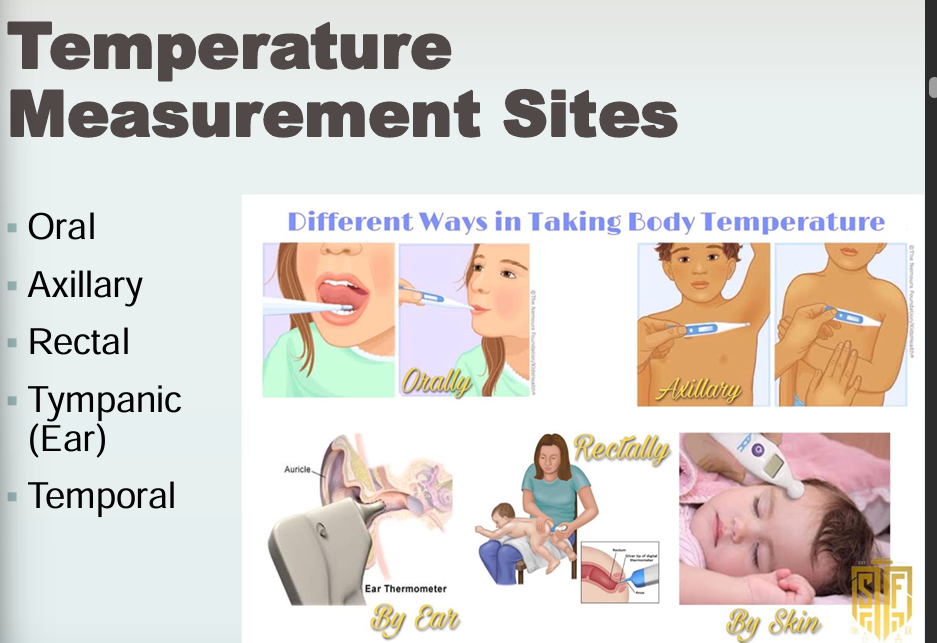
What is body temperature? What are the different sites for taking body temperature measurements?
Heat produced - Heat Loss = Body temperature
Sites:
Oral
Axillary
Rectal
Tympanic (Ear)
Temporal
What are the normal ranges for adults and older adults for temperature? When should/should not each site be used?
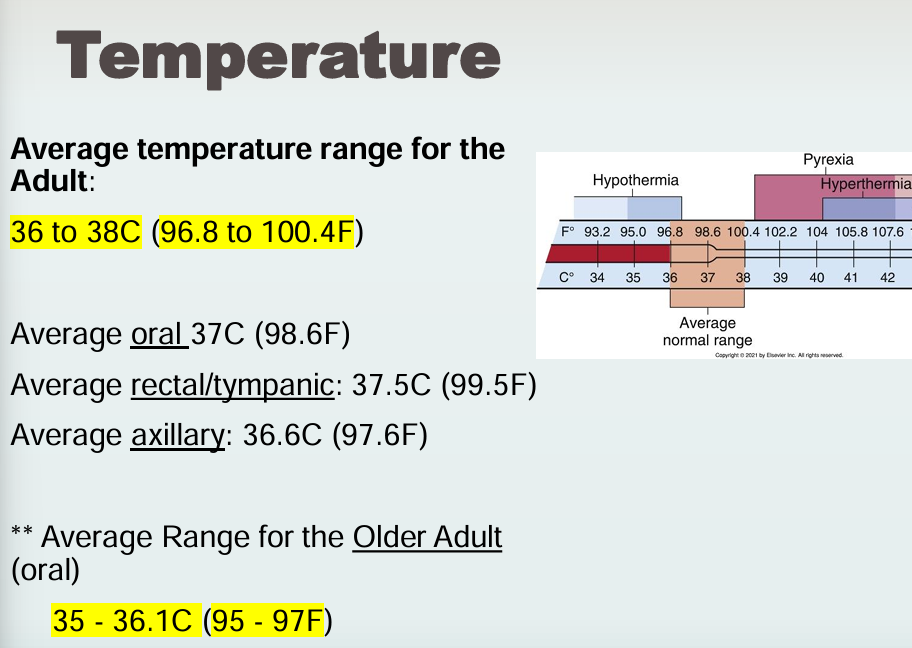
Average oral 37 C (98.6)
Average Rectal/tympanic 37.5 C (99.5)
Average axillary 36.6 (97.6)
Average older adult
35-36.1 C (95-97)
What are the normal ranges for adults and older adults for temperature? When should/should not each site be used? (ORAL)
Oral
🟢 Most common for cooperative, conscious adults
🔴 Do NOT use immediately after the patient has consumed hot or cold liquids/food — wait 30 minutes (directly tested in the Quick Quiz)
🔴 Not appropriate for patients who cannot hold thermometer in mouth (unconscious, confused, oral surgery, mouth-breathers, very young children)
What are the normal ranges for adults and older adults for temperature? When should/should not each site be used? (RECTAL)
Rectal
🟢 More accurate core temperature; useful when oral is not possible
🟢 Often used for infants and young children
🔴 Contraindicated in rectal surgery, rectal disorders, diarrhea, or when patient cannot tolerate positioning
What are the normal ranges for adults and older adults for temperature? When should/should not each site be used? (AXILLARY)
🟢 Safest, non-invasive; appropriate when other sites cannot be used
🟢 Good for newborns/infants
🔴 Least accurate — considered the least reliable site; readings run lower than core temperature
What are the normal ranges for adults and older adults for temperature? When should/should not each site be used? (TYMPANIC)
🟢 Fast and convenient; useful in children and adults
🔴 May be inaccurate with excessive earwax or ear infections
🔴 Improper positioning of the probe can lead to inaccurate readings
What are the normal ranges for adults and older adults for temperature? When should/should not each site be used? (TEMPORAL ARTERY)
🟢 Non-invasive, quick, and well-tolerated; good for all ages including children
🟢 Increasingly preferred in clinical settings
🔴 May be affected by perspiration or improper scanning technique
What are some of the factors influencing body temperature?
Age
Exercise
Hormonal level
Circadian Rhythm
Environment
Temperature altrerations
What do pulse measurements measure? What are some factors that influence pulse/heart rate? What are acceptable pulse rates for adults? What is bradycardia & tachycardia?
Number of pulsing sensations in 1 minute
Factors
Exercise
Temperature
Emotions
Medications
Postural changes
Pulmonary conditions
Hemorrhage
60 - 100 bpm (Eucardia)
Tachycardia > 100 bpm
Bradycardia < 60 bpm
When to be concerned P > 120, P< 50, pt specific
Where are pulse locations?
Carotid
Brachial
Radial
Femoral
Popliteal
Post Tibial
Dorsalis Pedis
What elements are contained in a pulse assessment and what are the characteristics of each element?
Technique: Palpation
Rate (beats/min)
Rhythm (Regular or Irregular)
Strength/Amplitude (force) (3+, 2+, 1+, 0)
Equality** (even, same on all peripheries)
You notice that a patient has an irregular pulse. The best action you should take includes:
A. Reading the history & physical
B. Assessing the apical pulse rate for 1 full minute
C. Auscultating for strength and depth of pulse
D. Asking whether the patient feels any palpitations or faintness of breath
B. Assessing the apical pulse rate for 1 full minute
What do respirations measure? Difference between ventilation, diffusion and perfusion?
Breaths per minute
Ventilation: The movement of gases in and out of the lungs
Diffusion: movement of oxygen and carbon dioxide between alveoli and RBCs
Perfusion: Distribution of RBCs to and from pulmonary capillaries
What are some factors that influence respirations?
Exercise
Acute Pain
Anxiety
Smoking
Body position
Medications
Neurological injury
Hemoglobin function
What are acceptable respiratory rates for adults? What is tachypnea vs bradypnea?
12-20 breaths per minute (Eupnea)
Tachypnea > 20 per minute
Bradypnea <12 per minute
When to be concerned >24 breaths/minute, <10 breaths/minute, pt specific
What elements are contained in a respiratory rate assessment and what are the characteristics of each element? What is the technique to measure respiratory rates and when should the technique differ?
• Ventilation is assessed by determining respiratory rate, depth, and rhythm.
• Technique: Observation and palpation • Best to do without patient knowing
• Rate (numeric value)
• Depth (deep, full/normal/even, or shallow)
• Rhythm (regular or irregular)
• Effort (easy/relaxed or hard to breathe
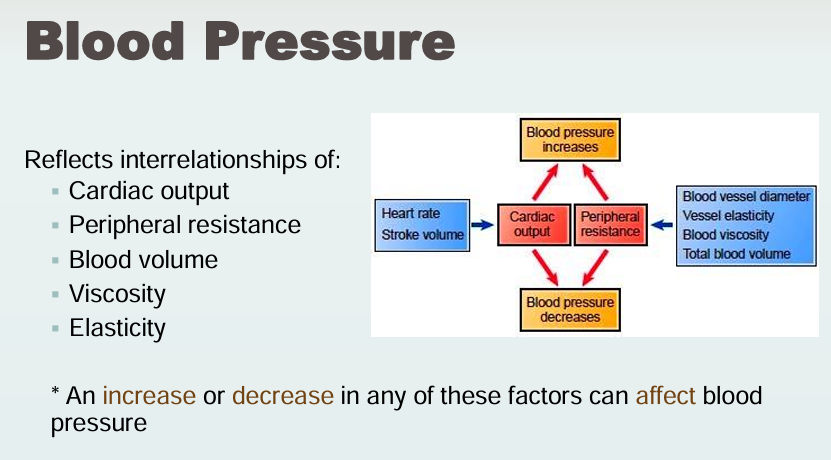
What do blood pressure readings measure? What are the interrelationships to blood pressure? What can happen if any of these relationships change?
The force exerted on the walls of an artery by pulsating blood under pressure?
Cardiac output
Peripheral resistance
Blood volume
Viscosity
Elasticity
An increase or decrease in any of these factors can affect blood pressure
What are some factors that influence blood pressure?
Age
Stress
Ethnicity
Gender
Daily variation
Medications
Activity & weight
Smoking
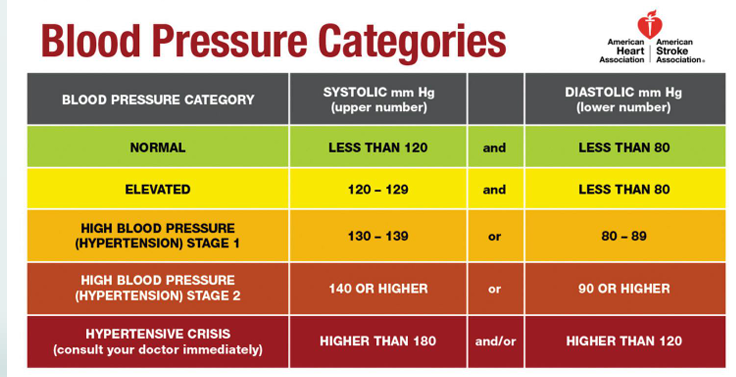
What is a normal BP reading for adults?
Less than 120/80
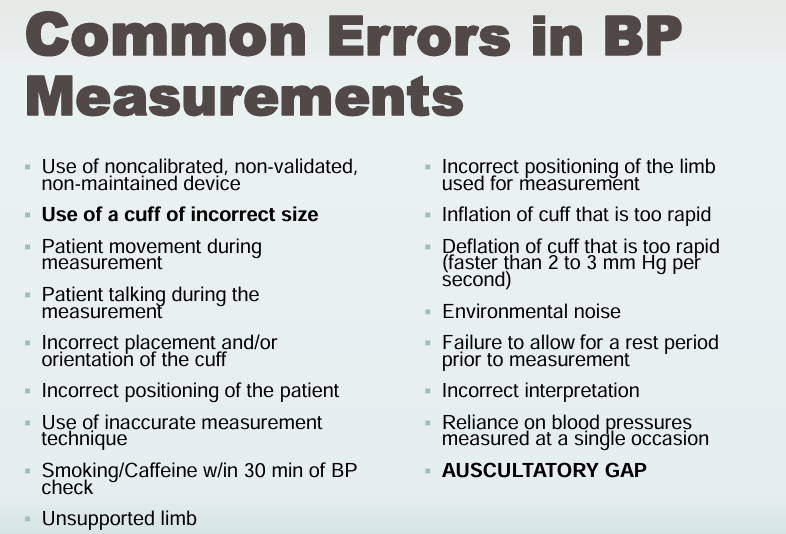
What are common errors in BP measurements?
Use of a cuff of incorrect size
Auscultatory Gap
What is the proper technique to measure a palpatory and auscultatory blood pressure?
Palpation & Auscultation
Inflate 30 mmHg above “normal” blood pressure
Avoids Auscultatory gap
When assessing the blood pressure of a frail older women, using an adult cuff of normal size will affect the reading and produce a value that is
A. Accurate
B. Indistinct
C. Falsely low
D. Falsely high
C. Falsely low
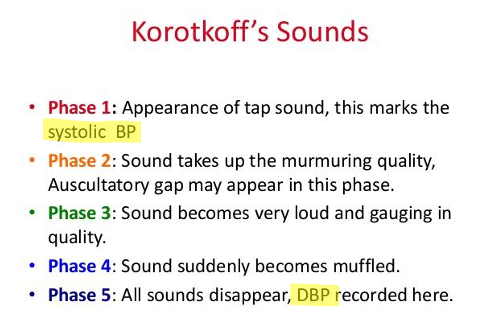
What are the different Korotkoff sounds? When do you measure systolic and diastolic blood pressure readings?
Phase 1: First tap sounds: Systolic BP
Phase 2
Phase 3
Phase 4
Phase 5: All sounds disappear, Diastolic BP
What is an auscultatory gap? How do we avoid measuring one? What happens if we don’t avoid one?
Occurs between first & second Korotkoff sounds
Underestimate SBP and overestimate DBP
Avoid this by first palpating the systolic and inflating the cuff 30 mmHg ABOVE that number
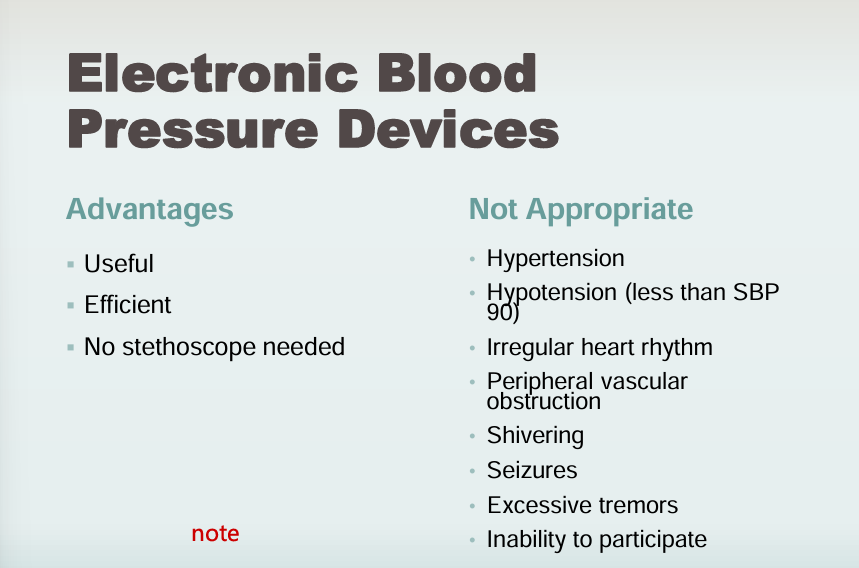
When should/should not an electronic blood pressure device be used?
Advantages
Useful
Efficient
No stethoscope needed
Not Appropriate
Hypertension
Hypotension
Irregular heart rhythm
Peripheral vascular obstruction
Shivering
Seizures
Excessive tremors
Inability to participate
What are some patient precautions to take when taking blood pressures? When should a different blood pressure site be used? Where are other sites that blood pressure can be taken instead?
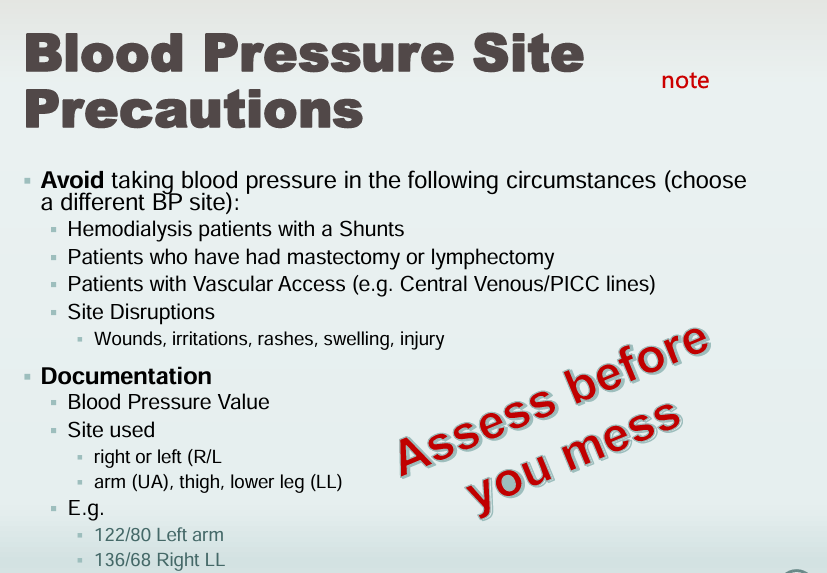
ASSESS BEFORE YOU MESS
Hemodialysis patients with shunts
Patients who have had mastectomy or lymphectomy
Patients with vascular accesss (e.g. Central Venous/PICC lines)
Site Disruptions
Wounds
Irritations
Rashes
Swelling
Injury
What are some patient precautions to take when taking blood pressures? When should a different blood pressure site be used? Where are other sites that blood pressure can be taken instead?
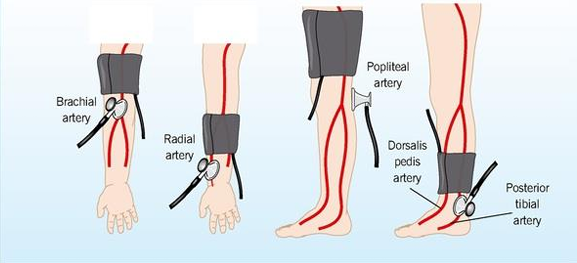
Choose different BP site from any contraindications of arms
Brachial Artery
Radial Artery
Popliteal Artery
Dorsalis Pedis Artery
Posterior Tibial Artery
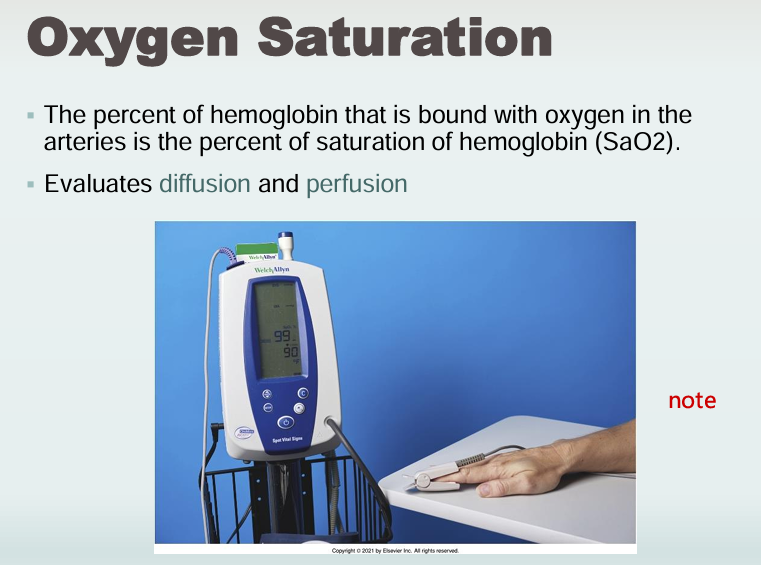
What does oxygen saturation measure?
Percent of hemoglobin that is bound with oxygen in the arteries (SaO2)
Evaluates diffusion and perfusion
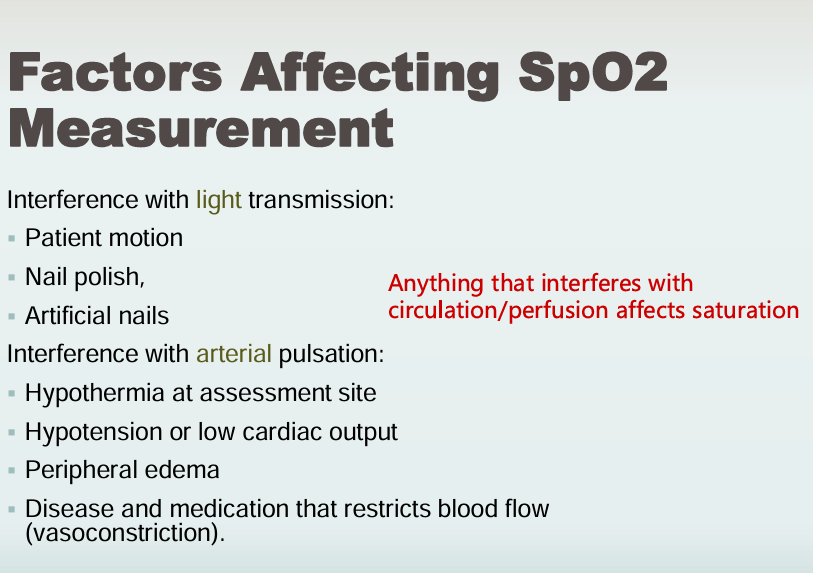
What are factors that can affect accurate oxygen saturation levels? What are some examples to avoid them?
Anything that interferes with circulation/perfusion affects saturation
Interferes with light transmission
Patient moving
Nail polish
Artificial nails
Interferes with arterial pulsation
Hypothermia at assessment site
Hypotension or low cardiac output
Peripheral edema
Disease and medication that restricts blood flow (Vasoconstriction)
A postoperative patient is breathing rapidly. You should immediately?
A. Call the physician
B. Count the respirations
C. Assess the oxygen saturation
D. Ask the patient if he feels uncomfortable
C. Assess the oxygen saturation
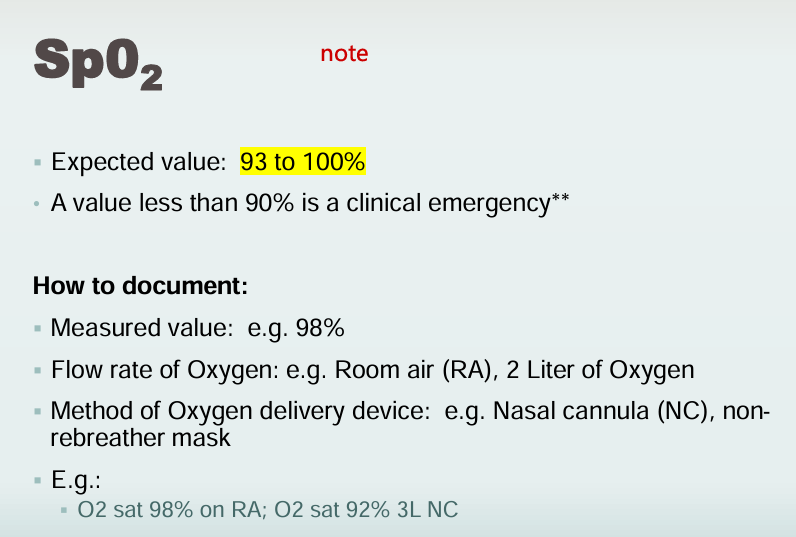
What is the expected normal ranges for SpO2? When is it a clinical emergency?
93 - 100%
Value less than 90% is a clinical emergency
Intervention: Sit the patient up, then retake it
What is Aphasia?
Injury to speech center in cerebral cortex
What is Dysarthria?
Weak, slowing moving or non moving muscles of the mouth
Hypotension is defined as a systolic blood pressure of less than < ___ mmHg
< 90 mmHG