Visual acuities .
 Call Kai
 Learn
Learn Practice Test
 Spaced Repetition
 Match
Match Flashcards
 Knowt Play
1/26

There's no tags or description
Looks like no tags are added yet.
Name | Mastery | Learn | Test | Matching | Spaced | Call with Kai |
|---|
No analytics yet
Send a link to your students to track their progress
27 Terms
what is acuity
means shaprt or acute
sharpness of vision: VA
the capacity for seeing distinctly the details of an object
what is visual acuity
it is a measure of the abi;ity to discriminate some particular detail in the image of a test object
could inolve presenting targets or letters ect

concept of visual angle
from persepctive of photo the cows look the same
near images look bigger when closer tha far
bigger objects have larger reitnal image sizes than smaller ones
but viewing distance also comes into it
here a larger distant object and a smaller but near object have the same retinal size
what is retinal image size determined by
determined by both object size and viewing distance
how far away and how big the letters are
eg if small letters are far cant see but if close its visible
together these are captured by the concept of visual angle
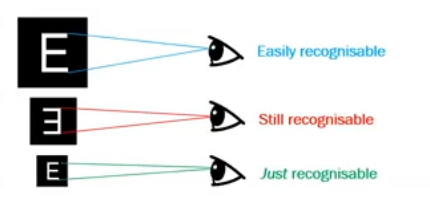
visual angle
the smaller the angle of VA, then px wont be able to read
size of the target is changed , viewing distance fixed until the patient is able to read it
when just recognisable, any smaller and they wont be able to read it
reflects distance and letter size; bigger the angle then recognised, if smallest then is not
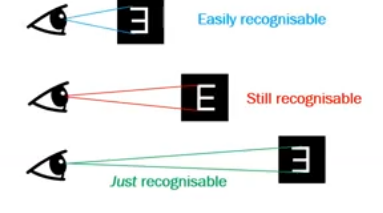
different approach to VA
can also do it where the angle remains the same, but the viewing distance changes
target size is fixed
what does visual acuity measurements involve
involves finding the size of the visual angle of the target when the task can JUST be performed
if any smaller the letter cant be recognised, any bigger then easily recognised
the letter size and viewing diatance determine the angle the letter will make at the eye
small angles mean good VA, and large angles means poor VA
what is MAR
it is the minimum angle of resolution : measure of visual auity
VA is specified as 1/minimum angle ( angle when just recognisable)
minimum angle given the symbol w
how the angle w is specified / measured depends on the nature of the test target, for letter targets the w is the visual angle made by the whole target

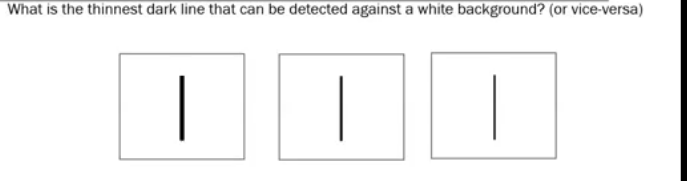
detection acuity
done until just recognisable, any thinner for that px and they wont be able to see
determined by line thickness and viewing distance
under ideal conditions w can be as low as 1 second of arc ( 1/360th degree)
VA detection can be as high as 60
VA detection of 10 means that you can detect 0.4mm dark line against a white background from a distance of around 14m
detection acuity:what is happening on the retina
the delta I : the change in intensity correspomding to the fact tht the line is dark compared to the white background
I is the intensity due to the white background
if the deta I is too small then the line is not detectable
when delta I gets bigger then the line becomes detectable : bigger dip when the line is thicker
the value of delta I depends on I, so that delta I/ I is constant : this means if I is bigger, then deltaI needs to be bigger
hyperacuities
involves judging the location of one target element relative to the rest of the target ( localisation acuity)
vernier acuity
2 lines present: asking whether the line on the top is to the left or right and same question for the bottom
resolution acuity is the order of 0.5 to 1 minute of arc
hyperacuity is typically <10 in visually normal individuals
the lower the number the better the acuity since the angle is smalle
measures ability to detect extremely small differences in the position or alignment of objects
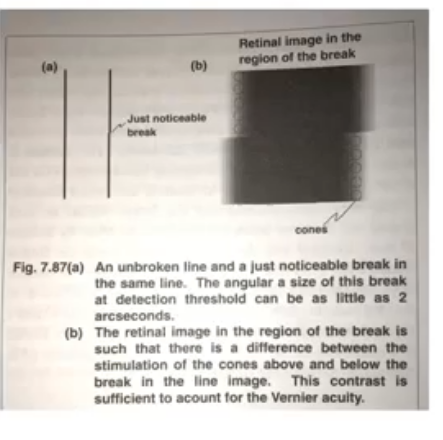
vernier acuity
the variation in intensity in the light ditribution in the reitnal image above and below the break in the lines
as with detection acuity, when deltaI is just large enough the break in the line will be identified
when the break in the line i sjust detectable the angular separation between the lines is a measure of the venier acuity
angular because it takes physical separation and viewing distance of observer into account
resolution acuity
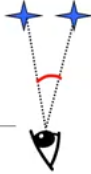
targets for a resoltuin task can be dark objects on a white background or vice versa eg stars in the night sky
eg if angle small can see 2 stars if big then will be seeing one star
simplest target consists of 2 points of light
they are moved closer together or further apart until the 2 points are just visible
if any closer, only one point is seen, if any further then easy to see that there are 2 points
resolution acuity: what is the limit of resolution
defined as the minimum separation of 2 images so they are seen as separate when viewing through an optical system
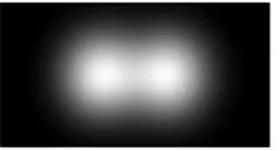
each point of light forms an image on the retina. The profile of the image a point is called: the point spread function
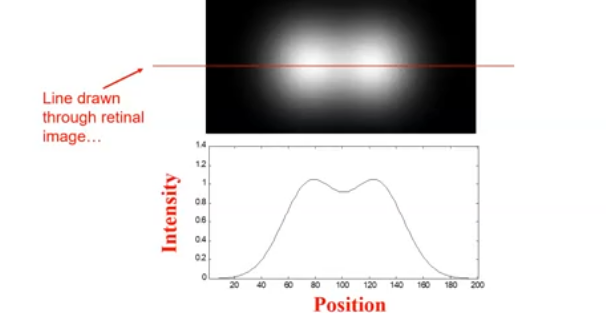
between the points is where there is a drop in intensity : deltaI
point spread function PSF
describes how a single point of light is blurred by an optical system
is is the image that an optical system produces when it tries to image a perfect point source
depends on the shape and size of the pupil, on diffraction, aberrations and scatter
if the points are sufficiently close, then the PSF overlap on the retina
optical limits on resolution
states that 2 points will just be resolvable by an otical system if theyre separated by not less than:
(1.22 x wavelength of the light) / pupil
eg for a wavelength of 578nm and a pupil diameter of 3mm, the optical resoltuin is arund 50 seconds of arc
the optical system of the eye will be able to resolve the points as seperate provided the visual angle is not smaller than 50
if pupil is smaller, the resoltuion increases : eg like the pinhole accluder
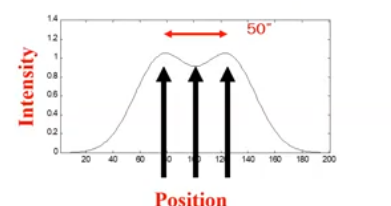
2 point resolution task
to distinguish the points as separate, the reina mst be able to register the light level at 3 points; at the two peaks and at the trough inbetween (arrows)
one arrow represents a cone recieving the light from one point/star
middle is reciving the dip in change of intensity
3rd is recieving the light from the other point/star
if the retina is to resolve the points as separate based on the image formed on the retina, the foveal cones need to be close emough to one another so that the 3 cones correspond to locations of the peak, trough and peak above
spacing of the foveal cones
at the centre of the fovea, the centre to centre cone spacing is around 25 seconds of arc
at the resolution limit, the 3 cones that recieve light from the 2 pointd are separated by 1 lesser stimulated cone
hence the stimulated cones are 50 seconds of arc apart ( neural limit)
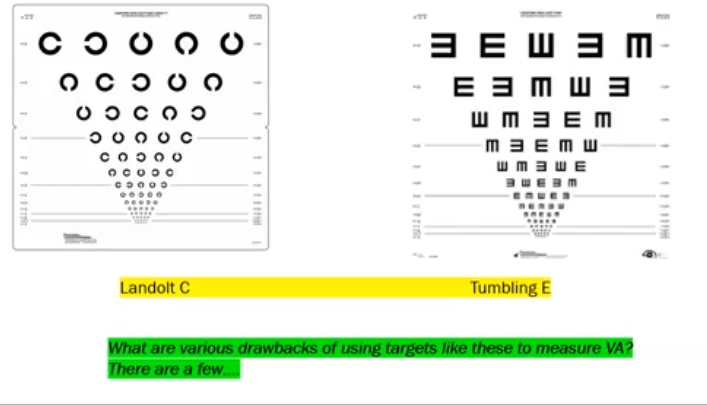
other resolution acuity task: landolt ring
px is asked to resolve the gap by stating its position; up down left or right
usually done if the px cannot speak
other resoltion tasks : grating acuity
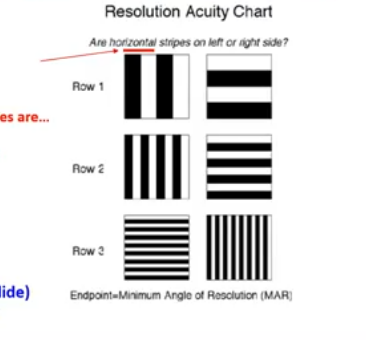
target lines can be horizontal or vertical. lines get progressively thinner, resolution limit is reached when the lines are thinned to the extent that the orientation can just be identified
resolution acuity: checkerboard pattern
block sizes made smaller until pattern is indistinguishable from a uniform grey pattern
cycles per degree
resolution acuity that is measured using gratings can be specifiied in cylces per degree
one cycle: width of 1 light bar
spatial frequency is a measure of how closely spaced the lines are
low spatial frequency: row 1
high spatial frequency: row 3
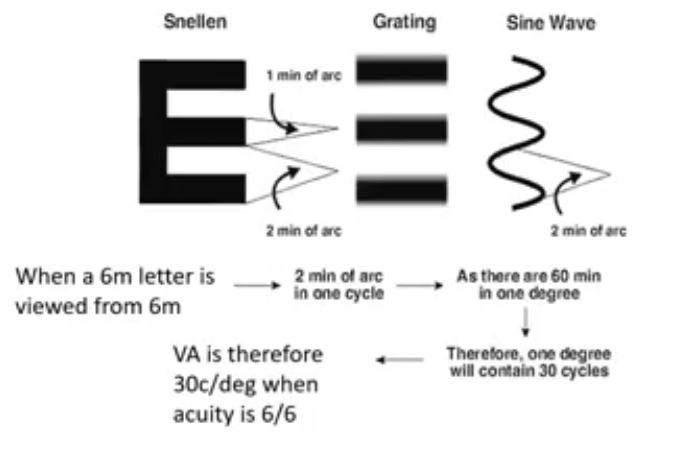
why does 6/6 acuity correspond to 30 cycles per degree
use the letter E to demonstrate the snellen principle : the E looks like a grating
measure acuity by measuring the gratings
1 cycle is 2 minutes of arc → as there are 60 min in one degree
so one degree will contain 30 cycles
VA is therefore 30 cycles per degree when visual acuity is 6/6
resolution acuity chart
these targets are forced choice; landolt C has 8 possible gap orientations tumbling E has 4
means that px can gues correctly even if they cant resolve
children or px with cognitive difficulties may confuse orientations
learning effects can occur with repetition
spme chapes are easier to recognise, and some depend on orientation perception
recognition acuity
test always involve the presentation of letters
recog acuity limit is set by contrast threshold
in landolt ring test there is a ¼ chance of guessing but in a letter acuity chart there is 1/26 chance of guessing
however only letters of roughly equal legibility is used- px dont know this
why we use letters for visual acuity testing
point sources and grating do not represent the type of detail that a patient normally views
it is important that the measure of acuity used is sensitive to retinal image blur: letter acuity is sensitive to blur, but some types of acuity like vernier are not