Math 2 Honors Final Exam Review
 Call Kai
 Learn
Learn Practice Test
 Spaced Repetition
 Match
Match Flashcards
 Knowt Play
1/123

There's no tags or description
Looks like no tags are added yet.
Name | Mastery | Learn | Test | Matching | Spaced | Call with Kai |
|---|
No analytics yet
Send a link to your students to track their progress
124 Terms
Circle
A circle of radius r with center O is the set of all points that are a distance of r units from O
Line Segment
A set of points on a line with two endpoints
Parallel
Two lines that don’t intersect are called parallel. We also call segments parallel if they extend into parallel lines
Conjecture
A reasonable guess that you are trying to either prove or disprove
Perpendicular Bisector
A line through the midpoint of the segment that’s perpendcular to it
Inscribed Polygon in a Circle
A polygon is inscribed in a circle if it fits inside the circle and every vertex of the polygon is on the circle
Inscribed Circle in a Polygon
A circle is inscribed in a polygon if it fits inside the polygon and every side of the polygon is tangent to the circle
Angle Bisector
A line through the vertex of an angle that divides it into two equal angles
Regular Polygon
A polygon where all of the sides are conguent and all the angles are congruent
Tessellation
An arrangement of figures that covers the entire plane without gaps or overlaps
Assertion
A statement you think is true but have not yet proven
Theorem
A statement that has been proved mathamatically
Image
If a transformation takes A to A’, than A is the original and A’ is the image
Congruent
A figure is congruent to another if there is a sequence of translations, rotations, and reflections that takes the first figure onto the second
Reflection
A reflection is defined using a line. It takes a point to another point that is the same distance from the given line, is on the other side of the given line, and so that the segment from the original point to the image is perpendicular to the given line
Directed Line Segment
A line segment with an arrow at one end specifying a direction
Translation
A translation is defined using a directed line segment. It takes a point to another point so that the directed line segment from the original point to the image is parallel to the given line segment and has the same length and direction
Parallel Line Translations
Translations take lines to parallel lines or to themselves
Rotation
A rotation has a center and a directed angle. It takes a point to another point on the circle through the original point with the given center. The 2 radii to the original point and the image make the given angle
Symmetry
A figure has symmetry if there is a rigid transformation which takes it onto itself (not counting a transformation that leaves every point where it is)
Line of Symmetry
A line of symmetry for a figure is a line such that reflection across the line takes the figure onto itself
Reflection Symmetry
A figure has reflection symmetry if there is a reflection that takes the figure to itself
Rotational Symmetry
A figure has rotation symmetry if there is a roation that takes the figure onto itself (we don’t count rotations using anges such as 0 degrees and 360 degrees that leave every point on the figure where it is)
Vertical Angles Theorem
2 intersecting lines from vertical angles which are congruent
Converse
Converse of a conditional statement is formed by swapping the hypothesis and the conclusion. P → Q, converse is Q → P
Alternate Interior Angles Theorem
If 2 parallel lines are cut by a transversal, then alternate interior angles are congruent
Converse of Alternate Interior Angles Theorem
If 2 lines are cut by a transversal and alternate interior angles are congruent, then the lines have to be paralel
Corresponding Angles Theorem
If 2 parallel lines are cut by a transversal, the corresponding angles are congruent
Converse of Corresponding Angles Theorem
If 2 lines are cut by a transversal and corresponding angles are congruent, then the lines have to be parallel
Triangle Angle Sum Theorem
All the angles in a triangle add up to 180 degrees
Corresponding Parts
For a rigid transformation that takes one figure onto another, a part of the first figure and its image in the second figure are called corresponding parts
CPCFC
Corresponding parts of congruent figures are congruent
CPCTC
Corresponding parts of congruent triangles are congruent
Segment congruence
If two segments have the same length then they are congruent
Auxiliary line
An extra line drawn in a figure to reveal a hiddn structure
Side-Angle-Side Triangle Congruence Theorem (SAS)
In two triangles, if two pairs of congruent corresponding sides and the pair of corresponding angles between the sides are congruent, then the two triangles are congruent
Isosceles Triangle Theorem (ITT)
In an isosceles triangle, the base angles are congruent
Parallelogram
A quadrilateral with opposite sides parallel
Angle-Side-Angle Triangle Congruence Theorem (ASA)
In two triangles, if two pairs of corresponding angles and their pair of corresponding sidesbetween the angles are congruent, then the triangles must be congruent
Parallelogram Property
In parallelograms opposite sides are conguent, opposite angles are congruent, consecutive angles are supplementary, and diagonals bisect each other
Points on a Perpendicular Bisector
If P is a point on the perpendicular bisector of AB, then the distance from P to A is the same as the distance from P to B
Converse of points on a perpendicular bisector
Point C must be the perpendicular bisector of AB, if C is the same distance from A as it is from B
Side-Side-Side Triangle Conguence Theorem (SSS)
In two triangles, if all 3 pairs of corresponding sides are congruent, then the triangles must be congruent
Parallelogram Property
A parallelogram with at least one right angle must be a rectangle. A parallelogram with two adjacent sides congruent must be a rhombus
Rectangle
A quadrilateral with 4 right angles
Rhombus
A quadrilateal with 4 congruent sides
Scale Factor
The factor by which every length in an original figure is increased or decreased when you make a scaled copy
Dilation
A dilation with center P and positive scale factor K takes a point A along the ray PA to another point whose distance is K times farther away from P than A is
Dilations of Lines
A dilation takes a line not passing through the center of dilation to a parallel line, and leaves a line passing through the center unchanged
Parallel Side Splitter (PSS)
If a line splits 2 sides of the triangle proportionally, that line is parallel to the third side of the triangle
Similar
one figure is similar to another if there is a sequence of rigid motions and dilations that takes the first figure so that it fits exactly over the second
CPSTP
Corresponding parts of similar triangles are proportional
Circle similarity
all circles are similar
Angle-Angle Triangle Similarity Theorem (AA)
If 2 triangles have 2 corresponding angles congruent, the 2 triangles are similar
Side-Angle-Side Triangle Similarity (SAS)
In 2 triangles, if 2 pairs of corresponding sides are proportional with the angle in between also congruent, the two triangles are similar
Side-Side-Side Triangle Similarity (SSS)
If we have 2 triangles with all 3 pairs of corresponding sides proportional, the two triangles are similar
Altitude in a triangle
A line segment drawn from a vertex perpendicular to the opposite side
Altitude in a right triangle
In a right triangle, the altitude drawn to the hypotenuse creates 3 similar triangles
Pythagorean Theorem
Pythagorean theorem defines the relationship between the sides in a right triangle
Complementary
two angles are complementary to each other if their measure add up to 90 degrees. The two acute angles in a right triangle are complementary to each other
Trigonometric Ratio
Sine, cosine, and tangent are called trigonometric ratios
Sine
the sine of an acute angle in a right triangle is the ratio (quotient) of the length of the opposite leg to the length of the hypotenuse
Cosine
The cosine of an acute angle in a right triangle is the ratio (quotient) of the length of the adjacent leg to the length of the hypotenuse
Tangent
The tangent of an acute angle in a right triangle is the ratio (quotient) of the length of the opposite leg to the length of the adjacent leg
Arc-sine (inverse sine)
The arcsine of a number between 0 and 1 is the acute angle whose sine (ratio) is that number
Arc-cosine (inverse cosine)
The arccosine of a number between 0 and 1 is the acute angle whose cosine (ratio) is that number
arc-tangent (inverse tangent)
The arctangent of a positive number is the acute angle whose tangent is that number
equation of a circle
a circle with center (h,k) and radius r has equation : (x-h)² + (y-k)² = r²
Parabola
the set of points that are equidistant from a given point, called the focus, and a given line, called the directrix
Directrix
the line that with the focus defines a parabolaFocu
Focus
The point that together with the directrix defines a parabola
Point-Slope Form
The form of an equation for a line with slope m through the point (h,k) written as y-k = m(x-h)
Parallel Lines Slopes
The slopes of parallel lines are the same
Perpendicular Line Slopes
The slopes of perpendicular lines are opposite reciprocals
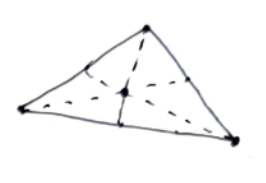
Median
A line from a vertex of a triangle to the midpoint of the opposite side. Each dashed line in the image is a median
Arc
The part of a circle lying between two points on the circle
Central Angle
An angle formed by two rays whose endpoints are the center of a circle
Chord
A chord of a circle is a line segment both of whose endpoints are on the circle
Inscribed Angle
An angle formed by two chords in a circle that shape an endpoint
Inscribed Angle Theorem
An inscribed angle is half the measure of the arc is intercepts
Tangent line
A line is tangent to a circle if the line intersects the circle at exactly one point
Line tangent to circle theorem
A line is tangent to a circle if and only if it is perpendicular to the radius drawn to the point of tangency
Circumscribed
We say a polygon is circumscribed by a circle if it fits inside the circle and every vertex of the polygon is on the circle
Cyclic Quadrilateral
A quadrilateral whose vertices all lie on the same circle
Circumcenter
The circumcenter of a triangle is the intersection of all three perpendicular bisectors of the triangle’s sides. It is the center of the triangle’s circumscribed circle
Triangle’s Circumcenter Theorem
The perpendicular bisector of a triangle’s sides intersect at a single point which is equidistant from all 3 vertices
Incenter
The intersection of all three of the triangle’s angle bisectors. it is the center of the triangle’s inscribed circle
Triangle incenter theorem
All 3 angle bisectors in a triangle meet at a single point called the triangles incenter
Sector
the region inside a circle lying between two radii of the circle
How to calculate area of a sector
angle/360 x pi r²
How to calculate length of an arc
area/360 × 2 pi r
Radian
The radian measure of an angle whose vertex is at the center of a circle is the ratio between the length of the arc defined by the angle and the radius of the circle
Chance experiment
Something you can do over and over again, and you don’t know what will happen each time
Event
A set of one or more outcomes in a chance experiment
Outcome
One of the things that can happen when you do a chance experiment
Probability
The probability of a chance event is a number from 0 to 1 that expresses the likelihood of the event occurring, with 0 meaning it will never occur and 1 meaning it will always occur
Sample space
List of every possible outcome for a chance experiment
Addition Rule
The addition rule states that given events A and B, the probability of either A or B is given by P(A or B) = P(A) + P(B) - P(A and B)
Dependent events
Two events from the same experiment for which the probability of one even depends on whether the other event happens