Opioids and Drugs of Abuse
 Call Kai
 Learn
Learn Practice Test
 Spaced Repetition
 Match
Match Flashcards
 Knowt Play
1/77

There's no tags or description
Looks like no tags are added yet.
Name | Mastery | Learn | Test | Matching | Spaced | Call with Kai |
|---|
No analytics yet
Send a link to your students to track their progress
78 Terms
What is the main target receptor for opioid analgesics?
µ opioid receptor (MOR).
What are the types of natural (opium) alkaloids?
morphine and codeine
What are the types of semisynthetic opioids?
Diacetylmorphine (aka heroin)
Hydromorphone
Oxymorphone
Pholcodine
Hydrocodone
Oxycodone
What are the types of synthetic opioids?
Meperidine (aka Pethidine)
Methadone
Tramadol
Fentanyl
Alfentanil
Sufentanil
Remifentanil
What are the pharmacodynamics of morphine regarding analgesia?
Visceral pain is more effectively treated than somatic pain, with a dose-dependent increase in analgesia.
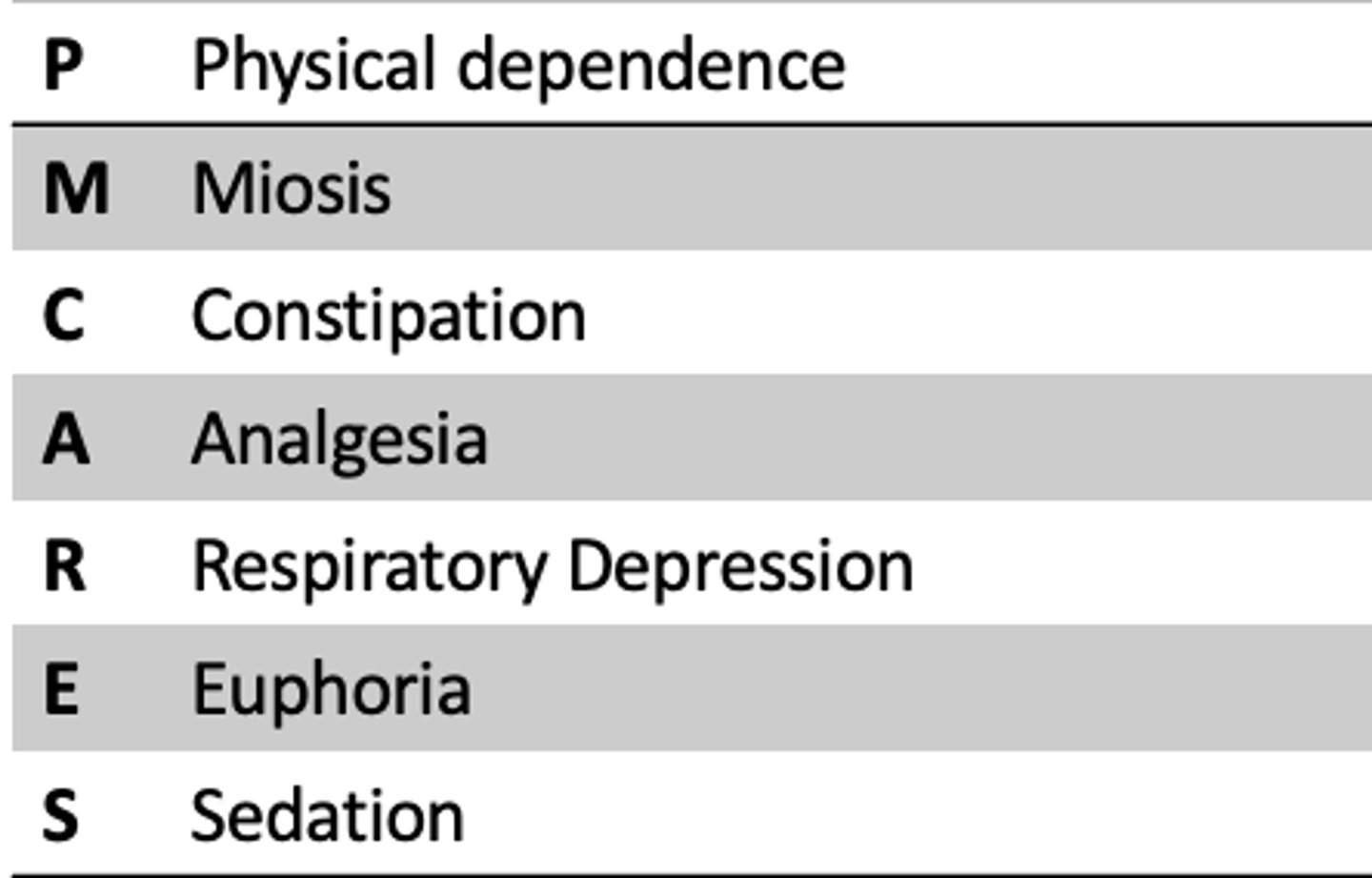
What are the other pharmacodynamic effects of opioids on the body?
sedation, euphoria, respiratory depression, cough center depression, miosis, histamine release, constipation (OIC), bronchial constriction,
What is a primary pharmacokinetic of opioids?
Frelly crosses placenta affecting fetus more than mother
Which type of opioid is used for cough?
codeine and substitutes widely used as cough suppressants
Which type of opioid is used for diarrhea?
loperamide (OTC) and diphenoxylate (prescription)
What is the other use of diphenoxylate?
combined with atropine to discourage abuse
What are the common adverse effects of opioids?
Nausea, vomiting, urinary retention, mental clouding, convulsions, blurred vision, and hypotension
What precautions should be taken when prescribing opioids to infants and the elderly?
Caution is advised as they are more susceptible to respiratory depression.
Which conditions require caution when prescribing opioids?
Hypothyroidism, liver and kidney disease, head injury, hypotension, respiratory insufficiency, and bronchial asthma.
Which side effects of opioids are not affected by tolerance?
constipation, miosis, and convulsions
What opioids are used for withdrawal symptoms?
buprenorphine or methadone followed up with suboxone (buprenorphine + naloxone) for maintenance)
What is the mechanism of action of methadone?
NMDA antagonist and a potent μ agonist.
What is the effect of codeine when demethylated by CYP2D6?
It produces morphine, which is responsible for the analgesic effect of codeine.
What is Meperidine used for?
Acute pain, preanesthetic medication
What is a risk of Meperidine?
serotonin syndrome with pro-serotonergic drugs
What are the uses of Fentanyl?
Transdermal patches used for cancer and other chronic pains or produces neurolept analgesia when injected with droperidol
What is the mechanism of action of Tramadol?
Centrally acting analgesic with low affinity for μ receptors and very low for κ and δ receptors. Simultaneously inhibits reuptake of NE and 5HT activating monoaminergic inhibition of pain
What is Tramadol used for?
Post op, chronic neuropathic or labor pain
What is a significant risk associated with tramadol?
It can lead to serotonin syndrome when combined with pro-serotonergic drugs.
Which opiates are used as antitussives?
Dextromethorphan suppressing medullary cough center and Benzonatate
What types of opioids are mixed μ agonist- antagonists (κ analgesics)?
Pentazocine
Nalbufine (nalbuphine)
Butorphanol
* complete me (μ) adopted 5 (penta) fine orphans *
What is the effect of k analgesia?
dysphoric, psychotomimetic and hallucinatory effects.
What are the pharmacodynamics of mixed antagonists?
Facilitate NE release↑ HR, BP and positive inotropy
What is the action of pentazocine?
Produces low ceiling spinal analgesia, sedation, and respiratory depression
What are the pharmacodynamics of pentazocine?
↑ HR and BP; can precipitate coronary insufficiency. Hence, C/I in patients with CAD
What are the effects of Butorphanol?
mild respiratory depression, sympathetic stimulation, dysphoria, psychotomimetics and produces physical dependence
What type of opioid is a partial agonist?
Buprenorphine
What is the mechanism of action of Buprenorphine?
Partial μ agonist + κ/𝛿 antagonist
How is buprenorphine commonly administered?
buccal film
What types of opioids are antagonists?
Naloxone, Naltrexone, Nalmefene, and Alvimopan
What is the mechanism of action of opioid antagonists?
Pure competitive antagonists at all 3 opioid receptor sub-types; does not cross the BBB
What is naloxone's primary clinical use?
Promptly reverses all actions of morphine within minutes when given IV, IM, or Intranasally
How is often is naloxone administered?
every 2-3 minutes until required then repeated every 30-60 minutes until cleared from the body to prevent relapse
What is the use of Naltrexone?
opioid 'blockade' therapy in a previously dependent detoxified subject by "blocking subjective effects when opioids are taken
What are the advantages of Naltrexone?
Subsides cravings of opioids/alcohol, nicotine abstinence with reduced weight gain, more potent, longer acting and orally active
What are the types of Hallucinogens?
LSD, Mescaline, Psilocybin
What are hallucinogens?
Alter perceptions without causing dependence or withdrawal leading to shape and color distortion. AKA psychotomimetics
What is the mechanism of action for hallucinogens?
serotonin receptors (5-HT2A,B) agoniism
What is risk factor of hallucinogens?
Impairs judgement and rationality leading to risk of accidents and injuries
What is a 'bad trip' in the context of hallucinogen use?
Severe anxiety, intense depression, suicidal thoughts and visual disturbances that may require medical attention.
What is the managements for bad trips on hallucinogens?
"talking down" is the first line followed by oral diazepam for severe agitation
What is contraindicated in hallucinogens?
Antipsychotics
What are the types of Dissociative Drugs?
Phencyclidine (PCP) and Ketamine
What is the mechanism of action of Dissociative Drugs?
NMDA-type glutamate receptor blocker
What is the effect of high does of PCP?
psychosis, hostility, agitation, hypertension, fixed dilated pupils, horizontal and vertical nystagmus
What are the clinical features of PCP use?
Emotional withdrawal, bizarre responses, impaired memory, and visual disturbances.
What is the most abused drug in the world?
Alcohol (ethyl alcohol or ethanol).
What enzymes are involved in Ethanol Metabolism?
1. Alcohol Dehydrogenase (ADH)
2. Microsomal Ethanol-Oxidizing System (MEOS)
3. Aldehyde dehydrogenase
What are the pharmacodynamics of ethanol?
A CNS depressant
What are the pharmacokinetics of ethanol?
1st order kinetics when BEC < 10 mg% and switches to zero-order kinetics at BECs >10mg%
What is the Alcohol Dehydrogenase Pathway?
Uses the cytosolic enzyme alcohol dehydrogenase to catalyze conversion of ethanol to acetaldehyde primarily in the liver (also brain and stomach)
What is an inhibitor of aldehyde dehydrogenase (ALDH)?
Disulfiram and causes an unpleasant reaction (flushing, N/V, dizziness) when combined with ethanol
What other drugs causes Disulfiram-like reaction?
Metronidazole, cefotetan, trimethoprim, and sulfonylureas
How does the Microsomal Ethanol-Oxidizing System (MEOS) change between acute and chronic alcohol use?
Acute uses causes CYP inhibition whereas chronic use leadings to CYP induction
What are the effects of CYP induction from chronic alcohol use?
Increased tolerance and clearance of other CYP substrates (phenytoin, warfarin) which increases their dosing requirements and risk of therapeutic failure
What is used for methanol poisoning?
Fomepizole which is an ADH inhibitor
What is delirium tremens?
A severe withdrawal syndrome occurring ≥ 2 days after cessation of alcohol, characterized by hallucinations, delirium, and arrhythmia, fever
What is the management of delirium tremens?
diazepam or chlordiazepoxide with supportive care
What is Wernicke-Korsakoff Syndrome?
characterized by confabulation, global confusion, ophthalmoplegia, and ataxia
What is the management of Wernicke-Korsakoff Syndrome?
IV thiamine followed up with oral maintenance Rx
What are the effects of chronic heavy drinking on the liver?
fatty liver, hepatitis, cirrhosis, portal hypertension, liver failure, pancreatitis, gastritis, PUD, GERD, and malabsorption
How is ethanol a carcinogen?
Increased risk of mouth, pharynx, larynx, esophagus, and liver cancer
What is the mechanism of action of cocaine in the CNS?
the re-uptake of dopamine, NE, and serotonin (5-HT) by blocking their respective transporters: DAT, NET, and SERT.
What are the rewarding effects of cocaine?
blockade of DAT leads to increased dopamine in the nucleus accumbens, resulting in rewarding effects such as euphoria.
What cardiovascular effects can result from cocaine use?
increased HR/BP, arrhythmias, MI, angina, and stroke form vasoconstriction
What are some complications of cocaine use during pregnancy?
preterm labor and placental abruption
What are the long-term effects of cocaine toxicity?
decreased libido, anxiety, depression, and psychosis
What is the mechanism of action of amphetamines?
indirect-acting sympathomimetics that produce stimulant effects similar to cocaine.
What are the common uses of amphetamines?
used to treat ADHD and narcolepsy.
What are the effects of amphetamine use?
Increased catecholamines, DA, and 5-HT leading to arousal, reduced sleep, euphornia, abnormal movements, psychosis, and hyperthermia
What is the mechanism of action of Ecstasy (MDMA)?
releases biogenic amines in synapses by reversing the action of their respective transporters especially SERT
What is the primary psychoactive component of marijuana?
Δ-9-tetrahydrocannabinol (Δ9-THC)
What are some potential medical uses of cannabinoids?
Antiemetic effects, muscle-relaxant effects, anticonvulsant properties, and decreased IOP in glaucoma.
What are the approved synthetic Δ9-THC formulations used in refractory chemotherapy induced vomiting?
Dronabinol (also used in AIDS) and nabilone