Session 4: Adaptation to Soft Sediments
 Call Kai
 Learn
Learn Practice Test
 Spaced Repetition
 Match
Match Flashcards
 Knowt Play
1/50

There's no tags or description
Looks like no tags are added yet.
Name | Mastery | Learn | Test | Matching | Spaced | Call with Kai |
|---|
No analytics yet
Send a link to your students to track their progress
51 Terms
Why do organisms adapt to their environment?
To tolerate/respond to changes in ecological or environmental context
To derive sufficient resources, such as food or shelter/camouflage
To defend themselves and their resources
To maximise reproductive success
Why a focus on soft sediment systems?
Seafloor is mainly soft sediment systems
Composition has implications for organisms that comprise benthic systems and adaptations
Cohesive v.s. non-cohesive sediment
What is ecological adaptation?
Phenotypic change
occurs within the lifetime of an individual organism;
results from exposure to a naturally occurring environmental challenge (acclimatization) or a lab/ field-setting induced environmental challenge (acclimation).
What is Evolutionary adaptation?
Genotypic change
occurs within a population over longer time scales (several generations);
product of natural selection
Facilitates an enhanced ability to survive and reproduce.
Similarities of acclimatization and acclimation
Within an individual organism
changes within lifetime
from env. change (reversible)
phenotypic change and ecological response
Difference between acclimatization and acclimation
Acclimatization: Env. change by natural conditions
v.s.
Acclimation: Env. change by experimental conditions (lab or controlled field setting)
What is adaptation?
Occurs within a population
Changes over several gen.
→ from env. change (irreversible)
by natural selection/artificial selection
genetic change and evolutionary response
Properties of non-cohesive sediments v.s. cohesive
Feature | Non-Cohesive Sediment | Cohesive Sediment |
Environmental Energy | High-energy environments (e.g., wave-swept) | Sheltered from wave action (but tidally influenced) |
Fine Material | Mud/silt removed | Mud/silt remain |
Physical Structure | Coarse grains & large pore spaces | Fine grains (< 63 µm) & small pore spaces |
Water Exchange | Regularly flushed | Infrequently flushed |
Biochemistry | Low organic matter & high oxygen content | High organic matter & low oxygen content |
Substrate Stability | Unstable sediments | Stable sediments |
Typical Fauna | Mobile infauna (most) & epifauna | Sessile & discretely sessile infauna |
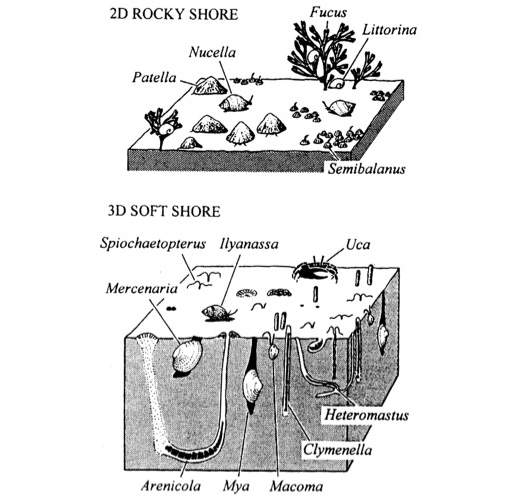
Comparing 2D rocky (hard) shore and 3D soft shore
2D rocky (hard):
Sessile species
Vertical zonation
Variable environment with low buffering capacity
3D soft:
Mobile species (small infauna)
Distribution overlap (varies with tide) - move vertically of sediment profile
Relatively stable environment that buffers environmental variation.
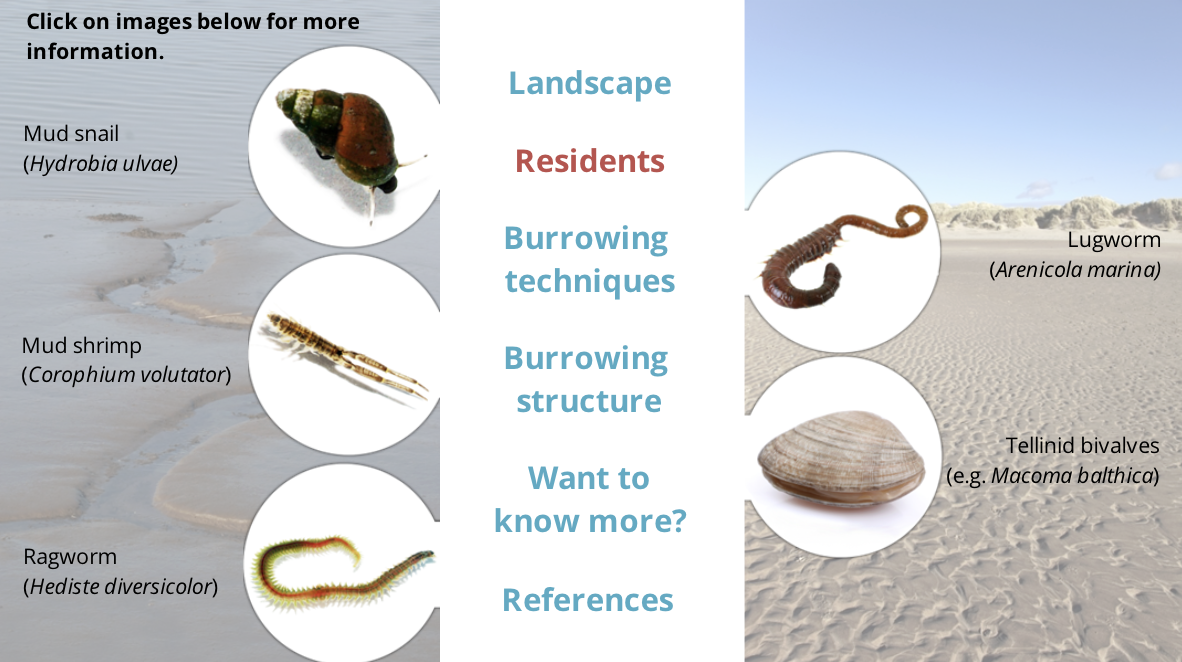
Cohesive v.s. Non-Cohesive species
Hydrobia (mud snail) , Corophium, Hediste diversicolor (ragworm)
v.s.
Arenicola (Lugworm), Macoma (Tellinid bivalves)
Cohesive v.s. Non- Cohesive species - burrowing techniques (bioirrigration)
Diffusion across burrow walls
v.s.
Advective pore water flow
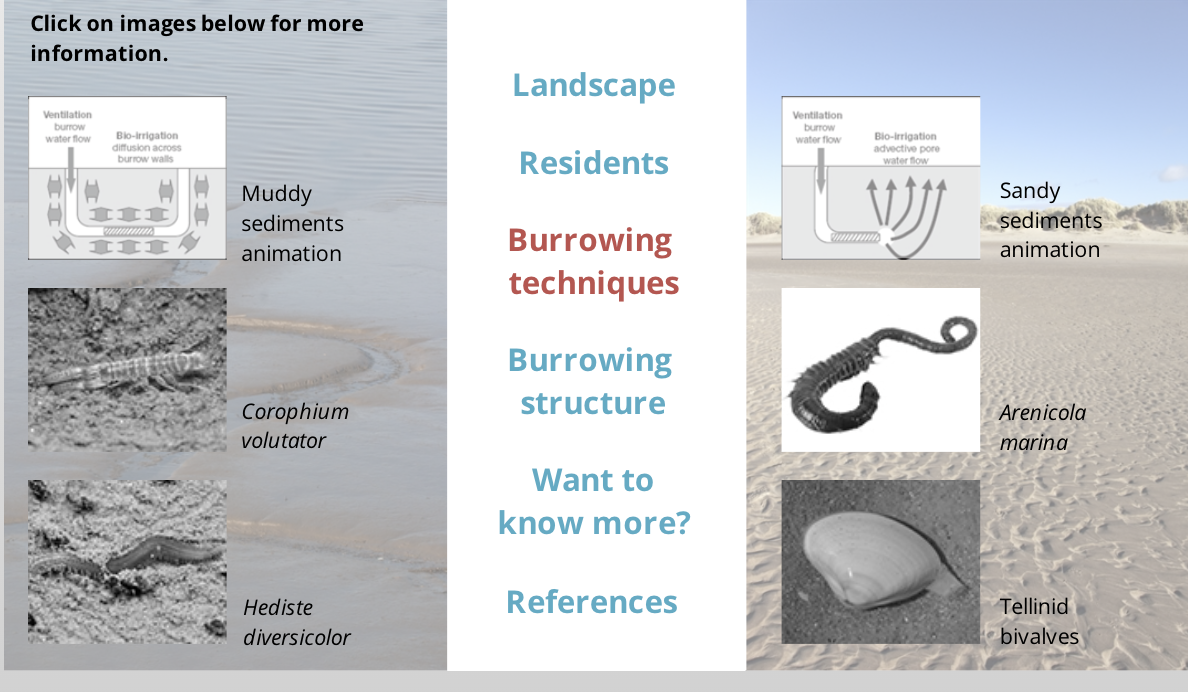
How does burrow shape and water flow differ between muddy and sandy sediments?
Muddy sediments: U-shaped burrows relying on diffusive bio-irrigation
Sandy sediments: J-shaped burrows relying on advective pore water flow
Stabilizing vs. Destabilizing Tubes
Stabilizing: Promote "skimming" flow, protecting the bed from turbulence (e.g., Sand mason worms).
Destabilizing: Promote bed scour through wake turbulence.
How do tube-forming worms (e.g., Lanice conchilega) alter sandy environments?
Stabilize the unstable sandy sediment
by promoting a 'skimming' water flow over their tubes
WHICH protects the seabed from turbulence and creates a habitable environment for other species
How do organisms survive in muddy sediments with low oxygen and toxic hydrogen sulphide (HS^-)?
Callianassa subterranea: oxidises toxic sulphide into less toxic thiosulphate.
Solemya reidi: hosts symbiotic bacteria in its gills to detoxify sulphide.
How do surf-zone diatoms respond to diurnal (day/night) cycles?
☀During the day:
lose their mucus coat
adhere to air bubbles → rise to the surface to photosynthesise.
🌙At night:
regain their mucus coat
adhere to sand grains → sink
Give an example of a benthic organism with an endogenous [Nocturnal] circadian (daily) rhythm (Talitrus saltator)
The Mediterranean amphipod Talitrus saltator:
Has a 24.5-hour endogenous rhythm
even in a lab under constant dim red light → restricts its activity to the hours it would naturally be dark on the shore.
Give an example of a benthic organism with an Diurnal circadian rhythm (Philine aperta)
The opisthobranch gastropod, Philine aperta:
use hydrostatic adjustments to bury
foraging activity coincide with day-time illumination levels
Give examples of benthic organisms driven by an endogenous circatidal (tidal) rhythm.
Microphytobenthos (diatoms/flagellates) migrate vertically to the surface of mudflats during daytime low tides.
The mud shrimp Corophium volutator exhibits wide-ranging exploratory behaviour at high tide and stays near its burrow at low tide.
What is Circa-semilunar Rhythm?
Maximum activity is aligned with spring tides
(e.g., Corophium volutator juveniles emerging to maximize dispersal).
Compare the activity rhythms of Amphiura filiformis in Galway Bay vs. Gullmarsfjord, Sweden.
Galway Bay (Strong Tides): Driven by tidal rhythms; max emergence at mid-tide to filter-feed in strong currents.
Sweden (Weak Tides): Driven by photoperiod; high activity at night and low/no activity during the day.
Why might A. filiformis use different local cues (tides vs. light) in different regions?
To achieve the same evolutionary goal, such as avoidance of predators, adapting to whichever local cue is most dominant.
Compare the summer vs. winter reproductive cycles of Corophium volutator in Japan.
Summer (>17.5°C): Exhibits a semi-lunar reproductive cycle.
Winter (<17.5°C): Shifts to a lunar cycle because the cooler temperatures prolong egg development.
Compare the swimming activity rhythm of Corophium volutator across the seasons.
Summer/Warmer Months: Exhibits a distinct endogenous circa-tidal rhythm with significant semi-lunar variations (spring/neap cycles).
Winter: The semi-lunar variation is not significant and the overall rhythm becomes less distinct.
What drives the shift from a semi-lunar to a lunar reproductive cycle in Japanese Corophium?
Temperature. Below 17.5°C, lower temperatures prolong egg development (semi-lunar to lunar)
High-Tide Migration Mode
The mysid shrimp Mesopodopsis slabberi shows maximum abundance around high tide.
Lower-Water Migration Mode
Species like Neomysis integer, Palaemonetes varians, Carcinus maenas (crab), Pomatoschistus microps (goby), and Corophium volutator show highest densities during lower water heights.
When are day/night (diel) differences in community composition most pronounced?
During spring tides (the difference is less pronounced during neap tides).
What evidence suggests a lunar influence on this estuarine community?
There is a noticeable shift in overall community composition between spring and neap tides.
Compare Deposit Feeding vs. Filter Feeding in Amphiura filiformis.
Deposit Feeding: Occurs at depth within the sediment.
Filter Feeding: Achieved by elevating arms out of the burrow into the passing water column currents.
Describe the "surfing" behaviour seen in sandy shore taxa.
Species like the surf clam Donax spp. + the predatory snail Bullia spp
Use the flood and ebb tides to move large distances efficiently.
Bullia expands its foot to use as an underwater sail when the incoming tide liquefies the thixotropic sand.
Mound-Pit Topography Effect
Excludes deposit feeders; Benefits suspension feeders (e.g., Euchone incolor).
Molpadia oolitica
Head-down deposit feeder; creates mound-pit landscapes.
Why regulate burrow environments?
Exploit otherwise uninhabitable ecospace
Thalassinidean shrimps (Hypoxia)
1. Increase pleopod beating.
2. Switch to anaerobic metabolism.
What is competitive displacement?
When a dominant species forces a weaker competitor into a less optimal habitat.
Benthic example of competitive displacement (space)
The amphipods Acanthohaustorius and Pseudohaustorius
both prefer oxygenated surface sediment.
→ co-occur, the dominant Acanthohaustorius forces Pseudohaustorius into deeper, anoxic sediments.
What is character displacement?
Populations diverge in phenotype and resource use (hence the term displacement)
→ thus reducing resource competition and permitting coexistence.
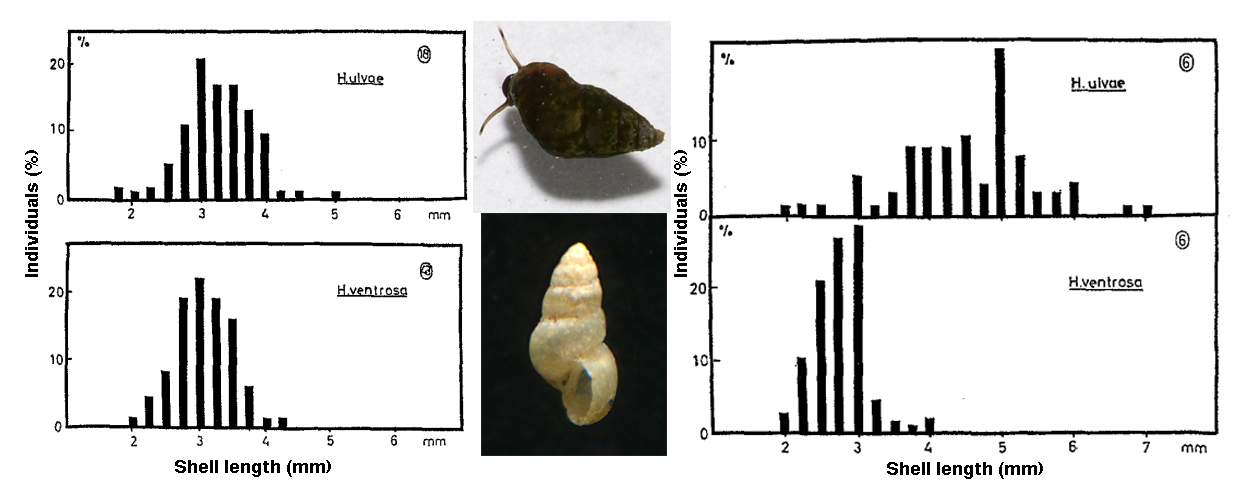
Explain character displacement (food) using Hydrobia snails as an example.
When H. ulvae and H. ventrosa live in separate habitats (allopatric),
→ they are the same size (3-3.5mm)
——————————————————————————————
When they live together (sympatric) → adapt to partition food resources:
H. ulvae grows larger (>3.5mm) and H. ventrosa stays smaller (<3mm).
How do Hydrobia snails show reproductive adaptation based on their habitat?
H. ulvae (living in estuarine muds) invests heavily in producing many small eggs with planktonic larvae.
H. ventrosa (living in lagoons) invests less body weight into reproducing, producing fewer, larger eggs with direct development.
Give an example of commensalism in soft sediments.
The ghost shrimp Callianassa spp. excavates large burrow systems in the sediment
Burrows provide a safe habitat and food access for various commensal species, such as scaleworms (Hesperonoë), pea crabs (Scleroplax), and gobies (Clevelandia).
What is behavioural plasticity in feeding?
The ability of an organism to change its feeding strategy based on environmental conditions (like flow or food availability).
Innate behavioural responses occur
Modification of behaviour is the result of evolution at the population scale over multiple generations
redetermined phenotypic trait is produced in response to a predetermined environmental stimulus (e.g. predator recognition)
Learning behavioural responses occur
Modification of behaviour is refined through experience within the lifetime of an individual (e.g. escape responses, prey capture).
Example of behavioural plasticity in feeding
Hediste diversicolor is an omnivore that uses various strategies
Pseudopolydora kempi can alternate between deposit and suspension feeding.
Streblospio benedicti changes its foraging choice/time exposed based on the level of organic enrichment.
Photoperiod Adaptation example
Alitta (Nereis) virens heavily restricts its out-of-burrow emergence events strictly to the hours of darkness.
Aggregation Benefits
Protection, resource capture, survival, modifying microhabitats.
Aggregation Costs
Reduced growth/size (due to intra-specific competition).
Haploops nirae
Tubiculous amphipod; dense aggregations engineer hospitable habitats.
Decapod Decorating Behaviour
Reduces predation risk; maximizes cryptic prey capture.
Harmothoe imbricata Defences
Green luminescence + autotomization (voluntary loss of body parts).