Heavy Civil Exam 3
 Call Kai
 Learn
Learn Practice Test
 Spaced Repetition
 Match
Match Flashcards
 Knowt Play
1/48

There's no tags or description
Looks like no tags are added yet.
Name | Mastery | Learn | Test | Matching | Spaced | Call with Kai |
|---|
No analytics yet
Send a link to your students to track their progress
49 Terms
What’s the difference between mass concrete and regular concrete pours?
Mass concrete has larger dimensions or a large volume that generates heat affects the temperature of the concrete poured.
Mass concrete is essential for what types of projects
-wind turbines
-offshore construction (oil rigs, bridges)
-dams
-Highrise foundations
-bridges
Mix Design for Mass Concrete
-Aggregates
-Water & Cement
-Fly ash, slag, and ground glass pozzolans
-admixtures (help with heat and curing)
What are some considerations during a mass concrete pour?
-care must be taken to uniformly vibrate and consolidate the concrete
-observation windows and cutout are required for inspection
-adequate lighting required for workers as work typically goes into the evening
what does the batching process look like?
-mixing ingredients in the right sequences
-strict quality control
-computer controlled with human oversight
What are admixtures?
materials used to modify the properties and performance of concrete. Included retarders, water reducers, and air entraining agents.
where are concrete joints shown?
construction shop drawing with show the location of every joint.
What is the maximum concrete temperature during curing?
160 degrees
what is the max temperature differential between the center and the surface of placement?
35 degrees
How can you control temperature when pouring mass concrete?
-precooling the aggregate
-use cement with moderate to low heat of hydration
-reduce placement temperature ambient 50-70 degrees is ideal
-liquid nitrogen
-reduce temperature of water mixed in (shaved ice)
-shade the concrete
-circulate coolant or water
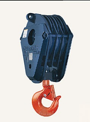
crane block
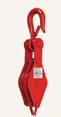
wire rope block

snatch block
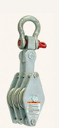
tackle block
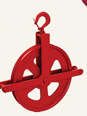
gin block
what’s the difference between the standing and traveling block?
the standing block is the upper block and us attached to a fixed object or structure. The traveling block is the lower moveable block attached to the load
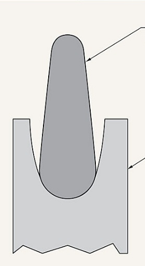
is this sheave acceptable?
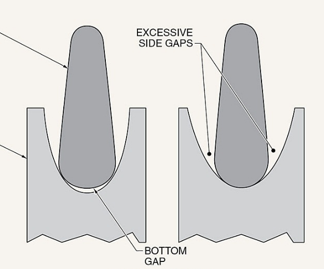
unacceptable
how to identify skip reeving
starts at a center sheave and passes from one side of the blocks to the other before being attached to a becket
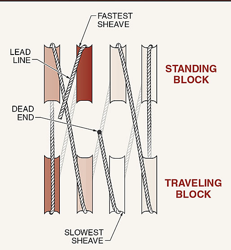
skip reeving
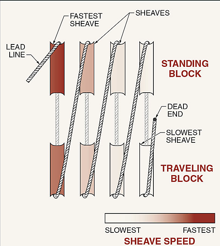
lacing
how to identify lacing
a rope starts on one side of the blocks and passes to the other side one sheave at a time.
what type of reeving is more complex than lacing but allows for more even distribution in speeds
skip reeving
which type of reeving utilizes the standing and skip block and 90 degrees to each other
Square reeving
what is the load path?
the path a load must take from its starting point to its destination and every point in between
what is the fall zone?
and area where partially or completely suspended materials might land if they become loose from a load or fails
what is cribbing?
blocking used to temporarily support a load at rest.
what is a tag line?
a rope used to prevent the load from rotating
Steel erection is part of subpart _____ and was OSHA’s _________ _________ __________.
Subpart R - Steel erection, was OSHA’s first negotiated rule.
Subpart R does not apply to:
communication and broadcast towers and tanks
connector
An employee who, working with hoisting equipment, is placing & connecting structural members and/or components.
connector : An ______ who, working with hoisting equipment, is placing & connecting ___________.
An employee who, working with hoisting equipment, is placing & connecting structural members and/or components.
what is a derrick floor?
An elevated floor of a building or structure that has been designated to receive hoisted pieces of steel prior to final placement
An elevated floor of a building or structure that has been designated to receive hoisted pieces of steel prior to final placement
derrick floor
A gap or void 12 inches or more in its least dimension in a floor, roof or other walking/working surface.
opening
opening: A gap or void _______ or more in its least dimension in a floor, roof or other walking/working surface.
A gap or void 12 inches or more in its least dimension in a floor, roof or other walking/working surface.
Project Structural Engineer of Record
•Registered, licensed professional engineer responsible for the design of structural steel framing and whose seal appears on the structural contract documents.
DOES NOT WORK FOR GENERAL CONTRACTOR
Steel bars, steel lugs, headed steel studs, and similar devices which are attached to a structural member for the purpose of achieving composite action with concrete.
shear connector
An open web, primary load-carrying member, designed by a manufacturer, used for the support of floors and roofs.
steel joist girder
An open web, secondary load-carrying member of 144 feet or less, designed by the manufacturer, used for the support of floors and roofs.
This does not include structural steel trusses or cold-formed joists.
steel joist
Field-assembled building system consisting of framing, roof and wall coverings.
systems engineered metal building
What is required to begin steel erection
concrete must be 75% of the minimum compressive design strength
repairs and replacements have been made correct
commencement of steel must not begin until
the steel erectors had received notification of the requirements of ‘a’ have been met.
The controlling contractor shall provide what for site layout?
adequate access
a firm, properly graded, drained, accessible for the safe storage and operation of equipment and materials.
Critical lifts are those that: that (1) exceeds _____ of the rated capacity of the crane or derrick, or (2) requires the use of _______.
A lift that (1) exceeds 75 percent of the rated capacity of the crane or derrick, or (2) requires the use of more than one crane or derrick.
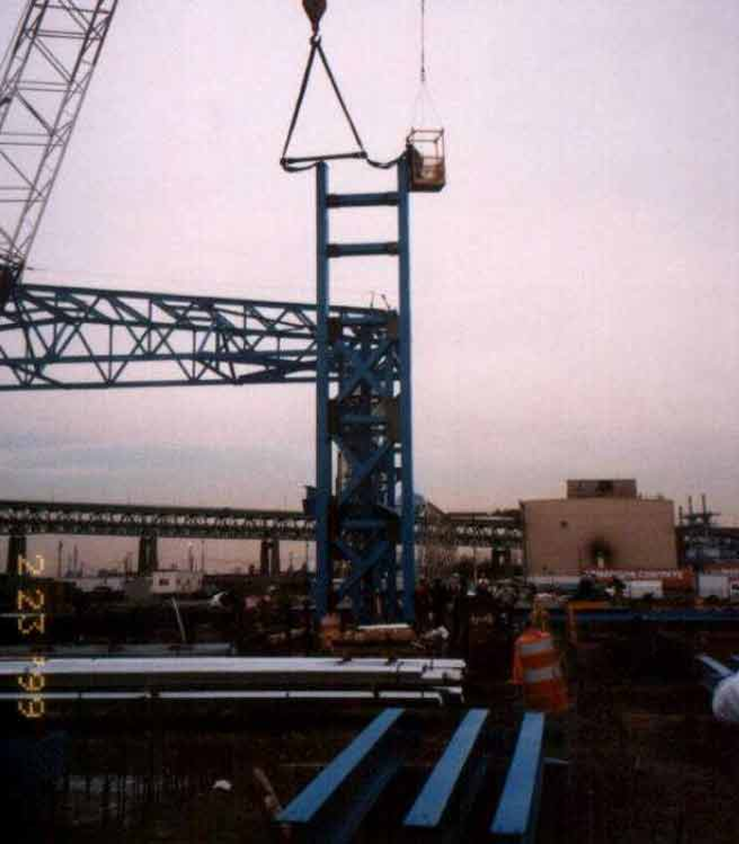
personnel basket
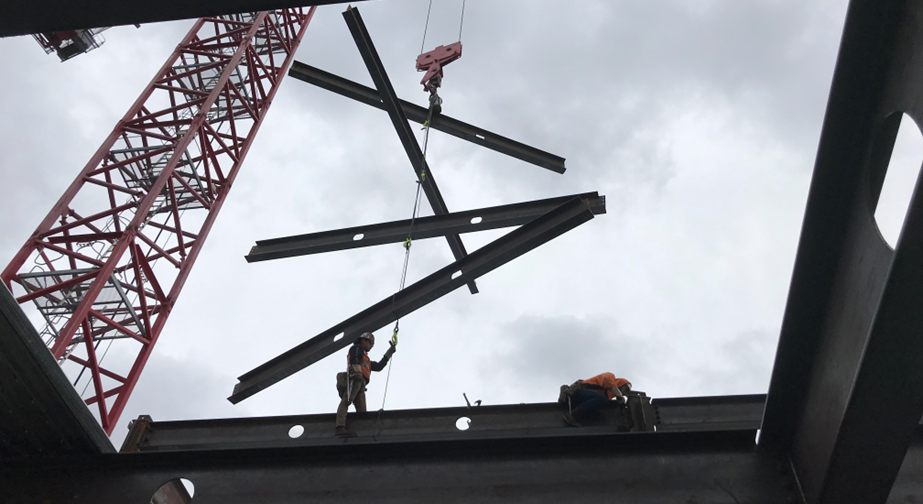
Christmas treeing
Christmas treeing requires
-5 members per lift
-multiple lift rigging assembly
-only structural members
-employees must have done Christmas tree training
-5 to 1 safety factor for rigging equipment
-must be rigged top down
-7 ft spacing between each member