Psych exam 2 part 2!
 Call Kai
 Learn
Learn Practice Test
 Spaced Repetition
 Match
Match Flashcards
 Knowt Play
1/51

There's no tags or description
Looks like no tags are added yet.
Name | Mastery | Learn | Test | Matching | Spaced | Call with Kai |
|---|
No analytics yet
Send a link to your students to track their progress
52 Terms
Social identity theory
People’s self-esteem stems in part from their group memberships
Types of bias
Explicit, Subtle, Implicit (unconscious or automatic)
Hostile sexism
a blatant form of sexism that functions to maintain men’s societal dominance
Benevolent sexism
A subtle form of sexism that functions to maintain men’s societal dominance
Hostile racism
A blatant form of racism where people hold explicit negative feelings toward, and stereotypes about people of a certain racial group
Modern racism
A subtle form of racism where people reject explicitly racist beliefs, yet feel discomfort with or animosity toward people of a certain racial group
Implicit bias
A subtle, sometimes unconscious, form of bias where people hold associations about social categories that may contradict explicit self-report
Implicit Association Test
Weakly predicts discriminatory behavior, strongly predicts outcomes on aggregate levels (e.g., states, countries)
How can bias be reduced: Superordinate goals, Intergroup contact, Awareness of and motivation to override, Knowledge
Superordinate goals
high-level, shared objectives that require cooperation between two or more groups to achieve, often reducing conflict and breaking down "us vs. them" barriers
Allport’s theory of intergroup contact
Optimal contact conditions for reducing intergroup prejudice include Common goals, Cooperative environment, Groups have equal status in context, Institutional support
“The Marley Hypothesis”
Lacking knowledge of past racism in the United States predicts Whites’ denial of the extent to which racism continues to be a problem
5 factors to bring people together / form relationships
Proximity, familiarity, similarity, reciprocity, attractiveness and arousal
Propinquity effect
the tendency to form friendships or romantic relationships with people you encounter often
Functional distance
the likelihood of connection between people based on architectural design or environmental layout, rather than simple physical distance
Mere exposure effect
Repeated exposure to a stimulus (object or person) leads to greater liking
Universal features of physical attractiveness
Facial Symmetry, Clear skin, Youth, “Averageness”, Some exaggerated features (e.g., big or strikingly-colored eyes, big lips)
The halo effect
The common belief that physically attractive people also have other positive qualities
Sternberg’s Triangle Love Theory
love is: passion, intimacy, commitment
passion
physiological arousal, longing, sexual attraction
intimacy
close bond, sharing, support
commitment
willingness to remain with one another
how do passion, intimacy, and commitment combine?
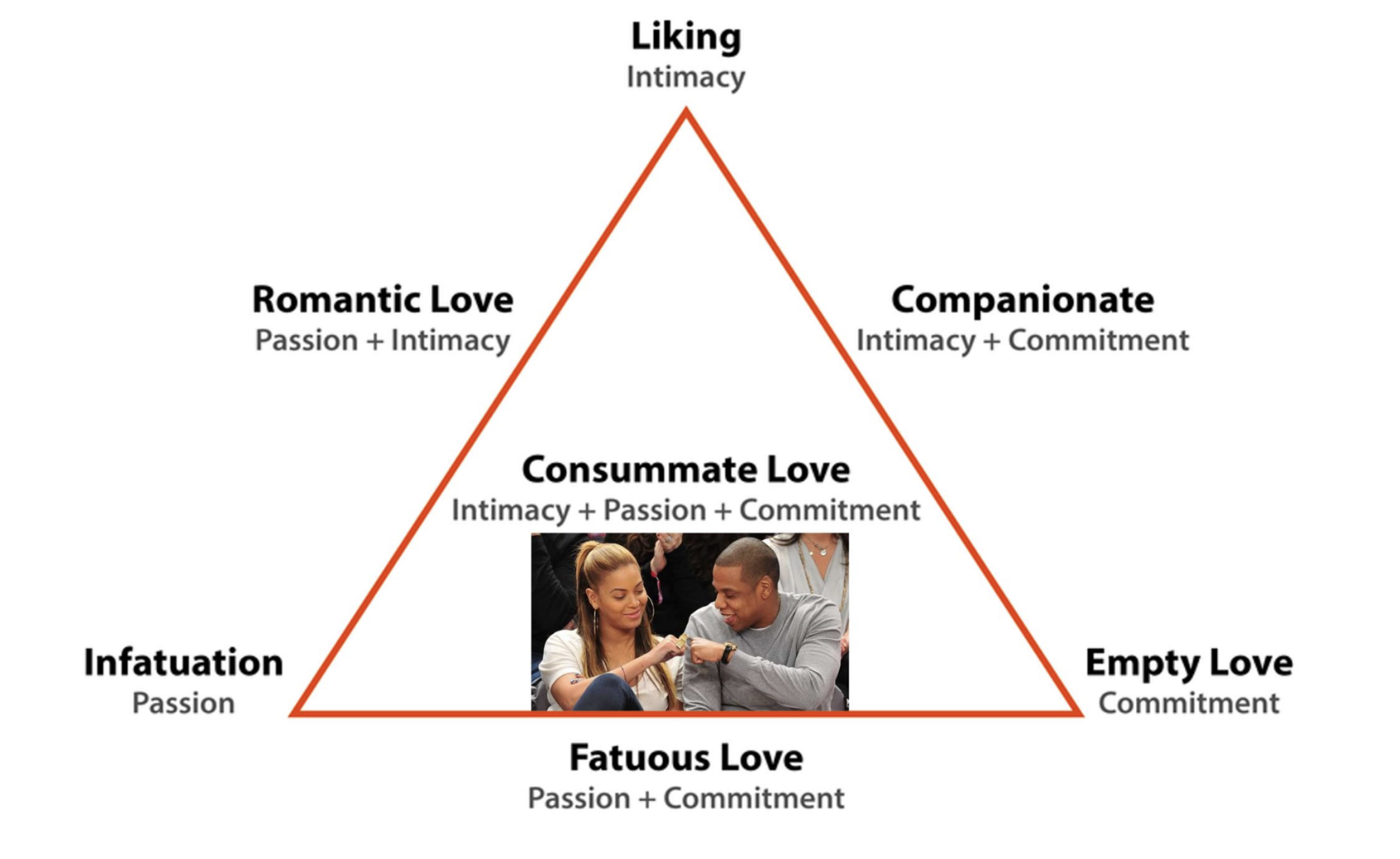
3 factors that determine if people stay in a relationship (investment model of commitment)
Satisfaction Level: Rewards, good interactions (5:1), Quality of Alternatives: If you left this relationship, what would replace it?, Investment Size: What you have put into the relationship that will be lost if you leave
Social support
information that indicates you’re loved, cared for and valued by others; and that links you to a network with communication and mutual responsibility
Buffering hypothesis
the role of one’s social network in providing social support kicks in under stress
Emotion regulation
Processes that determine what emotions we feel, how we experience them, and how we express them to others
motivation for emotion regulation
Hedonic (to feel better/worse) and Instrumental (to do, to know, to relate, to be)
Implicit theories of emotion
core beliefs about whether emotions are fixed or malleable
believing that emotions are malleable…
Corresponds to greater emotion regulation self-efficacy, Corresponds to when and how people may attempt to alter emotional experiences, Corresponds to overall subjective experience and wellbeing
Long-term associations between self-control and life outcomes
Higher SAT scores, Better Educational attainment, Rated more socially competent as adolescents by parents, Higher self-esteem in adulthood, Lower BMI in adulthood, Lower drug use
role of attention in affecting self-control
How you think about a stimulus is more important than the stimulus itself
role of situation in affecting self-control
modifying your environment is very effective at increasing self-control
role of construal in affecting self-control
Effect: Focusing on global, abstract, and superordinate features (e.g., "studying to become a doctor") promotes self-control.
cynical view of helping
We help other people for selfish reasons.
positive view of helping
We help other people to increase their welfare, regardless of other consequences brought about by the helping behavior
Reciprocal altruism
You help me now, I’ll help you later
Social rewards theory of helping
Benefits like praise, positive attention, tangible rewards, and gratitude motivate helping behavior, Being viewed as altruistic earns people status and power
Personal rewards theory of helping
People are motivated to help to relieve their own personal distress, which is elicited when they see people suffering or in need
Empathic concern
produces an altruistic motive for helping, When people feel empathy for another, they will help for altruistic reasons, regardless of what self has to gain
Affective empathy
the ability to experience the feelings of other people
Cognitive empathy
the ability to rationally understand a person’s feelings and thoughts
Individual differences in ‘who helps’
People who are more “agreeable” more likely to help, Men and women help at similar rates but differ in what type of help they provide, People from lower, relative to higher, SES backgrounds help more, People in rural communities help more, People in cultural contexts where value of simpatia is present
Bystander effect
The phenomenon in which individuals do not offer help in emergency situation when other people are present
Step 1 model to helping
noticing a person, event, or situation that may require help
Step 2 model to helping
interpreting that help is needed
Step 3 model to helping
taking responsibility for helping
Step 4 model to helping
deciding how to help
Step 5 model to helping
helping
Reducing obstacles of the bystander effect
Distraction/Noticing → She notices you, Pluralistic ignorance / ambiguity → She should understand that help is needed, Diffusion of responsibility → She should understand that she is responsible for helping, Lack of competence → She should understand exactly how to provide help
Gottman’s four horseman of the apocalypse
Criticism → Gentle start-up, Defensiveness → Take responsibility, Contempt (mocking and expression of superiority) → Appreciation, Stonewalling → Self-soothing