Ptosis/pupils/lids
 Call Kai
 Learn
Learn Practice Test
 Spaced Repetition
 Match
Match Flashcards
 Knowt Play
1/25

There's no tags or description
Looks like no tags are added yet.
Name | Mastery | Learn | Test | Matching | Spaced | Call with Kai | Chat |
|---|
No analytics yet
Send a link to your students to track their progress
26 Terms
Ptosis - muscles inv
Muscles involved
- Levator palpebrae superior – lps
o Lifts upper eyelid
o Controlled by CNIII
o Dysfunction = true ptosis
- Muller muscle
o Secondary elevator
o Sympathetically innervated – affected in Horner’s syndrome
- Frontalis
o Compensatory M – forehead m
o Overused when ptosis present
o Seen as raised eyebrows or forehead wrinkling
pseudo ptosis
Pseudo strabismus
- Eyelid drooped not due to muscle weakness
Mimics inc
- Enophthalmos - sunken eye
- Microphthalmos – sm eye
- Hypotropia
- Proptosis
Ptosis inv
Inv
- CH/AHP – chin elevation
- OM – SR ua = CNIII
- Pupil – mydriasis = CNIII
o Miosis – horners
- Levator = measure eyelid movement from up + down gaze
- Bells phenomenon: upward eye movement w/ eye closure
- Accommodation – affected in CNIII
Ptosis causes
Congenital
- Weak or abnormal levator
- can be:
o simplified isolated ptosis
o syndromic – blepharophimiosis
o neurological – congenital CNIII, marcus Gunn
o sx
Acquired
- myogenic – MG, CPEO, myositis
- neurogenic- CNPIII, Horner’s
- mechanical – lid tumour, scarring, trauma
- senile – age related, stretching of levator
- tx underlying cause
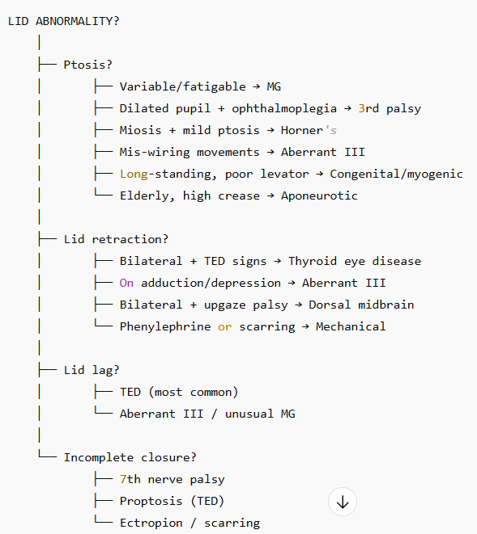
CNIII: ptosis, mydriasis, EOM issue
Horner’s – mild ptosis + miosis
Ptosis mx
Mx
- Correct RE _ amblyopia
- Observation – MGJW improves
- Remove dip – prism or occlusion
- Tx cause of acquired + await recovery
Non surgical
- Drugs
- Ptosis props
- Magnet
Sx
- Sm dev c gd LPS function
o Lps resection >5mm
- Fasanella – servat
o Excision of upper boarder of tarus + lower muller m
- Brow suspension
o Serve ptosis c poor LPS function – frontalis sling
o MGJW. CPEO, belpharophlmosis
Post op complications
- Corneal exposure
- Eye lid too high/ low
- Defective skin crease
- Lash eversion
Ptosis - ent/ect
Entropion
- Transverse suturing
- Lower lid retractors
Ectropion
- Tendon laxity
- Temp
o Lubrication
o BT to levator
Lid retraction
Lid retraction
- Opposite to ptosis
Causes:
- TED – IR tethering
- Ptosis of contralat eye
- Midbrain disease
- MG
- Iatrogenic
- Dc
- Parinauds
Tx
- BT – temp relief – induce ptosis/ TED
- Muller m sx
- LPS recession
Pupils - functions/ size influence
Functions of pupil
- regulate light
- reduce spherical + chromatic aberration
- increase depth of focus thru accom response
uniocular
o Horner’s
o anterior segment inflammation
- Binoc
o Argyl Robertson
o Convergence/ accom response
Pupil size influence
- Age
- Light intensity
- Drugs
- Emotions
- Hippus
mydriatic pupil – dilated
causes:
- 3rd CNP
- Holmes Aldie tonic
- Dorsal midbrain - parinauds
- Glaucoma
- Trauma
- Drugs
- Hutchinson
Dorsal midbrain
- LND
- Convergence retraction nystag
- Lid retraction
- Causes: pineal gland, MS, hydrocephalus
- Pupil accommodates – both react to light
- Parasympathetic
Holmes adie tonic
- Lesion in CG – bacterial viral infection
- Women in 30/40s
- Accom response impaired – N reduced
- Poor light response
- Reacts
o Pilocarpine – 0.125%
o Metacholine
o Reduced knee jerk
3rd CNP
- Dialted pupil
- Efferent PSF travel outer layer of 3rd N
- External compression on 3rd N – pupil inv
Miotic pupil – constricted
Occur in light reflex + accom reflex
Horner’s syndrome
- Ptosis – disseveration of muller m
- Miosis – sm pupil
- Anhidrosis – no sweating on affected side
Tests
- Cocaine test – dilate normal pupil but not Horner’s
- Paradine test – differentiate lesion site
- Anisocoria increases in dim light
Causes:
- Trauma
- Lung cancer
- Spinal issues
- Congenital defects
Argyll Robertson
- Lesion in rostral midbrain affect reflex to EWS
- Irregular miotic pupil + LND
- Respond to N
- Bilateral
Cause
- Neurosyphilis
- MS
Aberrant regeneration
pupil constriction
Adduction causes lid elevation.
Adduction causes pupillary constriction.
Elevation causes lid retraction.
Causes
Compression by aneurysm or tumour.
Head trauma
Relative afferent pupillary defect – RAPD
- MGJW
- Lesion in afferent pathway -e.g. retina// optic N
- Tests: swinging light test
Grades
1. Weak constriction – greater dilation
2. No change – dilation
3. Immediate dilation
4. No reaction
Causes:
- Optic neuropathy
- Retinal detachment
- TED
Pupils inv
Investigation
- CT: check N/D + gls
- PCT
- OM: asses paresis vs mechanical
- Ted, 3/4/6 Affect EOM
- Hess
- FDT
- VF: goldmann or automated check for compressive lesion
- Img – MRI, ms
- CT: orbital, TED
Another test
- ACH antibodies – MG
- Neurological exam – stroke or CNO
- Field of BSV
Irregular pupil/ neurological conditions
Irregular pupil
- Trauma – posterior synechiae
- Iris tumour - Correctopia
- Coloboma – heterochromia
- Anisocoria
Neurological conditions
- Spasmus newton – nystagmus, head bopping, torticollis in children
- OMA – ocular motor apraxia – lack of voluntary H eye movement
- OCR – CNV – vagus – bradycardia
Pupil reflex/ triad
Pupil reflex
- Retina – optic nerve – chiasm – pretectal nucleus
- Bilateral EWS – CNIII – ciliary ganglion – sphincter
Near triad
- Accommodation
- Convergence
- Pupilllary constriction
pupil - area 19
Area 19 of visual cortex
- Neuron – visual cortex – LGB
- Optic radiation – visual cortex – area 19
- Cortical fibre – internal capsule – EWN – CNIII – sphincter
LND
LND
- Aldie tonic
- Parinauds
- Argyll Robertson
- aberrant regeneration
- optic neuropathy
Parasympathetic
Parasympathetic
- automatic control of pupil
- miosis
- pupil constriction
- involves: inner circular muscles
- triggers – light reflex + accommodation reflex
pathway
- retina - optic N – optic chiasm – pretectal – EWS – oculomotor nerve – ciliary ganglion – iris sphincter = miosis
Sympathetic pathway
Sympathetic pathway
- mydriasis
- pupil dilation
- involve – radial fibres
- associated disorders
o Horner’s syndrome
- Pathway
o 1 ON – posterior hypothalamus – brainstem – C8 T2 – ciliospinal centre of budge
o 2 ON – preganglionic neuron – leaves spinal cord + enter – superior cervical ganglion
o 3rd ON – post ganglion neuron – ICA – ophthalmic nerve - CS – orbit via – SOF – iris dilater – muller m
Diagnostic testing
Diagnostic testing
- Observation – size, shape, symmetry
- Tests
o Swinging tests
o Direct + consensual reflex
o Near reflex
o Look for – eyelid + eyelid position
o Ask pt read down conv target see if pupil constricted – accommodation reflex
o If nothing wrong – PERLA – pupil equal and reactive to light and accommodation
Aberrant regeneration
Aberrant regeneration
- Eyelid retracts on add/ depression
- Adduction of eye on elevation/ depression
- Pupil constriction – adduction
- Ptosis
- Limited eye movements
- FROM 3RD NERVE = think AR
Lids - congenital
- Congenital
o Epiblepharon– extra skin folds
o Congenital entropion- inward lid
o Blepharophiomosis – ptosis, epicanthus inverse + flat nasal bridge
o Simple ptosis – no lid crease – poor levator function
o MGJW – ptosis varier with jaw movement
o Congenital Horner’s – ptosis, miosis, heterochromia
o Congenital fibrosis – restricted eye movement, ptosis, fibrotic EOM
Lids - acquired
Acquired
- Entropion – lid turn inward
- Extropian – lid turn outward
- Lid lag – lid remain elevated during downgaze
- Lid retraction
- Lagophthalmos – incomplete lid closure
- Belphatus – chronic lid margin inflammation
- Bell’s palsy – orbicularis weakness
Lid examination
Lid examination
Tests
- Levator function
o Press brow + neutralise frontalis muscle
o Measure pts eyes looking down to eyes looking up
- Bells phenomenon
o Check upward globe rotation during lid closure
- Marginal reflex
o MRD1 + MRD2
Synoptophore
- 9 positions of gaze
Non orthoptic test
- Photograph
- Neurologic
- Radiologic
- Muscle biopsy
- General med
Lids inv
Investigation
- History – MG, trauma, thyroid
- Observation – flutter, twitch, AHP
- Lid change
- CT – pseudo ptosis
- OM – retraction, lid lag
- AHP on movement
- Lid elevation
- Eyelid closure
Lids - mx
Mx
- Medical
- Lubricant – for exposure – ectropion
- Lagophthalmos
- BT – for lid retraction
Sx
- Levator resection – ptosis
- Corrective sx – entropion, ectropion, TED
Consecutive
- Ptosis props
- Tape support
- Temporary occlusion