Groups and Teams
 Call Kai
 Learn
Learn Practice Test
 Spaced Repetition
 Match
Match Flashcards
 Knowt Play
1/41

There's no tags or description
Looks like no tags are added yet.
Name | Mastery | Learn | Test | Matching | Spaced | Call with Kai |
|---|
No analytics yet
Send a link to your students to track their progress
42 Terms
Group
collection of people who interact such that one person’s actions have an impact on others
formal: managers and subordinates
informal: people working together in ways not formally prescribed
Team
coalition of people working together to achieve mutual goals
key feature: shared and collective purpose
Importance of Assembling one
accomplish larger, more complex goals that would be impossible for an individual alone
some tasks require multiple sets of KSAs
Team Size
cap at 5-7 members
team effectiveness drops when teams are too large (coordination costs tend to outweigh the benefits)
one less person is better than one more person
Team Composition
mix to try to build in variety
avoid similarity attraction phenomenon: people generally group themselves with similar others
makes them susceptible to conformity
Functional Roles in Teams
Devil’s Advocate: formally assigned to challenge group’s preferred option (improves decision quality as it forces group to justify its reasoning)
Information Broker: responsible for ensuring that unique information held by individual members actually reaches the group (limits common knowledge effect)
Boundary Spanner: manages team’s relationship with the outside (brings in external information, resources, and legitimacy, and representing the team’s work to stakeholders) and prevents insularity
Forming-Storming-Norming-Performing Model
Team development
teams go through stages of development in the same way humans do
However
evidence does not support theory that teams go through specific stages in linear fashion
instead, it shows that the life cycle of teams are much more dynamic and cyclical in nature
Forming
Team development
general sense of excitement as group comes together for the first time
marker: high uncertainty
members tend to be polite, conflict avoidant, and observant
Goals:
try to get to know each other
discover what appropriate boundaries are
Storming
Team Development
Members start to shed social facades and become more authentic and argumentative
Marker: Power and Influence
group members begin to stake out territory and form cliques
Goals
express deeper thoughts and feelings
explore whether one will truly be accepted
Norming
Team Development
Members resolve differences and are more energized and committed to each other
Marker: Cohesion
members are more open and respectful and ask each other for help and feedback
Goals
define operating procedures and goals
Performing
Team Development
People not only get work done, but paying attention to how they’re doing it and at a higher level
Marker: Accomplishment
members are fully bought in and have confidence to achieve goals
Goals
help members grow in skill and leadership
Adjourning
Team Development
Group separates or dissolves
Marker: Debriefing
team members discuss what went right or wrong and what could have been done differently
Goals
reflect on ways to improve for next time
Punctuated Equilibrium Model
Change within groups occurs in rapid spurts rather than gradually over time
group remains fairly static, maintaining equilibrium for long periods of time
change only occurs in punctuated bursts generally catalyzed by a crisis or problem
Norms
informal rules a group enforces about what is acceptable behavior
learned early on and difficult to change once set
Formation of Norms
primacy: whatever happens in the first meeting tends to stick
explicit statements from the leader
carry over from past groups members have been in
critical incidents that establish what the group cares about
Importance of Norms
governs information sharing, conflict tolerance, effort expectations, and how dissent is treated
Setting Norms
high-performing teams discuss the operating ones explicitly at the start (how decisions get made, how conflict gets raised, what happens when someone misses a deadline)
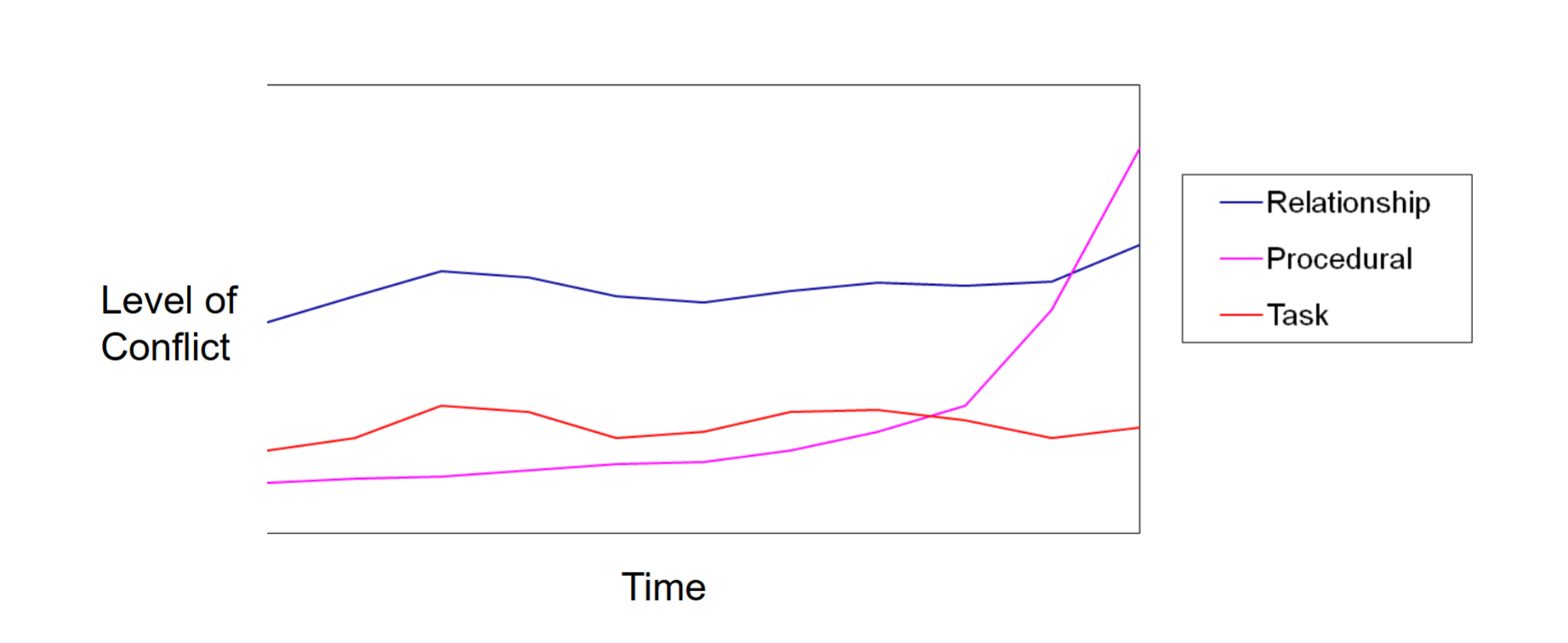
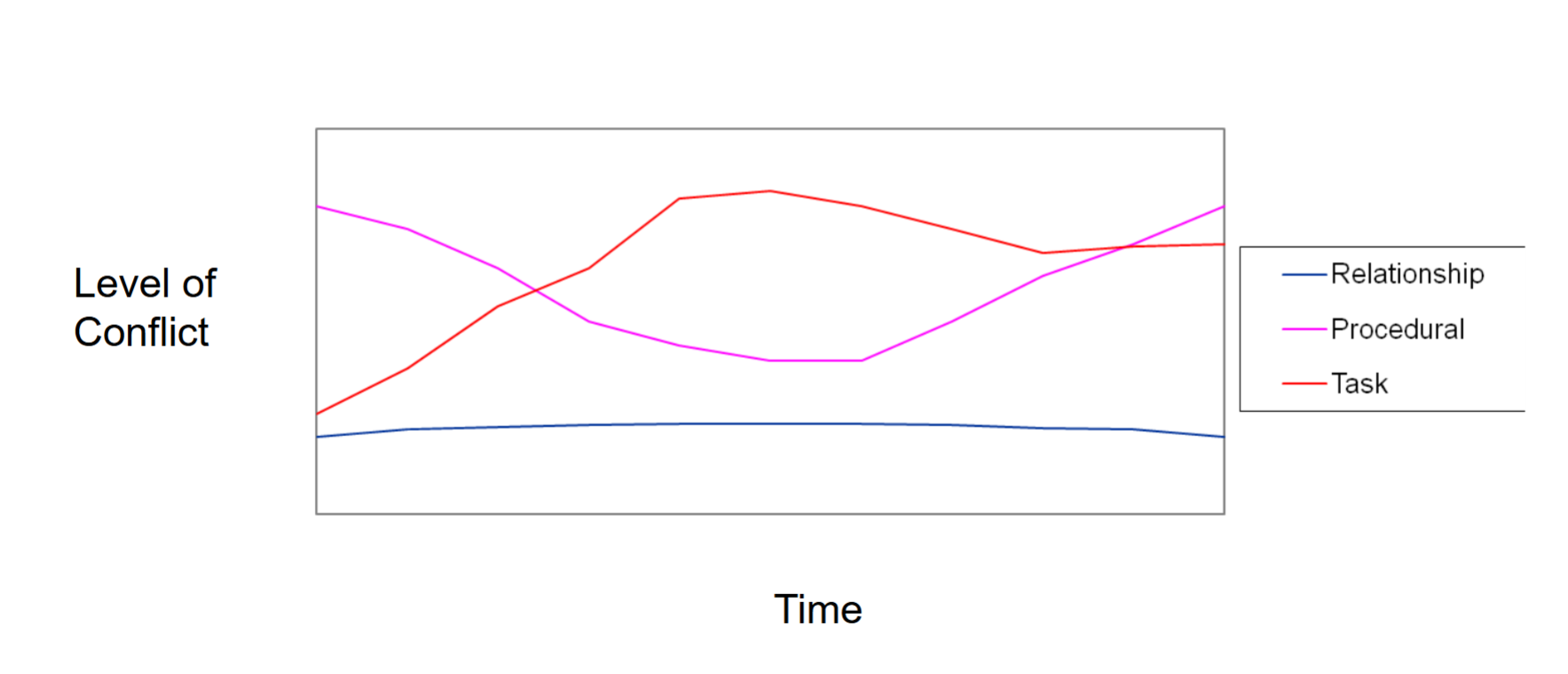
Relationship Conflict
personal, emotion-laden, friction, personality clashes, non-work
Task Conflict
work-based, content debates, non-personal
Procedural Conflict
delegation issues, role and resource distribution, coordination issues
Low Performing Group
High Performing Group
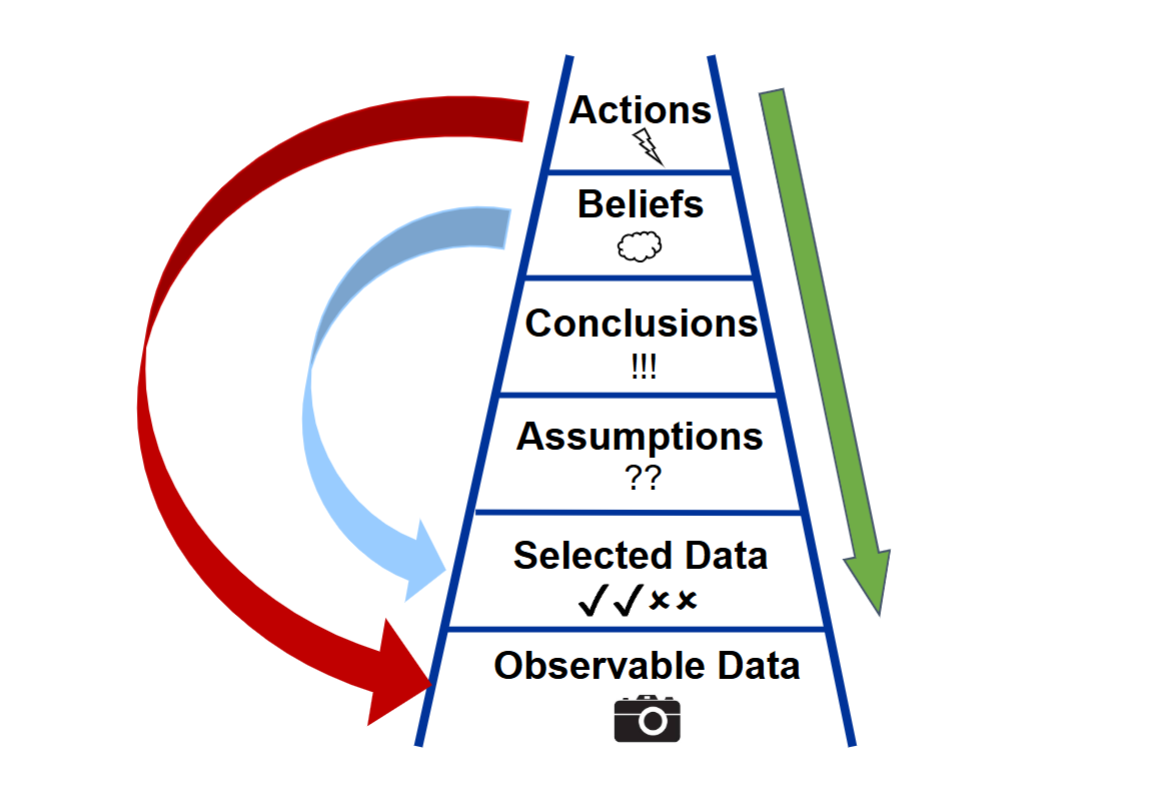
Ladder of Inference
Root of relationship conflict
Mistake: only arguing about conclusions
Overcoming Relationship Conflict
Walk back down the ladder of inference
do i understand your conclusion?
help me understand your data
infer and test underlying assumptions
be willing to be wrong
Evaluating Team Effectiveness
performance
output meets quantity and quality standards
learning and satisfaction
involvement contributes to growth and wellbeing of individual members
viability
team retains ability to work together in the future
Value of Teams
Actual Productivity = Potential Productivity - Process Losses
Process Gains: error correction, cognitive diversity, motivation gains, division of labor
Process Losses: coordination costs, motivation losses, communication failures, decision failures
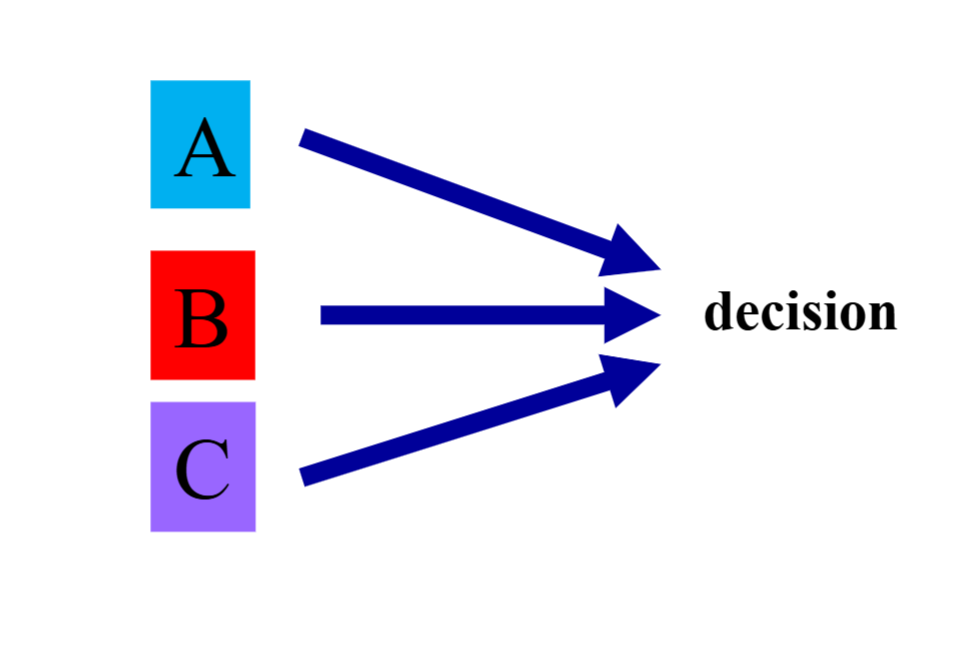
Pooled
Interdependence in Team Decision Making
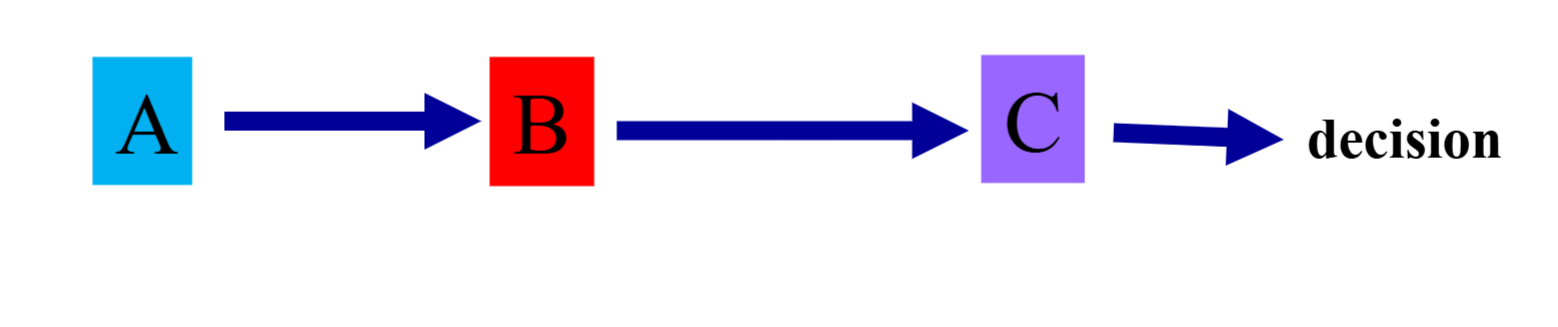
Sequential
Interdependence in Team Decision Making
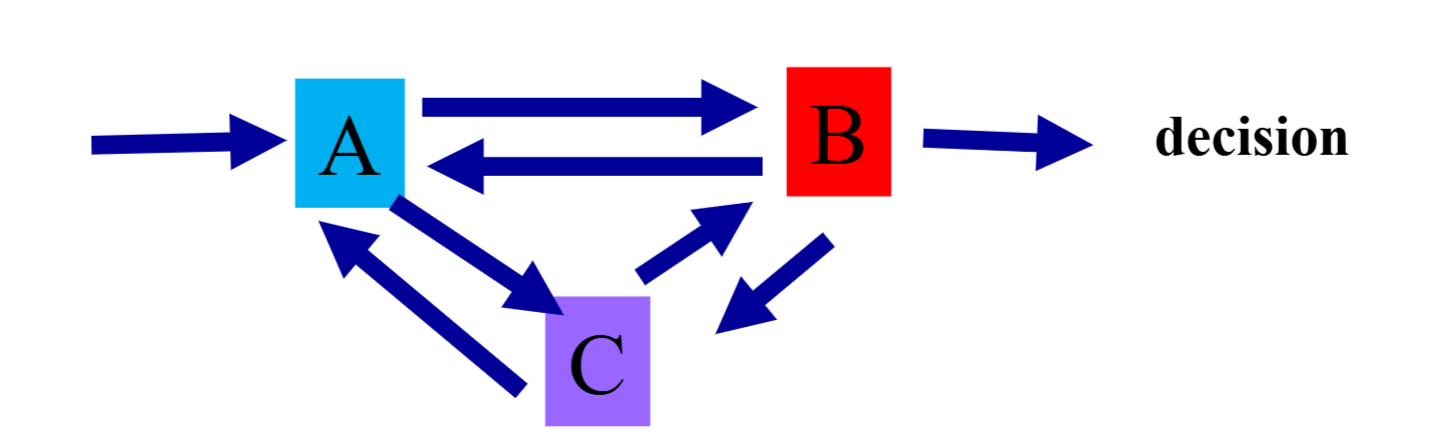
Reciprocal
Interdependence in Team Decision Making
Common Knowledge Effect
Biases in team decision making
collaborators tend to discuss what everyone already knows and miss unique info
Occurs due to
Availability: common info is more salient
Credibility: others can vouch for common info
Validation: makes you and others feel competent
Redundant information guides decisions
information held by more members before team discussion has more influence on team judgements than information held by fewer members
Overcoming Common Knowledge Effect
Improve information sharing
structure the process
assign the role of information manager
rank order alternatives instead of considering one at a time
discuss pros and cons of each option before disclosing preferences
advocate for ideas that challenge assumptions
make a consistent case for an important minority opinion
establish and enact norms for inquiry
unearth the silent minority
direct attention to unshared knowledge
Groupthink
Biases in team decision making
tendency to avoid a critical evaluation of ideas that group favors
occurs more frequently in highly cohesive groups and/or with strong leaders
often associated with reductions in moral judgment
even if people disagree, people fear they will become marginalized for daring to disagree with group or leader
people accordingly censor their thoughts to go along with group
increased social pressure to fit in with group creates illusion of unanimity
Overcoming Groupthink
Actively seek disconfirming evidence
Assign a devil’s advocate
Bring in a neutral, third party
Create psychological safety
Social Loafing
Biases in team decision making
tendency for people to put in less effort when working in a group context
as number of group members increases, the effort of each member typically decreases
diffusion of responsibility as group gets larger as it is easier to deflect blame if group fails
Overcoming Social Loafing
limit number of individuals you need
ideal team size
task significance: less likely when members believe what they are doing is highly important
Cohesion
degree of camaraderie within the team
“social glue” or shared bond
facts that predict
similarity
time: the longer a group stays together, the stronger their bond tends to be
size: smaller groups tend to have higher levels of this
Benefits of a Cohesive Team
higher levels of productivity
members are generally more satisfied and more invested
members support one another and more likely to persevere through challenging situations
Consequences of a Cohesive Team
people will modify their behaviors to keep in line with the majority if belonging is valued over all else
can lead to more instances of common knowledge effect and groupthink
Psychological Safety
belief held by team members on whether it’s okay to take risks
teams without this consistently underperform
leader’s job to encourage different opinions and explain why everyone’s voice matters
Ineffectiveness of Brainstorming
Production Blocking: forget ideas developed while others are talking
Social Loafing: easy to free ride during it as others are contributing
Anchoring on Early Ideas: first ideas shape entire session as later contributions cluster around what was said first
Brainwriting
working individually and then combining results
consistently outperforms other methods
Transactive Memory System
team’s shared understanding of who knows what and who knows who knows what
doesn’t waste time re-explaining context, coordinate varied knowledge, and functionalities
can be build through explicit role assignments, maps of who knows what, and committing these to memory
vulnerable to turnover, remote work, poor socialization or communication
Virtual and Distributed Teams
Challenges: decrease in coordination, cohesion
dynamics are similar, but more difficult to fix problems when they arise
trust slow to develop
TMS slower to develop
Remedies
In-person socialization, early investment in relationships, structured check-ins or drop-in periods