Stream Ecology Exam 2
 Call Kai
 Learn
Learn Practice Test
 Spaced Repetition
 Match
Match Flashcards
 Knowt Play
1/82

There's no tags or description
Looks like no tags are added yet.
Name | Mastery | Learn | Test | Matching | Spaced | Call with Kai |
|---|
No analytics yet
Send a link to your students to track their progress
83 Terms
What are 2 ways to measure water quality?
Instantaneous (grab samples)
• Advantages: Cheaper and easier
• Downside: Water quality is
highly variable in time
Continuous (installed sonde)
• Advantage: Don't miss important
data
• Downsides: Installation,
maintenance, cos
What is Dissolved Oxygen
The amount of free oxygen (O2 ) in water
What is Hypoxic/Hypoxia conditions?
Hypoxic/Hypoxia-When oxygen levels become alarmingly low
(usually less than 2-3 mg/L)
• May happen when there is excess organic matter (from nutrients) in water
What are Anoxic conditions?
When oxygen levels are at zero
What are Normoxic conditions?
Usually >2 mg/L
What are Oxygen supersaturated conditons?
When % saturation > 100
What are the ways that water gains Oxygen?
Photosynthesis (a waste product)
• Diffusion from the atmosphere
• Aeration. Aeration occurs when water mixes with air. Such mixing
occurs in waves, rapids/riffles, and waterfalls
How is dissolved Oxygen consumed or used?
Direct chemical reactions with dissolved organic compounds
(natural and human-related sources)
• Aerobic respiration by microbes degrading organic matter
• Aerobic respiration by all other biota
What 3 things affect the solubility of gases in water?
Pressure (for example, altitude)
• Temperature
• Salinity
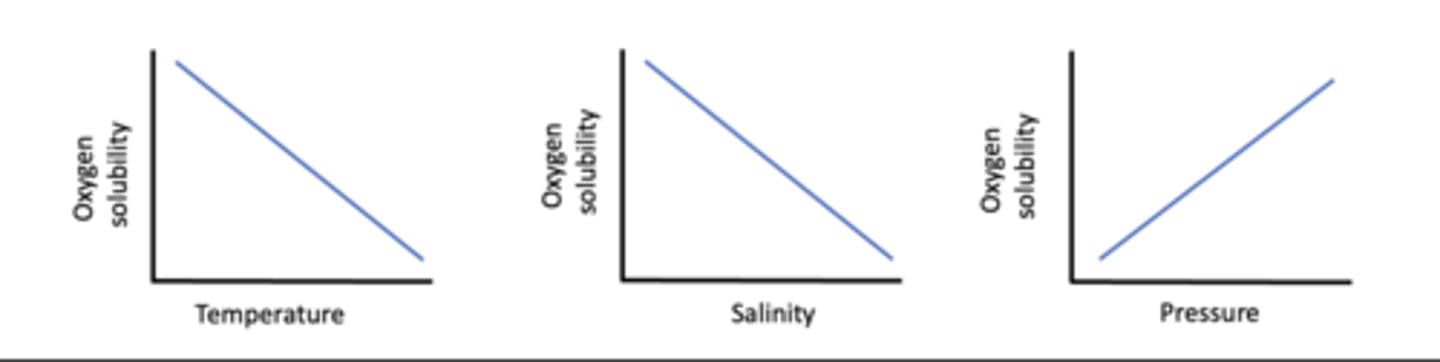
How does temperature affect water solubility?
The higher the water temperature, the lower the solubility.
• Cold water can hold more dissolved oxygen than warm water.
What is the end product of ecosystem respiration?
C02
What influences C02 in rivers and streams?
Diffusion with the atmosphere
• Groundwater
• Rain
• Ratio of primary production to respiration
• Gross Primary Production (GPP)
• Ecosystem Respiration (ER)
• GPP
Headwaters make up >96% of river networks how does that effect CO2 contribution?
YES
What is the definition of pH?
term used universally to express the intensity of the acidity of a solution
What does pH actually mean?
pH = "potential Hydrogen" ion concentration.
How does stream mineral makeup affect buffering capacity?
Granite dominated watersheds have lower acid buffering capacity than those with limestone or dolomite. (Limestone is essentially CaCO3)
What is acidification?
conditions that favor free metals and increase their bioavailability (toxicity)
What is Salinization?
Increasing concentrations of dissolved salts in freshwater correlate with conductivity.
What are Legacy Contanimants?
Contaminants that persist in the environment and organisms
What are examples of Legacy Contaminants?
Persistent organic pollutants that we have stopped using (e.g., DDT)
Metals and Persistent Organic Pollutants (Industrial, pesticides, PCBs)
What are Emerging Contaminants?
New contaminants or contaminants we don't yet understand
What are some examples of emerging contaminants?
New pesticides, PFAS, pharmaceuticals, and personal care products
Plastics
-rarely fully degrade, most become micro-nanoplastics
-Microplastics matter - what is on them and in them does too.
-contaminants mixture are a new concern and poorly understood
What are the different sources of Stream Acidification?
Atmospheric Deposition and Rainfall
• Rain is naturally acidic
• Airborne pollutants like sulfur dioxide
(SO2) and nitrogen oxides (NOx)
increase acidity
Geological Processes: Limestone can neutralize acidity, while rocks
like granite or shale can release acidic ions.
Natural Organic Acids: Organic acids like humic and fulvic acids
from decaying plant material increase acidity
•Biological Activity: Decomposing organic matter by bacteria and
microorganisms produces acidic by-products. Plant and organism
metabolic activities can also impact water pH.
What are the Consequences of Stream Acidification?
Ion Regulation: pH changes affect the fish's ability to regulate essential ions,
causing osmotic stress.
• Enzyme Activity: pH alterations can disrupt enzyme activity crucial for metabolic
processes.
• Toxicity: pH influences metal toxicity; some metals become more toxic in certain pH
conditions.
• Reproduction: pH impacts nutrient availability for reproductive processes in fish.
• Stress Response: Fish may exhibit stress responses to pH fluctuations, affecting
behavior and hormonal balance.
• Immune Function: Suboptimal pH weakens the immune system, making fish more
susceptible to diseases.
• Development and Growth: pH levels affect bone development and overall growth in fish
• Respiration: pH influences oxygen solubility (Acid: O2 + 4H+ + 4e−⇌ 2H2O), impacting
fish respiration.
How are dissolved Aluminum Ions toxic to ecosystems?
Cellular Interference: Aluminum ions disrupt enzymes, affect membranes, and interfere with nutrient uptake in microorganisms.
Toxic Complex Formation: Aluminum forms toxic complexes with organic matter, altering nutrient availability and metabolic pathways.
What is Conductivity?
measure of the electrical conductance (i.e., the ability of water to transmit an electrical current) of water
The An approximate measure of total dissolved solids (Ca2+, Mg2+, Na+, K+,
...) but also can be affected by dissolve organic carbon (DOC)
How does the amount of dissolved solids effect conductivity?
The more dissolved solids proportionally increases conductivity
Why is primary production / productivity important?
It is the base of energy for all ecosystems
• It forms the base of the food web, supporting all higher trophic
levels
What are the 2 bases for food webs/stream ecosystems?
Autochthonous and Allocthonous
What are Autochthonous resources?
Production occurs in the stream
What are Allothonous resources?
Production from outside the stream?
Are Autochthonous or Allochthonous resources preferred by consumers?
Autochthonous
What is Gross Primary Production? (GPP)
The total amount of carbon fixed by photosynthetic organisms
What are some ways to measure productivity?
Biomass Accrual: Measures the increase in tissue (biomass) material
over time
Gas Exchange: Estimates ecosystem-scale productivity by measuring
oxygen fluctuations in flowing water.
Light & Dark Bottle Method: Compares oxygen production (photosynthesis) in a light-exposed bottle to oxygen consumption (respiration) in a dark bottle.
What does it mean if P/R > 1
system is net autotrophic
What does it mean if P/R < 1
system is net heterotrophic
Are tropical streams net heterotrophic or autotrophic
heterotrophic
What are the things that limit primary production in streams?
Both resources and disturbances are important to limiting primary production
• Resources-Increase biomass/rate of production
- Light
- Nutrients - Dissolved inorganic phosphorus (P), Nitrogen (N), Silica (Si)
- CO2
- Substrate- A place to grow
- Temperature
• Disturbances-Decrease biomass/rate of production
- Flow/current/velocity
- Grazing (consumption)
- Sediments/pollution
What are the 3 types of Primary Producers
1. Benthic Algae
2. Cynobacteria
3. Diatoms
What is Benthic Algae?
Algae-Photosynthetic organisms but not plants,
no roots stems or leaves
• Grows on submerged surfaces (benthic)
What is Cynobacteria? (Blue Green Algae)
First photosynthetic organisms, only prokaryotic algae
• Nitrogen fixers
• Can bloom (reach high biomass) and produce toxins
What are Diatoms?
Silicon dioxide (SiO2) frustules
• Diverse growth forms (mats, films, motile)
• Can be sensitive, used as indicators of water quality
What are the 4 Benthic Algae Classfications on substrate?
1. Epilithon: Stones (usually cobble or larger)
2. Epipsammon: Grows in sand (diatoms, cyanobacteria)
3. Epdendritic: On wood surfaces
4. Epiphyton: Grows on the surface of other autotrophs
(e.g., algae, moss, plants)
What are the 2 Benthic Algae Classifications on size structure and growth?
Microscopic (Unicellular)
• Thin layers (biofilms) on
substrates (low profile)
• Interstitial spaces
• More common in diatoms
• Macroscopic (Colonies)
• Filamentous, stalked,
carpets
What is very important for Diatoms?
Silica
What are some limiting factors for Benthic Algae?
Temperature:
• Influences growth rates, with higher temperatures often
accelerating algal growth, while extreme temperatures can
be detrimental.
• Substrate:
• The type and stability of the substrate (e.g., cobble versus
gravel) impact the growth and attachment of algae.
• Flow:
• High velocities can hinder the attachment and growth of
benthic algae, especially on less stable substrates
• High-flow events, like floods, can be lethal to benthic
algae by washing them away, damaging structure, or
flipping substrate
What are Macrophytes?
Macrophytes include flowering
plants, mosses, liverworts,
encrusting lichens, Charales, and
other large algae (Hynes 1970).
• More common in low-order rivers with
open canopies
• Play a key role in habitat structure,
nutrient cycling, and primary
production
What are the 4 main growth habits of Macrophytes?
1.Free-floating plants usually are not
attached to the substrate and can
form large mats.
2. Submerged taxa are attached to
the substrate and their leaves are
entirely submerged.
3. Emergent plants rooted below the
water level with aerial leaves.
4. Floating-leaved taxa, are rooted in
submerged soils. Their leaves and
reproductive organs are floating or
aerial.
What are some limitations of macrophytes?
Seasonality:
• Highly seasonal in temperate zones.
• In tropical streams, growth is less
seasonal, except when influenced
by stream flow changes.
• Factors Influencing Distribution:
• pH, calcium, and alkalinity affect
macrophyte presence.
• Water velocity influences stability
and establishment.
What is Phytoplankton?
Centric Diatoms:
• Dominant in river phytoplankton
assemblages
• Key contributors to primary production
• Green Algae:
• Common in slower-moving water
• Contribute to ecosystem productivity
What are some limitations of Phytoplankton?
Temperature, Light, and Nutrients:
•Affect seasonal variation in phytoplankton
abundance.
•Discharge:
•Influences distribution and growth.
•Herbivory:
•Invasive filter feeding mollusks-major
impact
•Corbicula fluminea (Asian clam, and Dreissena
polymorpha (zebra mussel)
•Relatively few studies on effects of
native freshwater mussels
What is detritus?
Dead organic matter?
What are Allocthonous resources for organic matter?
Terrestrial plants
• Wood/branches (woody debris)
• Leaves/needles
• Flowers and fruit
• Animals
• Carcasses
• Feces/urine/gametes
• Terrestrial detritus/soil
• Groundwater
• Dissolved organic matter (DOM)
What are Autochthonous resources for organic matter?
Algae and macrophytes
• Sloughing
• Seasonal die-off
• Extracellular release/leachate
Animals
• Carcasses
• Feces/urine/gametes
What are the 3 Organic matter size classes?
1. Course particulate Organic Matter
2. Fine Particulate Organic Matter
3. Dissolved Organic Matter
What is Course Particulate Organic Matter?
Larger than 1 mm
• Allochthonous: Mostly wood and leaves
• Leaves are key!
• Autochthonous: Macrophytes, carcasses etc.
What is fine particulate organic matter?
0.5 μm to 1 mm
• Fragments of former CPOM-leaves,
wood, algae etc.
• Feces
• Organic precipitates
• Easily transported downstream
• Important to filter
feeder/collectors
What is dissolved organic matter?
Smallest < 0.5 m
• Soluble organic compounds that leach from
leaves, roots, decaying organisms, and other
sources
What are the drivers of organic matter decomposition?
1.Abiotic (physical) environment-
Leaching, mechanical abrasion
2. Microbes - Bacteria and Fungi-
Metabolize organic material and make
it more attractive/available to
detritivores (animals)
3. Animals - Shredders-break down
coarse organic matter into finer
particles, gathers/collectors consume
the fine particles
What are the 3 stages of leaf decomposition?
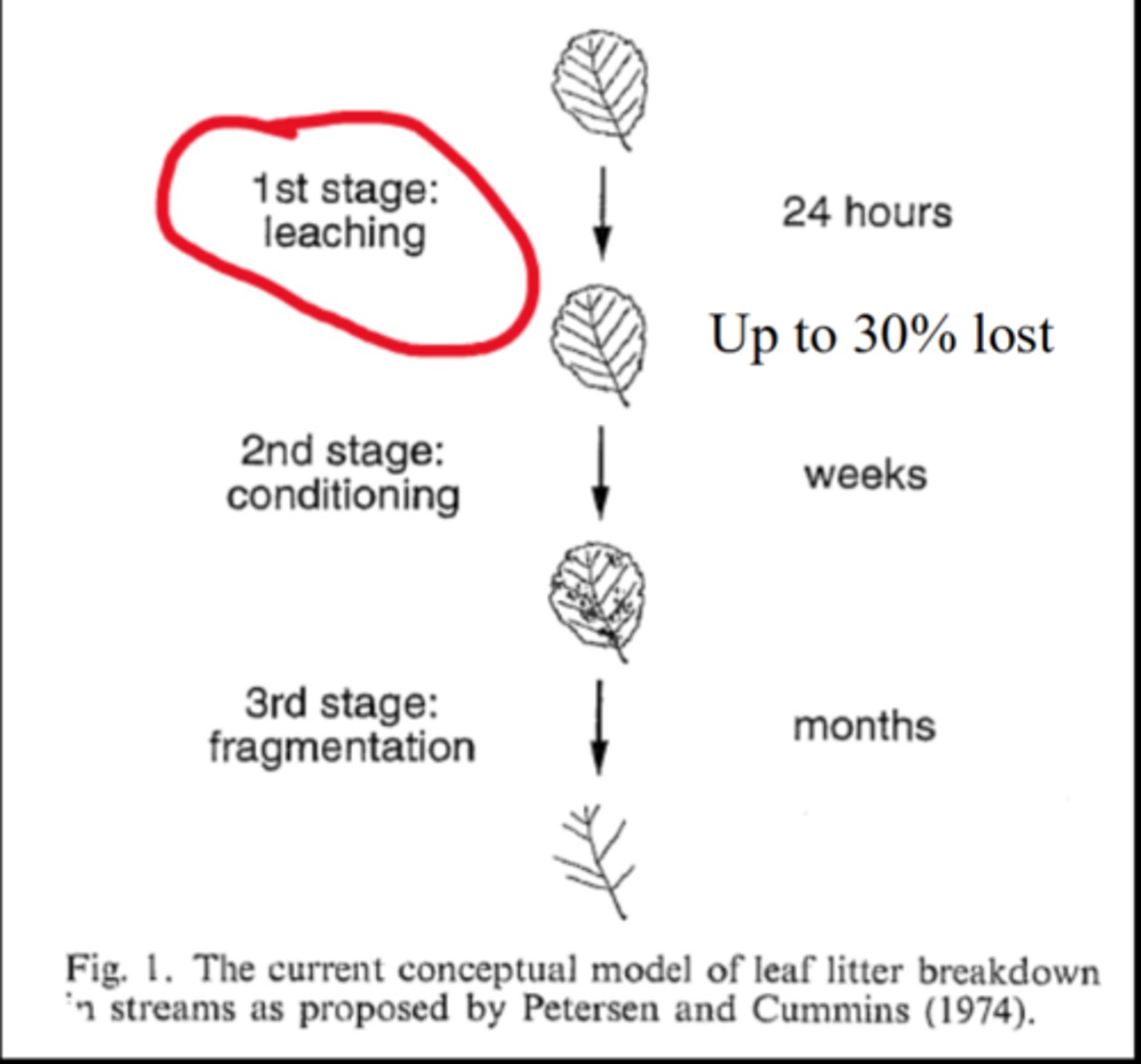
What is the peanut butter on a cracker analogy?
The cracker
• Leaves, wood, and plant debris
• Crackers alone are dry and hard to digest - just like raw detritus
• Peanut butter (or hummus or jelly)
• Biofilm - Bacteria & fungi that colonize and break
down detritus (decomposers)
• Makes organic matter more nutritious and easier for animals to consume
What are the decomposers in leaf conditioning?
Bacteria and fungi are the main decomposers
• Fungi probably 'do' the most
What are some abiotic factors that affect decomposition?
Temperature - Influences microbial activity and enzymatic breakdown; can have a positive effect by accelerating decomposition or a negative effect if extreme temperatures inhibit microbial function.
• Nutrients - Can enhance microbial growth and decomposition efficiency
• Heterotrophic microbes can be nutrient-limited too!
• but may also have a negative effect if excessive nutrients (eutrophication) lead to oxygen depletion.
• Discharge - Mechanical abrasion and
fragmentation
• Sedimentation - Can bury CPOM and FPOM,
generally slows decomposition
Leaf Decomposition Model
Measure mass loss of leaves in a stream through time
• Fit model (below) to data
• k is the slope (rate) of mass loss
• Can compare k between studies and
treatments
• Larger k value indicates faster
decomposition
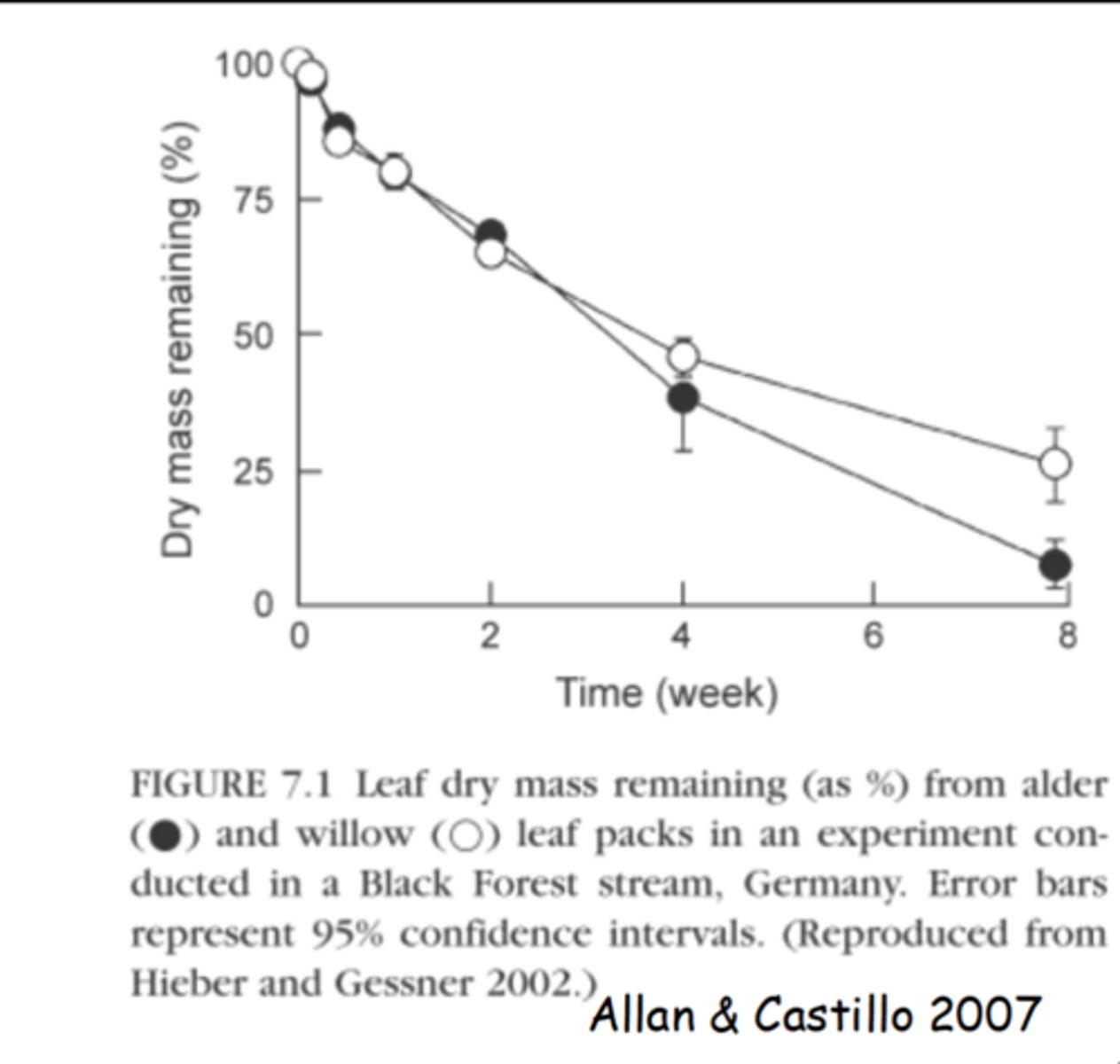
When it comes to decompisition what does a larger k value represent?
Faster decompisition
What are the 4 Macroinvertabrate Functional Feeding Groups?
1. Shredders
2. Collecters
3. Grazers
4. Predators
What are shredders and what do they eat?
Shredders cut or chew pieces of living or
dead plant material
• CPOM
• Macrophytes
What are collecters and what do they eat?
Collectors gather small particles (<1mm) accumulated
on the stream bottom or filter particles directly
from the water column
• FPOM
What are grazers and what do they eat?
Grazer consume resources that grow on
substrates by scraping, grazing, or browsing
• Periphyton/benthic algae
What are predators and what do they eat?
Predators consume other living animals either
by engulfing (ingesting whole or in parts) or
by piercing and sucking out fluids
What are the 5 fish trophic guilds?
1. Herbivore
2. Detritivore
3. Invertivore
4. Planktivore
5. Piscivore/generalist predator
What are herbivores and what do they eat?
Mostly consume benthic algae
• Inferior mouths, fleshy lips, teeth for rasping
• More common in tropical streams than temperate
What are detritivores and what do they eat?
mainly eat detritus and are often onmivorous
What are Invertivores and what do they eat?
Mainly eat invertibrates.
Two Types: Benthic, and Terrestrial
Most common guild in temperate
streams
What are Planktivores and what do they eat?
Mainly eat plankton
Two Types: Filter feeders, and sight feeders
What are Piscivores/generalist predators and what do they eat?
Mainly eat other fish,
Two Types: Benthic oriented, and Surface oriented
Where does energy come from in headwater streams and why?
Energy comes from CPOM (leaves and woody material)
that falls into the stream
• (Allochthonous > Autochthonous)
• Stream is narrow
• Sunlight is limited by overhanging trees, so
primary production is low
Macroinvertebrates: Shredders > Scrapers
Fish: Invertivores are very common
Where does energy come from in Middle reach streams and why?
The stream is wider and relatively shallow
• Sunlight reaches the stream bottom, provides
energy for production of benthic algae and
macrophytes
(Allochthonous < Autochthonous)
Macroinvertebrates: Shredders < Scrapers
Fish: Piscivores, herbivores become more common
Where does energy come from in lower reach streams and why?
Lower reaches
• Energy is supplied by FPOM from upstream reaches and
phytoplankton
Collectors, Filters > Shredders, Scrapers
Fish: Planktivores and detritivores become more common
Provide one explanantion for why Atkinson et al. (2018) found that autochthonous resources were more important in the highest elevation of streams in the Andes?
Sunlight was more available becasue of the lack of riparian vegetation. This decreased the availablity of allochtnonous resources
T/F Leaching is the first or fastest stage of leaf decompisition
TRUE
If P/R > 1 gross primary production is greater than community respiration, what does that make the stream?
net autotrophic (stream is producing its own food through autochthonous sources)
If P/R < 1 community respiration is greater than gross primary production, what does that make the stream?
Net Heterotrophic (stream is producing its own food through allochthonous sources)