Anatomy: Vertebral Column, Muscles of the Back, & Suboccipital Region
 Call Kai
 Learn
Learn Practice Test
 Spaced Repetition
 Match
Match Flashcards
 Knowt Play
1/82

There's no tags or description
Looks like no tags are added yet.
Name | Mastery | Learn | Test | Matching | Spaced | Call with Kai |
|---|
No analytics yet
Send a link to your students to track their progress
83 Terms
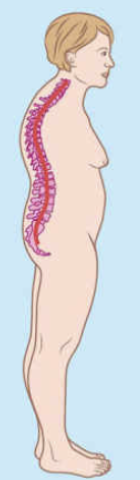
What is this curvature?
Kyphosis
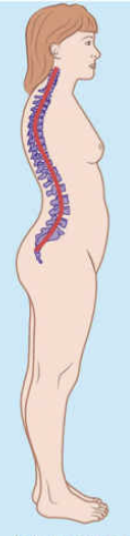
What is this curvature?
Lordosis
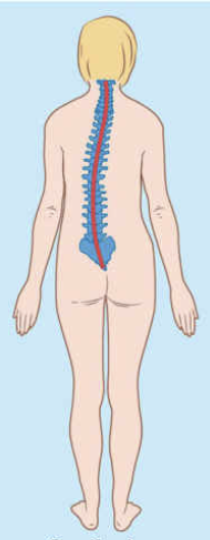
What is this curvature?
Scoliosis
What is the most common group for kyphosis? Why?
Older women due to lower levels of estrogen leading to decreased bone density
What is the most common group for lordosis? Why?
Pregnant or overweight people, as it pulls on the lower abdomen, causing increased pressure on the lumbar spine
Formed by the L and R pedicles and lamina
Arch
Combine to form vertebral canal which contains the spinal cord, meninges, fat, spinal nerve root, and vessels
Vertebral foramen
Regional characteristics of cervical vertebrae
body is small and wide
large, triangular foramen
short transverse processes
atypical C1, C2, & C7
Regional characteristics of thoracic vertebrae
body: heart shaped, costal facets
small, circular foramen
long, sloping spinous processes
articulate with ribs
Regional characteristics of lumbar vertebrae
large, kidney shaped body
large, triangular foramen
short, thick spinous processes
Where are intervertebral discs found?
Between the articulating surfaces of the vertebral bodies
What are the functions of the intervertebral discs?
Strong attachments, permit movements, resist deformity, and serve as shock absorbers
Outer concentric ring of fibrocartilage insert obliquely into the epiphysial rims
anulus fibros
Central core of semisolid proteoglycans that are compressed and stretched during movement
Nucleus pulposus
T/F: intervertebral discs are avascular
True
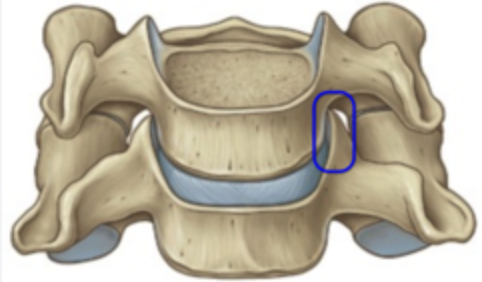
What is the name of this joint?
Uncovertebral joint or Joints of Luschka
Where are the uncovertebral joints located?
C3 to C6
What type of joint are uncovertebral joints?
synovial joints, but can be classified as degenerative spaces
Where is the anterior longitudinal ligament located?
From the pelvic surface of the sacrum to the anterior tubercle of C1 and the occipital bone, anterior to the foramen magnum
What is the purpose of the anterior longitudinal ligament?
Stability of the IV joints and limits extension of the vertebral column (helps to over extension/whiplash)
Where is the posterior longitudinal ligament located?
Within the canal on the posterior aspect of the bodies
What is the purpose of the posterior longitudinal ligament?
Prevents hyperflexion and posterior intervertebral disc herniation (holds disc in)
Which longitudinal ligament is highly sensitive to pain due to being well innervated with pain nerve endings?
Posterior longitudinal ligament
Why is the longitudinal ligament narrower and weaker?
to allow more flexion of the spine (bending forward)
Bony projections that form synovial zygapophyseal (facet) joints with the vertebrae above and below
superior and inferior articular facets
What types of joints are zygapophyseal (facet) joints?
synovial joints
What are the joints of the vertebral joints?
Zygapophyseal (facet) joints
Where is the pars interarticularis?
Region of the vertebra between the superior and inferior articular facets and the pedicle and lamina
Allow gliding movements between the articular processes, but can show anterior/posterior sliding, which can be painful due to pushing on nerves
Zygapophyseal (facet) joints
Where is the ligamentum flava?
Broad, yellow elastic fibrous tissue extending from the lamina above to the lamina below
What does the ligamentum flava do?
Resists separation of the vertebral column at the laminae
Where are the interspinous ligaments?
Thin, weak membrane connecting ALL adjacent spinous processes
Where are the supraspinous ligaments?
Strong, fibrous ligament connecting the adjacent spinous processes from C7 to the lumbar region
Where is the nuchal ligament?
from the external occipital protuberance and posterior border of the foramen magnum to the spinous processes of the cervical vertebrae (median ligament of neck)
Where is the Atlantooccipital Joint?
between lateral masses of C1 and occipital condyles
What are the principle movements of the Atlantooccipital Joint?
flexion and extension (yes movement)
Trapezius: Innervation? Action?
I: spinal accessory nerve
A: elevates, depresses, and retracts scapula; rotates gleniod superiorly
Latissimus dorsi: Innervation? Action?
I: throracodorsal nerve
A: extends, adducts, and medially rotates shoulder joint
Levator scapulae: Innervation? Action?
I: dorsal scapular and cervical spinal nerves
A: elevates scapula & rotates glenoid cavity inferiorly
Rhomboid major and minor: Innervation? Action?
I: dorsal scapular nerve
A: retracts scapula and rotates glenoid cavity inferiorly
Splenius: Innervation? Action?
I: posterior rami of spinal nerves
A: laterally flex the neck and rotate the head; extend the head and neck
Erector spinae (ILS): Innervation? Action?
I: posterior rami of spinal nerves
A: extend vertebral column and head; laterally flex vertebral column
Semispinalis: Innervation? Action?
I: posterior rami of spinal nerves
A: extend head and thoracic & cervical regions
Multifidus: Innervation? Action?
I: posterior rami of spinal nerves
A: stabilizes vertebrae
Rotatores: Innervation? Action?
I: posterior rami of spinal nerves
A: stabilize vertebrae: local extension and rotatory movements
Interspinales: Innervation? Action?
I: posterior rami of spinal nerves
A: extension and rotation of vertebral column
Intertransversarii: Innervation? Action?
I: posterior and anterior rami of spinal nerves
A: lateral flexion of vertebral column
Levatores costarum: Innervation? Action?
I: posterior rami of C8-T11 spinal nerves
A: elevate ribs, assist with respiration
Thoracolumbar fascia function and location
F: muscle attachment and support
L: lower thoracic and lumbar region
Major function of the Erector spinae muscle group
extensor of the vertebral column
What does the triangular area at the most superior part of the back of the neck allow for?
head movement
Suboccipital triangle: muscle at the superomedial boudnary
rectus captis posterior major
Suboccipital triangle: muscle at the superolateral boundary
obliquus capitis superior
Suboccipital triangle: muscle at the inferolateral boundary
obliquus capitis inferior
Suboccipital triangle: muscle at the most medial point
rectus capitis posterior minor
suboccipital nerve is known as
posterior ramus of C1 spinal nerve
Where does the first spinal (suboccipital) nerve emerge?
from the vertebral canal between the atlas and the vertebral artery
What are the 3 articulations of the atlantocaxial joint?
1 median antlantoaxial joint and 2 lateral atlantoaxial joints
What kind of joint is the atlantoaxial joint?
pivot joint
/What is the primary movement altlantoaxial joint?
rotation from L to R; “no” pattern
What nerve innervates the atlantoaxial joint?
C1 spinal nerve
What is the transverse ligament of the atlas?
ligament between the tubercles on the medial aspects of the lateral masses of C1
Purpose of the alar ligament
prevent excessive rotation
The ligaments that make up the cruciate ligaments
transverse ligament of the atlas
longitudinal bands
alar ligament
tectorial membrane
Vessels that supply all regions of the vertebral column
Periosteal and equatorial branches
Forms the venous plexuses along the vertebral column both inside and outside
spinal veins
Spina bifida
congenital malformation; defect in the closure of the vertebral arch
C1 fractures
result of vertical force
can also rupture transverse ligaments, making spinal cord injury more likely
C2 fractures
high force injury
“hangman’s fracture”
severe neck pain due to the C1 nerve
hyperextension (whiplash) injury
over stretched or torn anterior longitudinal ligament
can cause fracture and dislocation of vertebrae
spinal stenosis
narrowing of the vertebral foramen that causes compression of the spinal nerve roots
IV disc herniation: what is pushed out? what is compressed?
herniation of the nucleus pulposus
compressed spinal nerve root
How many of each type of spinal nerves?
8 cervical
12 thoracic
5 lumbar
5 sacral
1 coccygeal
Where does the spinal cord start?
medulla oblongata
What is the conus medularis?
the tapering end of the spinal cord
What is the cauda equina?
bundle of nerves spinal nerve roots, inferior to the spinal cord
spinal nerves: posterior (dorsal) roots
afferent (sensory) fibers
sensory info from receptors to the CNS
cell bodies in the spinal ganglia
Spinal nerves: anterior (ventral) roots
efferent (motor) fibers
from CNS to skeletal muscles/glands
cells bodies are in anterior grey horn
What are meninges?
coverings of the spinal cord and brain
What are the 3 types of mater?
dura mater: tough, external layer
arachnoid: thin, intermediate layer
pia: delicate/vascular, innermost layer
Cerebrospinal fluid: what is it? function?
clear liquid in the subarachnoid space
cushioning and nutrient to the brain and spinal cord
Where is the needle inserted in a lumbar spinal puncture?
subarachnoid space between the L3-4 or L4-5
Purpose of epidural anesthesia
block sensation inferior the the level of block