Chapter 10
 Call Kai
 Learn
Learn Practice Test
 Spaced Repetition
 Match
Match Flashcards
 Knowt Play
1/24

There's no tags or description
Looks like no tags are added yet.
Name | Mastery | Learn | Test | Matching | Spaced | Call with Kai |
|---|
No analytics yet
Send a link to your students to track their progress
25 Terms
What did Charles Darwin notice on his travels that led him to develop the theory of evolution?
that animals and plants in different parts of the world had unique features suited to the ecosystem they lived in - they ADAPTED to their environment
ex: finches
What very important book did Charles Darwin publish?
“On the Origin of Species”
Give two other names for evolution.
survival of the fittest
descent with modification
What is it called when an organism lives long enough to have offspring because it is well-adapted to its environment?
reproductive success
What is selective pressure? Provide a few examples.
The stress that an environment puts on the organisms that live in it, making certain traits good or bad
ex: limited food, harsh environment, predators
Over a long stretch of time, what can happen to two different populations of the same species if evolution acts very differently on each of them?
They can become two DIFFERENT, NEW species
ex: wolves vs coyotes (common ancestor, evolved differently because of different environments)
What is the difference between MICRO and MACRO evolution?
MICROevolution: single species, observable, over relatively short periods of time
MACROevolution: many species, the history of life, over huge stretches of time
What is a gene pool?
ALL the genetic information carried by ALL the individuals in a population
What are the four things that can influence the gene pool?
Natural selection
Mutations
Gene flow
Genetic drift
Mutations can only be inherited if they occur in…
GAMETES
NOT somatic cells
What can affect whether or not a gene is expressed (or even how it is expressed)? In other words, what is the difference between genotype and phenotype?
Environmental factors
ex: Himalayan rabbits (gene for white coats is expressed/”turned on” in colder weather to blend in with snow, “turned off” in warmer weather)
Is natural selection random or nonrandom? Explain.
NONRANDOM
certain organisms survive for a REASON, which is that their traits work better for the environment, allowing them to live long enough to have offspring
What is an adaptive trait, also known as an advantageous inherited trait?
a trait that is passed down to an organism from its parents that improves its chances of survival in a given environment
What is gene flow?
When individuals of a species move from one population to another and mate, introducing new DNA
Does gene flow cause two populations to become more genetically alike or different?
alike
What is genetic drift?
Accidental or chance events that cause individuals with certain characteristics to die off, reducing genetic variation
Is genetic drift random or non-random?
random
Does genetic drift have a greater impact on smaller or larger populations?
Smaller
What does it mean when an allele is “fixed”?
100% of a population has that allele
What kinds of alleles are more likely to become fixed in cases of natural selection? What about genetic drift?
Natural selection favors positive/beneficial alleles because they help survival
Because genetic drift is totally random, beneficial, neutral, or even harmful alleles can survive
What are the two “effects” associated with genetic drift? Define each of them.
Bottleneck effect: population goes from large to small (like the neck of a bottle), reducing genetic variation and potentially causing a species to go extinct
Founder effect: a smaller group breaks off from the large group due to a chance event (think: founding fathers), reducing genetic variability and making survival more difficult
What is the difference between directional, stabilizing, and disruptive selection? Relate each to the example of a population of frogs with sizes ranging from super tiny to gigantic.
Directional: one extreme end of the “phenotypic range” has an advantage
super tiny OR super big frogs
Stabilizing: intermediate phenotypes have an advantage
medium frogs
Disruptive: both extremes have an advantage
super tiny AND super big frogs (but NOT medium frogs)
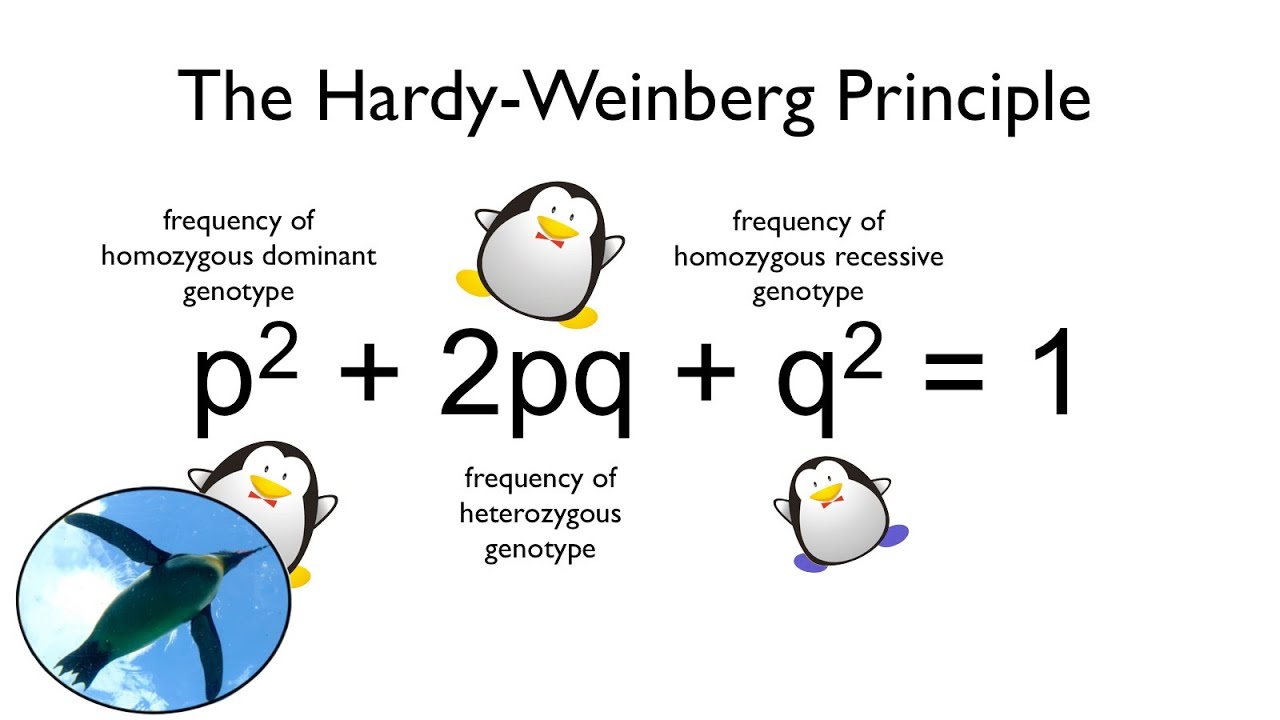
What is the Hardy Weinberg equation (give equation itself and define each variable).
p2 + 2pq + q2 = 1
p = frequency of homozygous dominant genotype
q = frequency of homozygous recessive genotype
pq = frequency of heterozygous genotype
What situations is the Hardy-Weinberg principle applicable in?
Hardy-Weinberg represents a perfect equilibrium → a non-evolving population where allele frequencies remain the same from generation to generation
This means…
large population
no mutations
no genetic drift or gene flow
random mating
Why is the Hardy-Weinberg Principle important when studying evolution?
If a population is studied and its genetic makeup differs from Hardy-Weinberg predictions, it means it is EVOLVING!