Multi store model of memory
 Call Kai
 Learn
Learn Practice Test
 Spaced Repetition
 Match
Match Flashcards
 Knowt Play
1/7

There's no tags or description
Looks like no tags are added yet.
Name | Mastery | Learn | Test | Matching | Spaced | Call with Kai |
|---|
No analytics yet
Send a link to your students to track their progress
8 Terms
Multi store model (MSM)
A representation of how memory works in terms of three stores called the sensory register, short term memory and long term memory. It also describes how information is transferred from one store to another, what makes some memories disappear and what makes other memories last
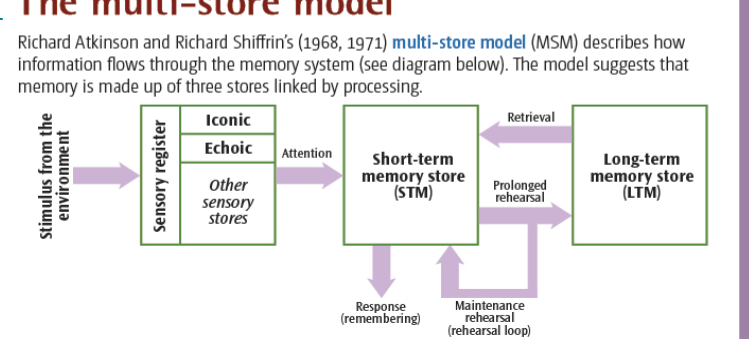
Sensory register
The memory stores for each of our five senses such as vision (iconic store) and our hearing (echoic store). Coding in iconic sensory register is visual and in the echoic sensory register it is acoustic (sounds) the capacity of sensory registers is huge (millions of receptors) and information lasts for very short time ( less than half a second)
Short term memory
Information in short-term memory is coded acoustically and lasts for about 18 seconds unless rehearsed. STM has a limited capacity of $7 \pm 2$ items, though Cowan’s research suggests it is closer to 5 items. Maintenance rehearsal (repeating information out loud or silently) keeps data in STM, and if done long enough, transfers it to long-term memory.
Long term memory
Long-term memory is a potentially permanent store for rehearsed information, featuring an unlimited capacity and a lifetime duration, as proven by Bahrick et al.’s (1975) yearbook study. LTM relies on semantic coding (based on meaning). To utilize information stored in LTM, it must be moved back into STM via the process of retrieval.
Research support
Baddeley (1966) found that we mix up acoustic words in STM and semantic words in LTM, proving they are separate stores. However, most supporting studies used artificial stimuli (digits, letters, consonant syllables) rather than meaningful everyday information. This means the MSM may lack validity when explaining how memory functions in real life.
More than one STM store
Shallice and Warrington (1970) studied KF, an amnesia patient whose STM for digits was very poor when read aloud, but much better when he read them silently to himself. Later studies also confirmed separate short-term stores exist for non-verbal sounds. This directly contradicts the MSM's core claim that STM is a single, unified processor for all types of information.
Elaborative rehearsal
The MSM claims that the quantity of prolonged rehearsal determines LTM transfer. However, Craik and Watkins (1973) discovered that the type of rehearsal matters more than the amount. They showed that elaborative rehearsal—linking new information to existing knowledge or thinking about its actual meaning—can transfer data to LTM completely without prolonged repetition.