Procedures - Bony Thorax (Unit 2-3)
 Call Kai
 Learn
Learn Practice Test
 Spaced Repetition
 Match
Match Flashcards
 Knowt Play
1/65

There's no tags or description
Looks like no tags are added yet.
Name | Mastery | Learn | Test | Matching | Spaced | Call with Kai |
|---|
No analytics yet
Send a link to your students to track their progress
66 Terms
What bones comprise the bony thorax?
Sternum
12 Thoracic Vertebrae
12 Pairs or Ribs
Clavicle
Scapula
The 4 segments of the sternal body may not be fully united until the age of:
25
The xiphoid tip of the sternum may not be completely ossified until the age of:
40
Ribs 1-7 are considered:
True ribs
Ribs 1-7 connect to the _________ via cartilage called _________.
Sternum
Costal cartilage
The sternum has 7 pairs of _________ located laterally along the _____________ & _______________.
Facets
Manubrium
Body
Ribs 8-12 are considered:
False ribs
Ribs 8-10 have costocartilage and join together at the costocartilage of rib ____.
7
Ribs 11 and 12 are considered:
Floating ribs
The posterior end of the rib (also referred to as the __________) articulates with the:
Vertebral End
Thoracic Verebrae
The anterior end (_________) of the rib articulates with the:
Sternal End
Costal Cartilage
The area of the rib which protects an artery, vein, and nerve is called:
Costal Groove
The bony thorax is typically widest at ribs:
8th or 9th ribs
Jugular notch can also be called:
Suprasternal Notch or Manubrial Notch
Jugular Notch: Vertebral Lvl
T2/3
Sternal Angle: Vertebral Lvl
T4/5
Xiphoid Process: Vertebral Lvl
T9/10
Inferior Rib Angle/ Interior Costal Margin: Vertebral Lvl
L2/3
The clavicles articulate with the _____________ of the sternum at the clavicular _________.
Manubrium
Notch
Rather than a true AP or PA projections, the patient is placed in this position to shift the sternum left of the thoracic vertebrae:
Hyposthenic or thin patients require more/less rotation.
Barrel chested patient requires more/less rotation.
15-20 degree RAO position
More
Less
Why would a PA projection be preferred over an AP for sternoclavicular joints?
Least amount of magnification distortion and reduces the amount of radiation to the thyroid.
AP is easier to palpate
The only articulation between the thorax and the upper extremity is the:
Sternoclavicular Joints (SC)
What are two other names for the body of the sternum?
Corpus or Gladiolus
What position is best for visualizing axillary ribs?
Oblique
List criteria needed for for x-raying ribs below the diaphragm:
Lower rib pain
Recumbent
On Expiration
Medium kVp
List criteria needed for for x-raying ribs above the diaphragm:
Upper rib pain
Erect
On Inspiration
Lower kVp
If your patient is having left rib pain (unspecified as anterior or posterior), which two obliques may be acquired?
RAO or LPO
What is the routine exam for a 2V sternum?
RAO and Lateral
How does the positioning for an oblique sternum change based on body habitus?
Patients with a thin chest will need more rotation than patients with a large thorax.
For a PA CXR, ___________ ribs are more magnified.
Posterior
For an AP CXR, ____________ ribs are more magnified.
Anterior
List the best breathing techniques for:
Lateral Sternum
Oblique Sternum
Above Diaphragm Ribs
Below Diaphragm Ribs
PA SC Joints
Anterior Obliques SC Joints
Inspiration
Orthostatic
Inspiration
Expiration
Expiration
Expiration
Which ribs are considered ‘true ribs’?
1-7
Which ribs are considered ‘floating’?
11 and 12
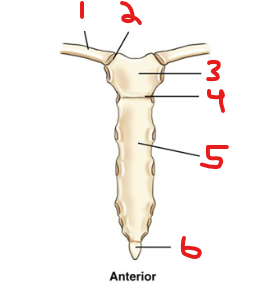
Label
Clavicle
Sternoclavicular Joint
Manubrium
Sternal Angle
Body
Xiphoid Process
List two additional terms to refer to the body of the sternum:
Corpus or Gladiolus
The only articulation between the bony thorax and the upper extremity is/are the:
Sternoclavicular Joint
Segments of the sternum may not fully fuse until _____ yr old.
25
RAO Sternum
________ degree oblique
This will shift the sternum to the right/left of the thoracic vertebrae.
Rotate hyposthenic patients more/less.
Rotate hypersthenic patients more/less.
15-20
Left
More
Less
The ‘axillary’ portion of ribs refers to this:
Which projections are best for visualization?
The area under the arm; curvature of the ribs
Oblique
Anterior Pain
PA/AP projection
Posterior/Anterior Obliques
PA
Anterior
Posterior Pain
PA/AP projection
Posterior/Anterior Obliques
AP
Posterior
Breathing
Above the diaphragm:
Below the diaphragm:
Inspiration
Expiration
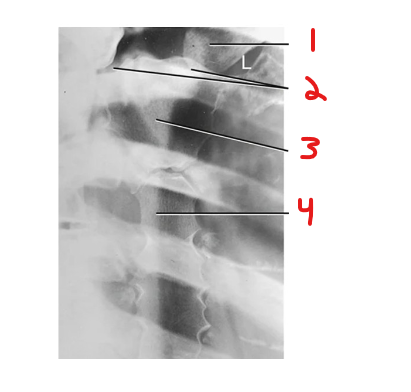
Label
Clavicle
Sternoclavicular Joint
Manubrium
Body of Sternum
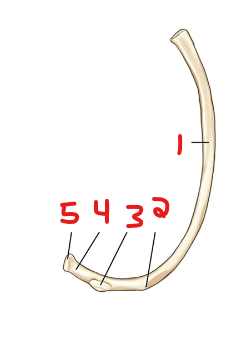
Label
Shaft
Angle
Tubercle
Neck
Head
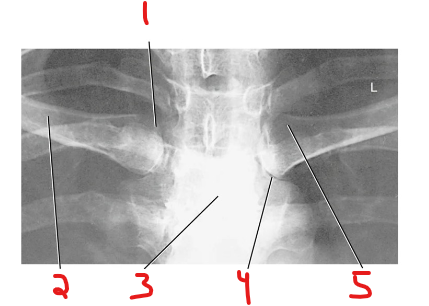
Label
Right SC Joint
Right Clavicle
Manubrium
Left SC Joint
Left Clavicle
Why an RAO over a PA or AP projection for the Sternum?
The oblique view is performed so the sternum is projected over the heart, which provides a homogenous density. Avoids superimposition of the spine.
What is the SID for all bony thorax imaging?
40”
Sternum CR
Center of sternum
Midway between jugular notch and xiphoid tip
Image Criteria: RAO Sternum
Sternum is visualized, superimposed on heart shadow
Shifts sternum to the left of the thoracic vertebrae
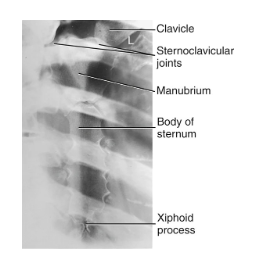
Image Criteria: Lateral Sternum
Entire sternum with minimal overlap of soft tissues
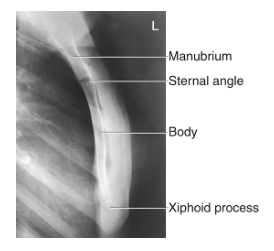
What is the routine for SC joints?
PA and Anterior Obliques (Both RAO and LAO)
SC Joints PA CR
MSP at lvl of T2-3
SC Joints Anterior Obliques CR
1-2” toward the upside from MSP @ lvl of T2-3
Rotate pt 10-15 degree for each oblique
Image Criteria: PA SC Joints
Bilateral SC Joints (for comparison)
Lateral aspect of manubrium
Medial portion of the clavicles visualized lateral to vertebral column through superimposing ribs and lungs
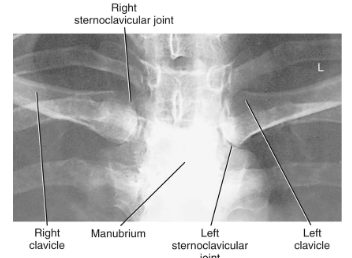
SC Joints: Anterior Obliques. Which joint is best visualized?
Downside SC joint is best visualized
RAO = right SC joint
LAO = left SC joint
Image Criteria: SC Joints Anterior Obliques
Both obliques are done for comparison
Manubrium
Medial portion of clavicles
Downside SC joint is best demoed
SC joint on the upside will be foreshortened
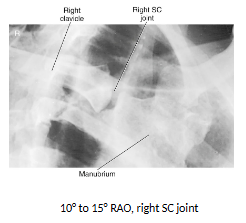
Rib Routine
Minimum of 2 projections that will:
Place the area of interest closest to the IR
Rotates the spine away from the area of interest
Possible CXR
Why is obtaining a patient hx for ribs exams required?
The patient’s hx will indicate what projections and positions must be performed.
Obtain the location of rib pain/injury
Which Rib Oblique: Right Anterior Pain
LAO
Which Rib Oblique: Left Anterior Pain
RAO
Which Rib Oblique: Right Posterior Pain
RPO
Which Rib Oblique: Left Posterior Pain
LPO
Rib Obliques
Anterior Pain
RAO or LAO
Affected side away from IR
Posterior Pain
RPO and LPO
Affected side is closest to IR
If your paitent is having right rib pain (unspecified as anterior or posterior), which two obliques may be acquired?
RPO and LAO
Unilateral vs Bilateral RIbs
Unilateral
One sided pain only
May be able to fit all ribs on 1 lengthwise IR
Radiation dose minimized
Bilateral
For comparision
May catch referred pain on other side
Preferred for trauma