Module 5 - Equivalence Class Testing
0.0(0)
Studied by 1 person Call Kai
 Learn
Learn Practice Test
 Spaced Repetition
 Match
Match Flashcards
 Knowt Play
Card Sorting
1/13

Earn XP
Description and Tags
Last updated 3:41 AM on 2/9/23
Name | Mastery | Learn | Test | Matching | Spaced | Call with Kai | Chat |
|---|
No analytics yet
Send a link to your students to track their progress
14 Terms
1
New cards
What is **partitioning**?
Partitioning refers to a collection of mutually disjointed subsets where the union is the entire set.
\
The entire set is represented and provides a form of completeness.
The disjointedness ensures a form of non-redundancy.
\
The entire set is represented and provides a form of completeness.
The disjointedness ensures a form of non-redundancy.
2
New cards
What are the **motivations** of Equivalence Class Testing?
1. To have a sense of complete testing
2. Boundary value testing has massive redundancy and serious gasps because the major focus is on the boundary.
3. Equivalence class testing can also handle robustness and single/multiple fault assumption.
3
New cards
Which **relationship** does equivalence class testing work best with?
Many-to-one relationships
4
New cards
What are the **five** equivalence testing techniques?
1. Traditional equivalence class testing.
2. Weak normal equivalence class testing.
3. Strong normal equivalence class testing.
4. Weak robust equivalence class testing.
5. Strong robust equivalence class testing.
5
New cards
What are the **perspectives** of equivalence testing techniques?
Normal (Valid Values)
Robust (Valid/Invalid Values)
Weak (Single Faults)
Strong (Multiple Faults)
Robust (Valid/Invalid Values)
Weak (Single Faults)
Strong (Multiple Faults)
6
New cards
What is **traditional** equivalence class testing?
This testing focuses on detecting invalid input.
\
For each variable, valid input is one one equivalence class and invalid input is in another.
\
There are 2n+1 test cases needed for n variables.
\
For each variable, valid input is one one equivalence class and invalid input is in another.
\
There are 2n+1 test cases needed for n variables.
7
New cards
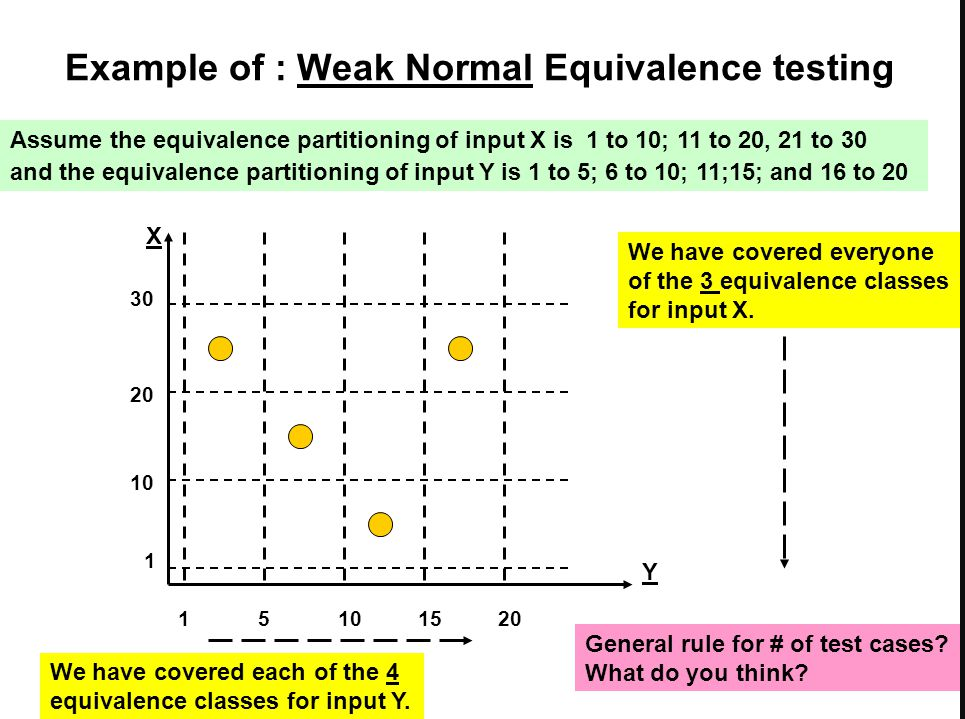
What is **weak normal** equivalence class testing?
This testing is accomplished by using one variable with valid input from each equivalence class to prepare a test case.
8
New cards
How many test cases should be prepared for the **weak normal** equivalence class testing?
The max number of equivalence classes from the set of variables.
9
New cards
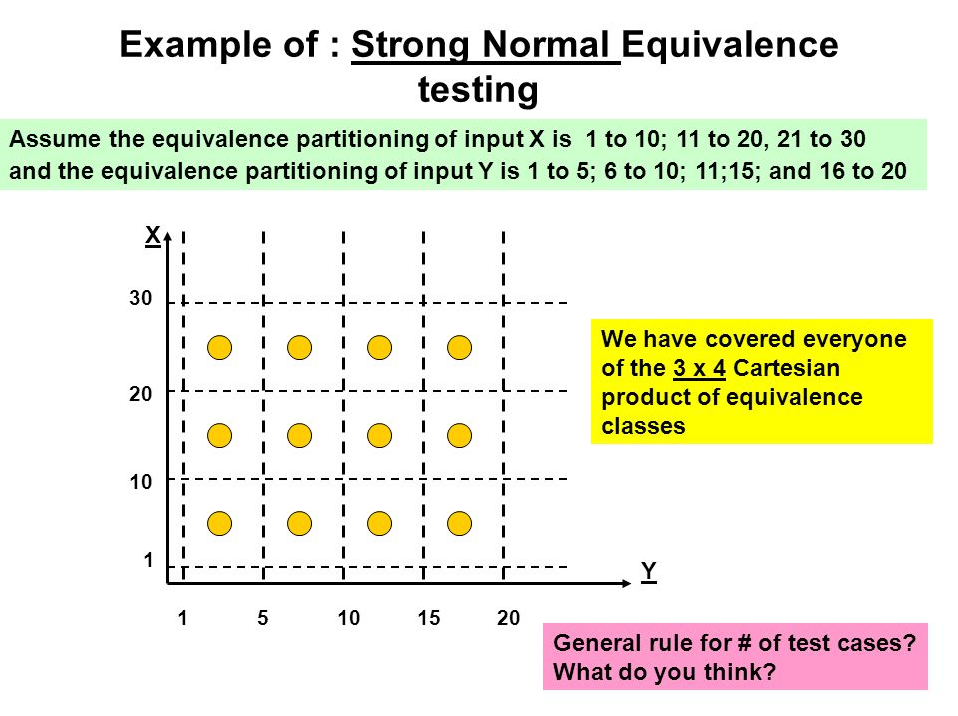
What is **strong normal** equivalence class testing?
This testing is based on the multiple fault assumption, so we need test cases from each element of the cartesian product of the equivalence classes.
10
New cards
How many test cases should be prepared for the **strong normal** equivalence class testing?
The product of the number of equivalent classes of each variable.
11
New cards
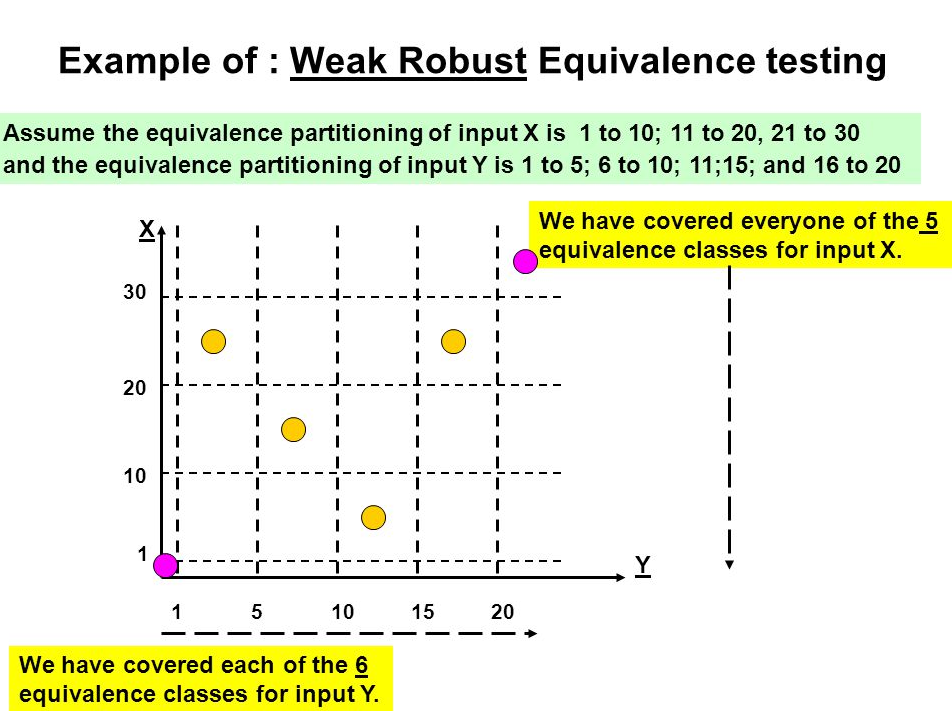
What is **weak robust** equivalence class testing?
This testing is accomplished by using one variable with valid or invalid input from each equivalence class to prepare a test case.
12
New cards
How many test cases should be prepared for the **weak robust** equivalence class testing?
The max number of equivalence classes of the variables + 2n where n is the number of variables.
13
New cards
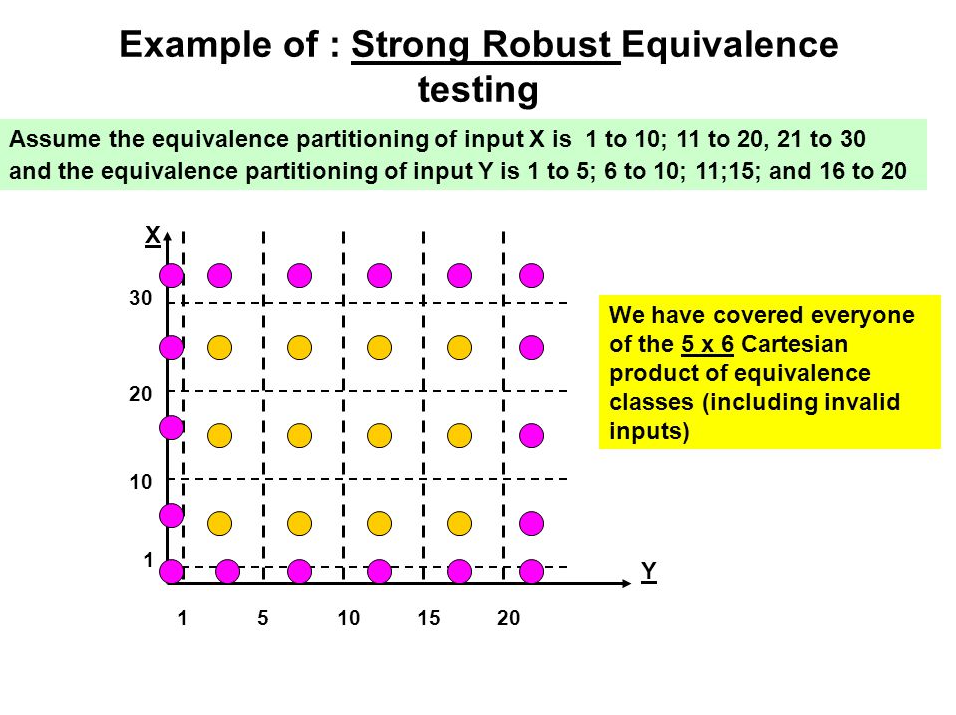
What is **strong robust** equivalence class testing?
This testing is based on the multiple fault assumption, so we need test cases from each element of the cartesian product of the equivalence classes. Both invalid and valid values are considered.
14
New cards
How many test cases should be prepared for the **strong robust** equivalence class testing?
The product of the number of valid equivalence classes + invalid equivalence classes