T3: Sensation and Perception
 Call Kai
 Learn
Learn Practice Test
 Spaced Repetition
 Match
Match Flashcards
 Knowt Play
1/149

There's no tags or description
Looks like no tags are added yet.
Name | Mastery | Learn | Test | Matching | Spaced | Call with Kai |
|---|
No analytics yet
Send a link to your students to track their progress
150 Terms
Attention
preferentially process some parts of a stimulus at the expense of processing of other parts of the stimulus
Why is attention needed
perceptual system has limited capacity - can’t process everything simultaneously
helps us avoid being overwhelmed
Overt attention
looking directly at an object
covert attention
looking at one object but attending to another object
fixation
when we look at an object
saccades
the ballistic (very fast) eye movements bw fixations
jumping around when looking
Two processes direct our attention
Initially, fixations are often involuntary
attentional capture
Then, the fixations are voluntary, goal directed and are influenced by our expectations
Involuntary direction of attention
Attentional capture: when scene initially presented, fixations captured by salient parts of scene - INVOLUNTARY
What influences attention?
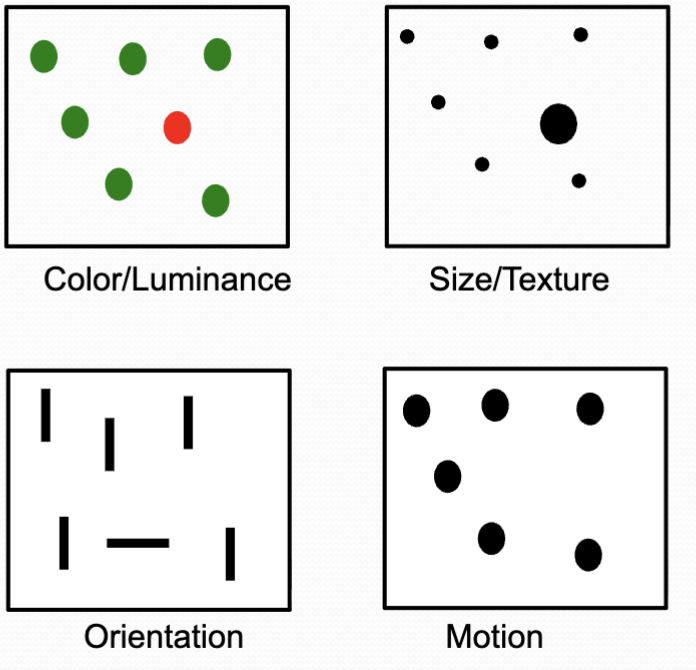
the salience of a stimuli - what captures our attention
Regions of colour contrast or luminance contrast
Regions of size contrast
Regions orientation contrast
Regions of motion/flicker contrast
Voluntary direction of attention
After initial first few fixations, you can direct your fixations towards goals
What influences the voluntary part of fixations
determined by cognitive factors such as the observer’s goals and expectations
Expectations influence on fixation
If an object is unexpected, you will fixate on it for longer and fixate it more often
eg. semantically inconsistent: not on theme/doesn’t belong
eg. laminator on stove
syntactically inconsistent: doesn’t make sense
eg. pan hovering in thin air
(Vo & Henderson, 2009)
What are the effects of attention
Attention speeds responses
Attention can influence appearance
Attention can influence physiological responding
Attention speeding responses evidence
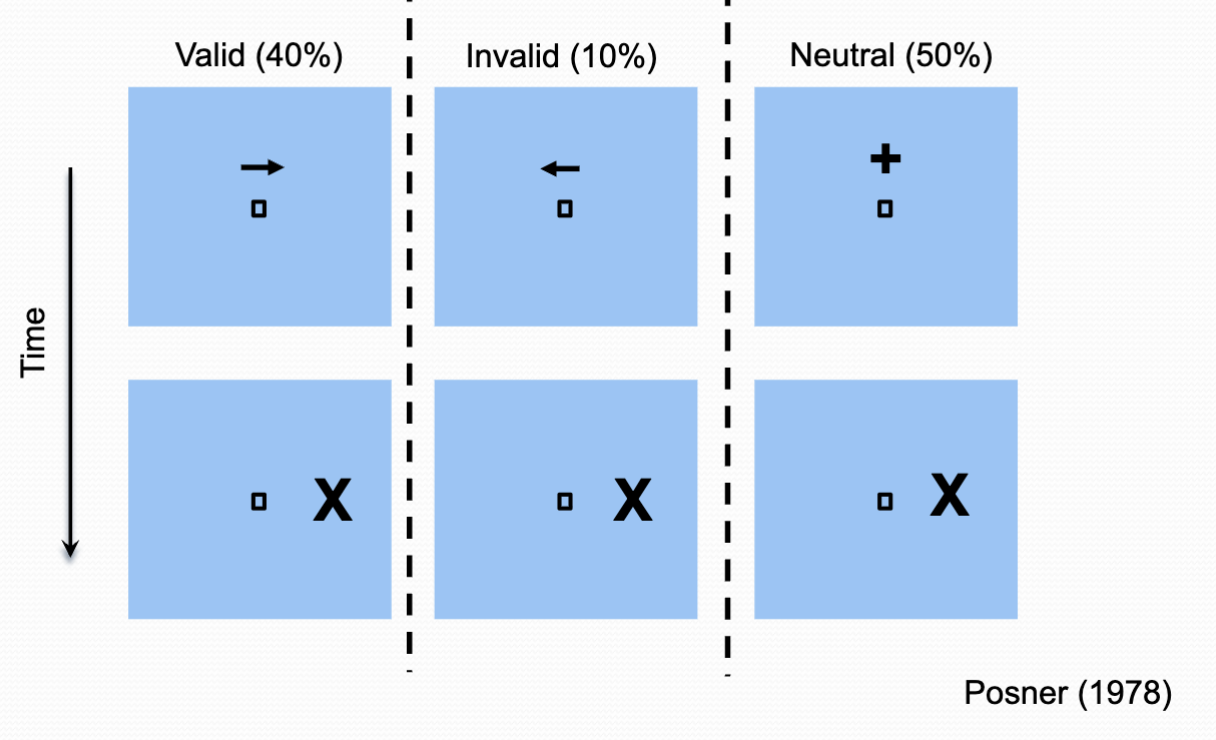
Posner (1978)
Valid = arrow points to where X is and you attend there so the time taken to spot X is quicker
Invalid = throws you off as you are attending to opposite side so slower
Neutral = No indication so takes longer
Attention changing contrast of an object
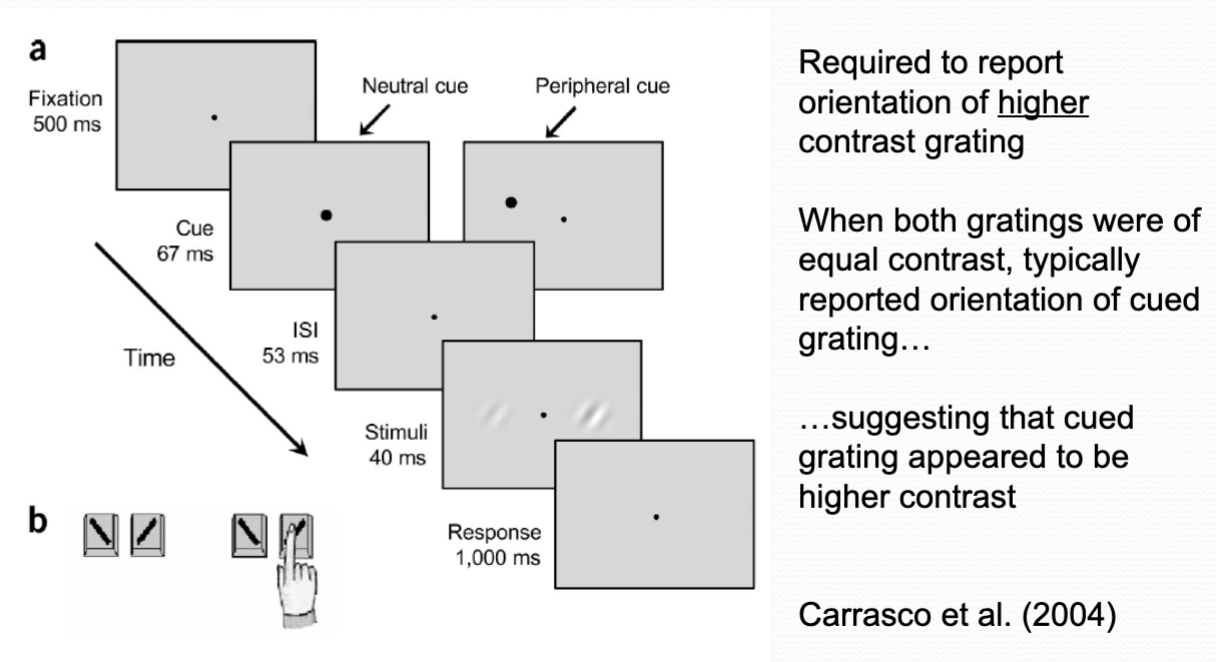
Carrasco et al. (2004)
attention makes perception more vivid - appearance of stim. changes
makes objects appear to have higher contrast
Attention influencing physiological responding
neurons in the brain respond more strongly to attended stimuli than to unattended stimuli
The Binding problem
Different aspects of a stimulus are processed independently, often in separate brain areas
eg. motion is processed by the dorsal stream and form is processed by the ventral stream
The issue of how an object’s individual features are combined (i.e. bound) to create a coherent percept is known as the binding problem.
eg. how can we see a red vertical and green horizontal? how do we associate correct colour with correct object?
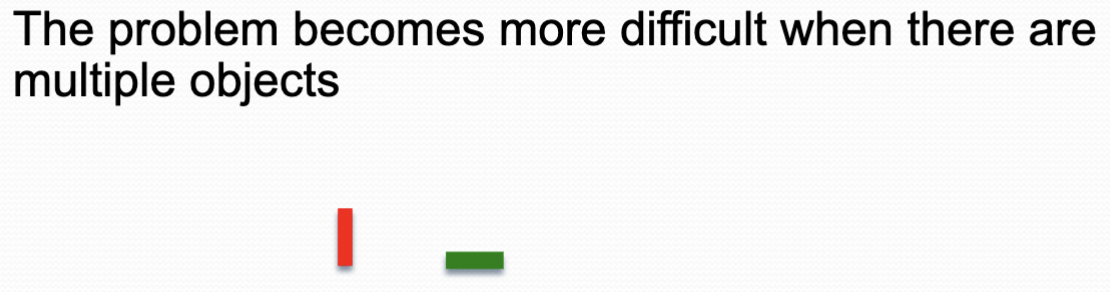
Feature integration theory (FIT)
suggests that the binding problem is solved by attending to only one location at at time.
only features assoc. with that location are processed and so only those bound tgt
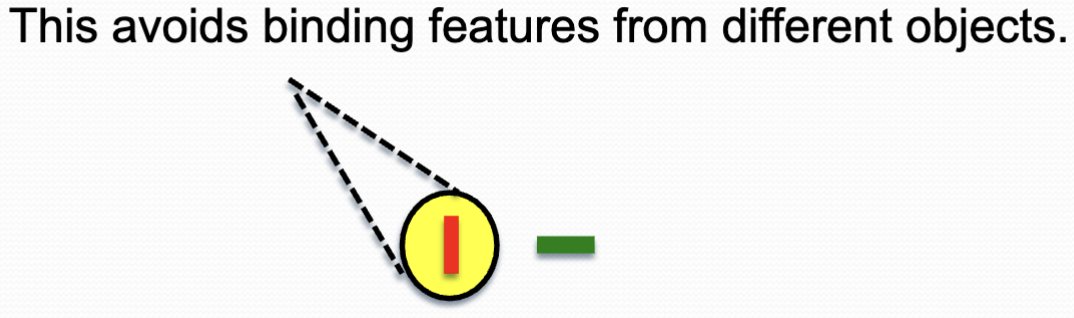
Illusory Conjunctions
Treisman & Schmidt (1982) said that binding of two diff objects mixed up creating percept that does not exist
Their goal was to attend to the digits so they weren’t attending to the letters. Therefore, they would get the colours and letters right but mix up which colour for which letter
This is because they weren’t attending to them → creating an illusory conjunction
Balint’s syndrome
RM has parietal lobe damage and when multiple objects present, he finds hard to focus attention on single object
when shown 2 letters with diff colours - reported wrong 23% of time even with 10secs to see them
prone to illusory conjunctions bc could not focus attention on just one object
Visual search
Binding might be necessary for visual search if target has same features as distractors
Conjunction search
If target differs from distractors only by particular conjunction then conjunction search
FIT predicts that in this type of search - attention needs to apply to each object one at a time to determine whether or not the attended object is targer
very slow search
Feature search
other type of visual search where target contains feature that distractors dont contain
binding doesn’t need to occur and don’t need to look at each on at a time
faster
Key idea about visual searches
Visual searches that require the binding problem to be solved (e.g. conjunction searches) are predicted to be slow
Visual searches that don’t require the binding problem to be solved (e.g. feature searches) are predicted to be fast.
Change blindness
Attention can also determine what we remember.
If you don’t attend to it, chances are you won’t remember it.
We can only remember some parts of a scene at one time
if one of those parts change, you notice, if other part changes - you won’t notice = change blindness
Motion transients - why change blindness doesn’t occur all the time
changes cause motion transients that draw attention to location change = so its easier to spot change
when blank screen in bw - motion transients occur for EVERY part of image not just changed parts so no guide for attention to change
Change blindness TUTORIAL
Central Interest (CI) vs Marginal Interest (MI)
Changes to objects people considered important/central to the scene's meaning (CIs) were detected much faster than changes to peripheral/unimportant details (MIs) — even when the MI changes were objectively larger in size.
This shows attention is guided by high-level interest/meaning, not just low-level visual salience.
A → A’ one flick trial
The Verbal Cue Experiment
When participants were told in advance what part of the scene to watch (a valid cue), detection sped up dramatically — for both CI and MI changes. Invalid cues slightly slowed things down.
Why this matters: it proves the difficulty isn't about visibility (the information was always there) — it's about knowing where to direct attention
Why some best computer algorithms misclassify objects
common objects presented at unusual angles misclassified - so object perception is hard
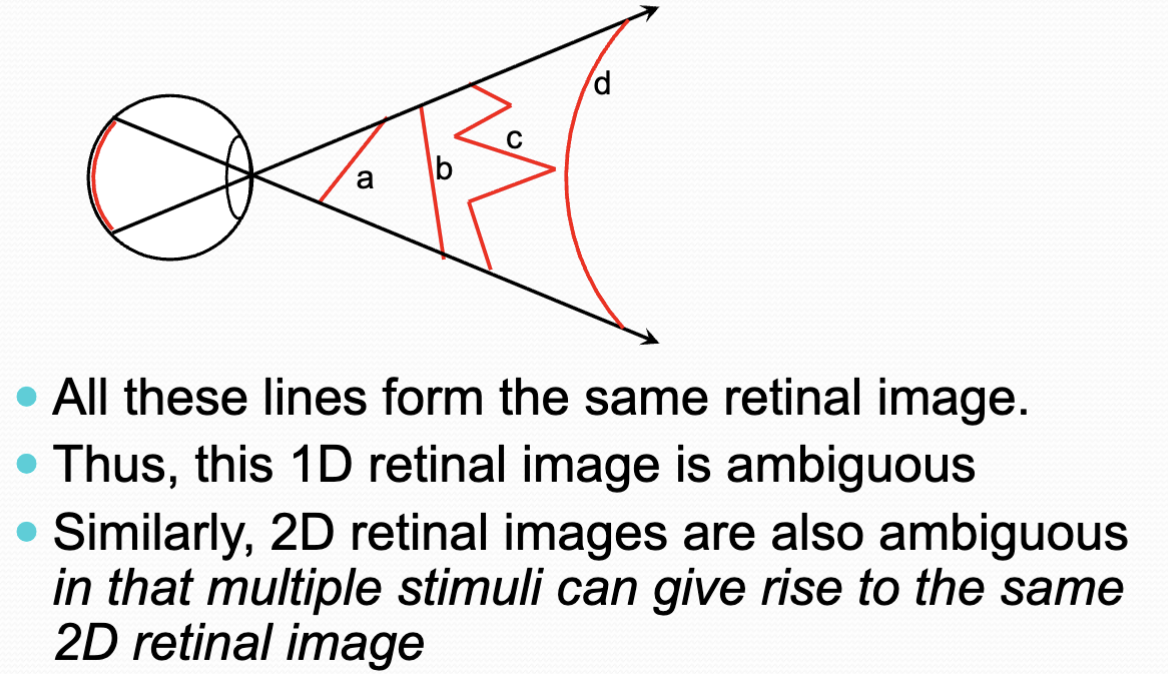
The stimulus on the retina is ambiguous
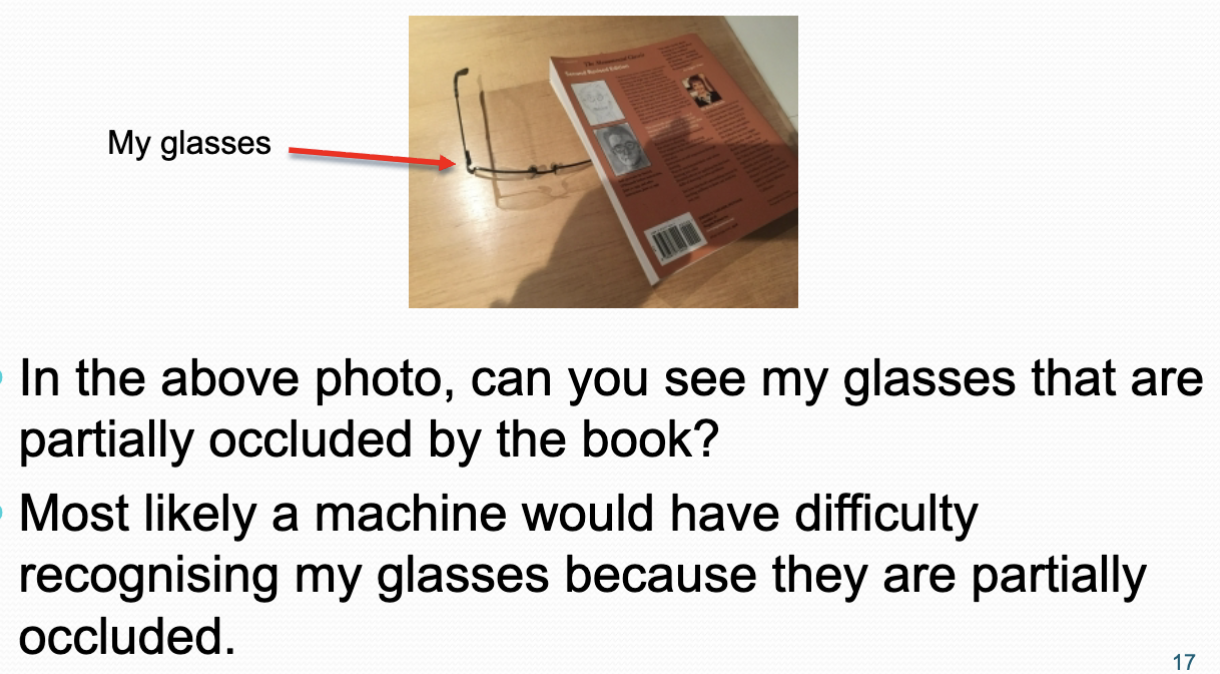
Objects can be hidden or blurred
Objects look different from different viewpoints and in different poses
Difficulty 1: stimulus on retina is ambiguous
Difficulty 2: objects partially occluded or blurred
Difficulty 3: objects look diff from diff viewpoints
Machines find it hard to recognise objects when they appear in unexpected poses or are viewed from unexpected angles
How do humans succeed?
Structuralism
Gestaltism
Structuralism
distinguishes bw sensations and perceptions
sensations: elementary processes that occur in response to stimulation
perceptions: conscious awareness of objects and scenes
Conscious awareness is the sum of elementary sensations
contains nothing that was not already present in elementary sensations
Gestaltism
directly contradicts Structuralism - conscious awareness is more than the sum of the elementary sensations
conscious awareness can have characteristics not present in any of the elementary sensations
Gestaltism evidence
There are two main pieces of evidence that support the claim that conscious awareness can be more than the sum of the elementary sensations
Apparent motion
Illusory contours
Apparent motion
observer sees two stationary dots flashed in succession and although stationary we perceive motion
conscious awareness/percept has character (MOTION) not present in elementary sensations (bc both stationary)
Illusory contours
Illusory contours are seen in locations where there are no physical contours.
The conscious awareness of the illusory contour is constructed – there is no physical contour at these locations.
Final gestaltism vs structuralism
There is plenty of evidence that conscious awareness is constructed and can contain characteristics not physically present in the image.
eg. motion can be perceived when there is no motion in the image (e.g. apparent motion)
eg. contours can be seen when there are no contours in the image (e.g. illusory contours)
This evidence argues against Structuralism but in favour of Gestaltism.
Perceptual organisation
Together, grouping and segregation allow a scene to perceptually organised into its constituent objects thereby allowing observers to make sense of the scene.
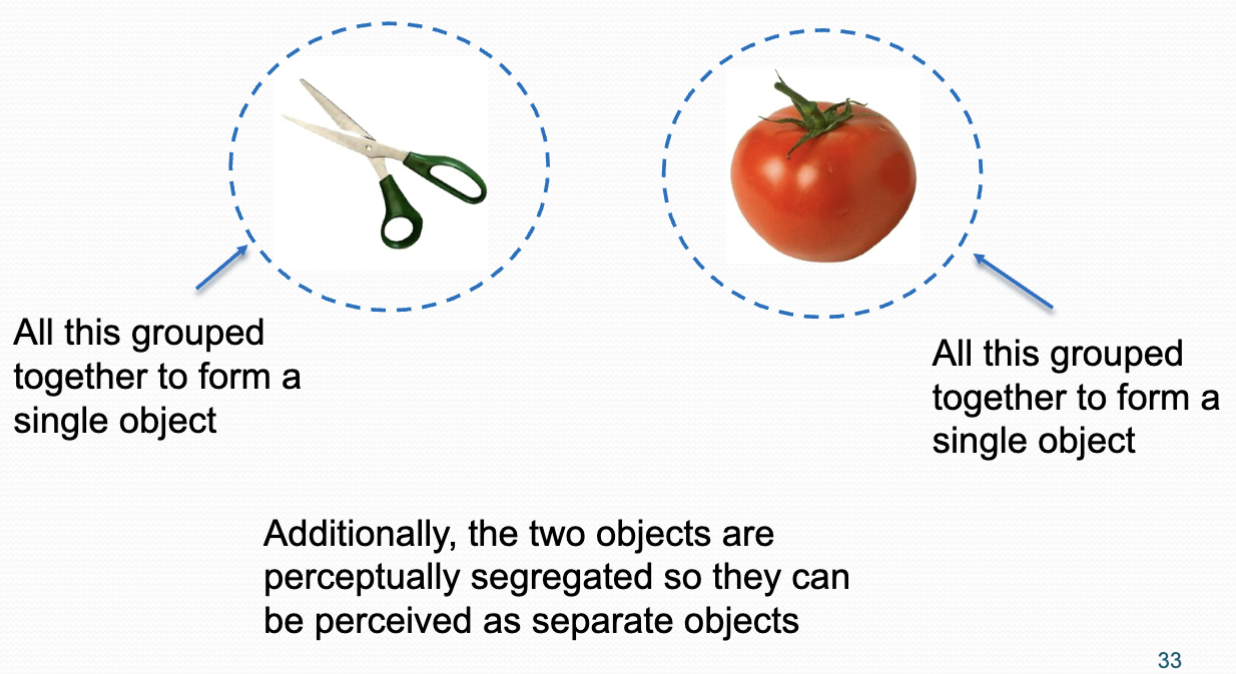
Grouping
process by which parts of an image are perceptually bound together to form a perceptual whole (e.g. the perception of an object)
Segregation
process by which parts of a scene are perceptually separated to form separate wholes (e.g. the perception of separate objects)
Gestalt principles of grouping
Grouping is governed by 5 key principles. The more of these principles that apply, the more likely components of an image will be grouped together to form a perceptual object.
Original Gestalt principles
Good continuation
Prägnanz
Similarity
Proximity
Common fate
Two additional ones (added later)
Common region
Uniform connectedness
Good continuation
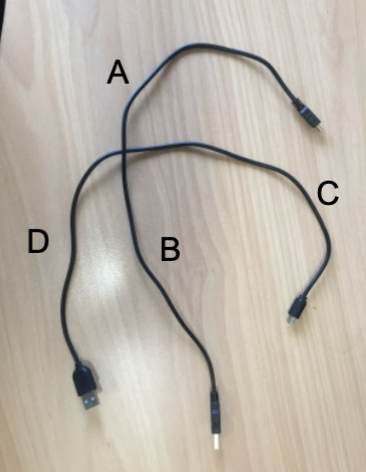
Aligned (or nearly aligned) contours are grouped together to form a single object.
This is why contour A is grouped with contour B, instead of with contours C or D
Prägnanz: principle of good figure
Essentially, groupings occur to make the resultant figure as simple as possible.
In the figure you see a panda, not a collection of unconnected splotches.

Similarity
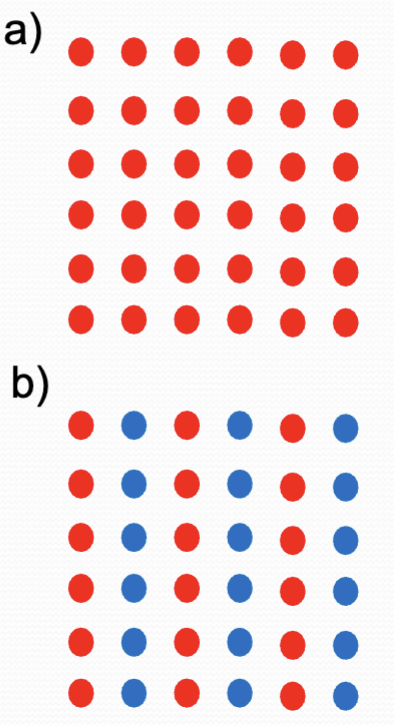
The more similar objects are, the more likely they will be grouped together.
In a), all the dots are the same colour so it is unclear whether things are organised vertically or horizontally.
In b), colour similarity groups the dots into columns
Proximity
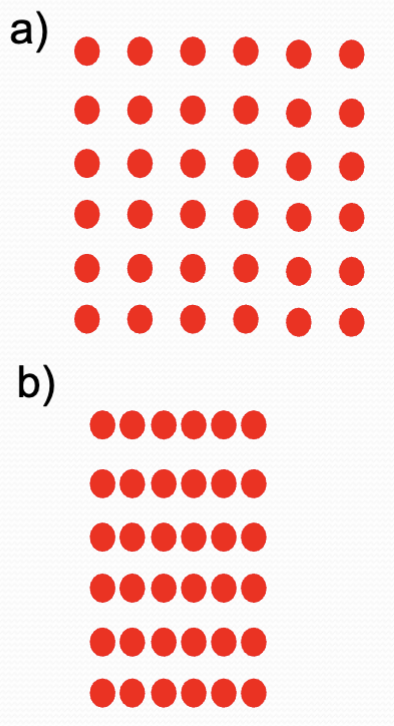
The closer the dots are, the more likely they are to be grouped together
In b), grouping by proximity forms horizontal rows
Common fate
Things that are moving in the same way are grouped together.
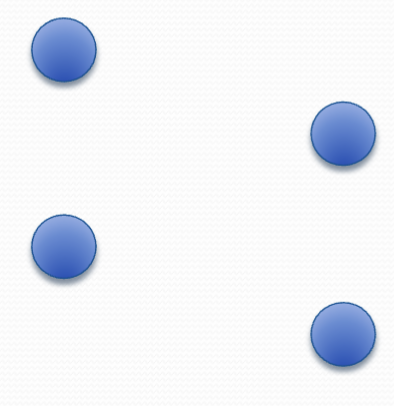
Common region
Elements that are within the same region of space tend to group together (Palmer, 1992)
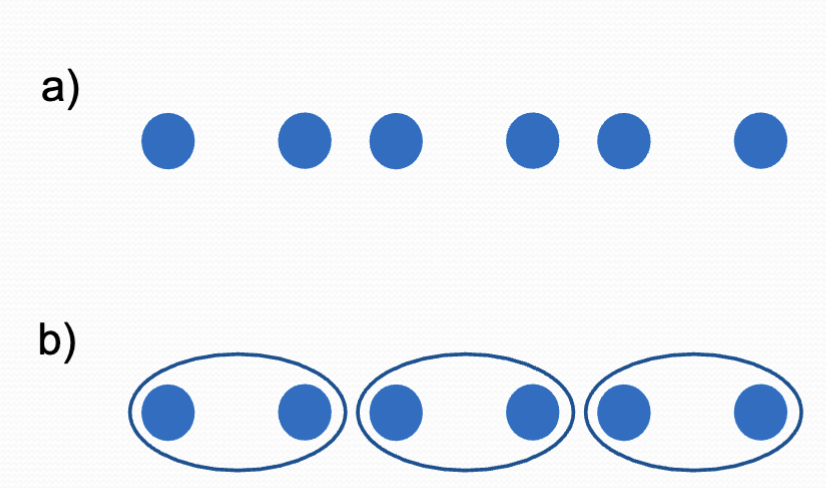
Uniform connectedness
Connected regions with the same visual characteristics (e.g. colour) tend to group together
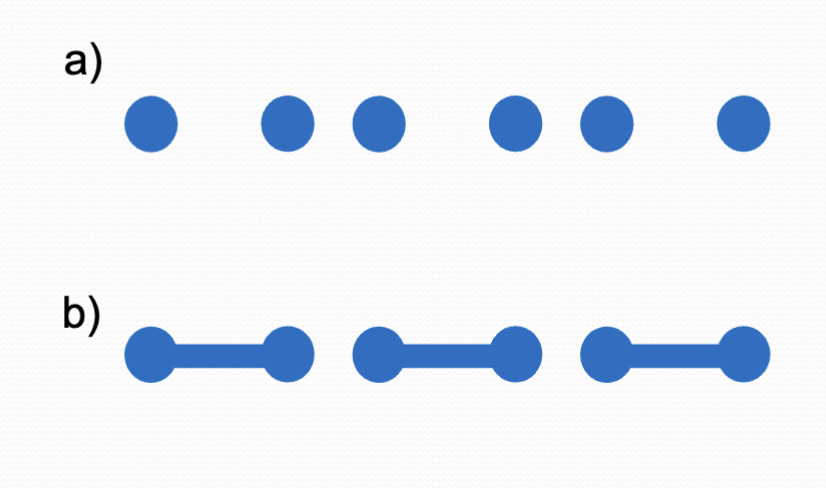
Segregation - not just within
not enough to group components of an image together to form an object, you also need to segregate the different objects in the scene from each other and also segregate the objects from the background
Figure-ground segregation
objects are normally perceived as “figures” and the background is typically perceived as the “ground”
Consequently, if you can identify what the figure is, you can typically identify the objects.
Figural properties
Regions of the image are more likely to be seen as figure if:
They are in front of the rest of the image
They are at the bottom of the image
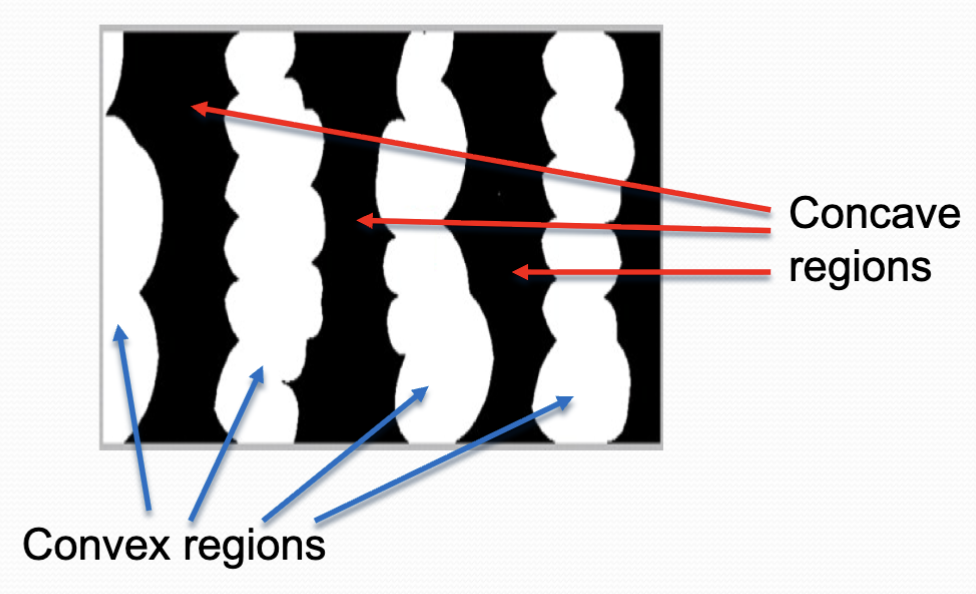
They are convex
They are recognisable.
Rubin vase - figural properties
Regions of an image in front of the rest of the image tend to be seen as figures
(i.e. they are seen as objects)
Rubin vase is ambiguous as it can be perceived as either a vase or two faces
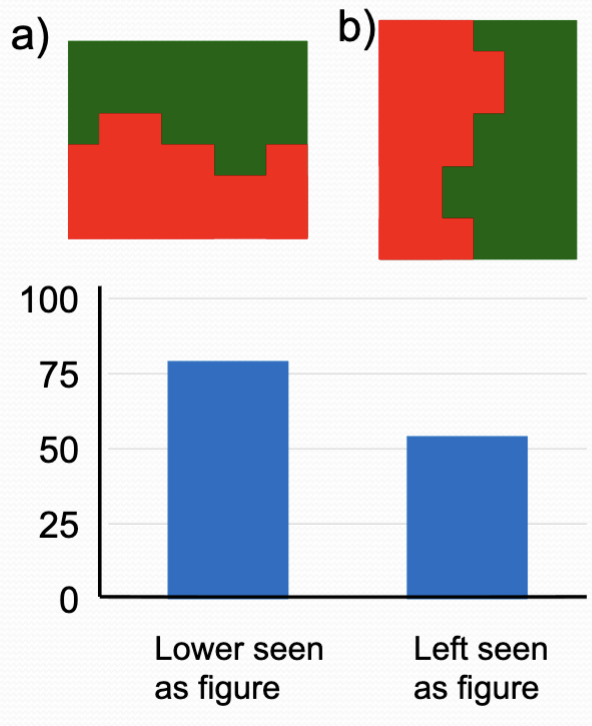
Lower areas perception as figures
No left-right bias though
only lower ground = figural properties
Vecera et al. (2002)
Convexity (Peterson & Salvagio (2008))
Convex regions are assumed to be figures (i.e. objects)
Experience effect of determining figure
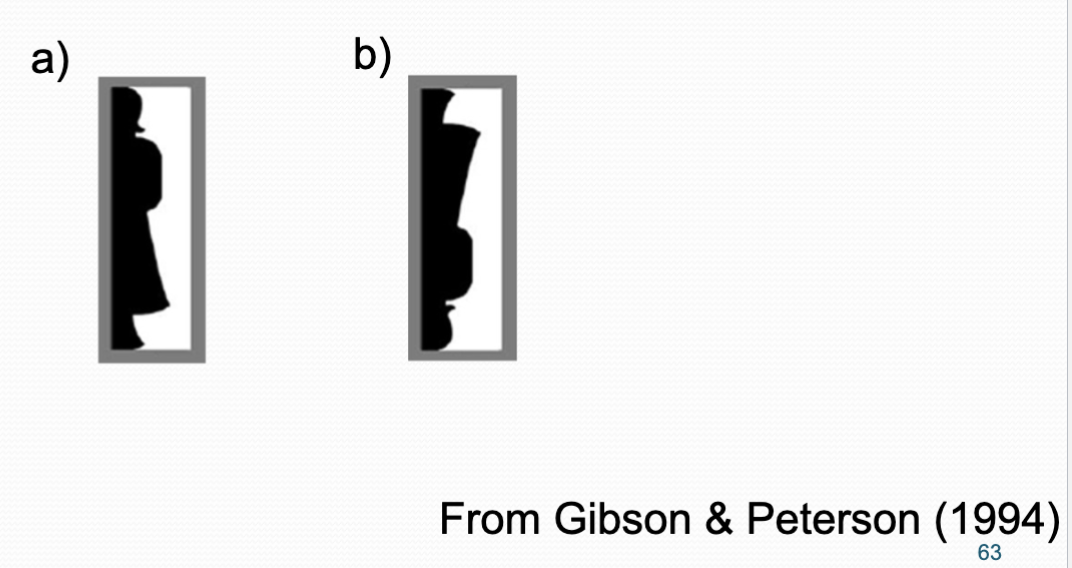
People also used past experience to segregate overlapping objects
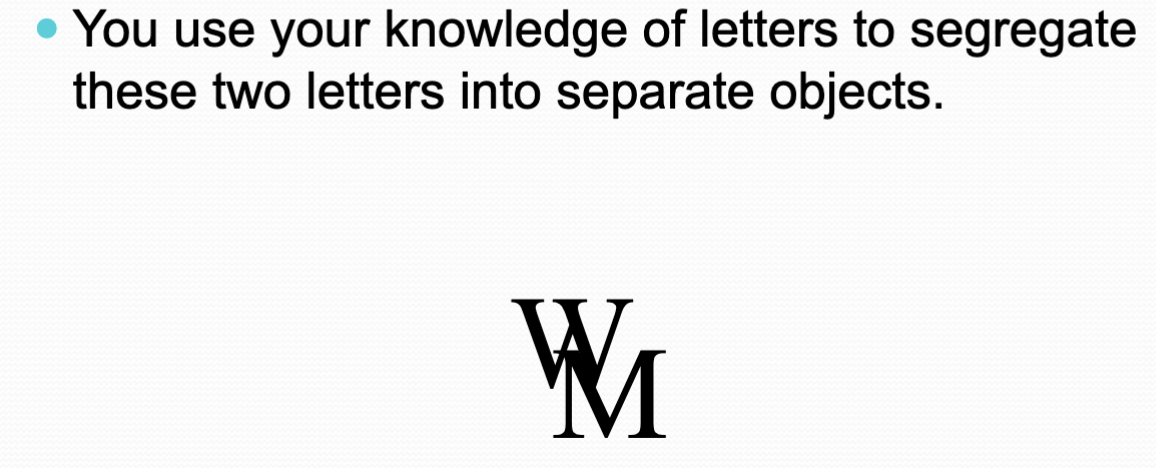
Experience
As a) is in a familiar orientation it is easier to segregate it from the background than in b)
once we see it, we cannot unsee it
Gist perception
When scenes are flashed rapidly in front of an observer, she may not be able to identify all the objects in the scene.
she might think that the image shows “a crowded cafe” so overall impression is gist
Gist perception
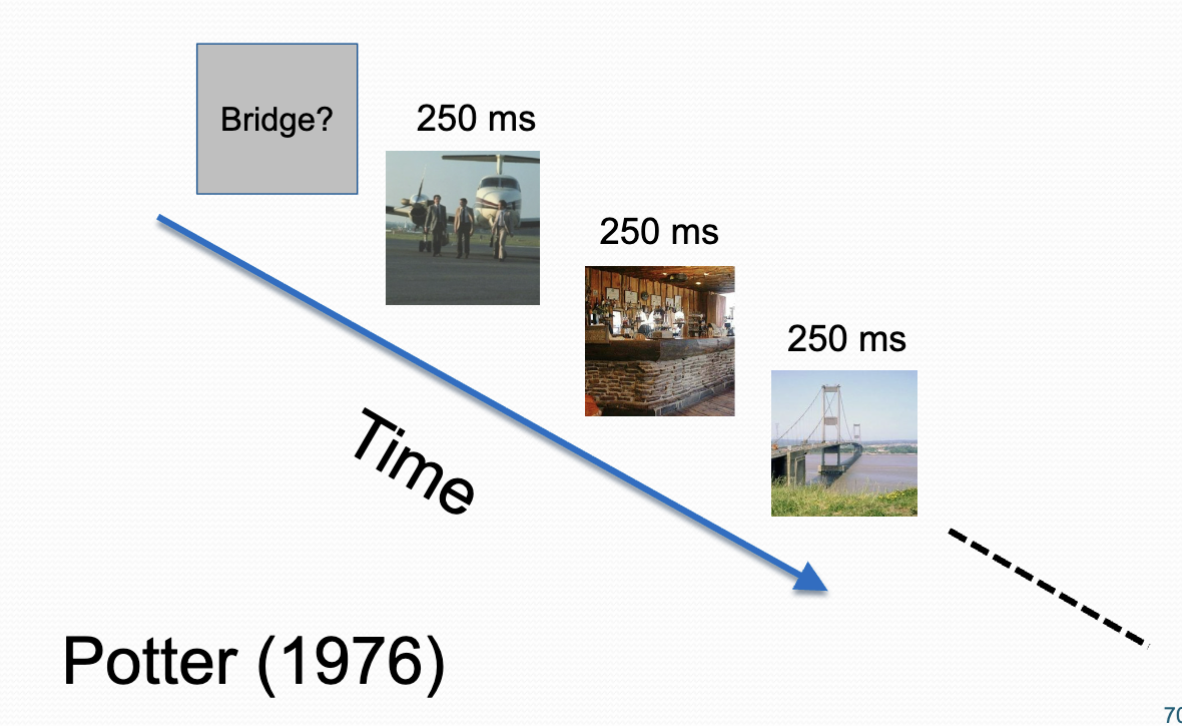
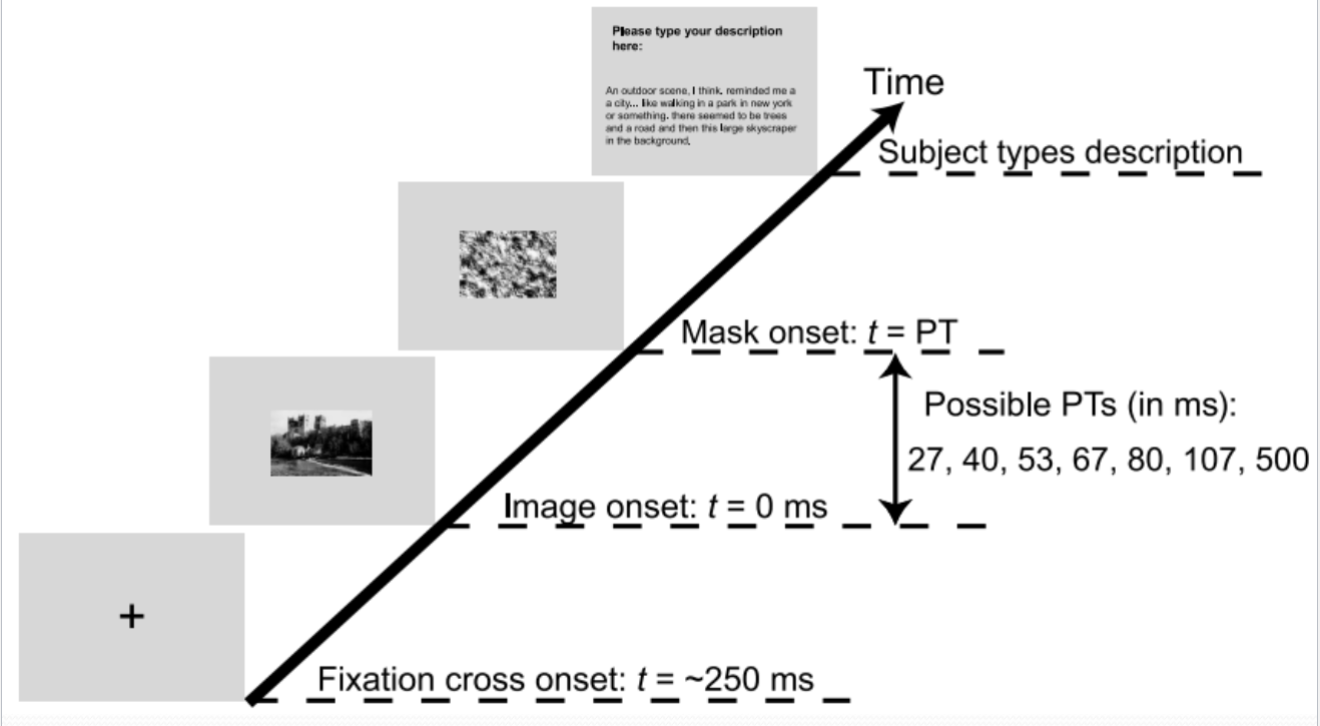
Potter (1976) studied gist perception using the following paradigm.
In each trial, the observer was cued with a particular scene description. - eg. bridge
Then she saw 16 randomly chosen scenes, each for 250 ms.
Then she was asked if any of the scenes fitted the description.
Observers were at near 100% accuracy.
This showed that observers can rapidly perceive a scene’s gist.
Fei-Fei → minimum exposure time req. for gist perception
could start perceiving aspects at 27ms
longer time = more detailed + accurate descriptions
THEREFORE, although gist extracted very quick - may not be detailed - very accurate perception in 250ms but gist in 27ms
Function of motion perception
motion attracts attention and help us segregate objects from the background.
Help break camouflage
Help attract attention
Help segregate objects from the background.
Help us interpret events.
Help us determine the structure of objects
Help us determine what actions people are performing
How motion helps interpret events
By seeing how objects interact, you can infer causality relationships and even social relationships.
gestures etc.
Inferring structure from motion
help us determine the shape of a moving object
This is sometimes referred to as the “kinetic depth effect”
eg. seeing smth from one angle and then it turning and you can recognise as 3D
Interpreting actions from motion
While static poses are often ambiguous when someone moves, their actions and intentions are often made clear
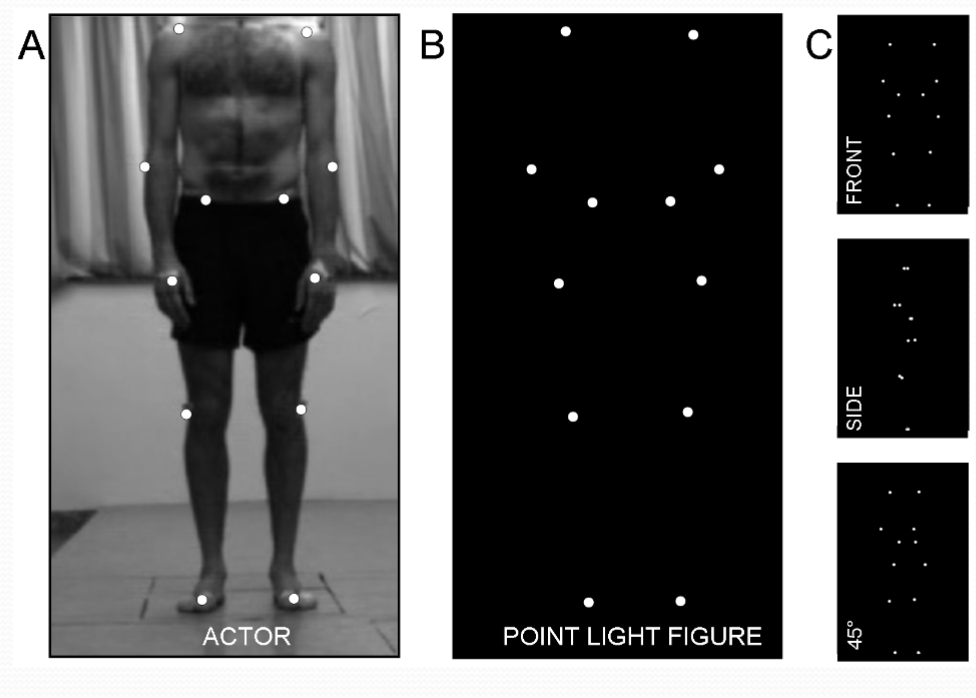
Point-light walkers
Point-light walkers are created by placing lights on a person’s joints and having them perform an action (e.g. walking!)
humans so good with processing stim. that they guess what action
Condition where can no longer perceive motion
akinetopsia
Case study of akinetopsia: L.M.
She had difficulty pouring cup of tea, crossing street, following speech
could see that things HAD moved but couldn’t see them MOVING
no motion perception
When do we perceive motion?
Real motion (smth actually moving)
Illusory motion (nothing actually moving)
Motion aftereffects
Induced motion (moving background causing still object to appear to move)
Types of Illusory motion
Rotating snakes illusion (Kitaoka & Ashida, 2003)
Apparent motion
Rotating snake illusion
Don’t know why static illusion gives impression of motion
caused by contrast bw the colours but unclear why that leads to percept of motion
Apparent motion
Series of stationary images presented in succession to give impression of motion
eg. two slides with dots in diff positions looks like dot moving
Korte’s Third Law of Apparent Motion
only works with dots sufficiently close tgt - if too far apart then no motion perception
as separation increases alternation rate needs to decrease
Apparent motion and colour
mostly insensitive to colour changes
but colours changes can make movement appear to be going certain ways
Motion aftereffect
when something is constantly moving in one direction, if you look at smth near it - all of a sudden it will look like its moving the opposite direction
Induced motion A
A nearby object (usually a large one) either affects the perceived motion of a second object (usually a small one) or causes a second object to appear to move
Large, surrounding objects tend to be treated as the "stationary frame"
Small, enclosed objects tend to be treated as "the thing that's moving"
Motion induced change blindness
Normally colour changes attract attention because of the transient signals associated with the change (i.e. the “flicker”)
However, when things are moving, there are transient signals associated with all objects – not just the ones that are changing
Thus, attention is no longer drawn preferentially to the changing objects, so the changes are not noticed.
EG. when dots are stationary, its easy to notice them changing colour but when they move its harder to notice
Motion illusions
inform us of the processes underlying motion perception
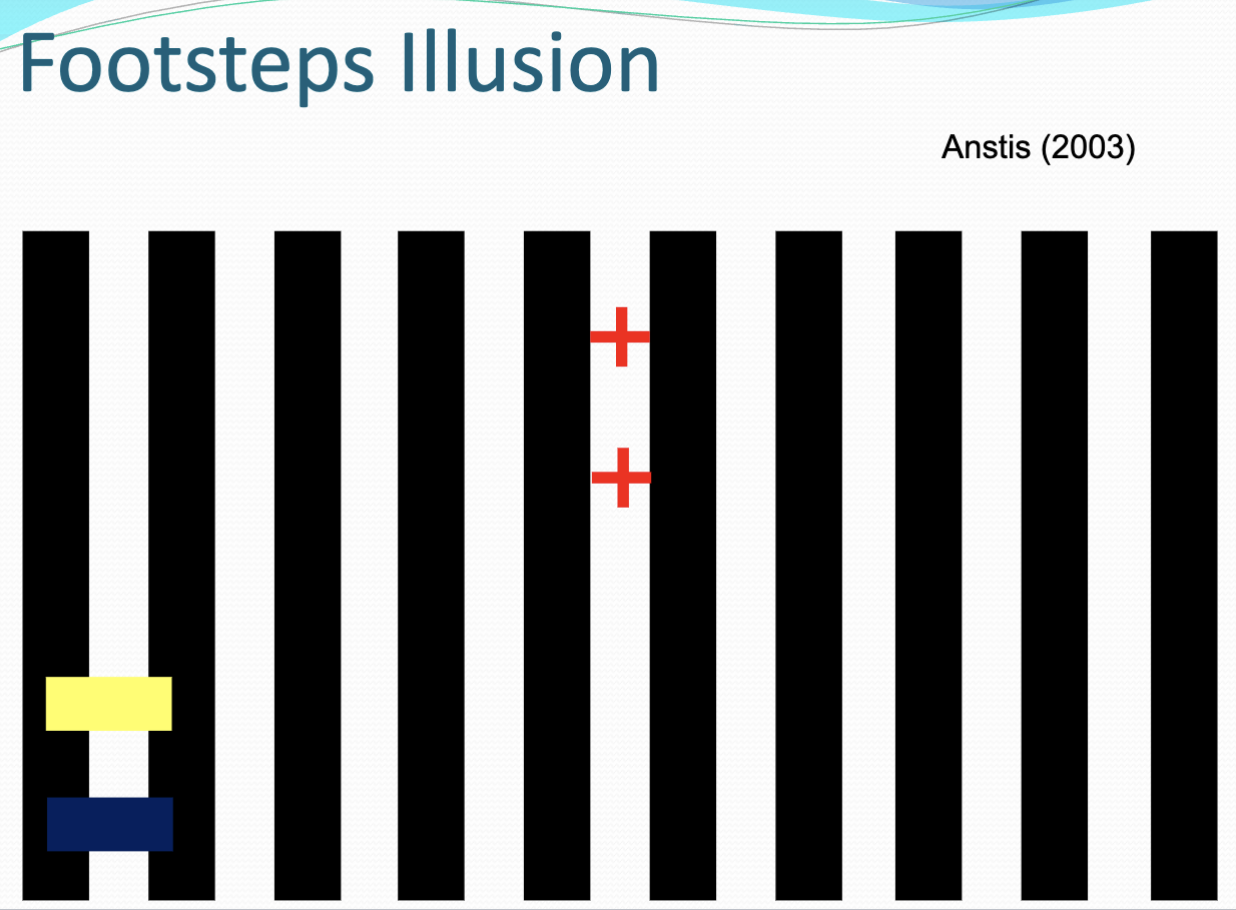
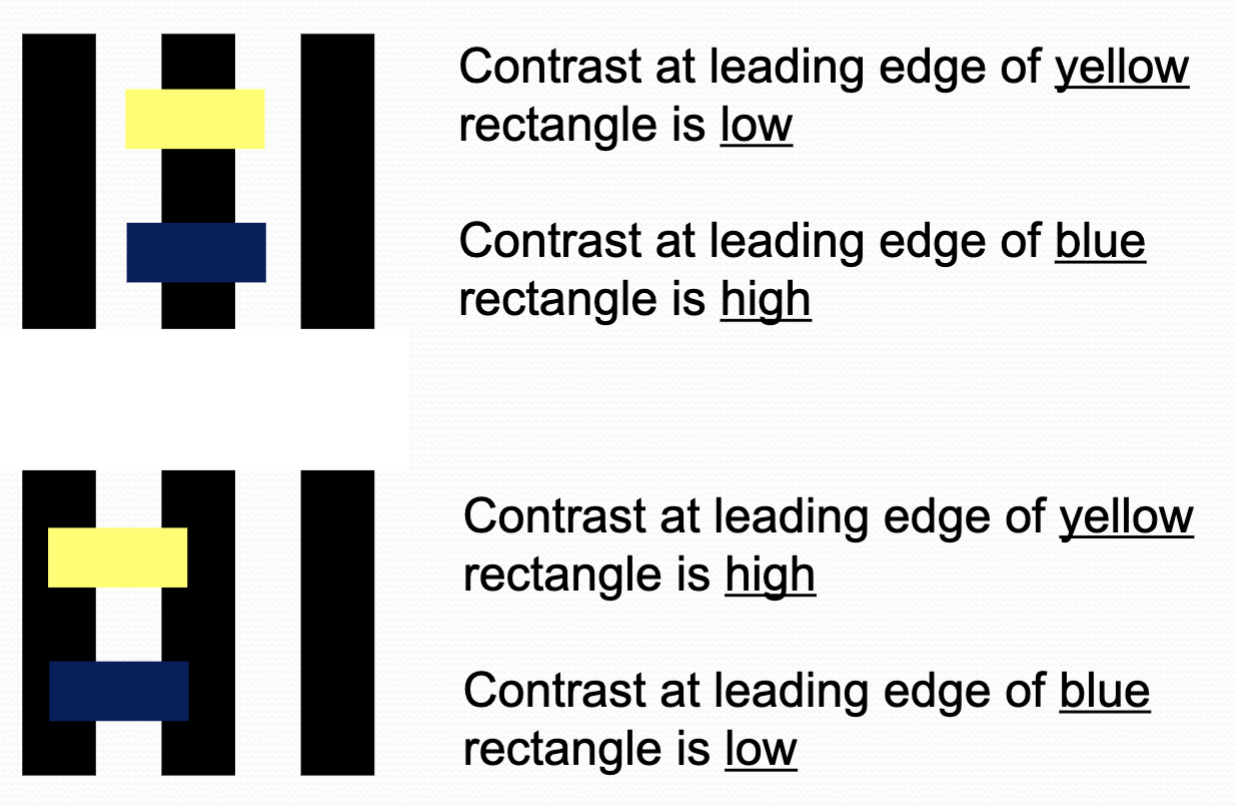
eg. the Footsteps Illusion shows us that contrast affects motion perception. As the yellow and blue rectangles traverse the striped background, they appear to speed up and slow down asynchronously.
Explaining contrast in motion illusions
higher contrast = easier to see = appears faster
As the rectangles traverse the striped background the contrast at the lead edges vary.
When the contrast is high, they appear to move faster.
When the contrast is low, they appears to move slower.
When the contrast the leading edge of the yellow rectangle is high the contrast at the leading edge of the blue rectangle is low (and vice versa)
Consequently, the yellow and blue rectangles appear to speed up and slow down asynchronously.
Apperture problem
If you can’t see the ends of a line, the movement of a line is ambiguous.
the motion of the line viewed through an aperture is ambiguous and is “captured” by the movement of the terminators (the points where the line joins the aperture)
When the terminators move horizontally, the line appears to move horizontally.
When the terminators move vertically, the line appears to move vertically.
When we can see that actual ends of the line, we can see its actual motion
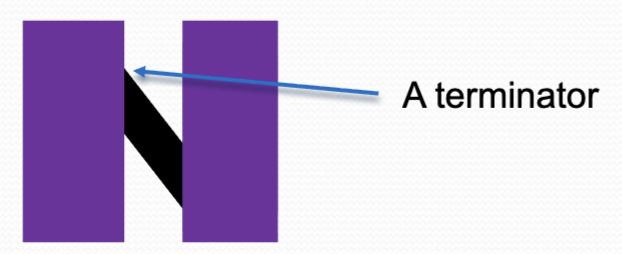
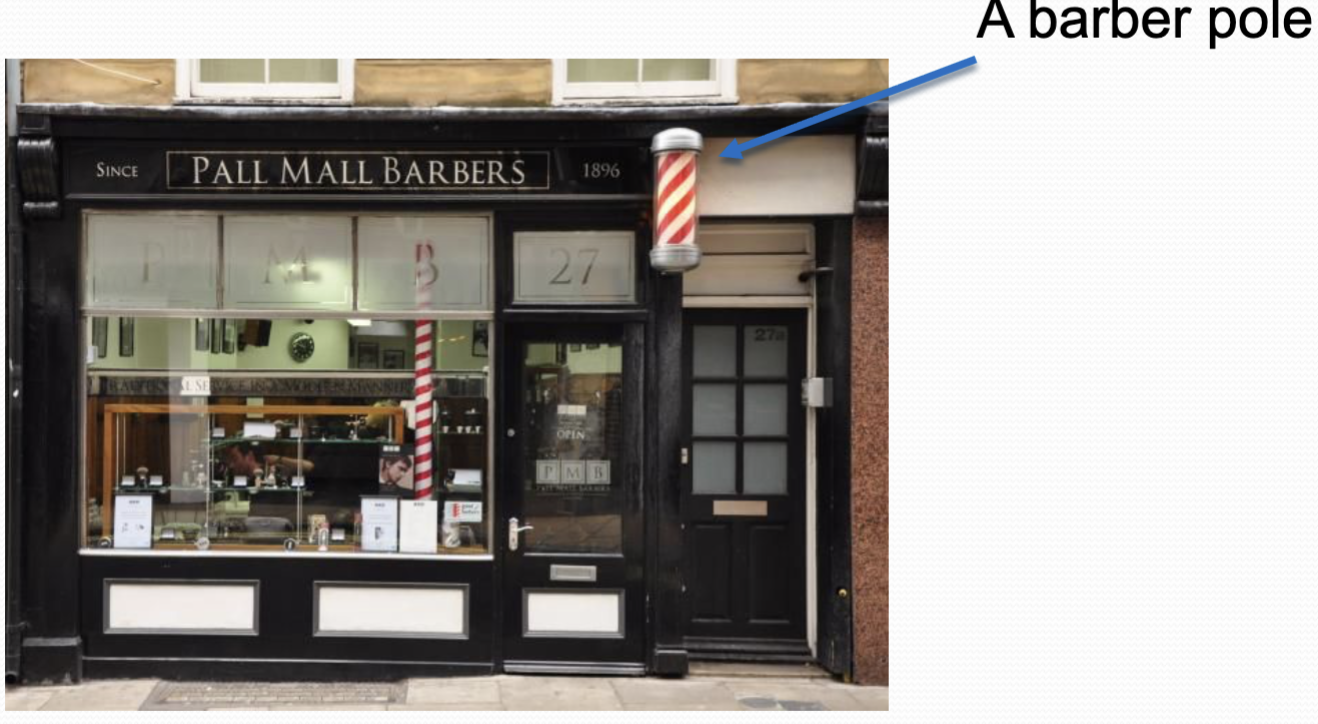
Barber Pole Illusion
In this illusion, lines curve around a cylinder creating virtual terminators that move vertically.
Thus, the lines themselves appear to move vertically.
Function of colour perception
Find things (like berries)
Determine if fruit is ripe
Spot (and identify) poisonous animals
Identify a potential mate
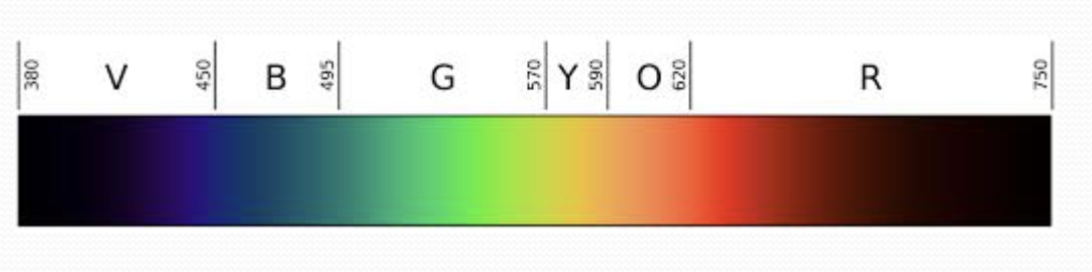
Visible light
Visible light is electromagnetic radiation with wavelengths varying from about 400 nm to about 700 nm
White light is a mixture of all these wavelengths
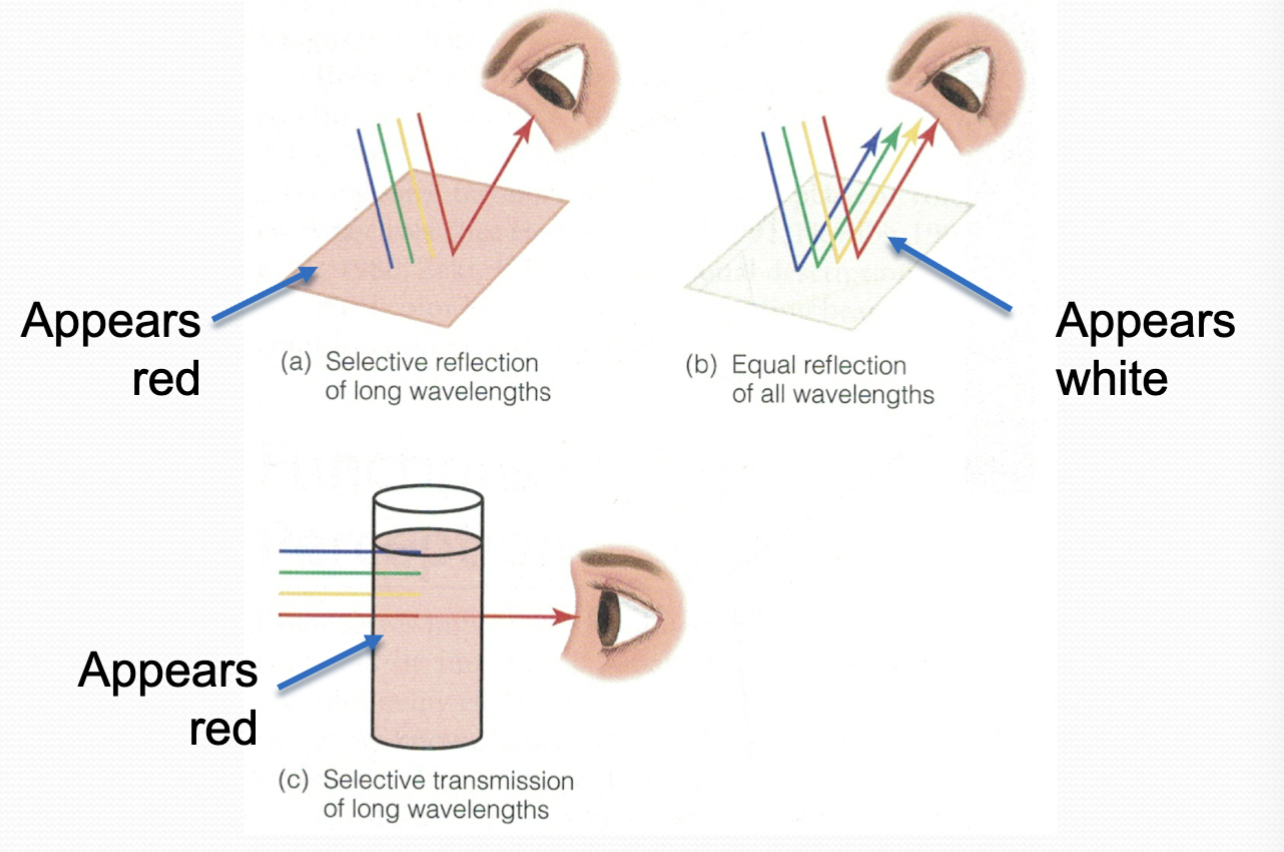
Colour of opaque objects
An opaque object is an object that light cannot pass through. It is not at all transparent.
The colour of an opaque object is determined by the light that it reflects
If an opaque object reflects all light, it will appear white
Colour of Transparent Objects
The colour of a transparent object is determined by the colour it transmits.
eg, If an object absorbs blue but transmits red, then it will appear red
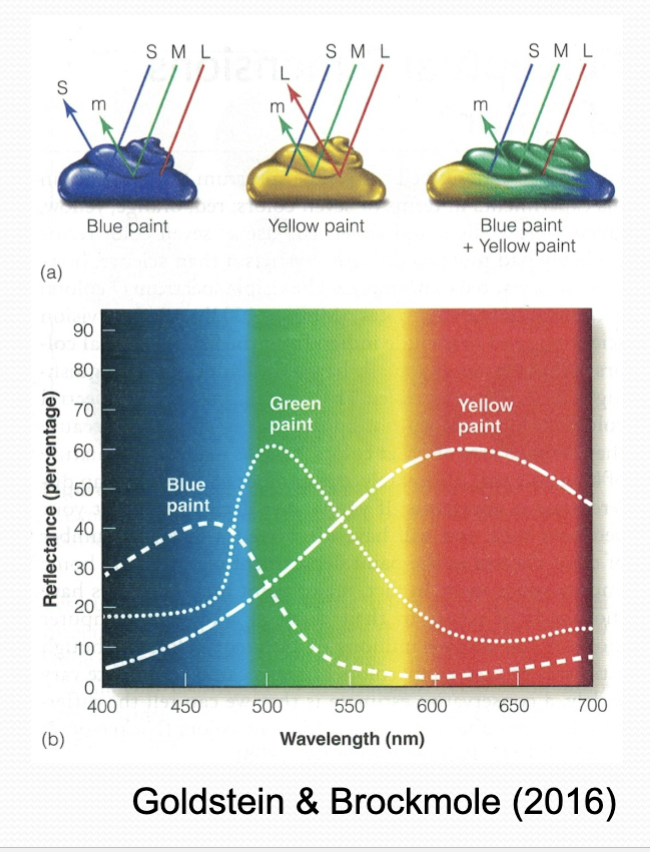
Mixing paint
Blue paint absorbs red light but reflects blue and green light.
Yellow paint absorbs blue light but reflects red and green light.
Mixing blue and yellow paint results in a mixture that absorbs both red and blue light but reflects green light – so looks green.
Blue = short (S) wavelength light, Green = medium (M) wavelength light, Red = long (L) wavelength light
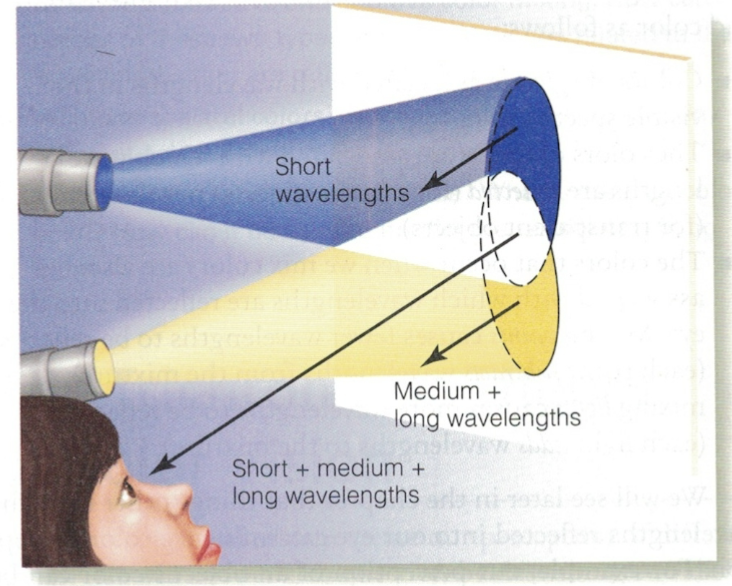
Mixing light
Mixing red and green light makes yellow light.
If you mix blue light with yellow light (i.e. light that contains both green and red), you will get light that contains blue, green and red.
This light will look white because that is what what white light is - a mixture of all three colours.
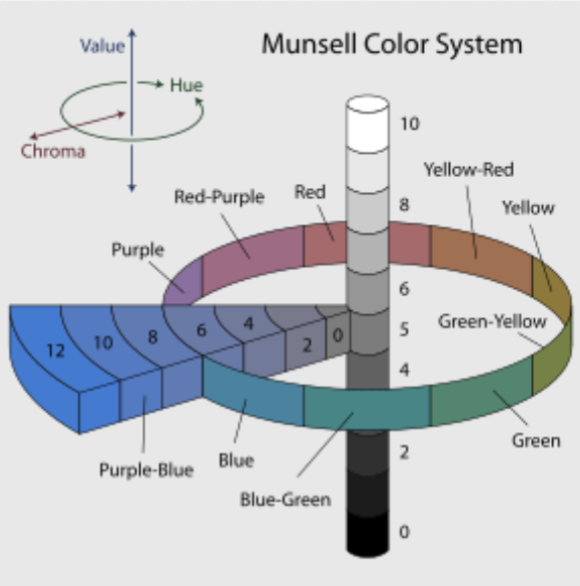
Munsell colour system
In the Munsell colour system colours are categorised according to:
Value (lightness)
Hue (colour)
Chroma (saturation)
Trichromatic theory of vision
In the retina, there are photoreceptors known as rods and cones.
Rods cannot distinguish between colours and are active only at low light levels.
In normal light conditions, only cones are active.
3 Types of Cones
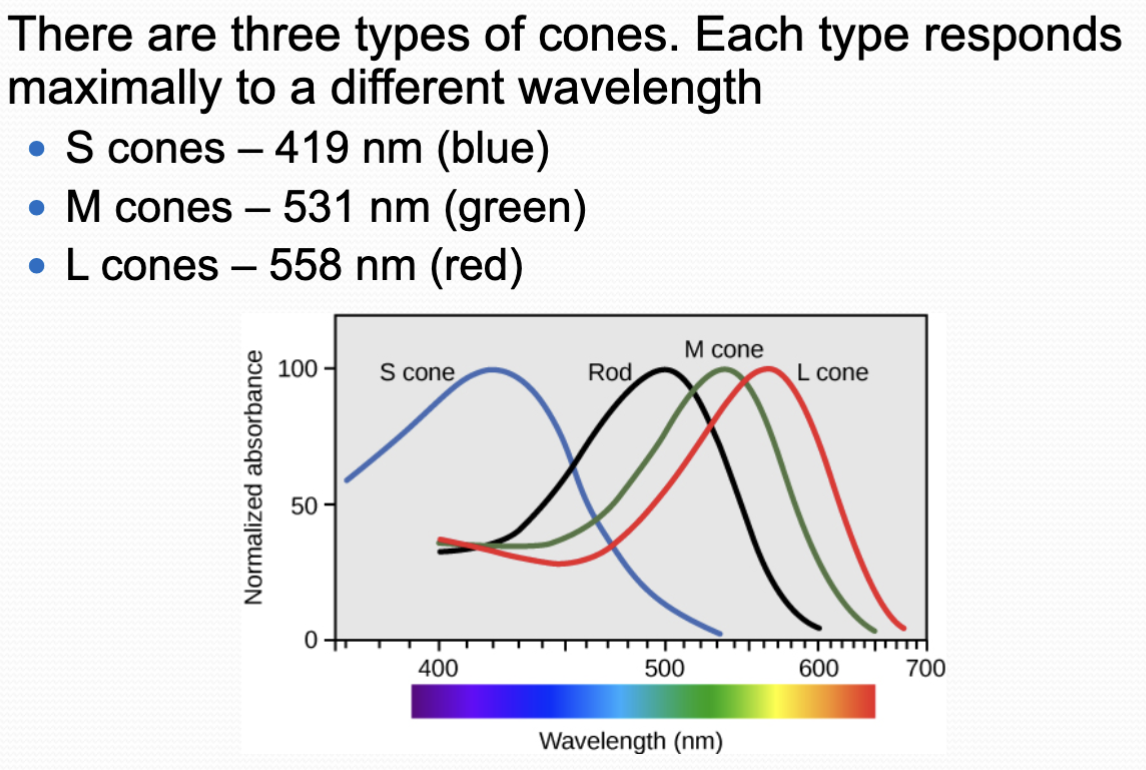
How we distinguish bw colours using cones
By comparing the relative activities of these three types of cones
Eg. if L cones are most active = light is primarily red
Colour matching
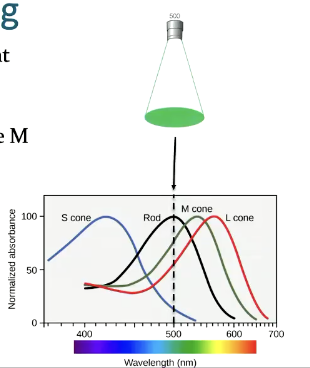
Consider a pure green light that only contains a wavelength of 500 nm
It will strongly activate the M cones and the L cones but only weakly activate the S cones
Colour matching by adjusting relativities of cone types
Looks identical to the test field even though physically not the same/identical
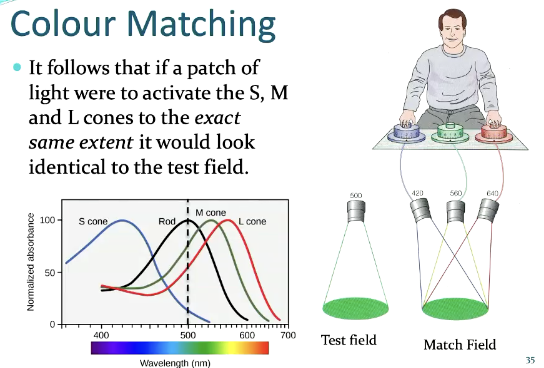
Metamers
Physically different stimuli that appear the same
By adjusting the amount of blue, green and red light we
can exactly match the cone activations caused by 500
nm test field even though the light patches themselves will be
physically different (i.e. one is pure 500 nm light while
the other is a combination of red, green and blue light).
Types of colour deficiency
monochromatism and dichromatism
Monochromatism
usually have no functioning cones and only have functioning rods
colourblinded and only see shades of grey, very sensitive to light (affects 1 in 100,000 people)
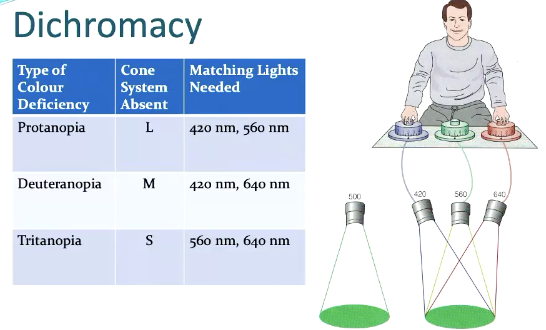
Dischromatism
Dichromats are lacking one of the three types of cones
3 Types of dichromats
Protanopes
Deuteranopes
Tritanopes
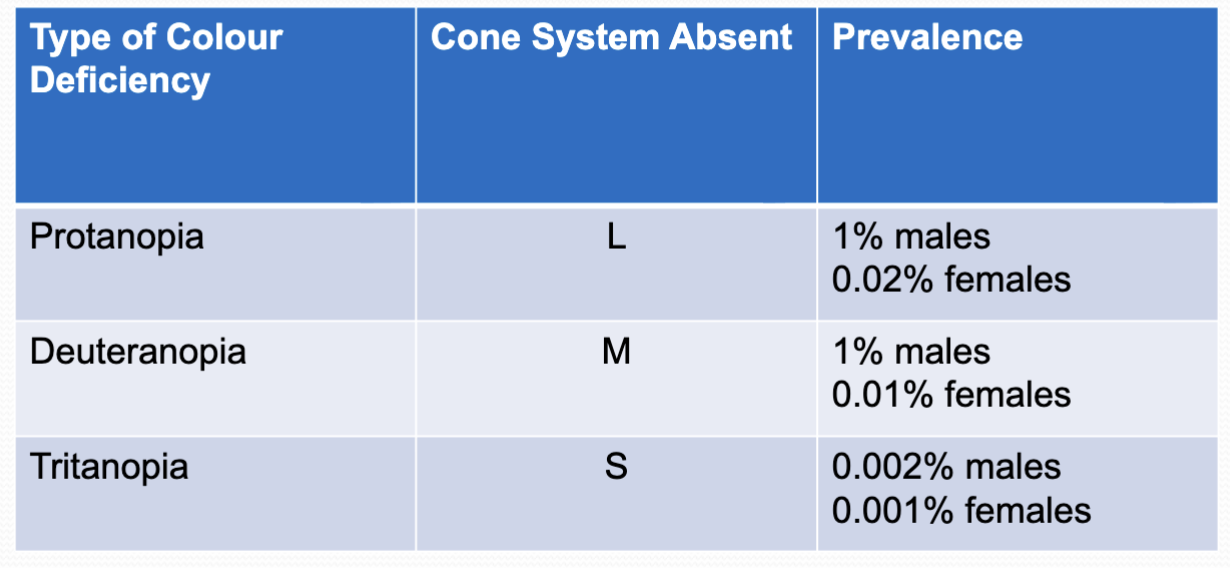
What colours do dichromats actually see?
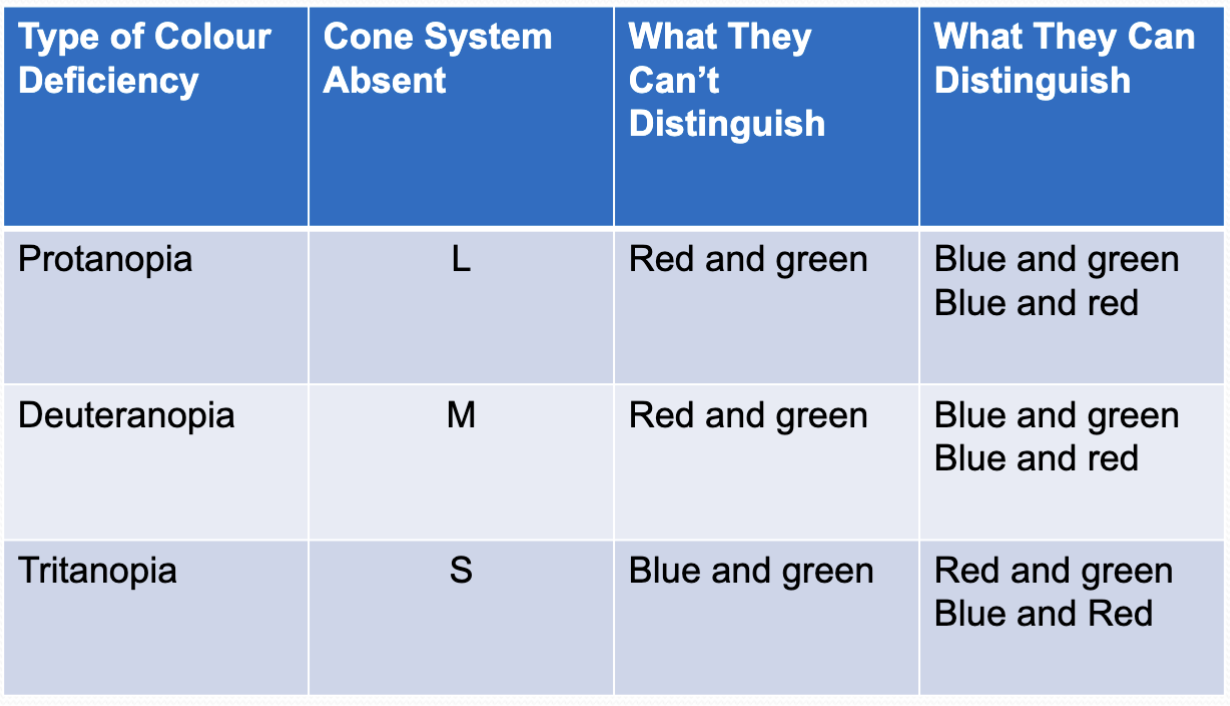
Colour matching as dichromats
possible to match a patch of any coloured light using just two lights
just need spotlights matching whichever cones they have