Escaping from Malthusian Stagnation
 Call Kai
 Learn
Learn Practice Test
 Spaced Repetition
 Match
Match Flashcards
 Knowt Play
1/3

Earn XP
Name | Mastery | Learn | Test | Matching | Spaced | Call with Kai | Chat |
|---|
No analytics yet
Send a link to your students to track their progress
4 Terms
Why did the Permanent Technological Revolution help defeat the Malthusian Model?
-The model failed to consider the possibility that improvements in technology can occur at a faster rate than population growth
-This offset the diminishing APL, and allowed the opportunity for living standards to increase rapidly and permanently
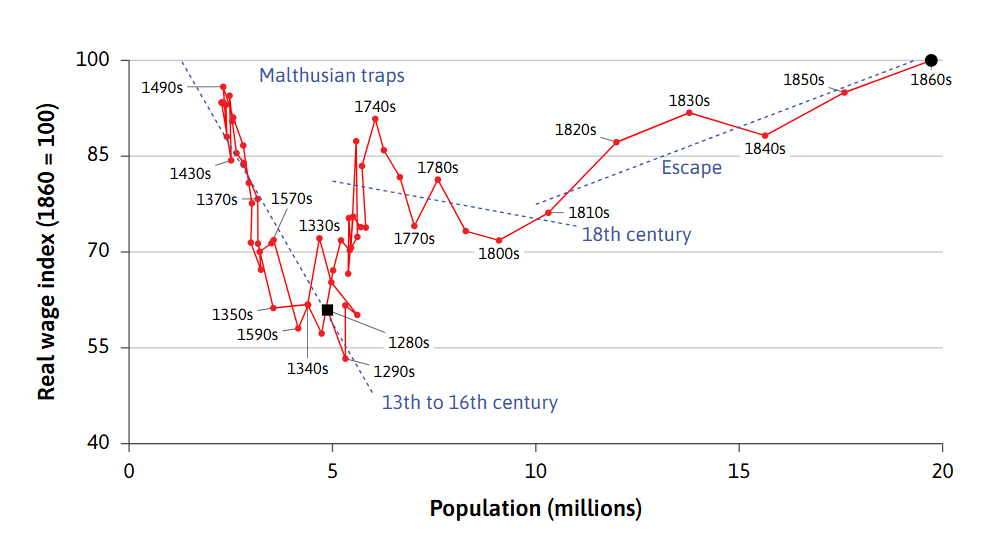
Seeing the visual escape occur, as real wages increase with population growth, explain how this could be.
The Industrial Revolution brought about more and better capital goods per worker and more displaced workers, because technology meant less workers were needed.
-More displaced workers led to their bargaining power falling, meaning their wages were barely rising.
-Greater capital goods, however, meant that their APL rose. Thus, combining this and the loss of bargaining power, firms had higher profits
-Higher profits resulted in expansion in their factor production, which needed more labour, thus increasing demand for labour.
-This, alongside greater legislative action taken on workers conditions restricting labour supply, as well as universal suffrage, meant that the bargaining power of workers rose
-Thus, wages rise.
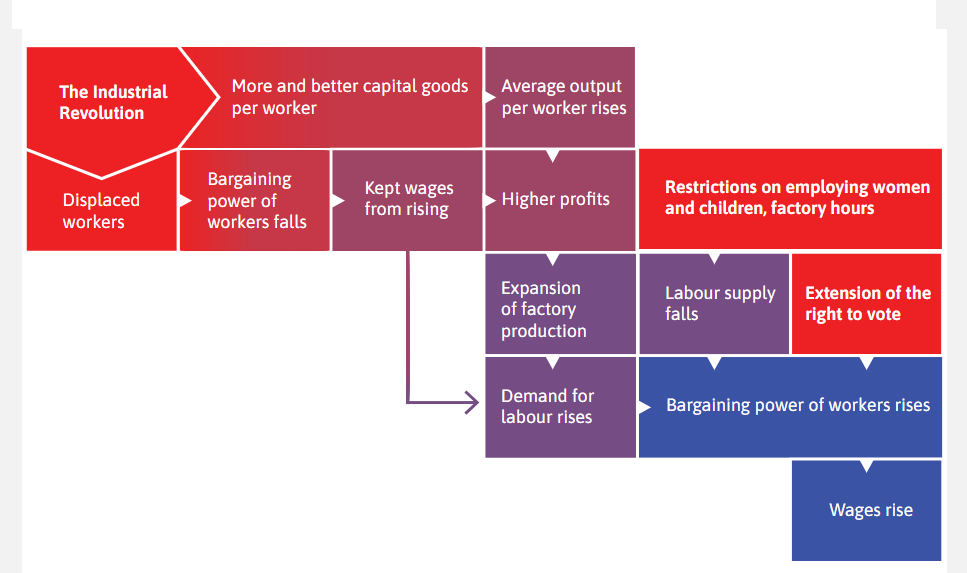
Because of the Industrial Revolution, what are the two influences on wages?
How much is produced: Seen as the size of the pie that will be divided between workers and the owners of other inputs (capital, land…)
Share going to workers: Depends on the bargaining power, in turn depending on how wages are determined - is it done individually, or collectively? AND the supply and demand for workers. If many workers compete for the same job, wages will be low.
Congratulations!
You have finished :)