(3.4a)L2-A genome, a proteome and the structure of RNA
 Call Kai
 Learn
Learn Practice Test
 Spaced Repetition
 Match
Match Flashcards
 Knowt Play
1/4

There's no tags or description
Looks like no tags are added yet.
Name | Mastery | Learn | Test | Matching | Spaced | Call with Kai |
|---|
No analytics yet
Send a link to your students to track their progress
5 Terms
1.What is a the genome?
The genome consists of DNA and includes both the genes and the …2? DNA which is found in the nucleus of …3? cells
4.In addition, the genome consists of the DNA which is found In two other organelles which are not the nucleus. Name the 2 organelles?
5.What is the proteome?
6.What is a gene?
A genome is the …7? set of genes and a gene is a base sequence that codes for the …8? sequence of a polypeptide, which are the chains found in a protein.
1.the complete set of genes in a cell or an
organism
Non-coding. 3.eukaryotic 4.mitochondrial DNA and chloroplast DNA
The full range of proteins that a cell is able to produce
A gene is a base sequence that codes for the amino acid sequence of a polypeptide
Complete 8. Amino acid
Deoxyribonucleic acid and Ribonucleic acid are members of a family of biopolymers called …1?
Info-Although the sugar in a DNA nucleotide and an RNA nucleotide are both pentose sugars, because they have 5 carbon atoms, they are not the same monosaccharide. A DNA nucleotide contains a deoxyribose sugar whereas an RNA nucleotide contains a ribose sugar
2.What is a phosphodiester bond?
How is the link between ribose sugars created?
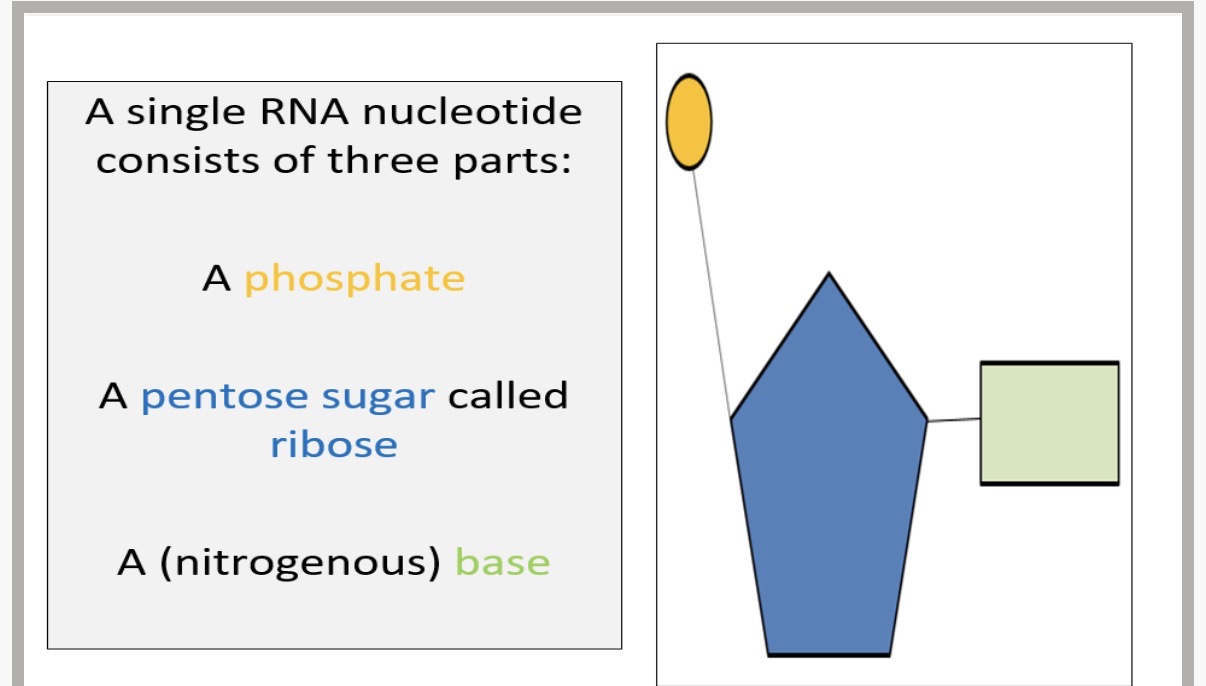
What are the parts that a single RNA nucleotide consists of?
•The third component of a DNA or RNA nucleotide is a nitrogenous base. 5.state the nitrogenous bases that are linked by three hydrogen bonds across a DNA molecule?
•In a strand of RNA, there is a 5'-end ("five prime end") where the phosphate group is attached to the 5 carbon of the ribose sugar, and a 3'-end ("three prime end") and an RNA strand runs in the 5'-to-3' direction. Therefore, nucleic acids can only be synthesised in the…6?
State 5 similarities of DNA and RNA?
State 4 differences between DNA and RNA?
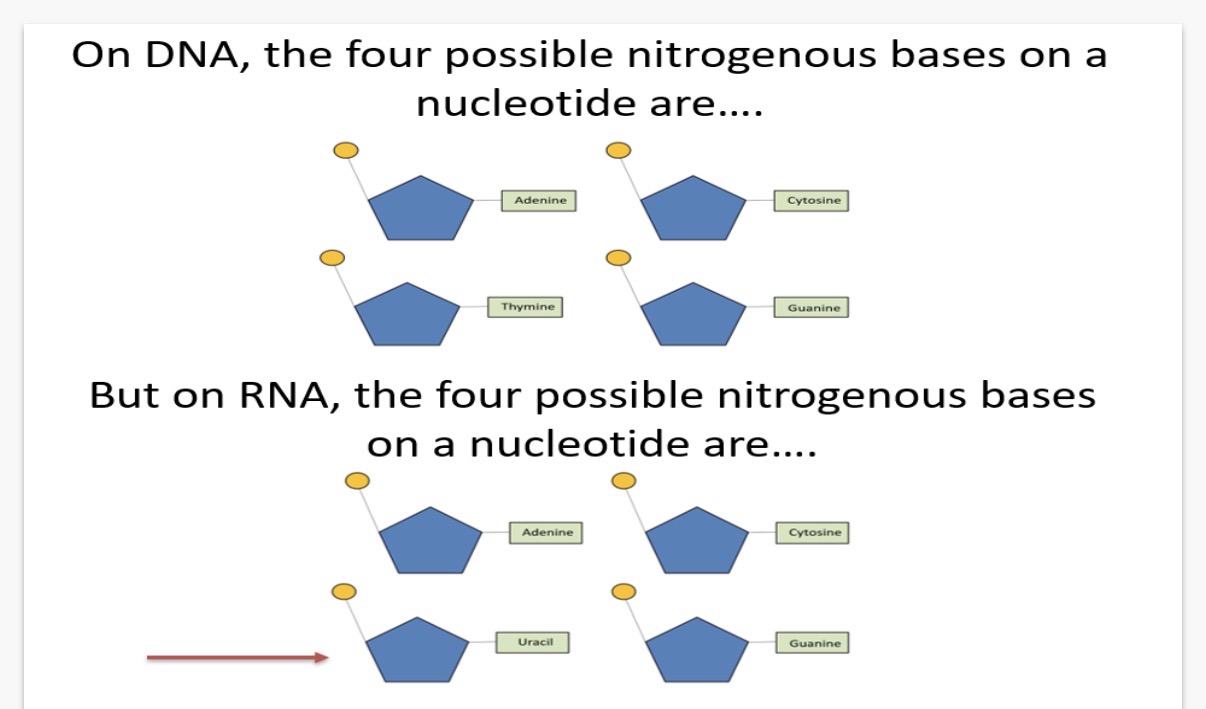
What are the 4 possible nitrogenous bases on a DNA nucleotide and an RNA nucleotide
info:Uracil (U) is a pyrimidine base and is complementary to adenine. During transcription, if an adenine base is exposed on the DNA template strand, an RNA nucleotide containing an uracil base will line up opposite according to complementary base pairing rules
Nucleus acids
a phosphodiester bond is the linkage between the 3' carbon atom of the ribose sugar in a RNA nucleotide and the 5' carbon atom of the ribose in an adjacent RNA nucleotide which are both connected to the same phosphate group via ester bonds.
The link between the ribose sugars is created when strong covalent bonds, specifically two ester bonds, form between the phosphate group (another component of the RNA nucleotide) and two adjacent ribose sugars.
A phosphate group, a pentose sugar(called ribose),a nitrogenous base
5.Both cytosine and guanine (they can also be found as part of an RNA nucleotide)
6.5'-to-3' direction.
•Both are a polymer of nucleotides
•Both are linked by phosphodiester bonds
•Both contain a pentose sugar
•Both can contain an adenine base
• Each DNA and each RNA strand runs in a 5’ to 3’ direction.
• RNA is a single-stranded polynucleotide whereas DNA is a double-stranded polynucleotide
• As RNA only consists of a single strand, there are no hydrogen bonds between nitrogenous bases (like there are in DNA) • RNA nucleotides contain the nitrogenous base uracil instead of thymine which is found in DNA nucleotides
• The pentose sugar in a RNA nucleotide is ribose whereas the pentose sugar in a DNA nucleotide is deoxyribose
DNA-A,T,C,G RNA: A,U,C,G
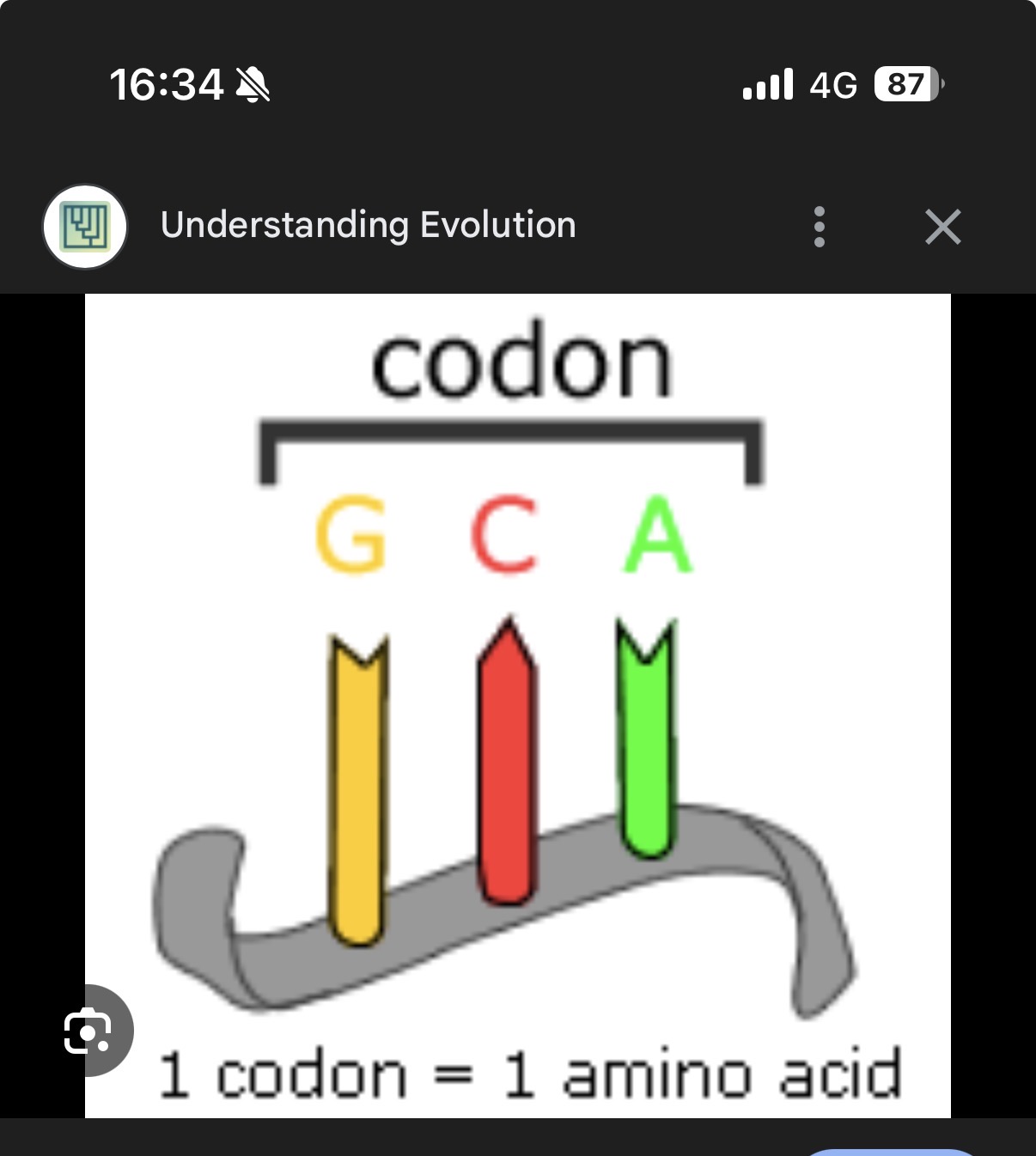
mRNA (messenger RNA) is formed as a result of the 1st stage of protein synthesis (...1?). The nucleotide bases found along this nucleic acid will be complementary to the sequence of DNA bases which are found on the …2? strand of the gene which was transcribed. We consider the sequence of bases on mRNA in groups of 3, which are known as …3?, and as each codon is complementary to a DNA triplet, it can be described as encoding for a specific …4?
(Note-Each codon will encode for a specific amino acid)
5.Explain why RNA is shorter than DNA?
State another reason for the difference in length?
The anti-codon on tRNA is a sequence of …7? bases which are …8? to a codon on mRNA. During translation (the 2nd stage of protein synthesis), the tRNA molecule will pick up a specific amino acid and bring it down to the …9? which is made from rRNA and proteins. The tRNA molecule uses the anti-codon to …10? …11? to the codon to hold the amino acid in place until it can form a …12? bond with an adjacent amino acid when forming the growing polypeptide chain
13.At the opposite end to the anti- codon, a tRNA molecule has another trio of nucleotide bases. What is their function?
1.transcription. 2.template. 3.codons 4. Amino acid
5.In the nucleus of a eukaryotic cell, each DNA molecule is tightly wound around histone proteins to form a chromosome. This is a long structure which consists of tens, if not hundreds of specific sequences of nucleotide bases known as genes, which code for the amino acid sequence of a polypeptide. An mRNA strand, which is formed during transcription, consists of a sequence of nucleotide bases which are complementary to just a single gene and this explains why RNA is a much shorter molecule
6.within the genes on DNA, there are non- coding regions called introns as well as the coding regions called exons. During a process called splicing, which follows transcription, the introns are removed and the resulting strand
(which is known as post-transcriptional mRNA)
will therefore only consists of exons
Three. 8. Complementary
Ribosome. 10.bind 11.Temporarily. 12.peptide
these recognise and attach to
the specific amino acid
mRNA is formed during the process of …1? but tRNA molecules were present in the cytoplasm waiting for …2? at the ribosome.
name the organelle which makes these transfer ribonucleic acid molecules(tRNA) (1 mark)
•The tRNA molecules that play a critical role in translation (at the ribosome in the cytoplasm) are made in the nucleolus.
4.explaining how the structure of this type of RNA allows this molecule to be present in the cytoplasm for translation (2 marks)
Name the 4 differences between tRNA and mRNA?
Transcription. 2.translation. 3.nucleolus
4.As RNA is only a single-stranded polynucleotide, it is able to move out of the nucleus via the nuclear pore
tRNA is 'clover leaf shape', mRNA is linear;
(Must be a comparison)
(Reject tRNA is double stranded)
(Accept tRNA is folded for tRNA is ‘clover leaf
shaped’)
tRNA has hydrogen bonds, mRNA does not;
tRNA has an amino acid binding site, mRNA does not;
(Accept ‘CCA end' for amino acid binding site)
tRNA has anticodon, mRNA has codon;
mRNA has more nucleotides/ is longer than tRNA
Transcription knowledge check process):
The sequence of bases on pre-mRNA, which was formed as a result of …1?, are complementary to the sequence of bases on the …2? strand of DNA. Following the removal of the non-coding regions during splicing, the functional mRNA will only consist of the coding regions called ...3?
1.transcription. 2.template. 3.exons