Chapter 5: Hypnosis (3)
0.0(0)
Studied by 1 person Call Kai
 Learn
Learn Practice Test
 Spaced Repetition
 Match
Match Flashcards
 Knowt Play
Card Sorting
1/13

Earn XP
Description and Tags
Last updated 4:45 AM on 5/31/26
Name | Mastery | Learn | Test | Matching | Spaced | Call with Kai |
|---|
No analytics yet
Send a link to your students to track their progress
14 Terms
1
New cards
Define HYPNOSIS
“Systematic procedure that
typically produces a
heightened state of
suggestibility.”
typically produces a
heightened state of
suggestibility.”
2
New cards
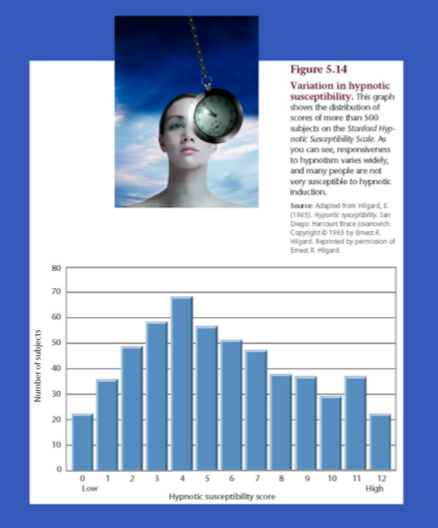
Susceptibility
Hypnotic ability is normally
distributed
Associated traits:
• absorption, imaginativeness, rich fantasy life
distributed
Associated traits:
• absorption, imaginativeness, rich fantasy life
3
New cards
What hypnosis can do
• Alleviate pain
• Sensory distortions
• Treatment of hypertension, migraines, allergies
• Sensory distortions
• Treatment of hypertension, migraines, allergies
4
New cards
What hypnosis cannot do
• Age regression/ Regression into past lives
• Make people act against their will
• Recover lost memories
• Make people act against their will
• Recover lost memories
5
New cards
Role enactment theory
Hypnosis is a normal mental state in which suggestible people act out the role of a hypnotic subject.
6
New cards
Hypnosis as an altered state
● Special sate of consciousness.
● Changes in brain activity
● Changes in brain activity
7
New cards
Unification
Hypnosis= Alterations in consciousness also influenced by role expectations.
8
New cards
Define Meditation
Group of practices that train attention to heighten awareness and bring mental processes under greater voluntary control
9
New cards
Types of Meditation
1) Focused attention:
• Zen, transcendental meditation (TM)
2) Open monitoring:
• Mindfulness meditation, Loving-kindness meditation
• Zen, transcendental meditation (TM)
2) Open monitoring:
• Mindfulness meditation, Loving-kindness meditation
10
New cards
Benefits
Attention, emotional, physical, psychological
11
New cards
Evidence
Training of executive functions:
Supported by brain imaging studies/ structural and functional changes in the brain with experienced meditators.
Supported by brain imaging studies/ structural and functional changes in the brain with experienced meditators.
12
New cards
EEG studies
Increase alpha and theta brain
patterns
patterns
13
New cards
Physiological Evidence
Lower stress response/ Greater pain tolerance
14
New cards
Long term gains
• Cognitive
• Emotional (e.g. anxiety; mood disorders)
• Mainstream application for mental and physical health
• Emotional (e.g. anxiety; mood disorders)
• Mainstream application for mental and physical health