Viruses and Bacteria Day One
 Call Kai
 Learn
Learn Practice Test
 Spaced Repetition
 Match
Match Flashcards
 Knowt Play
1/28

Earn XP
Description and Tags
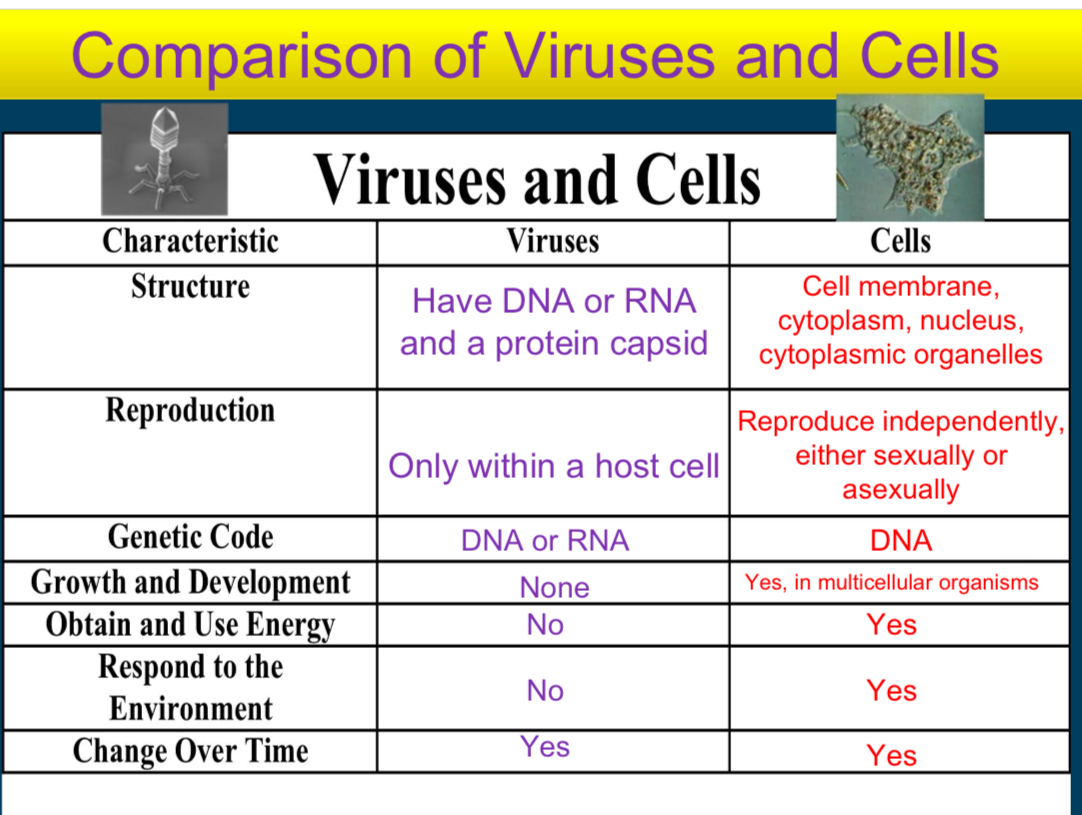
This flashcard set covers the fundamentals of virology including the history, structure, comparison between living and non-living traits, and the reproductive cycles (lytic and lysogenic) of viruses.
Name | Mastery | Learn | Test | Matching | Spaced | Call with Kai |
|---|
No analytics yet
Send a link to your students to track their progress
29 Terms
What is the definition of a virus according to the lecture?
An infectious particle that is nonliving.
What is the origin of the word 'virus'?
It comes from the Latin word meaning 'poison'.
Why are all viruses considered parasites?
Because they live in or on other living organisms and require a host, causing them harm.
Who is the Dutch Scientist considered the founder of virology?
Martinus Beijerinck
What did Martinus Beijerinck prove in 1898 regarding tobacco mosaic disease?
He proved that an agent smaller than a bacterium was causing the disease.
What contribution did Wendell Stanley make to the study of viruses in 1935?
He isolated crystals of the tobacco mosaic virus and inferred that viruses were not alive because living organisms do not crystallize.
What type of microscope is required to see most viruses?
An electron microscope
What happens to a virus when it is removed from a living cell?
It ceases all activities but retains its ability to infect the cell and can be stored indefinitely, even in crystallized form.
What is the one thing all viruses have in common despite differences in size and structure?
They enter living cells and use the machinery of the cell to produce more viruses.
List the 6 parts of the virus diagram mentioned in the lecture.
1 – Capsid, 2 – Base plate, 3 – Tail fibers, 4 – Sheath, 5 – Collar, 6 – DNA or RNA
What are the two components that make up a virus particle?
DNA or RNA surrounded by a protein coat.
What is the function of the viral capsid?
It is a protein coat that surrounds the genetic material and has a particular shape that matches receptors on a host cell to 'trick' the cell into letting the virus inside.
How do viruses get the cell to produce viral parts and not cell parts
By the protons capsid for now
Why do specific virus only infect specific ones?
Since viruses must bind precisely with the surface of a cell host they must specifically infect cells according to their capsid. This because viruses are Eukaryotic tissue specific.
What are bacteriophages?
Viruses that infect only certain types of bacteria.
Why are viruses not affected by antibiotics?
Because anything that will kill the virus will also kill the host.
What are the three living characteristics of viruses?
- They can reproduce (only inside a living cell), 2. They can mutate or change, and 3. They have DNA or RNA.
What are the three non-living characteristics of viruses?
- They are non-cellular, 2. They have no metabolism (no food or energy requirements), and 3. They can be crystallized and stored indefinitely.
How does a viral infection begin?
When the genetic material (DNA or RNA) of a virus makes its way into a host cell.
What are the two reproductive cycles of viruses?
The lytic cycle and the lysogenic cycle.
What occurs during a lytic infection?
A virus enters a cell, makes copies of itself, and causes the cell to burst (lyse).
Describe the steps of the Lytic Cycle.
Attachment, Entry (DNA injected), Synthesis (viral parts produced), Assembly (parts assembled into viruses), and Release (cell bursts).
How does the lysogenic cycle differ from the lytic cycle?
In the lysogenic cycle, the host cell makes copies of the viral genetic material indefinitely without killing the cell right away; the virus incorporates its DNA into the host DNA.
What is a prophage?
The viral DNA embedded into the host cell’s DNA during the lysogenic cycle.
How do retroviruses differ from typical viruses in terms of genetic material?
Retroviruses have RNA as their genetic information rather than DNA.
What is the role of the enzyme reverse transcriptase in retroviruses?
It transcribes the viral RNA template into DNA, which then enters the cell’s nucleus and integrates into a chromosome.
What is a vaccine and how does it work?
A vaccine contains a harmless variation of a pathogen; it trains the immune system to recognize and respond much faster to the 'real' pathogen upon exposure.
Name several common viral diseases list in the transcript.
AIDS, Hepatitis, Colds, Flu, West Nile Virus, and Chicken pox.