BIOL3060 Lecture #19 CRISPR-Cas9

0.0(0)
Studied by 0 people
call kaiCall Kai
learnLearn
examPractice Test
spaced repetitionSpaced Repetition
heart puzzleMatch
flashcardsFlashcards
GameKnowt Play
Card Sorting

1/10

encourage image

There's no tags or description

Looks like no tags are added yet.

Last updated 4:14 PM on 4/11/26
Name
Mastery
Learn
Test
Matching
Spaced
Call with Kai

No analytics yet

Send a link to your students to track their progress

11 Terms

1
New cards

Staggering Impact

  • Didn't invent CRISPR, discovered it

  • Life existed on Earth 4 billion years

  • 99.9% of time past before homo sapiens arrived

  • Then didn’t know anything about DNA until 65 years ago (only 1 lifetime)

    • Learned structure of DNA, genetic info copying and storage, how to read/write DNA, and now learned how to edit DNA

2
New cards

Evolution of CRISPR-Cas9

  • Didn’t invent CRISPR, discovered it in bacteria 

  • 1987: Repetitive DNA sequences found in E. coli

  • Name

    • Clustered

    • Regularly

    • Interspaced

    • Short

    • Palindromic

    • Repeats

  • 2005: Mojica proposed that CRISPR sequences serves as a bacterial immune system

  • 2012: Doudna and Charpentier publish a paper describing how you can progran CRISPR to edit specific genes

    • Programmable Dual-RNA-Guided DNA Endonuclease in Adaptive Bacterial Immunity

3
New cards

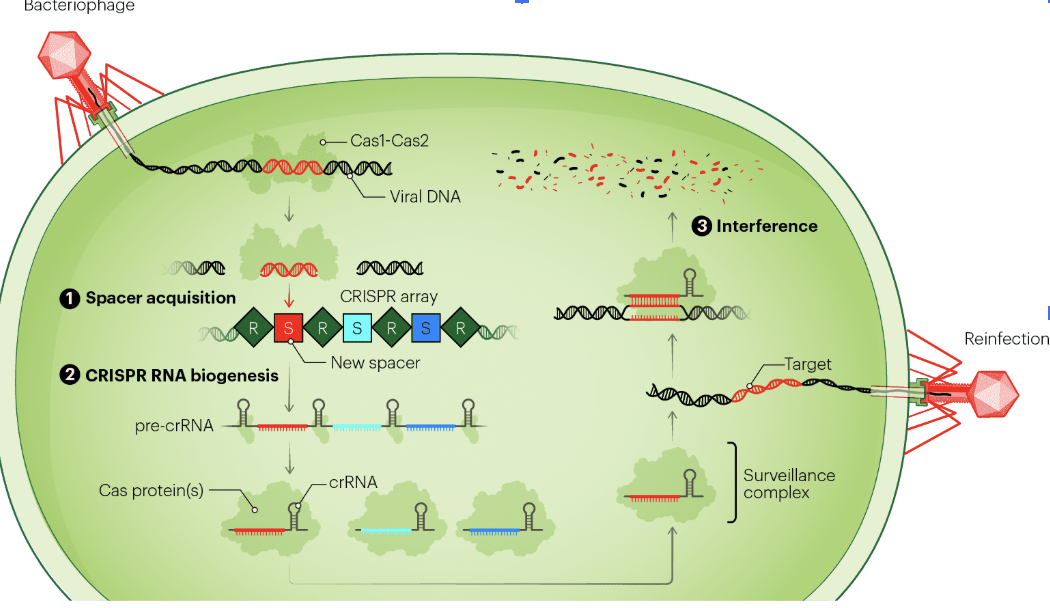
How Does CRISPR Work in Bacteria?

  • Bacteriophages inject genetic material into the cell, hijack cell(transcription/translation machinery)

  • Bacteria has to find a way to defend against viral DNA

  • Cas1 and Cas2 recognize viral DNA and cut it into short sequences

    • Viral sequences are inserted in between repeated palindromic sequences: Spacer acquisition (create molecular memory)

    • CRISPR RNA Biogenesis: cRNA is CRISPR RNA and trans-activating RNA, both created and come together to make structure wit- h hairpin loop: able to recognize viral sequence and bnd to CAS9 (a nonspecific DNA nuclease) 

      • Hairpin loop structure is a surveillance complex, which moves around cell looking for the viral sequence which is recgnizes with complementary base pairing and then nuclease Cas9 can double strand break viral genome

    • Interference: process by which surveillance complex with Cas9 cuts DNA
knowt flashcard image
  • Found that you can cut whatever you want, just have to provide it with the 20 nucleotide guide sequence

  • Tracker RNA can be attached to CRISPR RNA, so can provide a single guide RNA

  • Cas9 protein creates double stranded breaks in DNA

    • After break is made, goal is to repair it right away

<ul><li><p><span style="background-color: transparent; font-family: &quot;Times New Roman&quot;, serif;">Bacteriophages inject genetic material into the cell, hijack cell(transcription/translation machinery)</span></p></li><li><p><span style="background-color: transparent; font-family: &quot;Times New Roman&quot;, serif;">Bacteria has to find a way to defend against viral DNA</span></p></li><li><p><span style="background-color: transparent; font-family: &quot;Times New Roman&quot;, serif;">Cas1 and Cas2 recognize viral DNA and cut it into short sequences</span></p><ul><li><p><span style="background-color: transparent; font-family: &quot;Times New Roman&quot;, serif;">Viral sequences are inserted in between repeated palindromic sequences: Spacer acquisition (create molecular memory)</span></p></li><li><p><span style="background-color: transparent; font-family: &quot;Times New Roman&quot;, serif;">CRISPR RNA Biogenesis: cRNA is CRISPR RNA and trans-activating RNA, both created and come together to make structure wit- h hairpin loop: able to recognize viral sequence and bnd to CAS9 (a nonspecific DNA nuclease)&nbsp;</span></p><ul><li><p><span style="background-color: transparent; font-family: &quot;Times New Roman&quot;, serif;">Hairpin loop structure is a surveillance complex, which moves around cell looking for the viral sequence which is recgnizes with complementary base pairing and then nuclease Cas9 can double strand break viral genome</span></p></li></ul></li><li><p><span style="background-color: transparent; font-family: &quot;Times New Roman&quot;, serif;">Interference: process by which surveillance complex with Cas9 cuts DNA</span></p></li></ul></li></ul><img src="https://assets.knowt.com/user-attachments/3f1d77b9-4961-420d-b6d0-bcf0377d6be8.png" data-width="100%" data-align="center" alt="knowt flashcard image"><ul><li><p><span style="background-color: transparent; font-family: &quot;Times New Roman&quot;, serif;">Found that you can cut whatever you want, just have to provide it with the 20 nucleotide guide sequence</span></p></li><li><p><span style="background-color: transparent; font-family: &quot;Times New Roman&quot;, serif;">Tracker RNA can be attached to CRISPR RNA, so can provide a single guide RNA</span></p></li><li><p><span style="background-color: transparent; font-family: &quot;Times New Roman&quot;, serif;">Cas9 protein creates double stranded breaks in DNA</span></p><ul><li><p><span style="background-color: transparent; font-family: &quot;Times New Roman&quot;, serif;">After break is made, goal is to repair it right away</span></p></li></ul></li></ul><p></p>
4
New cards

From Bacterial Immune System to Precise Molecular Scissors

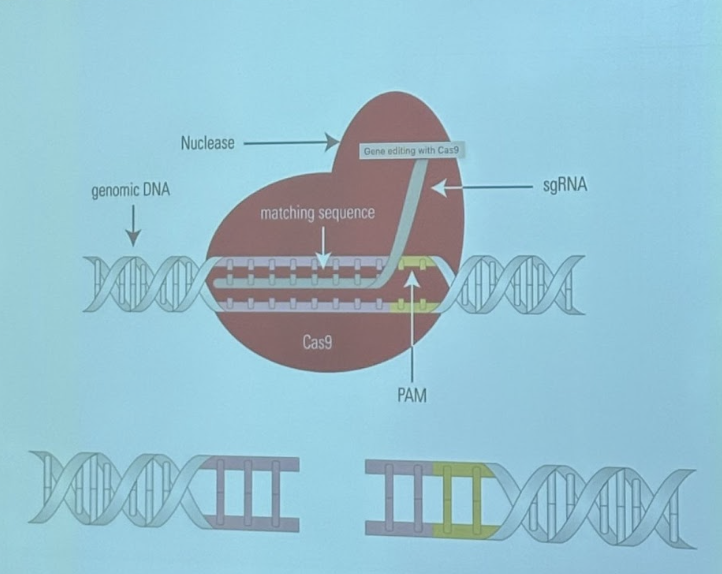
  • Target the right gene

  • Bind the target gene

  • Cut the DNA with complexed Cas9 protein

  • Repair and edit the sequence

knowt flashcard image

<ul><li><p><span style="background-color: transparent; font-family: &quot;Times New Roman&quot;, serif;">Target the right gene</span></p></li><li><p><span style="background-color: transparent; font-family: &quot;Times New Roman&quot;, serif;">Bind the target gene</span></p></li><li><p><span style="background-color: transparent; font-family: &quot;Times New Roman&quot;, serif;">Cut the DNA with complexed Cas9 protein</span></p></li><li><p><span style="background-color: transparent; font-family: &quot;Times New Roman&quot;, serif;">Repair and edit the sequence</span></p></li></ul><img src="https://assets.knowt.com/user-attachments/7b9f36d8-28a6-47c1-b5a2-3559edd6f50b.png" data-width="100%" data-align="center" alt="knowt flashcard image"><p></p>
5
New cards

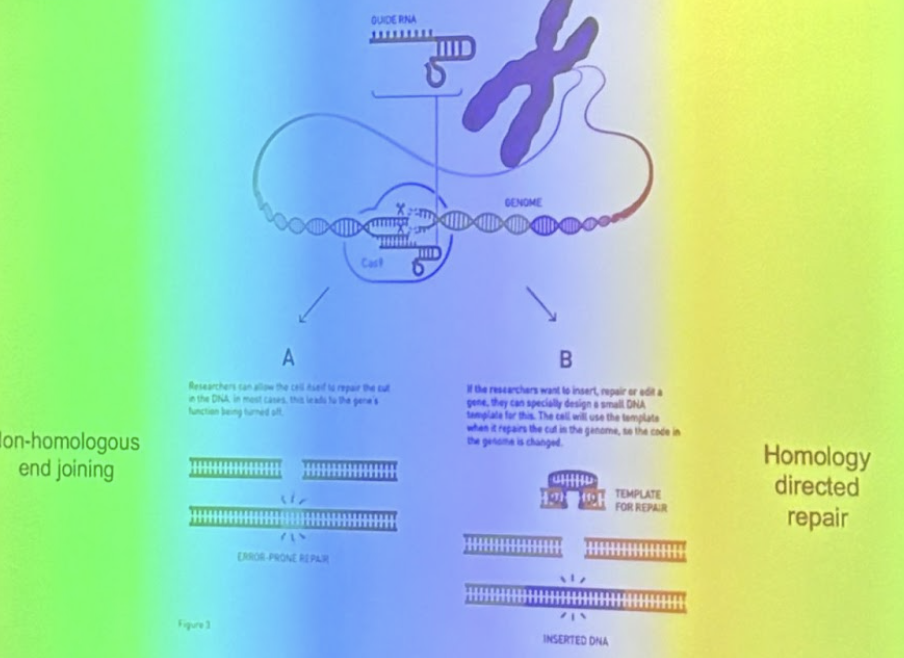
Two Mechanisms for Repairing Double-Stranded Breaks

  • A: Non-homologouse end joining

    • Quick but error-prone

    • Can cause small insertions or deletions that disrupt gene function

    • Used to disable genes

      • Used for knockouts: helps people figure out what the gene does bc can see what happens when it’s not working

  • B: Homology Directed Repair

    • Precise but slow

    • DNA template required

    • A custom DNA template can be inserted

    • Used for corrections, replacements, or insertions 
knowt flashcard image

<ul><li><p><span style="background-color: transparent; font-family: &quot;Times New Roman&quot;, serif;">A: Non-homologouse end joining</span></p><ul><li><p><span style="background-color: transparent; font-family: &quot;Times New Roman&quot;, serif;">Quick but error-prone</span></p></li><li><p><span style="background-color: transparent; font-family: &quot;Times New Roman&quot;, serif;">Can cause small insertions or deletions that disrupt gene function</span></p></li><li><p><span style="background-color: transparent; font-family: &quot;Times New Roman&quot;, serif;">Used to disable genes</span></p><ul><li><p><span style="background-color: transparent; font-family: &quot;Times New Roman&quot;, serif;">Used for knockouts: helps people figure out what the gene does bc can see what happens when it’s not working</span></p></li></ul></li></ul></li><li><p><span style="background-color: transparent; font-family: &quot;Times New Roman&quot;, serif;">B: Homology Directed Repair</span></p><ul><li><p><span style="background-color: transparent; font-family: &quot;Times New Roman&quot;, serif;">Precise but slow</span></p></li><li><p><span style="background-color: transparent; font-family: &quot;Times New Roman&quot;, serif;">DNA template required</span></p></li><li><p><span style="background-color: transparent; font-family: &quot;Times New Roman&quot;, serif;">A custom DNA template can be inserted</span></p></li><li><p><span style="background-color: transparent; font-family: &quot;Times New Roman&quot;, serif;">Used for corrections, replacements, or insertions&nbsp;</span></p></li></ul></li></ul><img src="https://assets.knowt.com/user-attachments/34929e49-ac2e-40bb-a372-ed27213030b1.png" data-width="100%" data-align="center" alt="knowt flashcard image"><p></p>
6
New cards

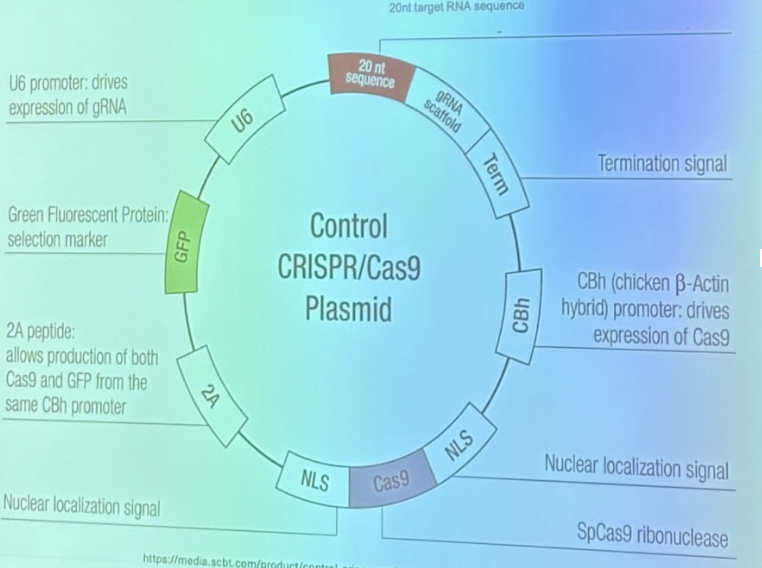
CRISPR-Cas9 Components

  • Key Components

    • Gene for Cas9

      • Complexed with Nuclear localization signal: so Cas9 will go to the nucleus, where the DNA is

    • 20 nt target RNA sequence

    • Selection marker: makes the cell fluorescent green so you know CRISPR made it in to the cell
knowt flashcard image

<ul><li><p><span style="background-color: transparent; font-family: &quot;Times New Roman&quot;, serif;">Key Components</span></p><ul><li><p><span style="background-color: transparent; font-family: &quot;Times New Roman&quot;, serif;">Gene for Cas9</span></p><ul><li><p><span style="background-color: transparent; font-family: &quot;Times New Roman&quot;, serif;">Complexed with Nuclear localization signal: so Cas9 will go to the nucleus, where the DNA is</span></p></li></ul></li><li><p><span style="background-color: transparent; font-family: &quot;Times New Roman&quot;, serif;">20 nt target RNA sequence</span></p></li><li><p><span style="background-color: transparent; font-family: &quot;Times New Roman&quot;, serif;">Selection marker: makes the cell fluorescent green so you know CRISPR made it in to the cell</span></p></li></ul></li></ul><img src="https://assets.knowt.com/user-attachments/4b43dcec-9b78-452b-998a-f2cdc745e4ec.png" data-width="100%" data-align="center" alt="knowt flashcard image"><p></p>
7
New cards

CRISPR-Cas9 Delivery Into Cells (In vitro: in a dish)

  • CRISPR-Cas9 on a plasmid

  • Ways to get plasmid into the cell

    • Microinjection: Take a needle and inject into cell

    • Electroporation: Electrocute the cell which creates transient holes in the cell for the plasmid to slip in 

      • Could potentially kill the cell, only 10% efficiency

    • Viral Mediated Delivery Vehicles

      • Hallow out the inside of specific vral vectors, put plasmid in, then infect the cell with the virus

    • Non-Viral Mediated Delivery Vehicles

      • Cover DNA with lipid nanoparticles (LNPs) that will fuse to the cell membrane and allow entry into the cell

8
New cards

The In vivo (in a person) Delivery Problem

  • The gene therapy delivery problem in humans is that it is VERY difficult to efficiently deliver these therapeutic genes directly into a human (need to get it to many cells, not just one)

    • If, for example, trying to address something in lungs like cystic fibrosis, can use a virus that affects the respiratory tract only, like using a flu or common cold virus (use of viral mediated delivery vehicles)

    • Can also use the LNPs lipid nanoparticles

9
New cards

Genome Editing with CRISPR-Cas9

  • Sickle Cell Anemia is caused by a single base change in a gene (approved by FDA)

    • We have access to bone marrow, can get CRISPR into cells and return bone marrow

    • Collect blood stem cells

    • Modify cells

    • Inject back to body through infusion

    • Price: 2.2 or 3.1 million dollars for a single infusion

  • CRISPR Assisted CAR-T Cell Therapy (for cancer)

    • Can take T-cells out in blood and provde them with CAR-T gene that recognizes cancer cells so then Cas9 can recognize cancer cells and kill them

    • Price: 500k for infusion, but more like 1M with indirect cost of hospitalization

10
New cards

How Can CRISPR Be Used?

  • Edits in somatic cells stop with you, so any change to disease in you will not be passed to children, so children can still get the disease

    • IMPORTANT: differences in editing babies v. embryos, somatic v. germ line
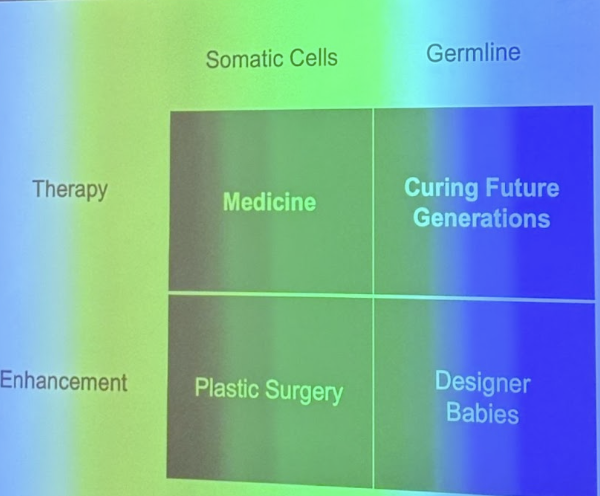
knowt flashcard image

<ul><li><p><span style="background-color: transparent; font-family: &quot;Times New Roman&quot;, serif;">Edits in somatic cells stop with you, so any change to disease in you will not be passed to children, so children can still get the disease</span></p><ul><li><p>IMPORTANT: differences in editing babies v. embryos, somatic v. germ line</p></li></ul></li></ul><img src="https://assets.knowt.com/user-attachments/ca9b0f4b-7afd-4cf6-b0d4-c7d249b06a41.png" data-width="100%" data-align="center" alt="knowt flashcard image"><p></p>
11
New cards

Debates about CRISPR

  • Concerns:

    • Access issues: only the wealthy will be able to cure their diseases, widens healthcare disparity

    • Can’t ensure there won’t be some off-site mutations, potential detrimental longterm affects

    • Religious reasons

    • Debate on what is or isn’t a “serious disease” that needs eradicated

    • Ethics of using CRISPR for enhancement (like attractiveness and intelligence) → Crosses into Eugenics

    • Crossing into the germline has severe ethical complications

      • Chinese scientist did already genetically engineer babies

  • Benefits:

    • Therapeutic applications: can be used to eliminate disease from the human genome