Principles and Application of Tactical Combat Casualty Care (TCCC) for Military and Civilian Trauma
 Call Kai
 Learn
Learn Practice Test
 Spaced Repetition
 Match
Match Flashcards
 Knowt Play
1/175

There's no tags or description
Looks like no tags are added yet.
176 Terms
What is Tactical Combat Casualty Care (TCCC)?
TCCC is the standard of care in battlefield prehospital medicine focused on lifesaving skills.
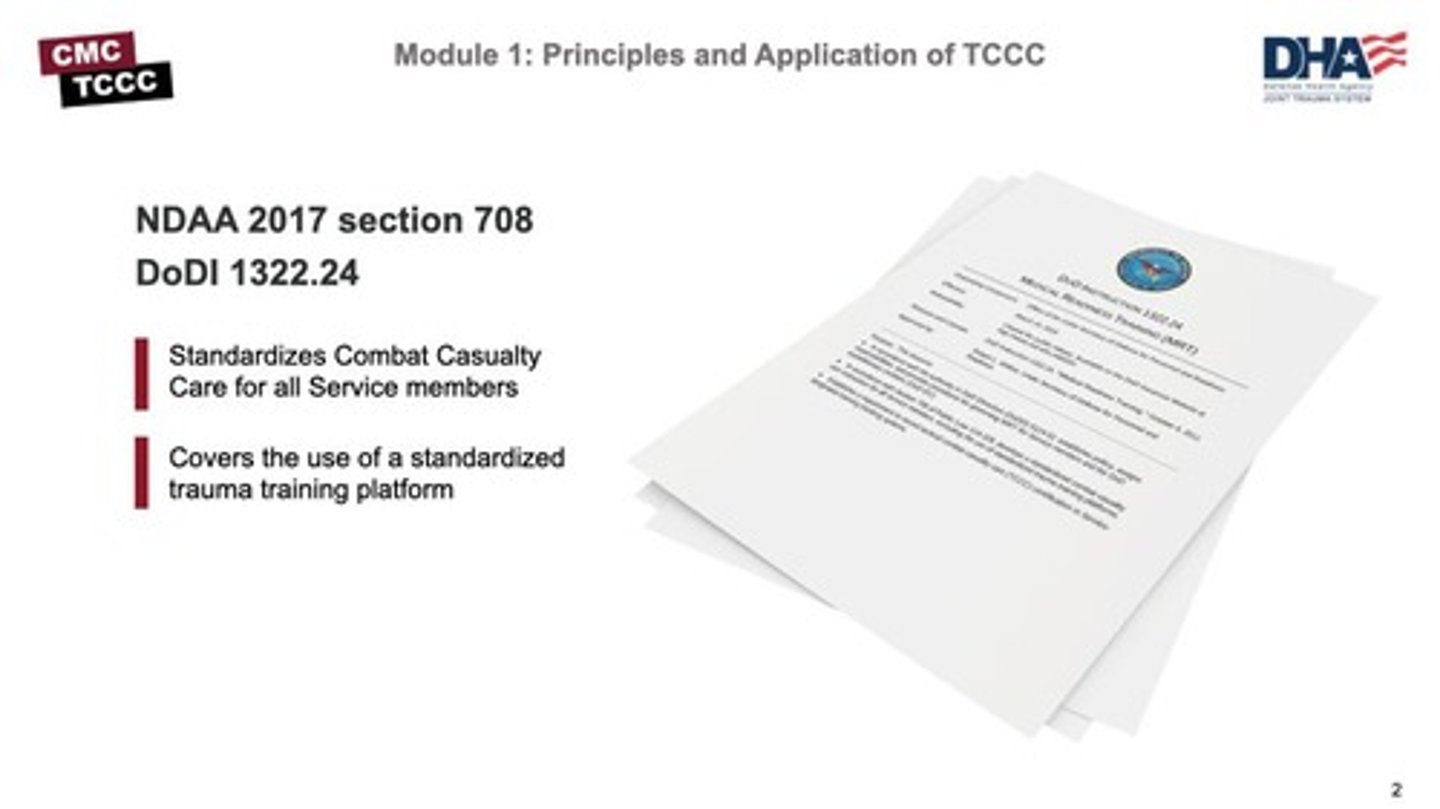
What is the purpose of DoDI 1322.24?
It implements standardized combat casualty care training for all Service members.
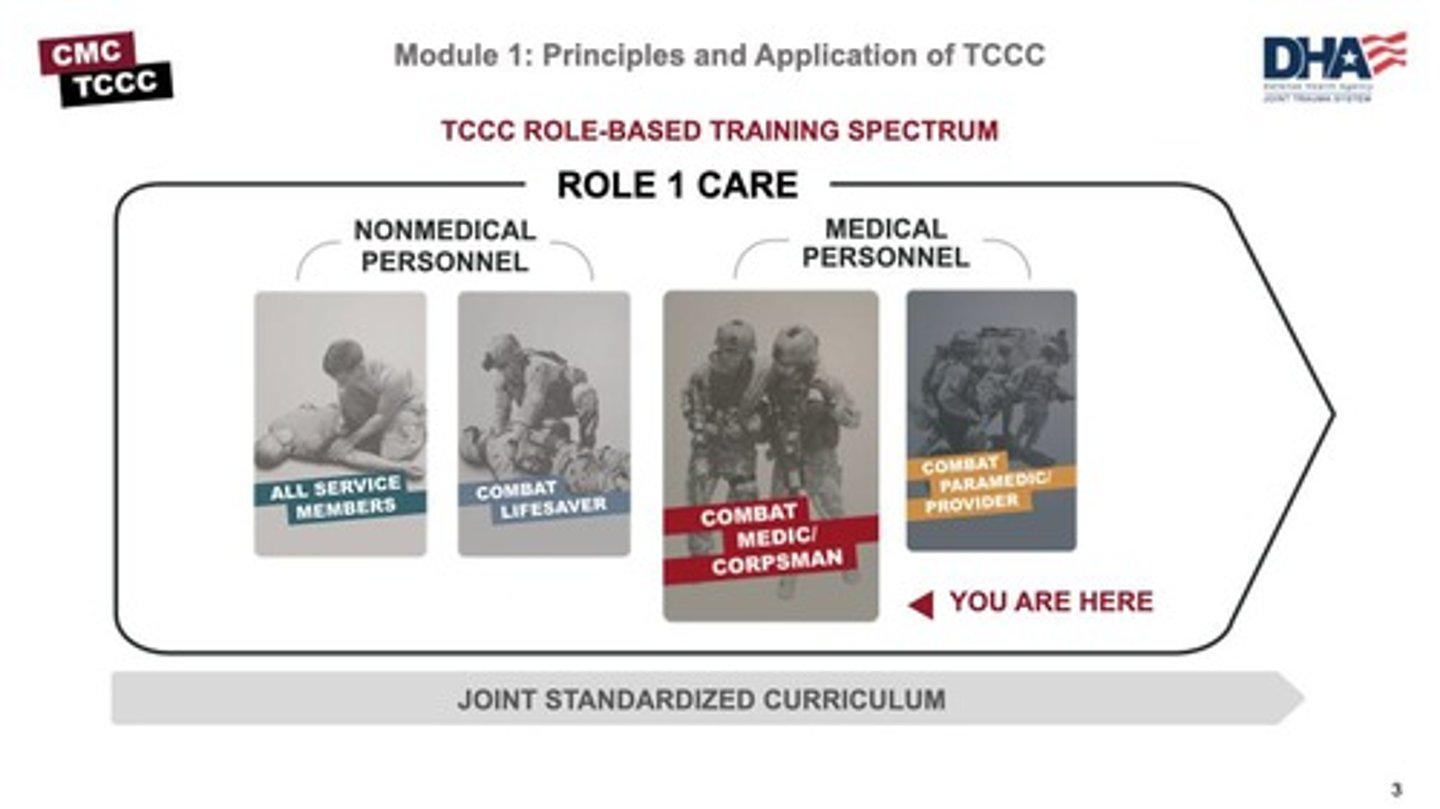
What are the four roles of care in TCCC?
1. All Service Members (ASM), 2. Combat Lifesaver (CLS), 3. Combat Medic/Corpsman (CMC), 4. Combat Paramedic/Provider (CPP).
What does the All Service Members (ASM) role focus on?
Basic hemorrhage control and recognition of serious problems.
What skills are taught in the Combat Lifesaver (CLS) role?
Advanced skills to treat common causes of preventable death, including hemorrhage and airway trauma.
What is the primary responsibility of the Combat Medic/Corpsman (CMC)?
To provide advanced care in the prehospital environment.
What is expected of the Combat Paramedic/Provider (CPP)?
To provide sophisticated care to keep wounded warriors alive and transport them to definitive care.
What feedback was received regarding previous TCCC training methods?
Training was too reliant on PowerPoint slides and needed more practical application.
What is Deployed Medicine?
A web- and mobile-based platform for classroom support and job performance support in TCCC.
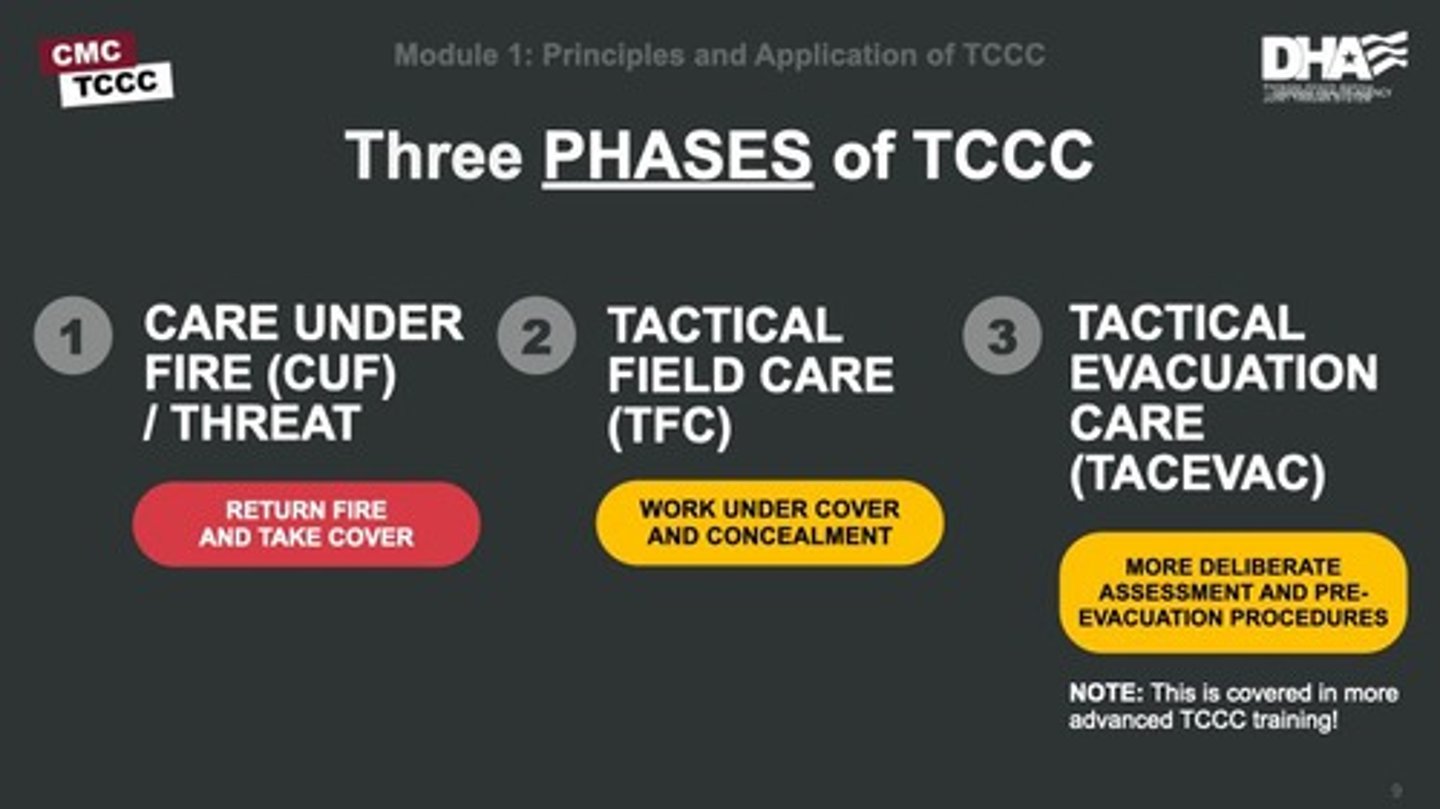
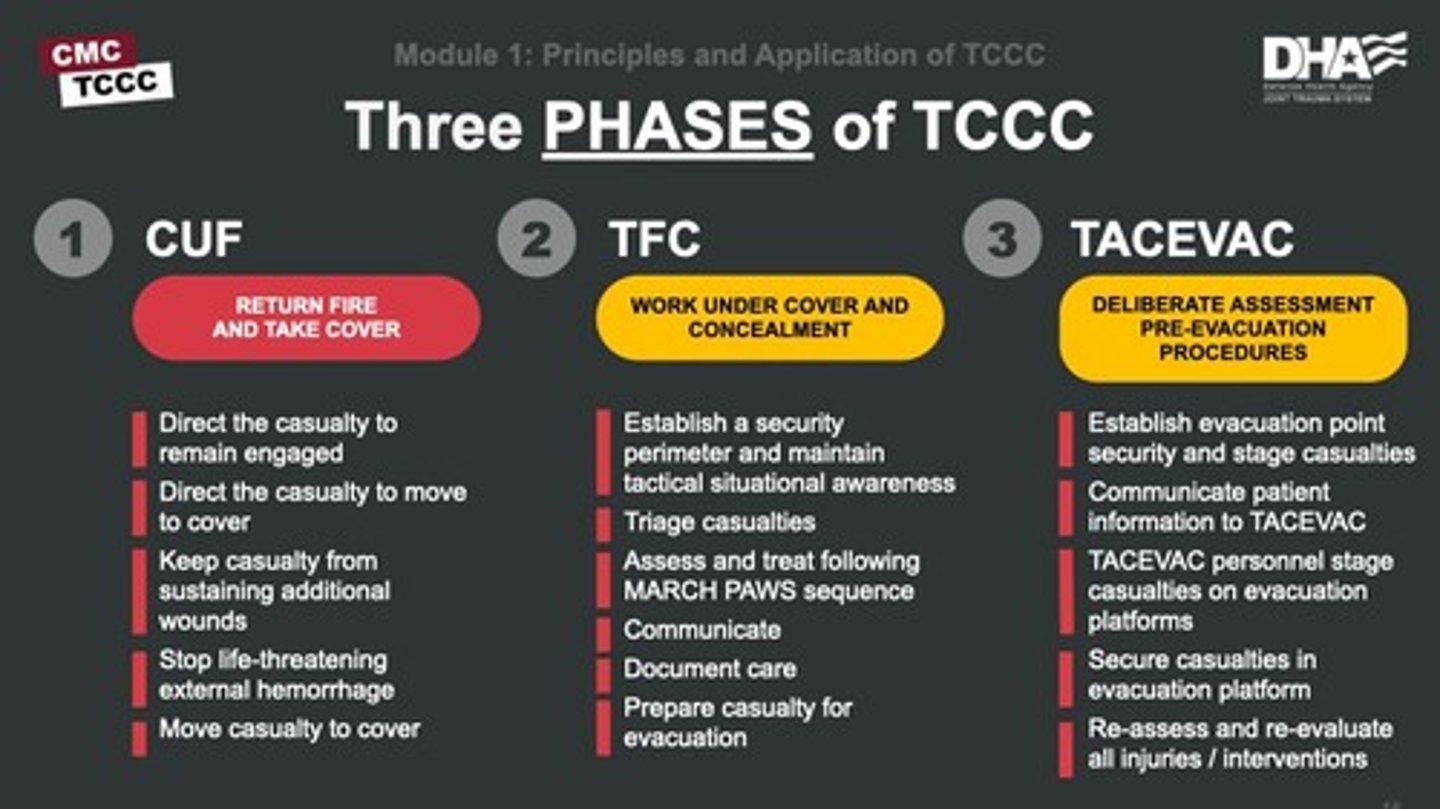
What are the three main phases of TCCC?
1. Care Under Fire (CUF), 2. Tactical Field Care (TFC), 3. Tactical Evacuation Care (TACEVAC).
What is the primary goal during the Care Under Fire phase?
To establish scene safety and control threats.
List the basic management plan for Care Under Fire.
1. Return fire and take cover. 2. Direct casualty to remain engaged. 3. Direct casualty to move to cover. 4. Stop life-threatening hemorrhage if feasible.
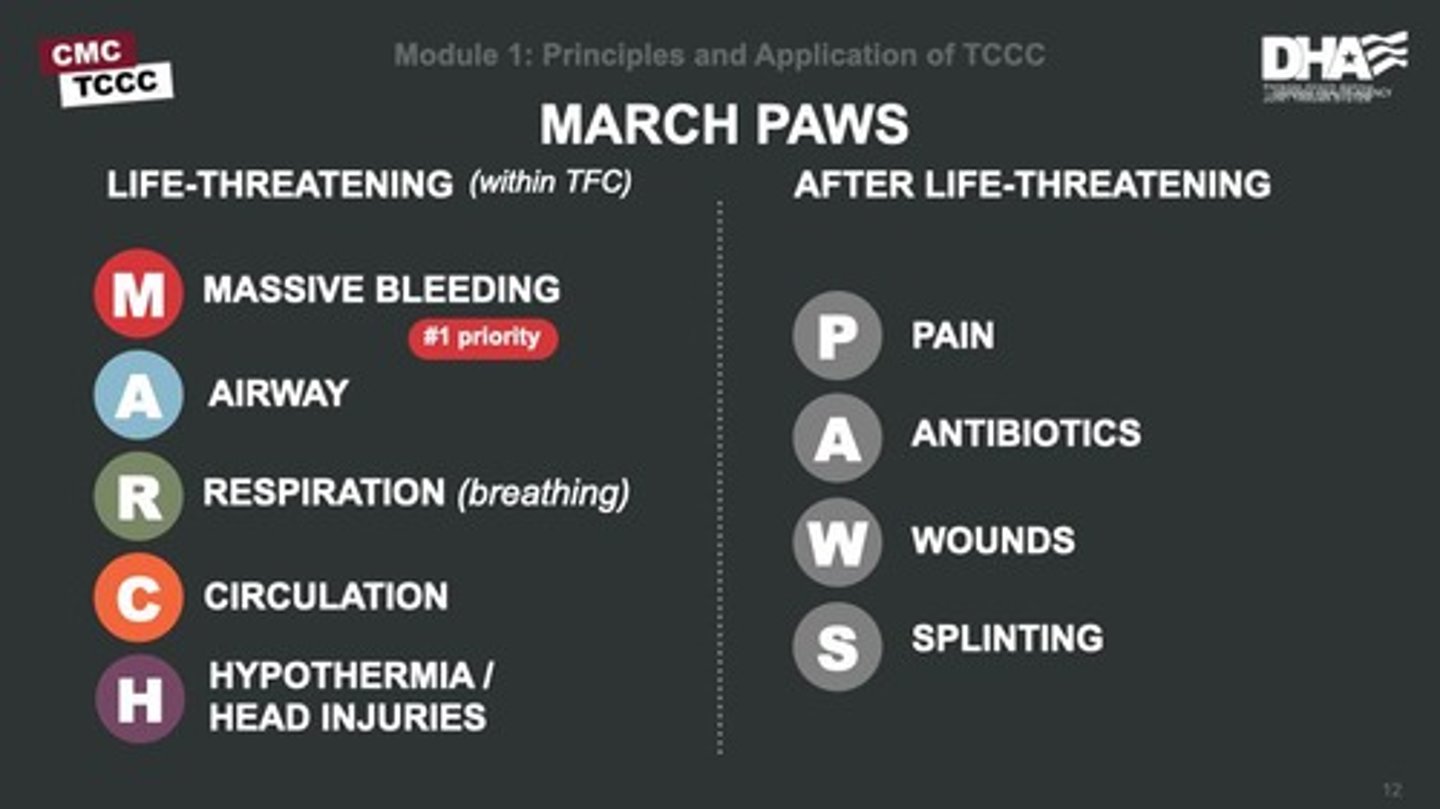
What is the MARCH PAWS approach?
A sequence for assessing and prioritizing treatment in Tactical Field Care.
What does the acronym MARCH stand for?
Massive bleeding, Airway, Respiratory, Circulation, Head injury/hypothermia.
What should be done if life-threatening bleeding is identified?
Apply a tourniquet or control hemorrhage using appropriate methods.
What is the importance of controlling bleeding in TCCC?
Massive hemorrhage is the leading cause of preventable death in traumatic injuries.
What is the role of the Tactical Field Care phase?
To provide care once the scene is secure and to address life-threatening issues.
What is emphasized throughout the TCCC course?
The importance of controlling bleeding and managing airway issues.
What are the key skills required in Tactical Evacuation Care (TACEVAC)?
To safely transport casualties while providing necessary medical care.
What should be done if a casualty is unable to move?
Stop life-threatening external hemorrhage and move the casualty to cover.
What is the significance of the Joint Service Working Group in TCCC training?
They commissioned additional objectives for the CMC personnel to enhance training.
What are the enabling learning objectives in the TCCC course?
They are categorized as cognitive (knowledge-based) and psychomotor (skill demonstration).
What is the focus of the first module in the TCCC course?
The basic principles and application of TCCC.
What is the expected outcome at the end of the TCCC course?
Demonstration of TCCC skills in a practical exercise.
What is a CoTCCC-recommended limb tourniquet used for?
To control hemorrhage that is amenable to tourniquet use.
What should be done if the site of life-threatening bleeding is not apparent?
Place the tourniquet 'high and tight' on the injured limb.
What is the priority when assessing a casualty in TCCC?
To pause the assessment to treat any life-threatening issues identified.
What is the first step in the Tactical Field Care (TFC) management plan?
Establish a security perimeter and maintain tactical situational awareness.
How should casualties with altered mental status be treated?
Weapons and communications equipment should be taken away immediately.
What sequence should be followed for assessment and treatment in TFC?
The MARCH PAWS sequence.
What should be done before preparing for evacuation?
Document care provided to casualties.
What can Tactical Field Care revert to if scene safety is compromised?
Care Under Fire situation.
What is the initial source of supplies in the field?
The casualty's JFAK (Joint First Aid Kit).
What is the minimum information to communicate to TACEVAC personnel?
Stable or unstable status, injuries identified, and treatments rendered.
What should TACEVAC personnel do upon receiving casualties?
Stage casualties on evacuation platforms as required.
What is the role of TACEVAC medical personnel during the evacuation?
Re-assess casualties and re-evaluate all injuries and previous interventions.
What are the three distinct phases of care from point of injury to evacuation?
Care Under Fire, Tactical Field Care, and TACEVAC.
What principle applies to trauma in both combat and noncombat settings?
The principles of TCCC.
What environmental factors can influence the application of TCCC principles?
Hostile fire, darkness, environmental extremes, limited equipment, and long delays to hospital care.
What is the responsibility of Combat Lifesavers (CLS)?
Provide enhanced first aid for injuries before advanced medical care arrives.
What lifesaving skills will ASM personnel be trained on?
RCA, tourniquet application, hemostatic dressing/wound packing, pressure bandages, and basic airway maneuvers.
What is the primary focus of CLS during the Care Under Fire phase?
Gaining fire superiority and preventing further risk to casualties.
What is the CMC's role in Tactical Field Care?
Responsible for specialized first aid, triage, resuscitation, and stabilization of casualties.
What must be done before the arrival of evacuation assets in TACEVAC?
Reassess casualties and communicate findings to TACEVAC medical personnel.
What should be prioritized when using limited supplies in the field?
Use the casualty's JFAK first, then unit's combat lifesaver kits, and finally the CMC aid bag.
What is the emphasis of TCCC training for service members?
Training in self-aid and buddy care.
What is the significance of situational awareness in Tactical Field Care?
It helps maintain safety and resource management during casualty care.
What should be communicated clearly to TACEVAC personnel?
Patient information and status.
What is a key difference in TCCC application between urban and austere settings?
Access to advanced trauma and evacuation assets.
What does the MARCH PAWS sequence stand for?
Massive hemorrhage, Airway, Respiratory, Circulation, Head injury/hypothermia, Pain management, and Wound care.
What is the role of CMC personnel during the TACEVAC phase?
Prepare casualties for evacuation and ensure proper staging and securing on evacuation platforms.
What should be done if the situation changes during Tactical Field Care?
The CLS may need to return to the fight.
What is the goal of the TCCC Guidelines?
To provide effective trauma care in both combat and noncombat situations.
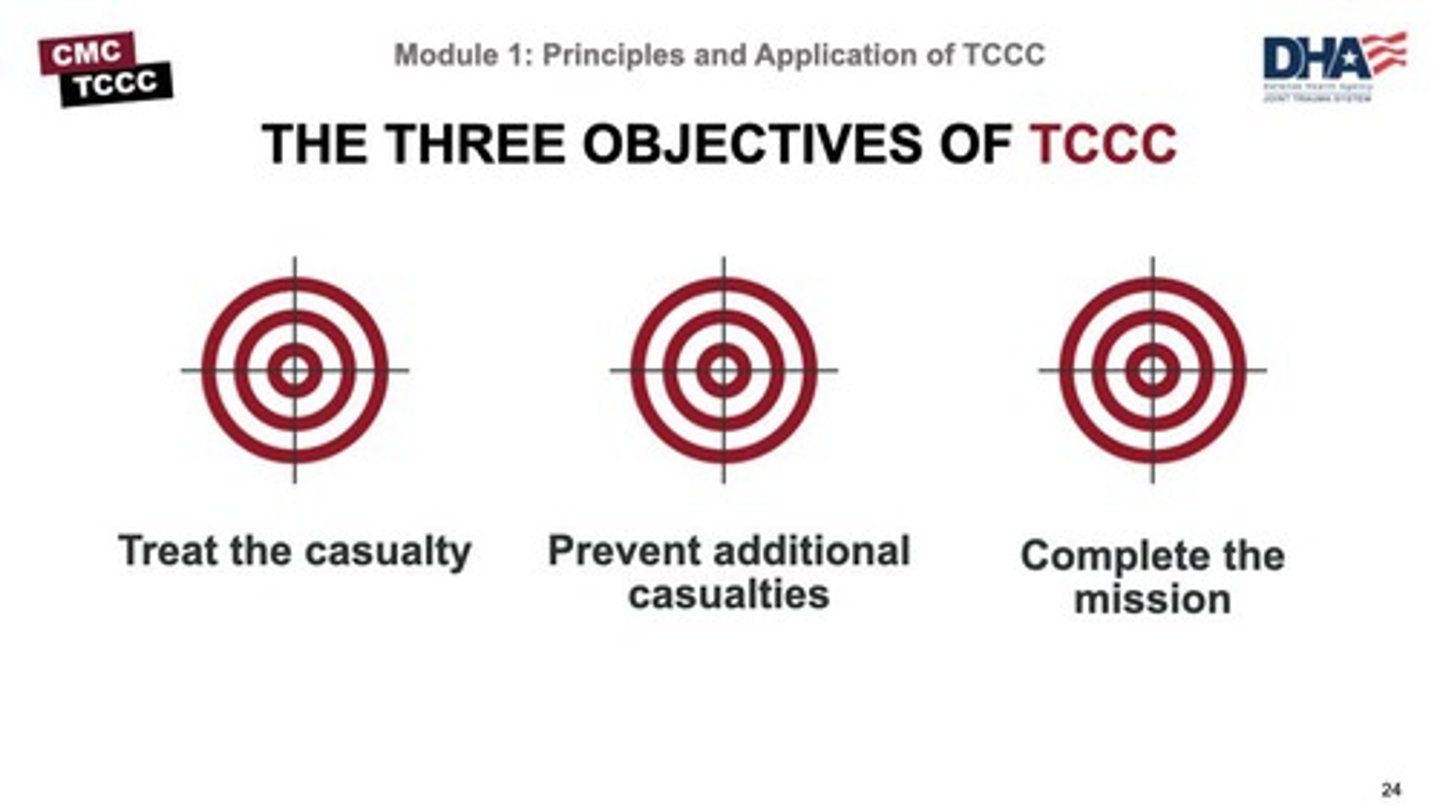
What are the three objectives of TCCC?
1. Treat the Casualty, 2. Prevent Additional Casualties, 3. Complete the Mission.
What does TCCC stand for?
Tactical Combat Casualty Care.
What is the most essential treatment task in Care Under Fire (CUF)?
Application of a limb tourniquet to control massive bleeding.
What are the phases of care in TCCC?
Care Under Fire/Threat, Tactical Field Care, and Tactical Evacuation Care.
What factors influence TCCC?
Hostile fire, tactical considerations, wounding patterns, environmental considerations, level of first-responder training and experience, equipment constraints, and potential delays in evacuation.
What is the role of every first responder in CUF?
Suppress hostile fire and/or establish scene safety, assist in self-aid, and assist in moving casualties, if feasible.
What does MARCH PAWS stand for?
Massive bleeding, Airway, Respirations (breathing), Circulation, Hypothermia AND Head injury, Pain, Antibiotics, Wounds, and Splints.
Why is training in TCCC valuable?
It has been shown to prevent deaths and improve performance in operational settings.
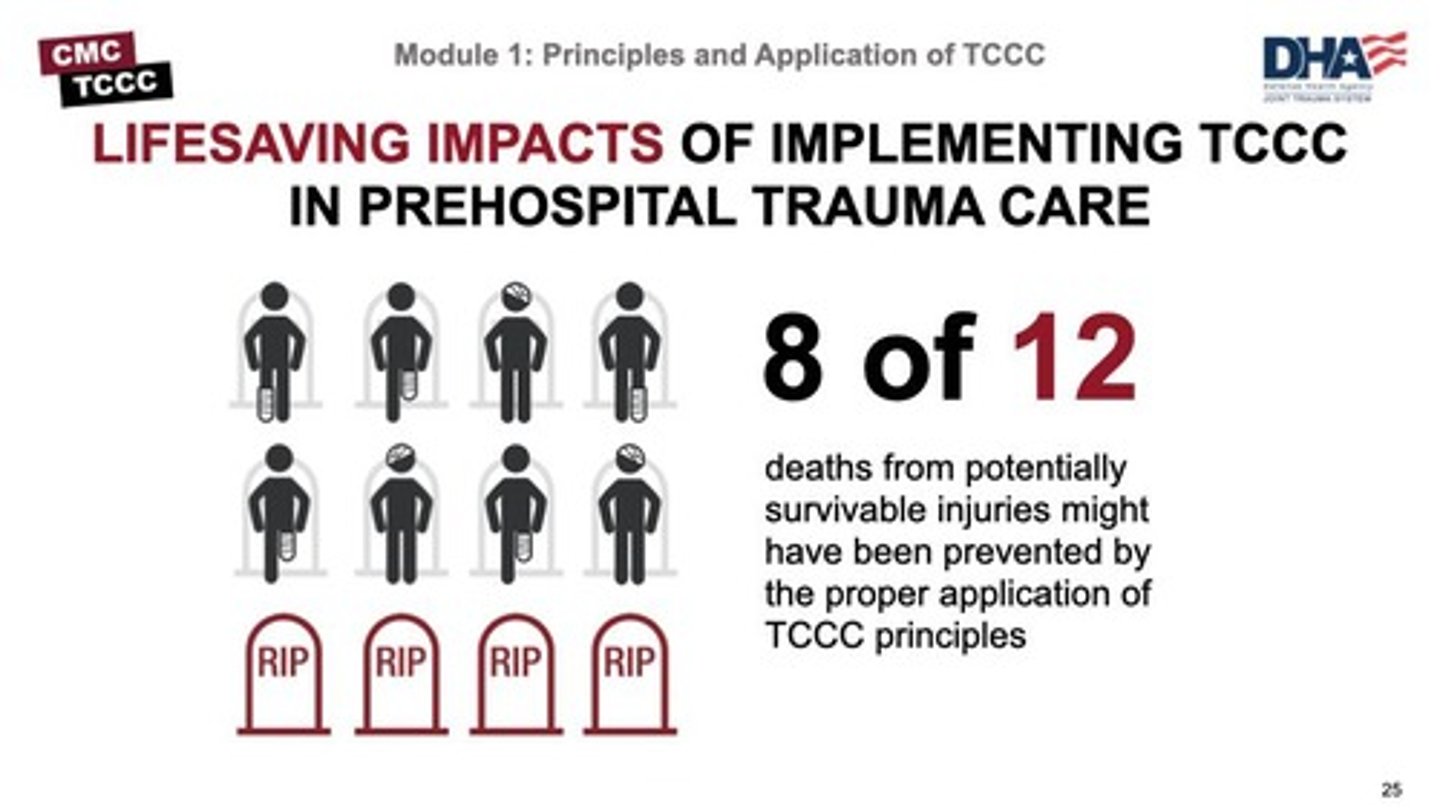
What was the impact of the first preventable death analysis in TCCC?
It revealed that 8 of the 12 individuals who died from injuries that were potentially survivable might have been saved by proper application of TCCC principles.
What significant advance in battlefield trauma care was achieved during the wars in Iraq and Afghanistan?
The ubiquitous use of tourniquets.
What committee is responsible for updating TCCC Guidelines?
The Committee on Tactical Combat Casualty Care (CoTCCC).
What types of personnel are included in CoTCCC membership?
Combat medical personnel, physicians, physician assistants, medical planners, and medical educators.
How often are the TCCC Guidelines reviewed and updated?
Quarterly and as needed.
What is the official website for the most up-to-date TCCC materials?
Deployed Medicine.
What was the historical model for tactical medical training?
It was modeled on civilian courses like EMT and ATLS, which provided excellent in-hospital care.
What was a radical departure from prehospital trauma care practice?
The use of tourniquets.
What are some TCCC advances adopted in military prehospital trauma care?
Hemostatic agents, Needle Decompression of the chest (NDC), advanced/surgical airways, resuscitation with blood products, and hypothermia prevention.
What is the goal of TCCC?
To provide the best possible medical care consistent with good small-unit tactics.
What is the importance of unit-based training in TCCC?
It teaches medical personnel and combat lifesavers/first responders how to work as a team, improving efficiency in real-life situations.
What is the relationship between TCCC training and preventable deaths?
Units that trained all members in TCCC documented the lowest incidence of preventable deaths among casualties.
What does the acronym TCCC emphasize?
The principles of rapidly assessing a trauma patient using an orderly approach.
What is the significance of tourniquet use in TCCC?
It has been the single most important lifesaving battlefield trauma care advance.
What does the term 'tactical environment' refer to in TCCC?
An environment that dictates movements, communication options, and access to support personnel and equipment.
What challenges may affect resupply during a mission?
Resupply can be erratic or nonexistent, and tactical considerations may limit what can be taken.
What is the potential impact of significant delays in evacuation?
It may lead to prolonged field care issues.
What is the role of scientific evidence in TCCC?
It shows that TCCC principles will prevent deaths.
What type of tourniquet found in the CMC Aid Bag is used to control massive hemorrhage in the axilla that is too proximal for effective limb tourniquet application?
Junctional Tourniquet
When should you inspect your JFAK, CLS bag, CMC bag, and other Service-specific medical kits?
Before, during, and after all training events and missions.
What is Care Under Fire?
Care Under Fire is the care given by the first responder at the scene of the injury while they and the casualty are still under effective hostile fire or near the threat
What are the signs of life-threatening bleeding?
Bright red blood is pooling on the ground
The overlying clothes are soaked with blood
There is a traumatic AMPUTATION of an arm or leg
There is pulsatile (pulsing) or steady bleeding from the wound
How long does it take to bleed to death from a complete femoral artery and vein disruption?
3 minutes or less
What are advantages and disadvantages of one-person drags?
Advantages: Only one rescuer is exposed to enemy fire
Disadvantages: They are difficult to perform and can cause the rescuer to tire quickly
What are advantages and disadvantages of two-person carries?
Advantages: They are useful in situations where drags do not work well and are quicker than most one-person carries
Disadvantages: They cause the rescuers to have a higher silhouette than most drags, and are hard to accomplish with the added weight of rescuer’s and/or the casualty’s equipment
What is the difference between TFC and CUF?
Tactical Field Care is the care rendered once the combat medic/corpsman and casualty are no longer under direct threat from effective enemy fire. This allows for the time and the relative safety for a more deliberate approach to casualty assessment and treatment.
True or False: During TFC, the tactical situation could change back to CUF again at any time?
True
What is MARCH PAWS?
In the Tactical Field Care phase, the MARCH PAWS sequence is followed for a more deliberate approach to the assessment and treatment of casualties than was possible during Care Under Fire. A full tactical trauma assessment should follow the steps of the MARCH PAWS sequence.
What is triage?
Triage is the deliberate sorting of casualties and allocation of limited treatment resources according to a system of priorities designed to maximize the number of survivors on the battlefield.
What is a CCP?
The Casualty Collection Point (CCP) is a location on the battlefield for the triage, treatment and monitoring, and the packaging/staging of casualties for evacuation. The CCP should be established reasonably close to the fight where casualties are likely to occur, be near natural “lines of drift,” provide relative cover and concealment from the enemy whenever possible, and have access to evacuation routes.
In which phase of care is most of the Tactical Trauma Assessment performed?
Tactical Field Care
What pneumonic is used to prioritize care in the Tactical Trauma Assessment?
MARCH PAWS
Why is it important to access the casualty’s mental status?
They may need to be disarmed and to have communications equipment removed. Following their mental status throughout the assessment may help responders identify changes in clinical status, leading to early casualty reassessment.
What is a blood sweep?
A blood sweep is a rapid visual and palpable head-to-toe check of the front and back of the casualty for any unrecognized life-threatening bleeding.
What is the proper distance a deliberate tourniquet should be placed from the bleeding site in TFC?
A deliberate tourniquet placed in TFC should be 2-3 inches above (proximal) to the site of bleeding.
What are the differences between the high & tight/hasty tourniquets placed in CUF and the deliberate tourniquets placed in TFC?
The tourniquets placed in CUF are typically placed over the uniform/clothing as high up on the extremity as possible, as time is very limited and the exact site of bleeding may not have been identified. In contrast, the tourniquets placed in TFC are placed more deliberately after uniform/clothing has been removed and 2-3 inches above the identified site of bleeding.
How long should direct pressure be applied onto packed hemostatic dressings?
3 minutes
Why is it important to check the pulse after applying a pressure bandage?
A pressure bandage should not be a tourniquet. It is important to check to ensure a pulse is till present distally after bleeding has been controlled by application of a pressure bandage. If no pulse is present the pressure bandage should be loosened and reapplied.
What is inguinal junctional hemorrhage and how is it treated?
Inguinal junctional hemorrhage is bleeding from the large blood vessels at the junction where the lower extremities join the torso. Injuries to these junctional areas are typically not amendable to a limb tourniquet and require other intervention. If available a CoTCCC-recommended junctional tourniquet should be applied. If not available, the wound should be packed with hemostatic gauze and direct pressure applied to the wound. Application of an improvised pressure delivery device may be needed to apply additional, targeted, and sustained pressure to control hemorrhage.