15.2 - Energy in Simple Harmonic Motion
 Call Kai
 Learn
Learn Practice Test
 Spaced Repetition
 Match
Match Flashcards
 Knowt Play
1/3

There's no tags or description
Looks like no tags are added yet.
Name | Mastery | Learn | Test | Matching | Spaced | Call with Kai |
|---|
No analytics yet
Send a link to your students to track their progress
4 Terms
Potential Spring Energy of a Linear Oscillator
Recall that the energy for a spring-mass system is given by:
U(t) = (1/2)k(x(t))²
But because we know that x(t) = xmcos(wt + phi), we know that the potential energy of the spring-mass system is given by the following:
U(t) = (1/2)k(xm)²cos²(wt + phi)

Kinetic Energy for a Spring-Mass System
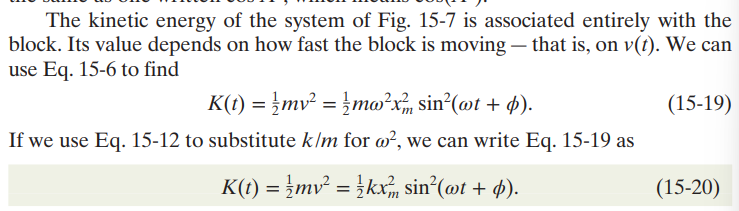
Like with the potential energy of the system, we use the differentiated form of the position function and plug it into the kinetic energy formula to find the kinetic energy of the spring-mass system itself:
Conservation of Mechanical Energy for a Spring-Mass Linear Oscillator System
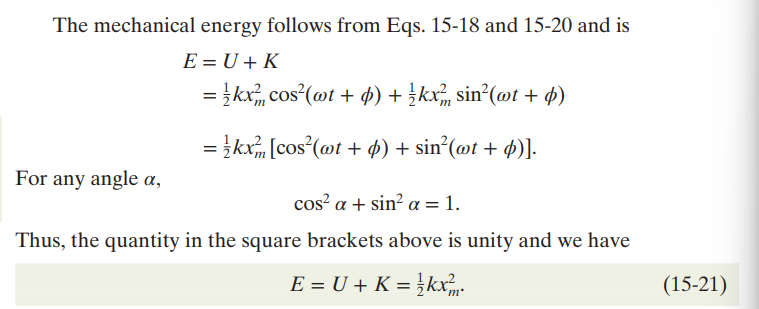
Since the mechanical energy is the sum of the potential and kinetic energy, we can just combine the formulas before and identify the trigonometric identity necessary to simplify the expression:
This reinforces the Conservation of Mechanical Energy is also applicable of the linear-oscillator; this only works because we assume that the surface is frictionless, so there is no energy lost due to friction with each oscillation
filler
filler deeedd