Chapter 6: Making Life Work
 Call Kai
 Learn
Learn Practice Test
 Spaced Repetition
 Match
Match Flashcards
 Knowt Play
1/50

There's no tags or description
Looks like no tags are added yet.
Name | Mastery | Learn | Test | Matching | Spaced | Call with Kai |
|---|
No analytics yet
Send a link to your students to track their progress
51 Terms
A person who is running, the release of heat from fire, and light emitted from a lamp are all examples of _____ energy.
kinetic
The C-C covalent bonds in molecules such as carbohydrates and lipids as well as the bonds between the phosphates in a molecule of ATP are both examples of _____ energy.
potential
Phototrophs: Obtain energy from ?
sunlight
Chemotrophs: Obtain energy from ?
chemical compounds
Examples of autotrophs under the phototrophs umbrella
Cyanobacteria and plants
Difference between autotrophs and heterotrophs
Carbon comes from inorganic sources for autotrophs; carbon comes from organic compounds for heterotrophs
Examples of heterotrophs under the phototroph umbrella
Heliobacteria, most green NON-SULFUR bacteria
Examples of autotrophs under the chemotroph umbrella
sulfur-oxidizing bacteria, hydrogen bacteria
Examples of heterotrophs under the chemotroph umbrella
Most bacteria, animals
______ is the building and breakdown of carbon sources to harness or release energy.
met
Metabolism builds up and breaks down sources of ______ to harness or release energy.
carbon
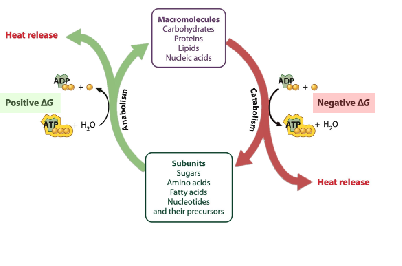
______ is the building of molecules form smaller units, requiring an input of energy (ATP).
Anabolism
______ is the breakdown of molecules into smaller units, producing energy (ATP).
Catabolism
Are carbohydrates, proteins, lipids, and nucleic acids converted to sugars, amino acids, fatty acids, and nucleotides through catabolism or anabolism?
catabolism
Sugars, amino acids, fatty acids, and nucleotides are converted to carbohydrates, proteins, lipids, and nucleotides via anabolism or catabolism?
Anabolism
Do anabolic pathways consume or release energy to build?
Dehydration or hydrolysis reactions?
Consume energy to build, dehydration reactions
Do catabolic pathways consume or release energy to break down materials ?
Dehydration or hydrolysis reactions?
release energy to break down, hydrolysis reactionsAd
ATP stand for?
Adenosine Triphosphate
Energy releases by breaking the bonds in ____ helps drive reactions in the cell that fuel cellular metabolism.
ATP
Energy releases by breaking the bonds in ATP helps drive reactions in the cell that fuel cellular ______.
metabolismHigh
In ATP, do the bonds linking the phosphate groups have a high or low potentil energy?
High
Potential energy is the energy thats ?
stored
Kinetic energy is the energy of ?
motion
First law of thermodynamics states that?
Energy cannot be created or destroyed; it can only be transformed
The total amount of energy does not change
When energy is transformed, does the energy available to do work in the cell increase or decrease? Does the amount of disorder in the system increase or decrease? What is the amount of disorder in a system called?
decrease, increase, entropy
Endergonic reactions ____ energy but exergonic reactions ___ energy.
require, release
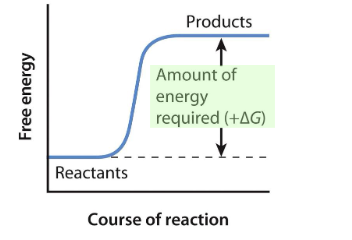
Is this an endergonic or exergonic reaction? is it spontaneous or nonspontaneous?
Endergonic, nonspontaneous
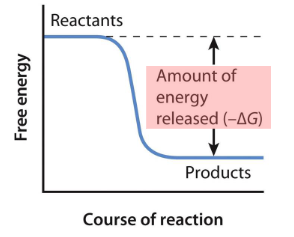
Is this an endergonic or exergonic reaction? is it spontaneous or nonspontaneous?
exergonic, spontaneous
is gravitational motion, diffusion, and chemical reactions are examples of spontaneous or nonspontaneous changes.
spontaneous
ΔG = ?
ΔG = ΔH - TΔS
Do catabolic reactions have a positive or negative ΔG?
negative
Do anabolic reactions have a positive or negative ΔG?
positive
ATP hydrolysis rxn
ATP + H2O —> ADP(adenosine diphosphate) + Pi (inorganic phosphate)
The higher the EA, the ____ the rate of the rxn.
higher
An enzyme accelerates reactions by reducting the?
EA (activation energy)
The ΔG of a rxn is the same with and without an ____?
enzyme
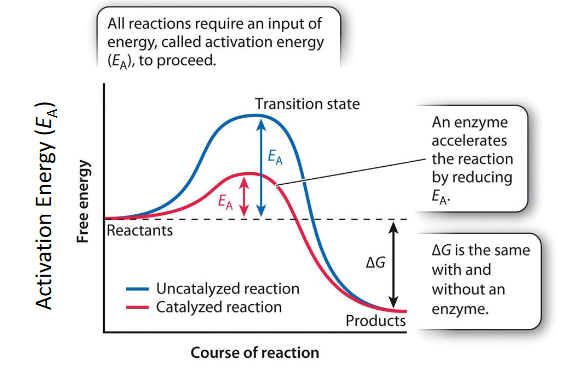
Lowering EA ____ the rate of the reaction but does not change the free enrgy (delta G) of the reaction.
increases
Enzyme shape:
The ____ is formed within the functional protein.
an enzyme ____ the substrates.
An enzyme ____ the EA
An enzyme ____ the transition state
active site, binds, lowers, stabilizes
The amino acids that form the active site are often ______ in the linear sequence of the unfolded enzyme.
far apart
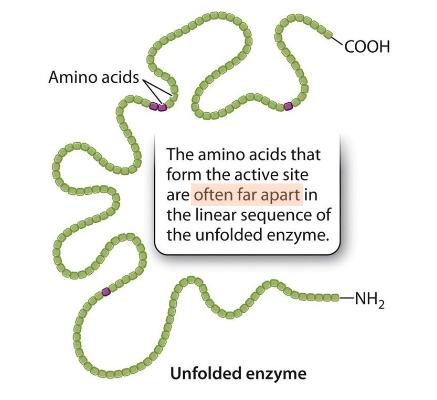
Protein folding brings specific _____ close to each other to form the active site.
Amino acids
ATP cycle
A competitive _____ binds to the active site, competing with the substrate and reducing the rate of the reaction.
Competitive inhibitor
A competitive inhibitor binds to the active site, competing with the ____ and reducing the _____.
active site, rate of the reaction
A _____ inhibitor binds to a site other than the active site, changing the shape of the enzyme and reducing the rate of the reaction.
noncompetitive
A noncompetitive inhibitor binds to a site other than the _____, changing the ___ of the enzyme and reducing the rate of the rxn.
active site, shape
A ____ pathway begins with a specific starting molecule and ends with a product. Each step is catalyzed by a specific?
metabolic, enzyme
What is catalysis?
the increase in the rate of a rxn due to the addition of a substance called a catalyst
_____ is characterized by a product inhibiting the enzyme that catalyzed an earlier reaction. Important in helping the cell to conserve energy.
Negative feedback
what are 3 ways to regulate chemical rxns?
Concentration of enzyme and substrate, temperature, pH