Chapter 9: Heritability and Repeatability
 Call Kai
 Learn
Learn Practice Test
 Spaced Repetition
 Match
Match Flashcards
 Knowt Play
1/76

There's no tags or description
Looks like no tags are added yet.
Name | Mastery | Learn | Test | Matching | Spaced | Call with Kai |
|---|
No analytics yet
Send a link to your students to track their progress
77 Terms
What does heritability tell us?
to what extent the differences we observe in animal performance are due to inheritance
Heritability =
the measure of the strength (consistency, reliability) of the relationship between performance (phenotypic values) and breeding values for a trait in a population/
With high heritability, breeding values generally:
have a large influence on phenotypic values
Larger breeding values =
larger phenotypic deviations from the mean
When heritability is high, performance is, on average:
a good indicator of breeding value
Heritability is always:
positive — ranging from 0 to 1
What is an example of traits which tend to be lowly heritable?
traits related to fertility and survivability
What is an example of traits which tend to be moderately heritable?
production traits like milk production and growth rate
What is an example of traits which tend to be highly heritable?
carcass or “product traits“ and traits that are relate to skeletal dimentions (structural size and mature body weight)
Heritability is a ___ measure?
population
Heritability varies from:
population to population and environment to environment
When individuals share genes, they also share the ___ effects of those genes?
independent
What are “independent effects of those genes”?
These are also called additive genetic effects.
Each gene contributes a small, predictable effect to a trait
These effects are independent of:
dominance (interaction between alleles at the same locus)
epistasis (interaction between different genes)
The correlation in breeding values in relative is due to:
their pedigree relationship
In general, when relatives exhibit ____ in a trait, the trait is quite heritable?
similar performance
When there is little more similarity in the performance of relatives than in the performance of individuals that have been randomly chosen from the population, the heritability of the trait is:
low
The closer the resemblance among relatives for a trait, the higher the trait's:
heritability
Mathematically, heritability is the:
regression of breeding value on phenotypic value
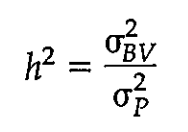
Heritability can also be thought of as a ratio of:
variances
In phenotypic selection:
the only information used to determine whether an individual is selected or not is that individual’s own performance
If heritability is low, phenotypic values generally reveal ___ about underlying breeding values?
little
When heritability is high, performance is a good indicator of:
breeding value
accuracy of selection will be good —> genetic change should be fast
Accuracy of selection will always be:
better for a more heritable trait than for a less heritable one
Producers tend to select for:
more highly heritable traits
Why do producers select for more highly heritable traits?
since they know they can make a significant genetic change
How do producers improve lowly inheritable traits?
though management
But some traits are so important economically that:
they deserve to be selected for despite low heritability
What type of traits tend to be quite heritable?
growth triats
Fertility traits are usually:
lowly heritable
Repeatability =
a measure of the strength of the relationship between repeated records for a trait in a population
Examples of repeated traits =
milk yield, racing and show performance, litter size, fleece weight
What is PA made up of?
strictly permanent influences
If repeatability is high, the first record is:
on average, a good indicator of that animal’s second record
Only having little relationship between phenotypic records and producing abilities means that the repeatability will be:
low
What is another definition of repeatability?
the strength of the relationship between single performance records and producing abilities
As a correlation, repeatability ranges from:
-1 to +1
Negative repeatabilities are:
rare
r = 1 means:
the trait is extremely repeatable
r = 0 means:
the trait is hardly repeatable at all
Repeatability is a ____ measure?
population
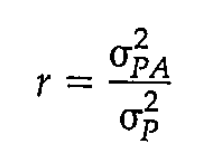
This equation shows that repeatability can also be thought of as:
the ratio of variances of producing ability to the variance of phenotypic value
When repeatability is high, the differences in animal performance are:
largely attributable to differences in producing ability
When r is low, differences in performance are determined:
less by differneces in PA and more by differences in temporary environmental effects
Repeatability is often considered an ____ for heritability?
upper limit
When r is low, what should you do before making a culling decision?
wait for more records
When h² is high, prediction of BV will be:
more accurate, fewer mistakes will be made in replacement selection, & genetic progress will be faster
When r is high, prediction of PA will be:
more accurate and fewer mistakes will be made in culling
What is one important way to inc h² and r?
making the environment as uniform as possible
Making the environment uniform means:
to manage animals in such a way that envi effects on the performance of diff animals are as similar as possible
Why is performance not a good indicator of underlying breeding values?
because differnces in training — environmental diff — have biased performance
Horse example: With a uniform environment/similar training —
horses with the better breeding values are likely to outperform the horses with poorer breeding values
Does more uniform environment always inc heritability?
usually, but not always
If you reduce environmental variation, genetics makes up a larger proportion & heritability increases
How do you manage animals so that environmental effects are as consistent as possible?
minimize the environmental advantages that some animals have over other
The more accurate the measurement of performance in a trait, the higher the trait's:
heritability
Examples of unknown envi effects?
training regimen
level of feed
pasture quality
What are known environmental effects?
they are influences that are so consistent that researchers have developed mathematical adjustment factors or adjustment procedures to account for them
Examples of known environmental effects?
age of calf
age of dam
sex of calf
parity
The age of calf adjustment removes:
the weight adjustment of older calves
The age of dam adjustment account for the:
increased milk production and therefore better nutritional environment provided by older dams
How are adjustment factors typically determined?
by animal breeding researchers using large amounts of performance data from a number of research populations and(or) private herds or flocks
What can be done in situations where all animals cannot be managed the same?
one answer is to express animal performance not in absolute terms, but rather as a deviation from a contemporary group mean
Contemporary group =
a group of animals that have experienced a similar environment with respect to the expression of a trait
What is a “similar environment“ in the context of contemporary groups?
when animals in the group (contemporaries) perform in the same location, are of the same sex, are of similar age, and have been managed alike.
For example, a contemporary group for weaning weight in lambs or calves would commonly be defined by:
breeder, herd, year, season of year, sex, and management effects
Contemporary groups are most commonly used to account for:
environmental differerences between groups of animals
Very small contemporary groups make:
meaniningful com parisons difficult
Breeders use contemporary groups to account for:
contemporary group effects (Ecg)
Ecg =
environmental effects common to all members of a contempororary group

What is this?
genetic model for quantitative traits after inforporating contemporary group effects

What is this?
the equation for repeated traits
Comparing deviations across contemporary groups works best when:
contemporary groups are thought to be genetically similar-as, for example, when they are from the same herd or flock
When contemporary groups are correctly formed, they can:
help to increase heritability and repeatability
Trait ratio =
an expression of relative performance — the ratio of an indivisuals performance to the average performance of all animals in the individual’s contemporary group
In order to account for contemporary group effects, animal performance is often expressed as:
a deviation from a contemporary group mean
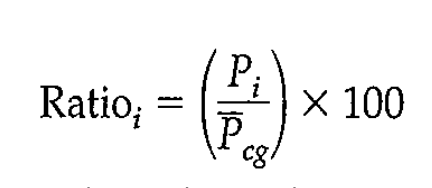
What does this equation show?
the equation to find a trait ratio
A trait ratio above 100 =
higher than average performance
A trait ratio below 100 =
lower than average performance