F2-M8 Ratio and Variance Analysis (FAR Formulas)
 Call Kai
 Learn
Learn Practice Test
 Spaced Repetition
 Match
Match Flashcards
 Knowt Play
1/36

There's no tags or description
Looks like no tags are added yet.
Name | Mastery | Learn | Test | Matching | Spaced | Call with Kai |
|---|
No analytics yet
Send a link to your students to track their progress
37 Terms
Profitability Ratios (Definition)
Measures of the success or failure of an enterprise for a given time period.
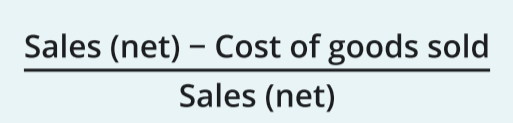
Gross (Profit) Margin
[Sales (net) - COGS] / [Sales (net)]
![<p>[Sales (net) - COGS] / [Sales (net)]</p>](https://assets.knowt.com/user-attachments/7e263b62-e9a9-48e0-a6d5-b9d1061c4449.png)
Profit Margin
[Net Income] / [Sales (net)]
Indicates the percentage return on each sale
![<p>[Net Income] / [Sales (net)]</p><p></p><p>Indicates the percentage return on each sale</p>](https://assets.knowt.com/user-attachments/cebb82a2-6fa0-4ffd-ad18-184978943ef4.png)
Return on Sales
[Income before Interest Income, Interest Expense, & Taxes] / [Sales (net)]
![<p>[Income before Interest Income, Interest Expense, & Taxes] / [Sales (net)]</p>](https://assets.knowt.com/user-attachments/57801061-b095-4fa6-8aec-a28fde866215.png)
Return on Assets
[Net Income] / [Average Total Assets]
![<p>[Net Income] / [Average Total Assets]</p>](https://assets.knowt.com/user-attachments/b65bc5f4-6e7a-4062-8979-0e07cd2e8683.png)
DuPont Return on Assets
[Profit Margin] * [Asset Turnover]
OR
It can be calculated the same as Return on Assets
[Net Income] / [Average Total Assets]
Uses both Profit Margin and Asset Turnover. Allows for increased analysis of the changes in percentages.
![<p>[Profit Margin] * [Asset Turnover]</p><p>OR</p><p>It can be calculated the same as Return on Assets</p><p>[Net Income] / [Average Total Assets]</p><p></p><p>Uses both Profit Margin and Asset Turnover. Allows for increased analysis of the changes in percentages.</p>](https://assets.knowt.com/user-attachments/9f001580-d3e7-4a23-9de4-1efa89375d02.png)
If Turnover is in the name of the formula - the “X” Turnover is in the… (Numerator or Denominator)
Denominator
Example: “Asset” Turnover = Sales / Average Total “Assets”
If Return is in the name of the formula - the Return on “X” is in the… (Numerator or Denominator)
Denominator
Example: Return on “Equity” = Net Income / Average Total “Equity”
If “Days in” is in the name of the formula - the Days in “X” is in the… (Numerator or Denominator)
Numerator
Example: Days in Inventory = [Ending Inventory] / [COGS / 365]
Asset Turnover
[Sales (net)] / [Average Total Assets]
Indicates the effective use of assets in generating sales
![<p>[Sales (net)] / [Average Total Assets]</p><p></p><p>Indicates the effective use of assets in generating sales</p>](https://assets.knowt.com/user-attachments/8182767f-15d8-4616-8e04-f57dfe388c22.png)
Return on Equity
[Net Income] / [Average Total Equity]
![<p>[Net Income] / [Average Total Equity]</p>](https://assets.knowt.com/user-attachments/7867b093-e517-4199-8893-d129a8394e7e.png)
Operating Cash Flow Ratio
[Cash Flow from Operations] / [Current Liabilities]
![<p>[Cash Flow from Operations] / [Current Liabilities]</p>](https://assets.knowt.com/user-attachments/a1b413cf-2eb3-40da-a972-f7ff79525204.png)
Liquidity Ratios (Definition)
Measures of a firm’s short-term ability to pay maturing obligations
Current Ratio
[Current Assets] / [Current Liabilities]
![<p>[Current Assets] / [Current Liabilities]</p>](https://assets.knowt.com/user-attachments/1a94bd3e-962f-4d64-bb9b-466d0d8a5d99.png)
Quick Ratio
[Cash & Equivalents + ST Marketable Securities + Receivables (net)] / [Current Liabilities]
![<p>[Cash & Equivalents + ST Marketable Securities + Receivables (net)] / [Current Liabilities]</p>](https://assets.knowt.com/user-attachments/24fb2d63-f30c-4811-9040-2c0c7c8133ed.png)
Account Receivable Turnover
[Sales (net)] / [Average Accounts Receivable (net)]
Indicates the receivables’ quality and indicates the success of the firm in collecting outstanding receivables. Faster turnover gives credibility to the current and acid-test ratios.
![<p>[Sales (net)] / [Average Accounts Receivable (net)]</p><p></p><p>Indicates the receivables’ quality and indicates the success of the firm in collecting outstanding receivables. Faster turnover gives credibility to the current and acid-test ratios.</p>](https://assets.knowt.com/user-attachments/eb5cc0bf-3d33-4c66-8ef0-53d6b9738212.png)
Days Sales in Account Receivable
[Ending Accounts Receivable (net)] / [Sales (net) / 365]
Indicates the average number of days required to collect accounts receivable.
![<p>[Ending Accounts Receivable (net)] / [Sales (net) / 365]</p><p></p><p>Indicates the average number of days required to collect accounts receivable.</p>](https://assets.knowt.com/user-attachments/ed3a1f2a-2f05-4480-9b7f-a5fdb6827225.png)
Inventory Turnover
[COGS] / [Average Inventory]
Measure of how quickly inventory is sold is an indicator of enterprise performance. The higher the turnover, in general, the better the performance.
![<p>[COGS] / [Average Inventory]</p><p></p><p>Measure of how quickly inventory is sold is an indicator of enterprise performance. The higher the turnover, in general, the better the performance.</p>](https://assets.knowt.com/user-attachments/dda927cb-8e86-4939-a7bd-7614533bda15.png)
Days in Inventory
[Ending Inventory] / [COGS / 365]
Indicates the average number of days required to sell inventory
![<p>[Ending Inventory] / [COGS / 365]</p><p></p><p>Indicates the average number of days required to sell inventory</p>](https://assets.knowt.com/user-attachments/b8eb713d-93d8-43f7-86c3-f1c081c679f6.png)
Accounts Payable Turnover
[COGS] / [Average Accounts Payable]
Indicates the number of times trade payables turn over during the year. A low turnover may indicate a delay in payments, such as form a shortage of cash.
![<p>[COGS] / [Average Accounts Payable]</p><p></p><p>Indicates the number of times trade payables turn over during the year. A low turnover may indicate a delay in payments, such as form a shortage of cash.</p>](https://assets.knowt.com/user-attachments/131f55e8-b007-48c9-85f8-2992ba49465b.png)
Days of Payables Outstanding
[Ending Accounts Payable] / [COGS / 365]
![<p>[Ending Accounts Payable] / [COGS / 365]</p>](https://assets.knowt.com/user-attachments/176764d4-07b0-402e-875f-9232a7a64844.png)
Cash Conversion Cycle
[Days Sales in AR] + [Days in Inventory] - [Days of Payables Outstanding]
![<p>[Days Sales in AR] + [Days in Inventory] - [Days of Payables Outstanding]</p>](https://assets.knowt.com/user-attachments/42b66ec7-c432-4a61-88a8-e905e9316830.png)
Solvency Ratios
Measures of security or protection for long-term creditors/investors
Debt-to-Equity
[Total Liabilities] / [Total Equity]
![<p>[Total Liabilities] / [Total Equity]</p>](https://assets.knowt.com/user-attachments/cdeaa55d-1adc-4d68-b22a-bbd89f9b3cfe.png)
Total Debt Ratio
[Total Liabilities] / [Total Assets]
![<p>[Total Liabilities] / [Total Assets]</p>](https://assets.knowt.com/user-attachments/63dcb6b0-f5ae-4960-8be1-7c4ea65ec4c0.png)
Equity Multiplier
[Total Assets] / [Total Equity]
![<p>[Total Assets] / [Total Equity]</p>](https://assets.knowt.com/user-attachments/18c21ff0-2586-4d9c-a622-1f19f228b330.png)
Times Interest Earned
[Income before Interest Expense & Taxes] / [Interest Expense]
or
[Earnings before Interest & Taxes] / [Interest Expense]
Reflects the ability of a company to cover interest charges. It uses income before interest and taxes to reflect the amount of income available to cover interest expense.
![<p>[Income before Interest Expense & Taxes] / [Interest Expense]</p><p>or</p><p>[Earnings before Interest & Taxes] / [Interest Expense]</p><p></p><p>Reflects the ability of a company to cover interest charges. It uses income before interest and taxes to reflect the amount of income available to cover interest expense.</p>](https://assets.knowt.com/user-attachments/84c9c9ba-9772-49b8-9612-44708d8ceb42.png)
Performance Metrics
Measures used to evaluate operating performance and elements of a company’s stock performance from the perspective of current and potential investors
EBTIA (Definition)
Earnings Before Interest, Taxes, Depreciation, and Amortization
Can be calculated from the income statement using either a “top-down” or “bottom-up” approach
Top-Down - EBITDA Calculation
Sales - COGS - Operating Expenses (Excluding Depr. & Amort.)
Bottom-Up - EBITDA Calculation
Net Income + Income Tax Expense + Interest Expenses + Depr. & Amort.
Earnings Per Share
[Income Available to Common Shareholders] / [Weighted Average Common Shares Outstanding]
![<p>[Income Available to Common Shareholders] / [Weighted Average Common Shares Outstanding]</p>](https://assets.knowt.com/user-attachments/c7170603-6301-47d3-973a-8ef3d1601caa.png)
Price-to-Earnings Ratio
[Price per Share] / [Basic Earnings per Share]
Indicates the investment potential of an enterprise; a rise in this ratio indicates that investors are pleased with the firm’s opportunity for growth.
![<p>[Price per Share] / [Basic Earnings per Share]</p><p></p><p>Indicates the investment potential of an enterprise; a rise in this ratio indicates that investors are pleased with the firm’s opportunity for growth.</p>](https://assets.knowt.com/user-attachments/44bb307e-9fc6-4a65-a639-9fcb9d2df3c8.png)
Dividend Payout
[Cash Dividends] / [Net Income]
Indicates the portion of current earnings being paid out in dividends
![<p>[Cash Dividends] / [Net Income]</p><p></p><p>Indicates the portion of current earnings being paid out in dividends</p>](https://assets.knowt.com/user-attachments/0481681c-aee9-4ba2-910c-15827379033d.png)
Asset Turnover
[Sales (net)] / [Average Total Assets]
Indicates how a firm makes effective use of its assets. A high ratio indicates effective asset use to generate sales.
![<p>[Sales (net)] / [Average Total Assets]</p><p></p><p>Indicates how a firm makes effective use of its assets. A high ratio indicates effective asset use to generate sales.</p>](https://assets.knowt.com/user-attachments/6d54999b-122b-4f32-8f21-79faed1afdd2.png)
What are the limitations of Ratios?
They depend on the reliability of the data. Additional information is also valuable when analyzing a company.
Horizontal analysis measures the dollar and percentages change over time. This is useful in evaluating trends and material changes.
Vertical analysis reduces statements to a common size. It not only allows for period-to-period comparison, but also allows for comparability to other entities as the statement is in a common size
Variance Analysis (Actual Versus Budget)
A tool for comparing some measure of performance to a plan, budget, or standard for that measure.
Examples:
Budget vs Plan Performance Report: Compares a Budget to a Actual Performance
Flexible Budget Performance Report: Adjusts Budgets of Variable Expenses based on actual vs budget Units Sold (Measures revenue per unit)