Unit 4: Evolution Grade 11 AP Bio
 Call Kai
 Learn
Learn Practice Test
 Spaced Repetition
 Match
Match Flashcards
 Knowt Play
1/98

There's no tags or description
Looks like no tags are added yet.
Name | Mastery | Learn | Test | Matching | Spaced | Call with Kai |
|---|
No analytics yet
Send a link to your students to track their progress
99 Terms
Evolution:
The change in genetic composition of a population during successive generations
Macroevolution
The evolution that occurs when a new species is developed
Microevolution
Change in frequency/percentage of alleles within a population
(not speciation, smaller degrees of change)
Aristotle (384-322) BC
Viewed the living world as fixed and unchanging
Arranged organisms in a ladder
(inferior -> superior organisms)
Theory of Uniformitarianism
James Hutton (1726-1797) + Charles Lyell (1797-1875)
States that the physical laws that now shape the earth have always done so
Catastrophism
Georges Cuvier (1769-1832)
One origin of life is wiped out by a catastrophic event
Organisms from other areas move in after the event
Line of Descent
Jean-Baptiste de Lamarck (1744-1829)
A progression between current species and fossil forms
Continues from original life to current life
Theory of Inheritance of Acquired Characteristics
Jean-Baptiste de Lamarck (1744-1829)
Giraffe's lengthened neck was passed onto its offspring
On the Origin of Species by Means of Natural Selection (Darwin)
1. Species were not created in their present form, but evolved from ancestral species
2. Proposed a mechanism for evolution - natural selection
Evolution by Natural Selection
1. Organisms produce more offspring than can survive. Therefore, organisms compete for limited resources.
2. Individuals of a population vary extensively, and much of this variation is heritable.
3. Individuals that are better suited to local conditions survive to produce more offspring.
4. Processes for change are gradual.
Descent with Modification
The changes in a population do not demonstrate progress, it is just change
Biogeography
The study of past and present geographical distribution of organisms
Geographically close environments are more likely to be populated by related species
Fossils
Fossils in younger rock are more similar to current species than those in deeper strata
Appear in chronological order in the rock - probable ancestors are found in older rocks
Homologous structures
Structures with similar structural elements and origin but may have a different function
Originates from a common ancestry
Analogous structures
Structures that do not have a common origin but perform similar functions
Vestigial structures
Structures that are reduced versions of what was a once function structure
Proved by fossil records that show past functional use of present day structure
Typically reduced in size and function in comparison to other members of a group
Embryological Similarities
Similar structures and similar developmental processes in embryos suggests common ancestry
Biochemical & Genetic Analysis
Species with similar DNA share a common ancestor
DNA evidence supports conclusions about relationships and common ancestry provided by other areas of evidence
Mutation
The original source of different alleles
The only source of new genetic variation
Creates variation within species
Selective advantages
A genetic advantage that improves an organism's chances of survival
Modern Synthesis
1. Acquired characters not inherited
2. Continuous variation explained by Mendelian genetics (Fisher)
3. Natural Selection (NS) can work with what is available in nature - nothing else is required
4. Speciation only requires natural selection not macromutation/acquired character
5. Species are not morphotypes - dynamic concept
Natural Selection
Individuals with favorable traits are more likely to leave more offspring which are better suited for reproduction
Requirements of Natural Selection
1. Phenotypic Variation
2. Heritability
3. Competition
4. Variations in survival + reproduction
Adaptation
Favored traits will spread through the population
Species will become adapted to their environment in response to environmental pressures
ex. Rock-pocket mice
Types of natural selection
Directional selection
Stabilizing selection
Disruptive selection
Directional selection
A specific extreme of a gene is favoured
Stabilizing selection
Favours intermediate phenotypes and acts against extreme variants
Disruptive selection
Both extremes of a gene are favoured
Often leads to new species being formed
Sex-linked usually does not lead to speciation
Artificial Selection (Selective Breeding)
The selective breeding of domesticated plants and animals to encourage the occurrence of desirable traits
Advantages of Selective Breeding
Allows us to choose desirable traits
Disease resistance
Endurance
Strength
Tameness
Disadvantages of Selective Breeding
Other traits become negatively affected
Decreases genetic diversity
Monocultures
A large area with one type of plant with little genetic diversity
Usually uses artificial selection
Gene Pool
All of the alleles of all of the individuals in a genetic population
Genetic Population
An array of alleles temporarily embodied in individuals but combines through sexual reproduction and conjugation
Allelic frequency
Represents the incidence of a gene variant in a population
Divide # of times the allele is observed by copies of all alleles in the population
Genotypic Frequency
Represents the proportion of a specific genotype in a population
# of individuals in the population with the trait divided by total # of individuals
5 Causes of Microevolution
1. Mutation
2. Gene flow (migration)
3. Non-random mating
4. Genetic drift
5. Natural selection
Mutation (Microevolution)
The source of genetic variation
Causes more genetic diversity and selective advantages for some individuals
Gene flow (Microevolution)
The net movement of alleles from one population to another
A result of the migration of individuals
Can both separate and unite populations
Non-Random Mating (Microevolution)
Mating among individuals on the basis of a particular phenotype/due to inbreeding
3 Types of Non-Random Mating
Assortative Mating
Disassortative Mating
Inbreeding
Assortative Mating
Preference for similar genotypes or phenotypes
Usually leads to directional/stabilizing
Disassortative Mating
Preference for different genotypes or phenotypes
Most likely leads to disruptive(when trait is not sex-linked)
Inbreeding
Occurs when closely related individuals breed
Can occur naturally or by human-led breeding program
Genetic Drift (Microevolution)
The change in frequencies of alleles due to random events in a small breeding population
Smaller populations have less genetic variation, more genetic drift
2 Types of Genetic Drift
Founder Effect
Bottleneck Effect
Founder Effect
A new population is begun by a few migrating individuals
New pop. gene pool only has alleles from founders - gene pool is reduced
Causes extreme genetic drift
Bottleneck Effect
An existing population is quickly reduced in size by environment
Survivors have a fraction of the alleles present
Extreme loss of genetic diversity, high genetic drift
3 Types of Natural Selection (Microevolution)
1. Sexual selection
- Intersexual selection
- Intrasexual selection
2. Altruism
3. Kin Selection
Intersexual Selection
Member of one sex chooses other to mate with
Usually female choice
Explains flamboyant appearance in birds
Intrasexual selection
Members of one biological sex compete with members of the same sex for access to members of the opposite sex
Explains Male vs. Male Competition
Altruism
Individual behaviour benefits a social group at the expense of the individual
Helping another organism at a detriment to yourself
Animal does not have to be related/family
Kin Selection
Version of altruism
Helpful behaviour for family/kin
Ensures some part of the family's genes are passed on
Sibling helps sibling = children carry similar genes, ensures survival
Bateman's Principle
Female reproductive success is limited by access to resources
Male reproductive success is limited by access to females
Sexually Monomorphic
Males & females look similar
Sexually Dimorphic
Male & females look different
Good Genes Hypothesis
Secondary sexual characteristics signal increased fitness
Post-copulatory Selection
Sperm competition - competes for fertilization
Females can also choose (sperm storage, etc)
Sexy Sons Hypothesis
Having a sexy partner = having a sexy son
Fisherian Runaway Selection
Cost of trait vs cost of benefit(reproductive success)
Balance is found in between both costs
Hardy-Weinberg Equilibrium
When a population is not evolving and allele frequencies stay the same
5 Requirements for H-W Equilibrium
1. No Mutation
2. Random Mating
3. No natural selection
4. No Migration
5. Large population
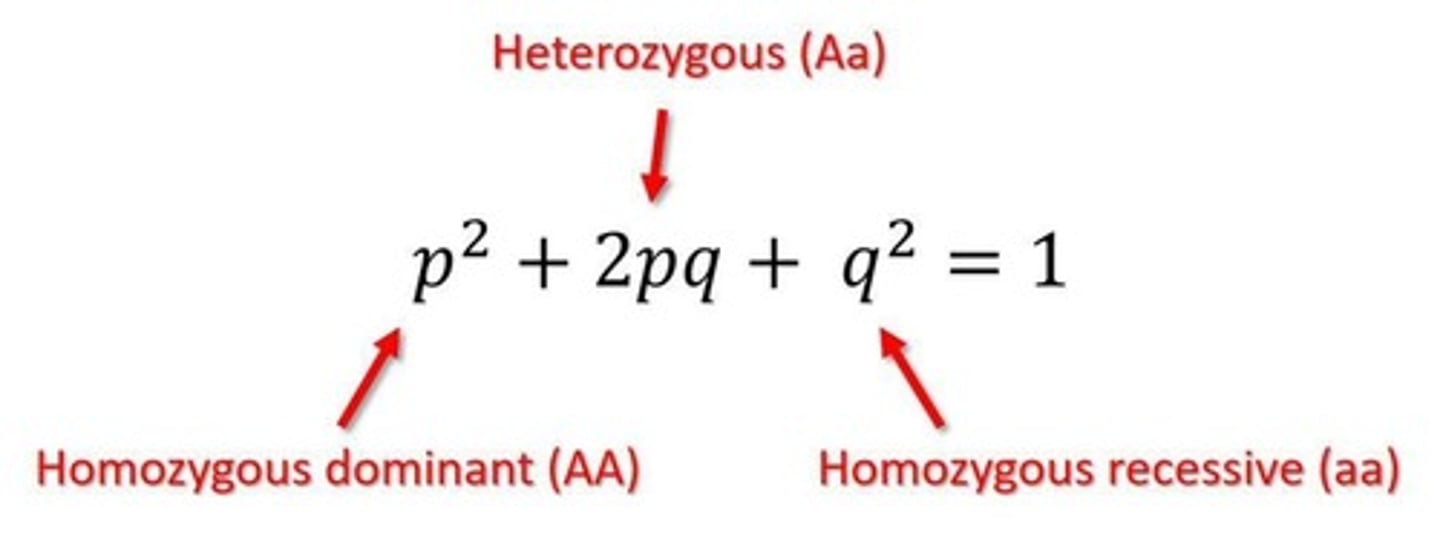
H-W Equation
p^2 + 2pq + q^2 = 1
p+q=1
Species
The most basic category of biological classification
No universally applicable concept
Speciation
Occurs when a group within a species separates from other members of its species and develops its own unique characteristics
Caused by:
- Genetic distinctiveness
- Reproductive isolation
Reproductive Isolation
Allows species to evolve independently of other species
Biological Species Concept
Species recognize each other as mates
Offspring is viable and fertile
Organisms are reproductively isolated from other populations
Anagenesis
Evolutionary change within lineages over time
Cladogenesis
Splitting of lineages over time
2 Categories of Reproductive Isolation
Pre-Zygotic
Post-Zygotic
2 Categories of Pre-Zygotic Isolation
Prevention of Mating
- Behavioural Isolation
- Temporal Isolation
- Ecological/Habitat Isolation
Prevention of Fertilization
- Mechanical Isolation
- Gametic Isolation
Behavioural Isolation
Differences in mating behavior leads to reproductive isolation
Organisms do not recognize each other's mating rituals
Temporal Isolation
Differences in the timing of mating prevents different species from interbreeding
Ecological/Habitat Isolation
Species occupy different habitats - do not meet
Mechanical Isolation
Anatomical differences make mating physically impossible
ex. genitalia, body size
Occurs often in plants and insects
Floral Isolation (Type of Mechanical)
Flower structures & pollination methods are different
Gametic Isolation
Gametes of different species cannot fuse
Organisms who use random mating must use gametic isolation
Hybrids
The offspring of parents from two genetically distinct populations
Postzygotic barriers reduce viability or fertility
Reproduction of fertile hybrids can lead to formation of a new species
Types of Post-zygotic Isolation
Zygotic Mortality
Hybrid Inviability
Hybrid Infertility/Sterility
+
Hybrid Breakdown
Zygotic Mortality
Zygote is not viable
Fused zygote immediately stops developing - does not reach pregnancy
Hybrid Inviability
Hybrid zygotes fails to develop into an adult hybrid
Dies before reaching maturity
Mammal species - dies before birth
Hybrid Infertility
Hybrids live to adulthood but cannot produce viable gametes
Hybrid Breakdown
Fertile hybrid is formed, reaches adulthood
Offspring has reduced fitness
Modes of Speciation
Allopatric Speciation
Peripatric Speciation
Parapatric Speciation
Sympatric Speciation
Allopatric Speciation
Population is split into 2+ isolated groups by a geographical barrier
Reproductive isolation evolves in the different populations
Genetic divergence through: natural selection, mutation, genetic drift
Most common mode of speciation (believed to be)
Peripatric Speciation (Founder Effect)
Small population is isolated from parent population
Genetic divergence through: natural selection, genetic drift
Parapatric Speciation
Continuous population
Modest gene exchange occurs
Genetic divergence through: natural w selection
Continuous population
Neighboring populations share small zones of contact
Sympatric Speciation
1 interbreeding population - reproductive isolation occurs within it
Genetic divergence through: diversifying selection, polyploidy
Polyploidy
3+ sets of chromosomes
Error in cell division -> extra set(s) of chromosomes
Organism becomes reproductively & genetically isolated from population
Rare in animals, common in plants
Strawberry genome (polyploidy)
Commercial strawberry - octoploid
2n=8
8 x 7 chromosome sets = 56 total
Allopolyploids
Allopolyploidy
Genome comes from different ancestral diploid sub-genomes
Comes from gametic non-reduction (daughter cell keeps all parent cell chromosomes) + cross pollination
Rate of Speciation
Full process takes long periods of time
Varies widely
Influenced by a variety of factors
i.e. size & degree of geographic isolation
Mass extinction
The extinction of a large number of species within a relatively short period of geological time
Occurs due to catastrophic events or rapid widespread environmental change
Results in a burst of evolution of new species filling empty niches
Adaptive Radiation (divergent evolution)
The evolution of an animal or plant group into a wide variety of types adapted to specialized modes of life
Convergent evolution
Opposite of divergent evolution/adaptive evolution
Unrelated organisms independently evolve similarities when adapting to similar environments/niches
Analogous structures are produced
Coevolution
When two species evolve in response to changes in each other
Closely connected by ecological interactions (symbiotic relationships)
Each party exerts selective pressures on the other
Gradualism
The evolution of new species by gradual accumulation of small genetic changes over long periods of time
Punctuated Equilibrium
"Equilibrium" is "punctuated" by episodes of very fast development of new forms
Involves many different lines of descent
Opposite of gradualism
Rare & rapid event of speciation