Marine Invert
 Call Kai
 Learn
Learn Practice Test
 Spaced Repetition
 Match
Match Flashcards
 Knowt Play
1/238

There's no tags or description
Looks like no tags are added yet.
Name | Mastery | Learn | Test | Matching | Spaced | Call with Kai |
|---|
No analytics yet
Send a link to your students to track their progress
239 Terms
What does the root of a phylogenetic tree represent?
The oldest common ancestor and starting point of the tree.
What does a node represent on a phylogenetic tree?
A point where lineages split and a common ancestor existed.
What is a terminal node?
The end of a branch representing a taxon/group.
What are sister groups?
Two groups that share the most recent common ancestor.
What is a clade?
A monophyletic group containing an ancestor and all of its descendants.
What is a monophyletic group?
A group containing a common ancestor and all descendants.
What is a paraphyletic group?
A group containing a common ancestor but not all descendants.
What is a polyphyletic group?
A group containing organisms from different ancestors.
What is homology?
A similarity caused by shared ancestry.
What is a homologous character?
A trait inherited from a common ancestor.
What is an apomorphy?
A derived character state that evolved at a specific point in a lineage.
What is a plesiomorphy?
An ancestral character state.
What is a synapomorphy?
A shared derived trait that defines a group.
What is an autapomorphy?
A unique derived trait found in only one group.
What is a symplesiomorphy?
An ancestral trait shared by multiple lineages.
What is homoplasy?
A similarity not caused by common ancestry, usually from convergence.
What is evolutionary convergence?
When unrelated organisms evolve similar traits independently.
What is binomial nomenclature?
A naming system using genus + species.
Who created binomial nomenclature?
Carl von Linné (Linnaeus).
What are the major taxonomic levels?
Kingdom, Phylum, Class, Order, Family, Genus, Species.
What is the genus in a scientific name?
The first word of a scientific name.
What is the species epithet?
The second word of a scientific name.
What is asymmetry?
A body plan with no axis or plane of symmetry.
What is radial symmetry?
Body parts arranged around a central axis.
What is bilateral symmetry?
A body plan with left and right sides separated by one plane.
What is cephalization?
The development of a specialized head region with sensory structures.
What are germ layers?
Embryonic tissue layers that form body tissues.
What are the germ layers of diploblasts?
Ectoderm and endoderm.
What are the germ layers of triploblasts?
Ectoderm, mesoderm, and endoderm.
What animals are considered non-Bilateria?
Porifera, Placozoa, Cnidaria, and Ctenophora.
Why can't animals increase size indefinitely?
Cells need access to the body surface for exchange, so organisms must increase surface area.
What phylum contains sponges?
Porifera.
What does Porifera mean?
Pore-bearing.
What are sponges?
Simple aquatic animals that filter water through their bodies.
How many living sponge species exist?
Approximately 8,550.
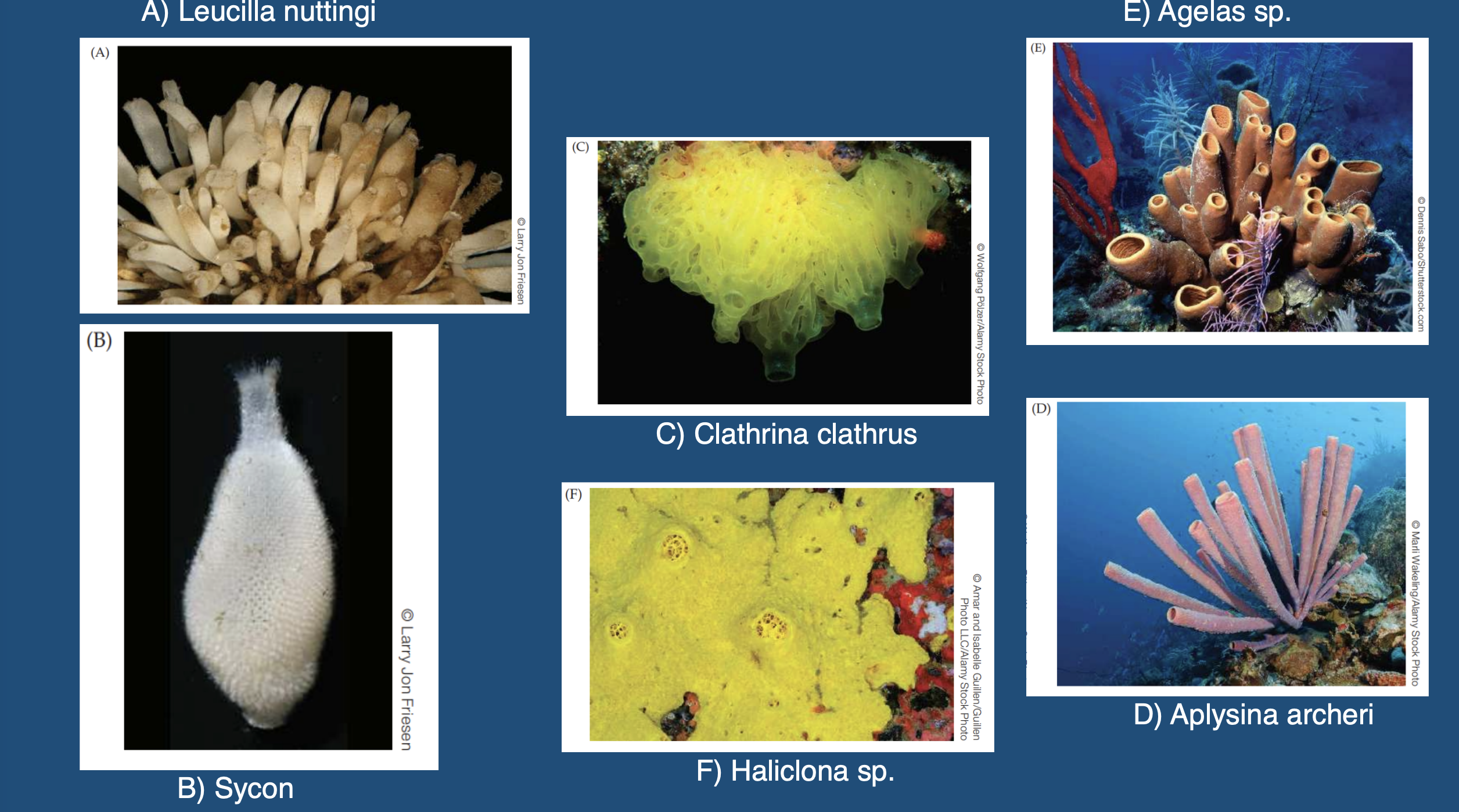
What are the four classes of Porifera?
Calcarea, Hexactinellida, Homoscleromorpha, and Demospongiae.
Which sponge class is the largest?
Demospongiae.
What percentage of sponge species are Demospongiae?
About 81%.
What is the skeleton material of Demospongiae?
Spongin and/or siliceous spicules.
What are Hexactinellida commonly called?
Glass sponges.
What are Calcarea commonly called?
Calcareous sponges.
What are Calcarea skeletons made of?
Calcium carbonate (CaCO₃).
What are Hexactinellida skeletons made of?
Silica spicules.
What makes Homoscleromorpha unique?
They are exclusively marine sponges.
What type of animals are sponges?
Sessile suspension feeders.
Do adult sponges have a nervous system?
No.
Do adult sponges have muscles?
No.
Do sponges have a digestive tract?
No.
What cells move water through sponges?
Choanocytes.
What is the function of choanocytes?
Water movement, feeding, gas exchange, and waste removal.
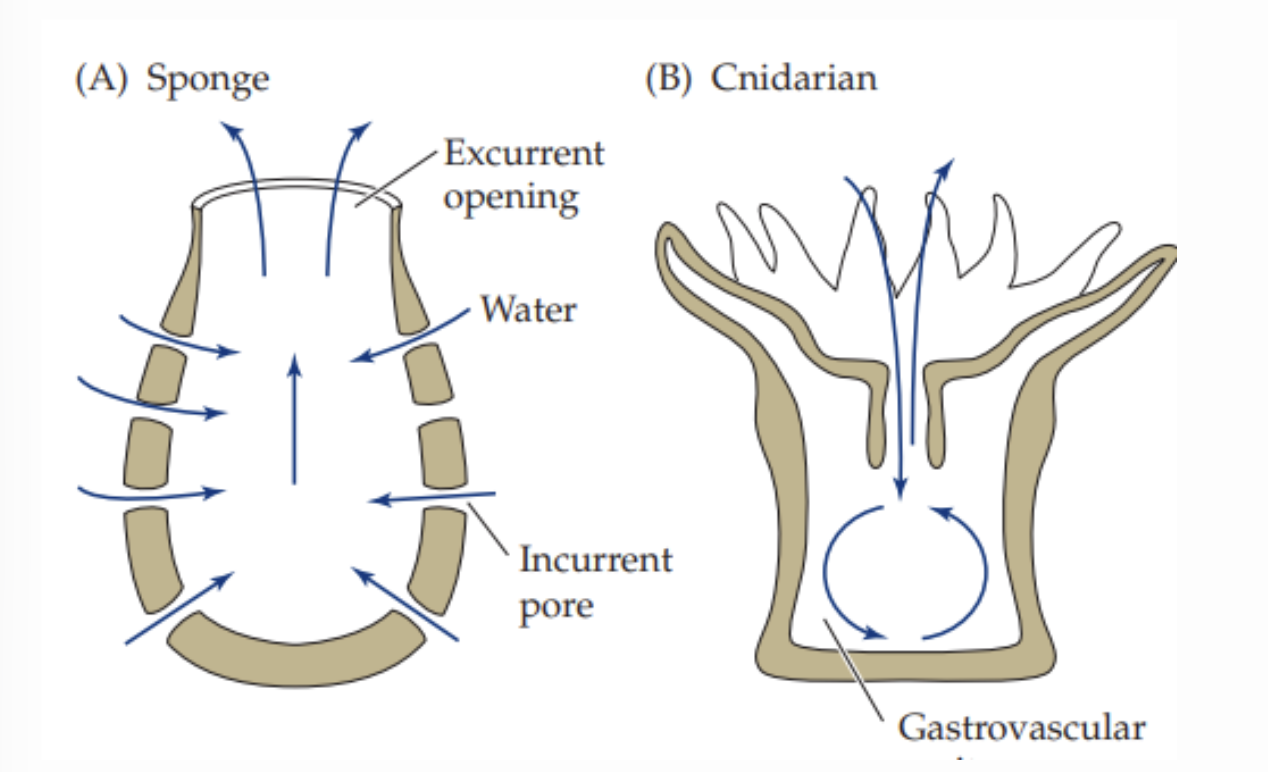
What is the aquiferous system?
The sponge water canal system.
Why do sponges need an aquiferous system?
To bring food and oxygen to cells and remove waste.
What are ostia?
Small pores where water enters the sponge.
What is the osculum?
The opening where water exits the sponge.
What is the basic sponge water flow?
Ostia → canals → choanocytes → osculum.
What causes water movement in sponges?
Choanocyte flagella beating.
What is the pinacoderm?
The outer layer of sponge cells.
What are pinacocytes?
Cells that make up the outer surface of the sponge.
What is the choanoderm?
The inner layer containing choanocytes.
What is the mesohyl?
The tissue layer between the pinacoderm and choanoderm.
What is the purpose of sponge folding?
To increase surface area and maintain surface area-to-volume ratio.
How do sponges increase size?
By increasing internal folding.
What are the three main sponge body plans?
Asconoid, syconoid, and leuconoid.
What is an asconoid sponge?
The simplest sponge body form with a thin wall and central cavity. [Image: asconoid sponge diagram]
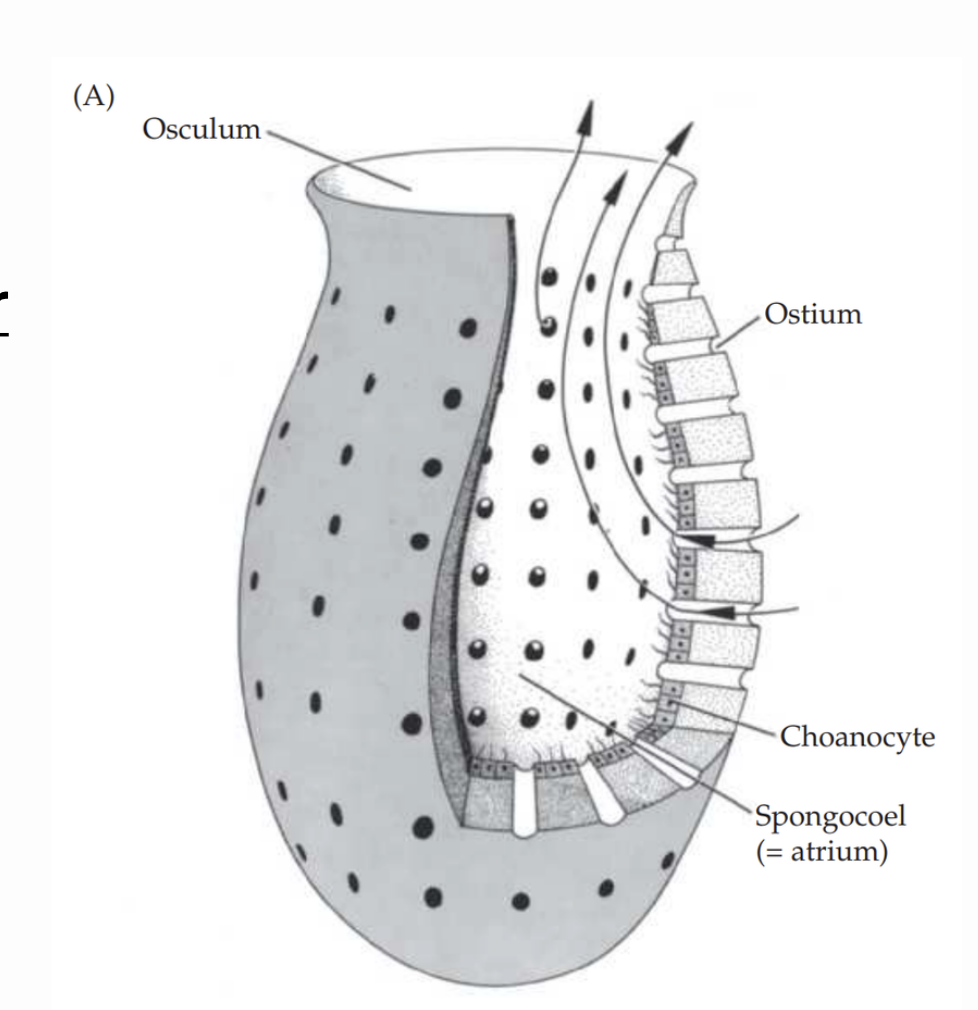
What is water flow in an asconoid sponge?
Ostia → atrium/spongocoel → osculum.
What is a syconoid sponge?
A sponge with folded walls and specialized choanocyte chambers. [Image: syconoid sponge diagram]
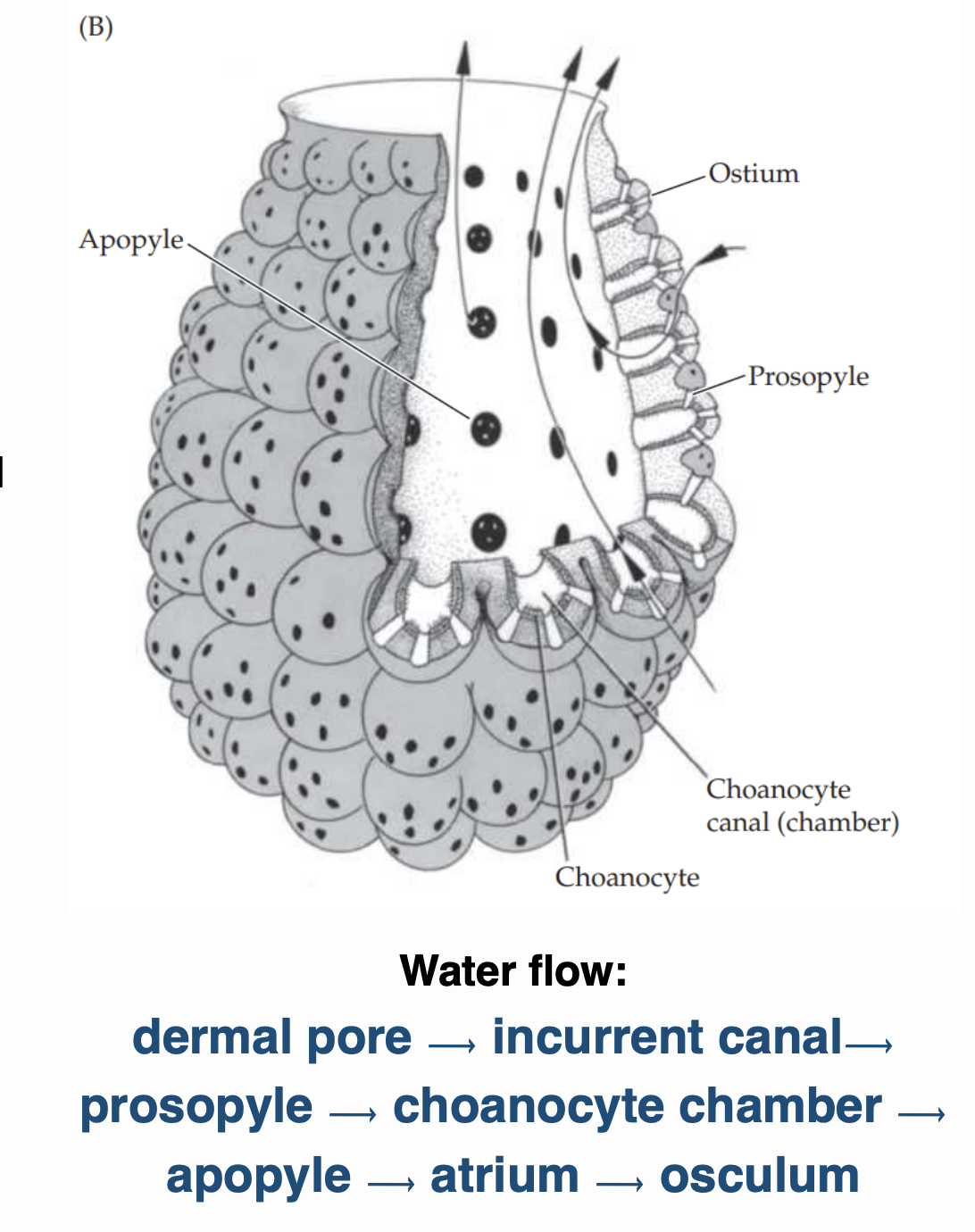
What is water flow in a syconoid sponge?
Dermal pore → incurrent canal → prosopyle → choanocyte chamber → apopyle → atrium → osculum.
What is a leuconoid sponge?
The most complex sponge body plan with many small choanocyte chambers. [Image: leuconoid sponge diagram]
Why are leuconoid sponges more efficient?
They have many smaller chambers that increase filtering ability.
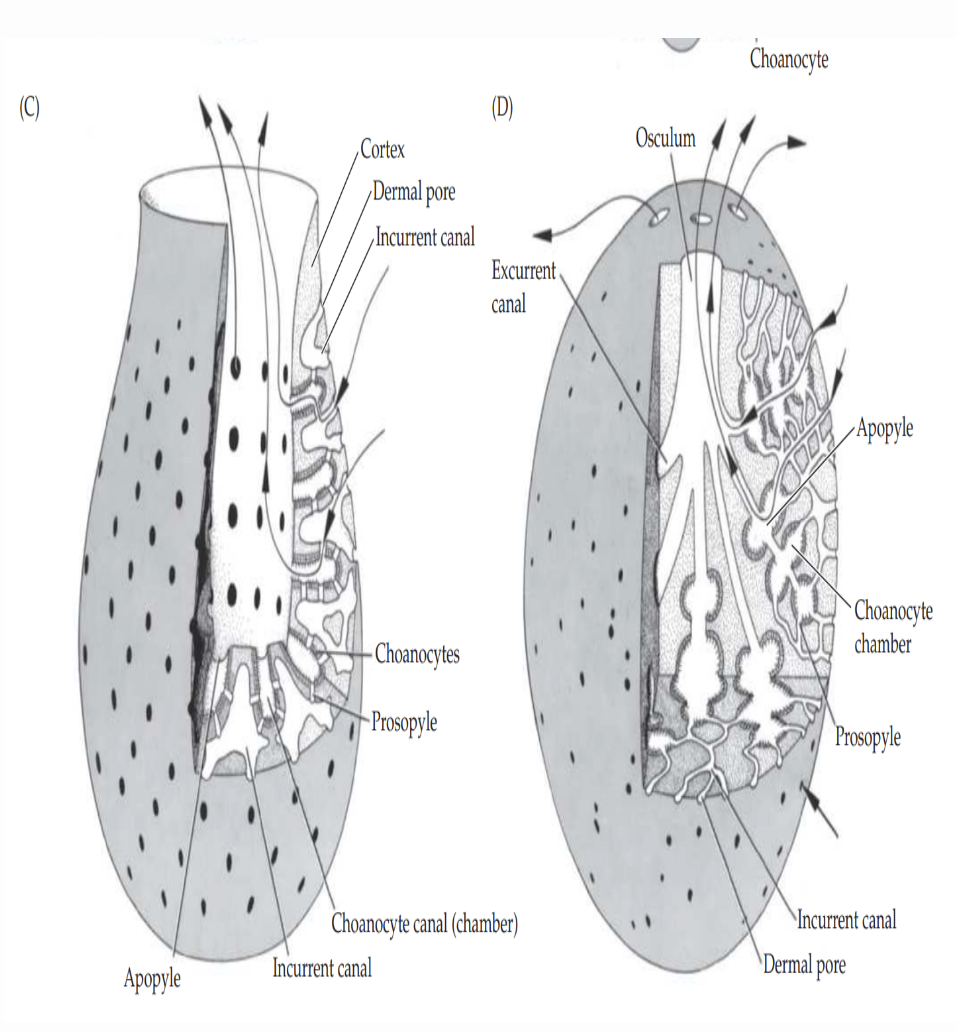
What is water flow in a leuconoid sponge?
Dermal pore → incurrent canal → prosopyle → choanocyte chamber → apopyle → excurrent canal → osculum.
What is an ectosome?
The outer sponge layer containing spicules and surface structures.
What are dermal pores?
Openings that allow water into sponge canals.
What is a prosopyle?
The opening into a choanocyte chamber.
What is an apopyle?
The opening where water leaves a choanocyte chamber.
What are excurrent canals?
Channels that move water toward the osculum.
What are the main sponge cell types?
Pinacocytes, choanocytes, amoebocytes, sclerocytes, spongocytes, and myocytes.
What are pinacocytes?
Outer surface cells of a sponge.
What is an exopinacocyte?
A pinacocyte lining the outside surface.
What is an endopinacocyte?
A pinacocyte lining canals.
What is a basopinacocyte?
A pinacocyte found at the sponge attachment region.
What are choanocytes?
Flagellated cells that pump water and capture food.
What are sclerocytes?
Cells that produce sponge spicules.
What are spongocytes?
Cells that produce spongin fibers.
What are myocytes?
Contractile cells that help sponge tissues move.
What are lophocytes?
Large cells that produce collagen fibers.
What are collencytes?
Cells involved in collagen production.
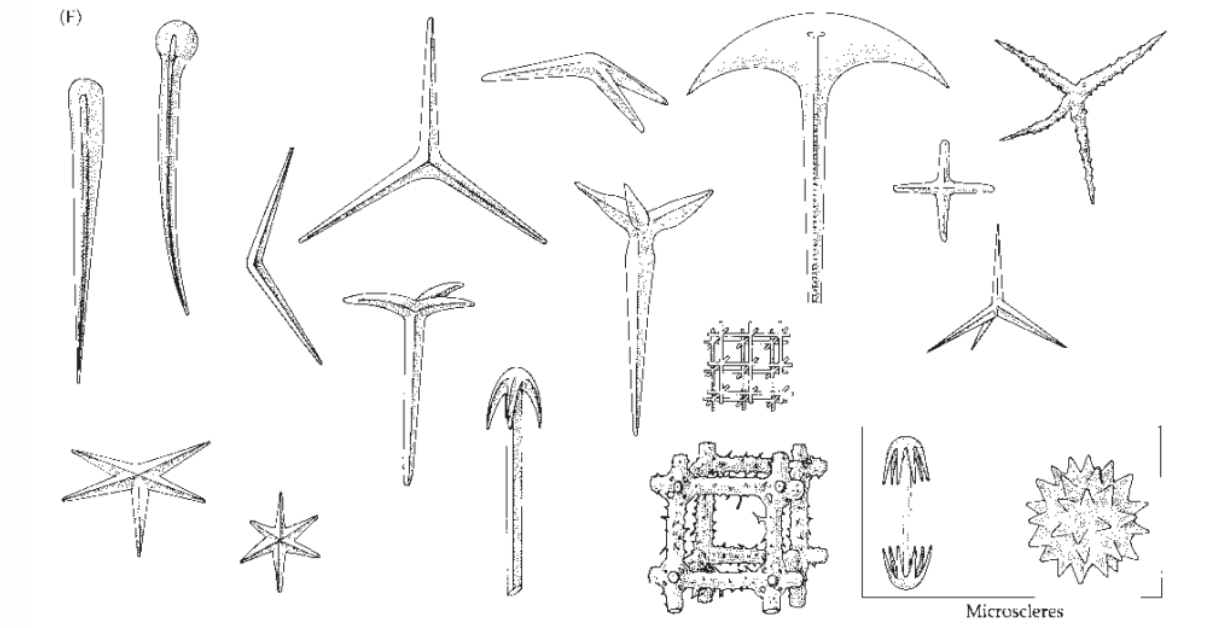
What are sponge spicules?
Hard skeletal structures that support and protect the sponge. [Image: sponge spicules]
What are the two types of sponge skeletons?
Organic collagen-based and inorganic silica/calcium carbonate.
What is spongin?
A collagen fiber used for sponge support.
Which sponge group has true spongin?
Demospongiae.
What are calcareous spicules made of?
Calcium carbonate.
What are siliceous spicules made of?
Silica.
What type of material makes sponge skeletons unique?
Sponges are the only animals that use hydrated silica.
What percentage of living sponge species are siliceous?
About 92%.