Comprehensive Skeletal System and Joint Anatomy Quizlet for Students
 Call Kai
 Learn
Learn Practice Test
 Spaced Repetition
 Match
Match Flashcards
 Knowt Play
1/111

There's no tags or description
Looks like no tags are added yet.
Name | Mastery | Learn | Test | Matching | Spaced | Call with Kai |
|---|
No analytics yet
Send a link to your students to track their progress
112 Terms
What are the functions of the skeletal system?
Reservoir for minerals like calcium and phosphate, hematopoiesis, triglyceride storage, anchorage of muscles.
What is hematopoiesis?
Blood formation.
Where is red bone marrow located in adults?
In the hips, sternum, cranial bones, and shoulder blade.
What do osteoclasts do?
They dissolve or break down bony matrix.
What are lamellae?
Well-organized layers of bony matrix found in compact bone.
What is the role of osteoblasts?
They build bony matrix and secrete non-mineralized osteoid.
What is the periosteum?
A fibrous membrane that covers the surface of a bone.
What is the epiphyseal plate?
Area where bone longitudinal growth takes place during childhood and adolescence.
What is the epiphyseal line?
A feature in the epiphyses of long bones that indicates longitudinal growth has ceased.
What is intramembranous ossification?
The process by which bone develops from a fibrous membrane.
What is endochondral ossification?
The process by which bone develops from a hyaline cartilage model.
What is the function of canaliculi?
They allow osteocytes to communicate with other bone cells.
What happens to yellow bone marrow if red bone marrow decreases too much?
Yellow bone marrow can convert into red.
What is the role of parathyroid hormone (PTH)?
It regulates calcium levels in the blood.
What are the additional functions of the skeleton?
Support for the body and organs, protection of organs like the brain, heart, and lungs, and hormone production.
What is the significance of osteocytes?
They reside in small spaces called lacunae and maintain bone tissue.
What is the primary function of bones in relation to muscles?
Bones provide anchorage for muscles via tendons and function as levers for movement.
What is the role of chondrocytes in bone development?
They are responsible for early stages of bone development and form primary ossification centers within cartilage.
What occurs during bone remodeling?
Bone is constantly being replaced as osteoclasts resorb bone and osteoblasts make new bone.
What is the function of the endosteum?
It lines the medullary cavity and covers trabeculae of spongy bone.
What is the composition of yellow bone marrow?
It contains mostly fat or triglycerides, which is a source of energy.
What happens to the epiphyseal plate when longitudinal growth ceases?
It stops producing cartilage and becomes the epiphyseal line.
What is the role of osteocytes in bone health?
They ensure proper bone deposition and resorption.
What happens to chondrocytes in the primary ossification center?
They calcify and die, leaving calcified fragments of hyaline cartilage.
What forms around the diaphysis of the hyaline cartilage model during endochondral ossification?
A bone collar.
What is the role of the periosteal bud in bone development?
It penetrates internal cavities and osteoblasts secrete osteoid onto the calcified hyaline cartilage fragments.
What occurs during week 9 of fetal bone development?
The bone collar forms around the diaphysis and the primary ossification center forms inside the shaft.
What happens to the diaphysis during bone development?
It gets longer and secondary ossification centers develop in both epiphyses.
What is the fate of the epiphyses during childhood to adolescence?
They ossify except for the hyaline cartilage in the epiphyseal plates and articular cartilage.
What is contained in the central canal of the Haversian system in compact bone?
Blood vessels and nerve fibers.
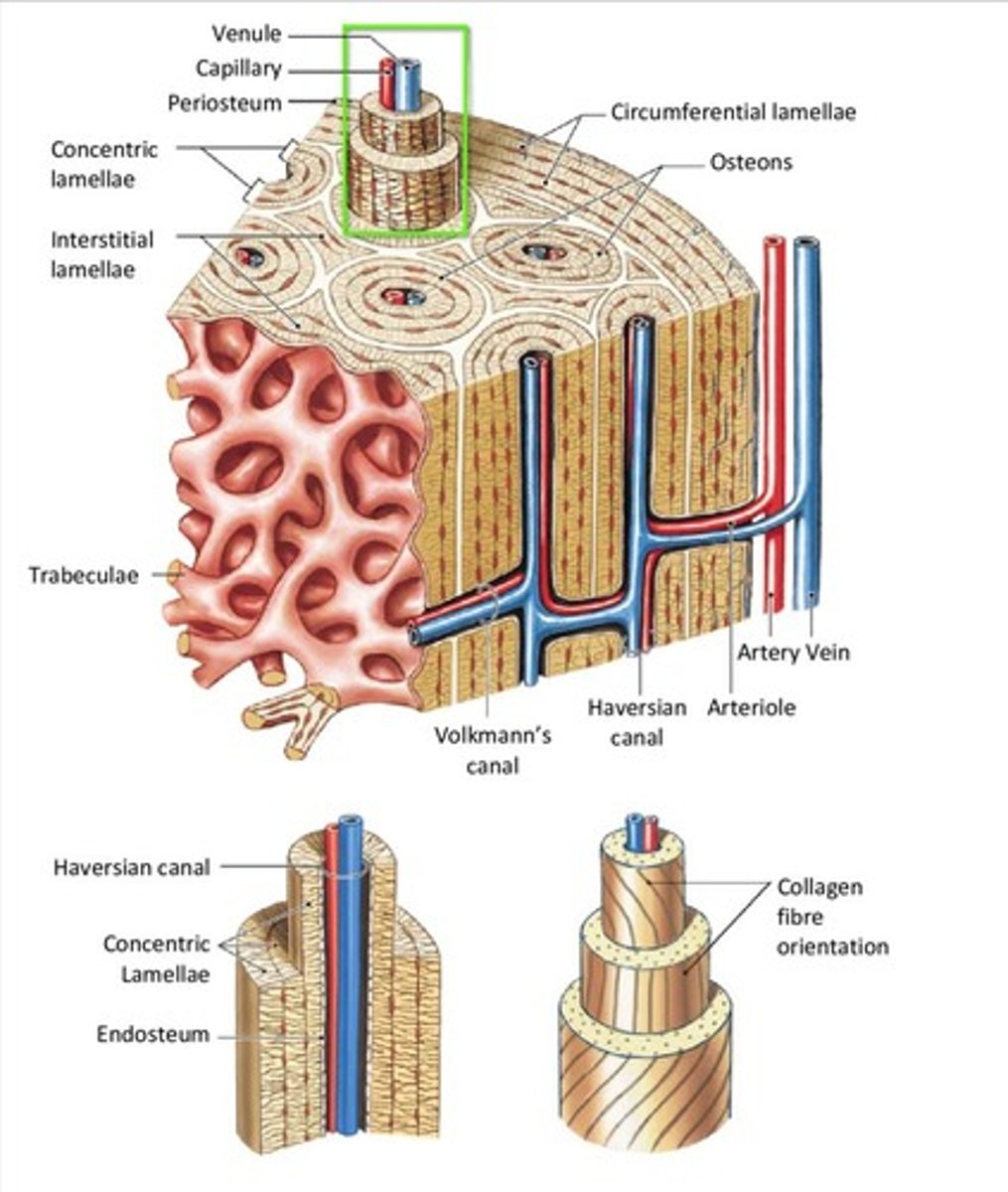
What is the structure of compact bone organized into?
Osteons.
What type of bone contains trabeculae that align along lines of stress?
Spongy bone.
What indicates that longitudinal growth has stopped in a long bone?
The appearance of the epiphyseal plate.
What type of tissue covers bone and is important in bone formation and healing?
Dense, fibrous connective tissue.
What is the appearance of the Haversian system in compact bone?
It consists of 'tubes' of lamellae stacked within each other.
What is the primary function of osteoblasts during bone development?
To secrete osteoid onto calcified cartilage fragments.
What type of marrow is found in the medullary cavity of infants?
Red marrow.
What type of marrow is found in the medullary cavity of adults?
Yellow marrow.
What happens to chondrocytes during hypertrophy in the primary ossification center?
They get larger, calcify, and die.
What is the role of osteoclasts during bone development?
They help in the resorption of bone.
What is the significance of the periosteal bud in bone formation?
It consists of nutrient artery, vein, red marrow elements, nerve fibers, osteoclasts, and osteoprogenitor cells.
What happens to the diaphysis at birth?
It gets longer and secondary ossification centers develop in both epiphyses.
What is the appearance of the epiphyseal plate in a long bone?
It indicates that longitudinal growth has stopped.
What type of bone is characterized by a dense and smooth structure?
Compact bone.
What is the primary function of the Haversian canal?
To allow blood vessels and nerves to pass through.
What type of cartilage remains in the epiphyseal plates after ossification?
Hyaline cartilage.
What is the significance of the bone collar in endochondral ossification?
It provides structural support around the diaphysis.
What occurs during the third month of fetal development regarding bone?
A periosteal bud penetrates internal cavities.
What is the role of osteoprogenitor cells in bone development?
They turn into osteoblasts.
What is the primary function of trabeculae in spongy bone?
To help the bone resist stress.
What do osteoclasts do in bone resorption?
They dissolve bone matrix with acid and use lysosomal enzymes to digest the organic matrix.
What do osteoblasts deposit?
They deposit bone matrix called osteoid.
What mineral makes up 65% of bone mass?
Hydroxyapatite.
How do long bones grow in width?
By appositional growth.
What is the organic part of the matrix of compact bones?
Osteoid.
What hormone is most responsible for epiphyseal plate activity during infancy and childhood?
Growth Hormone.
What hormone stimulates bone resorption?
Parathyroid Hormone (PTH).
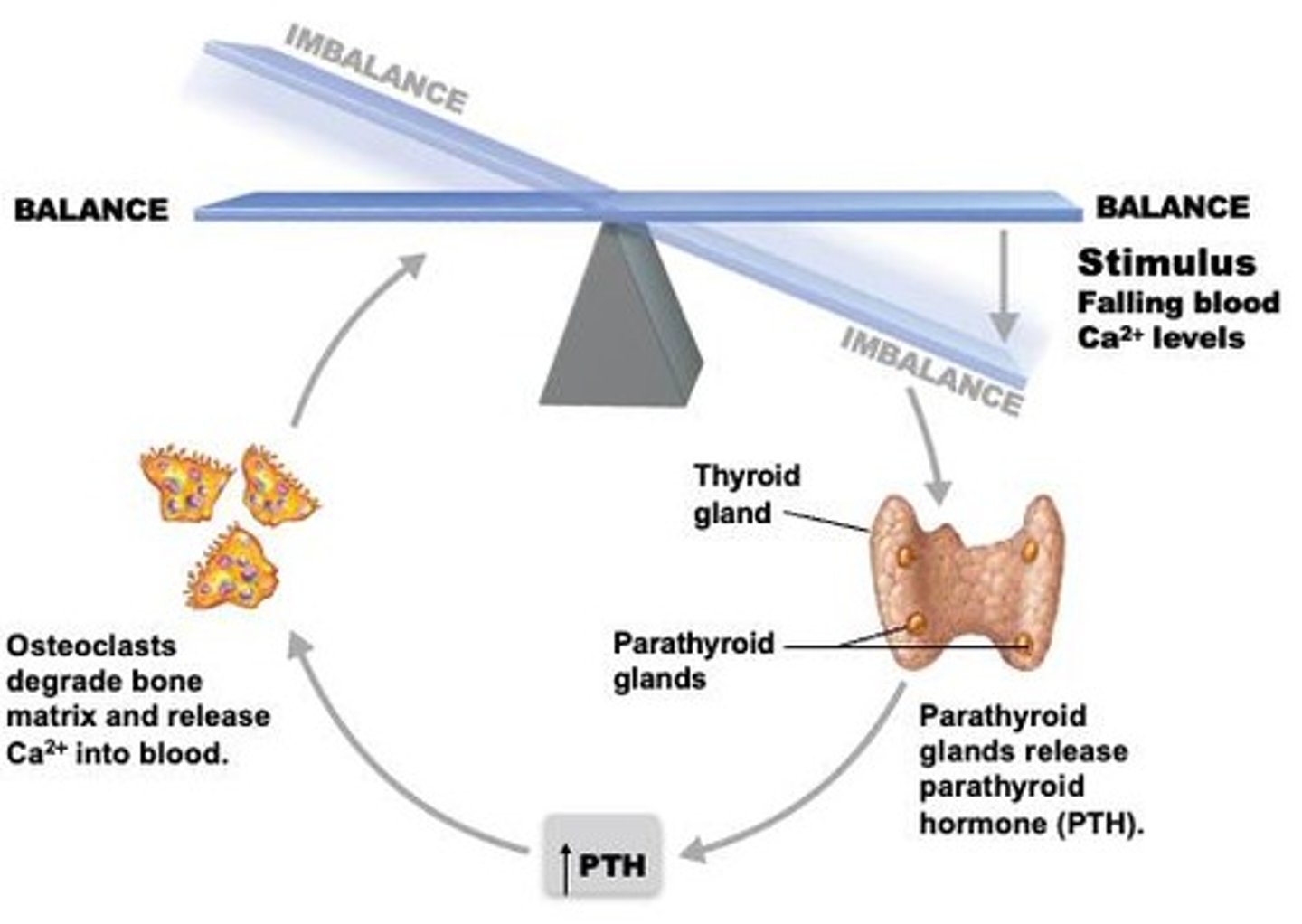
What happens when calcium ion levels are low in the blood?
Parathyroid glands release PTH, signaling osteoclasts to dissolve bone tissue.
What is Wolff's law concerned with?
The thickness and shape of a bone being dependent on stresses placed upon it.
What provides flexibility and tensile strength to bones?
Collagen fibers.
What is the normal range for calcium concentration in the blood?
9-11 mg/100 mL.
What stimulates the parathyroid glands to release PTH?
Low calcium ion levels in the blood.
What type of cell dissolves or resorbs bone?
Osteoclasts.
What is the effect of PTH on calcium levels?
It increases calcium levels in the blood by stimulating bone resorption.
What happens to PTH release when calcium levels return to normal?
PTH release is stopped.
What is appositional growth?
Growth in the diameter of the bone.
What maintains blood calcium concentration?
Hormonal control, specifically with PTH.
Why is a diet rich in calcium important?
To maintain the strength and well-being of the skeleton.
What is a comminuted fracture?
A fracture in which the bone breaks into three or more pieces.
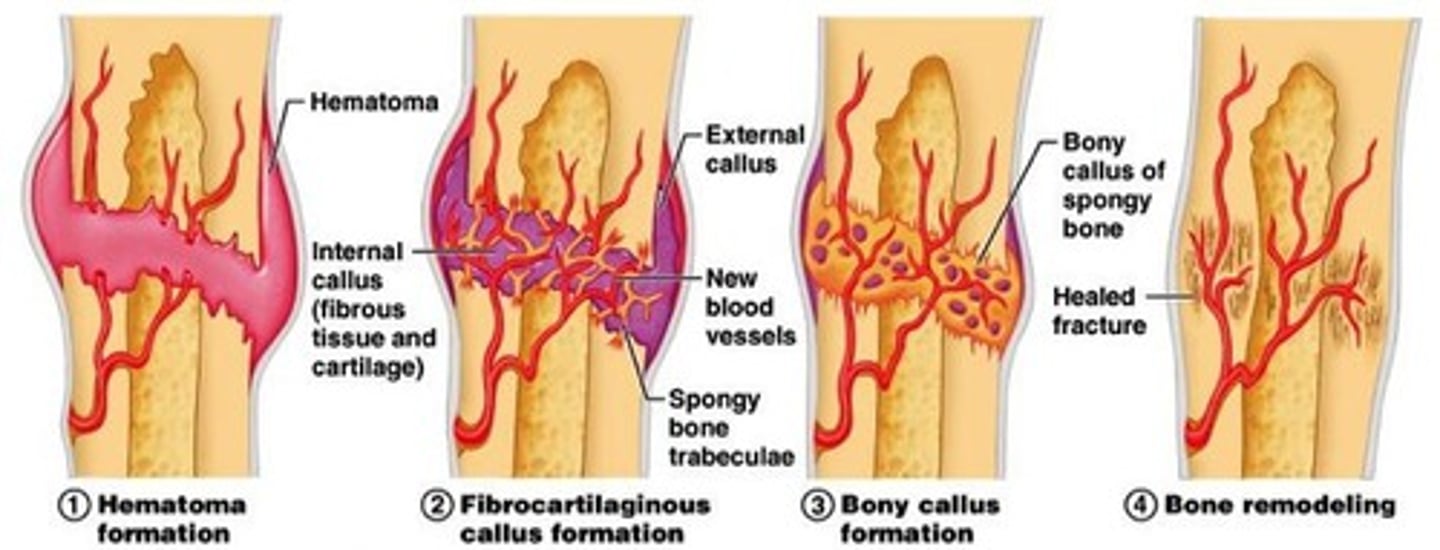
What occurs first in the bone repair process?
Hematoma (blood clot) forms due to damaged blood vessels.
What forms after the hematoma in bone repair?
A fibrocartilagenous callus, comprised of collagen fibers and cartilagenous matrix.
What is a spiral fracture?
A ragged break that occurs when excessive twisting force is applied to a bone.
What happens after the fibrocartilagenous callus in bone repair?
A bony callus forms when osteoblasts secrete osteoid to make spongy bone.
What is the final step in the bone repair process?
Bone remodeling occurs as compact bone is laid down and excess material is removed.
What causes osteomalacia and rickets?
Insufficient calcium or Vitamin D in the diet.
What is the adult form of rickets?
Osteomalacia.
What can result from bone resorption being greater than bone deposition?
Osteoporosis, leading to a decline in bone mass.
What is Paget's Disease?
A condition involving abnormally rapid and haphazard deposition of spongy bone.
What are the three main structural classifications of joints?
Fibrous, Synovial, Cartilagenous.
What type of fibrous joint is found only in the skull?
Suture.
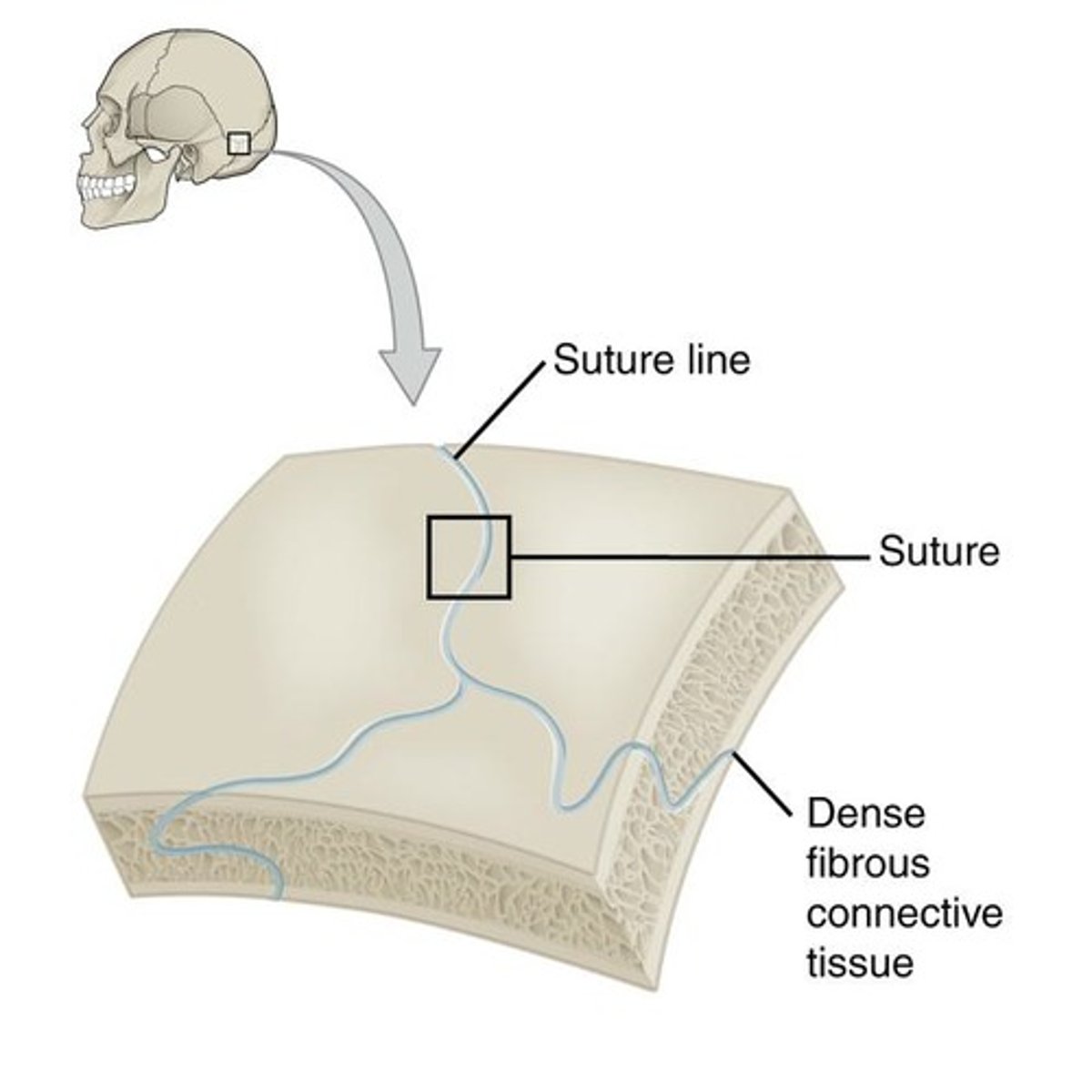
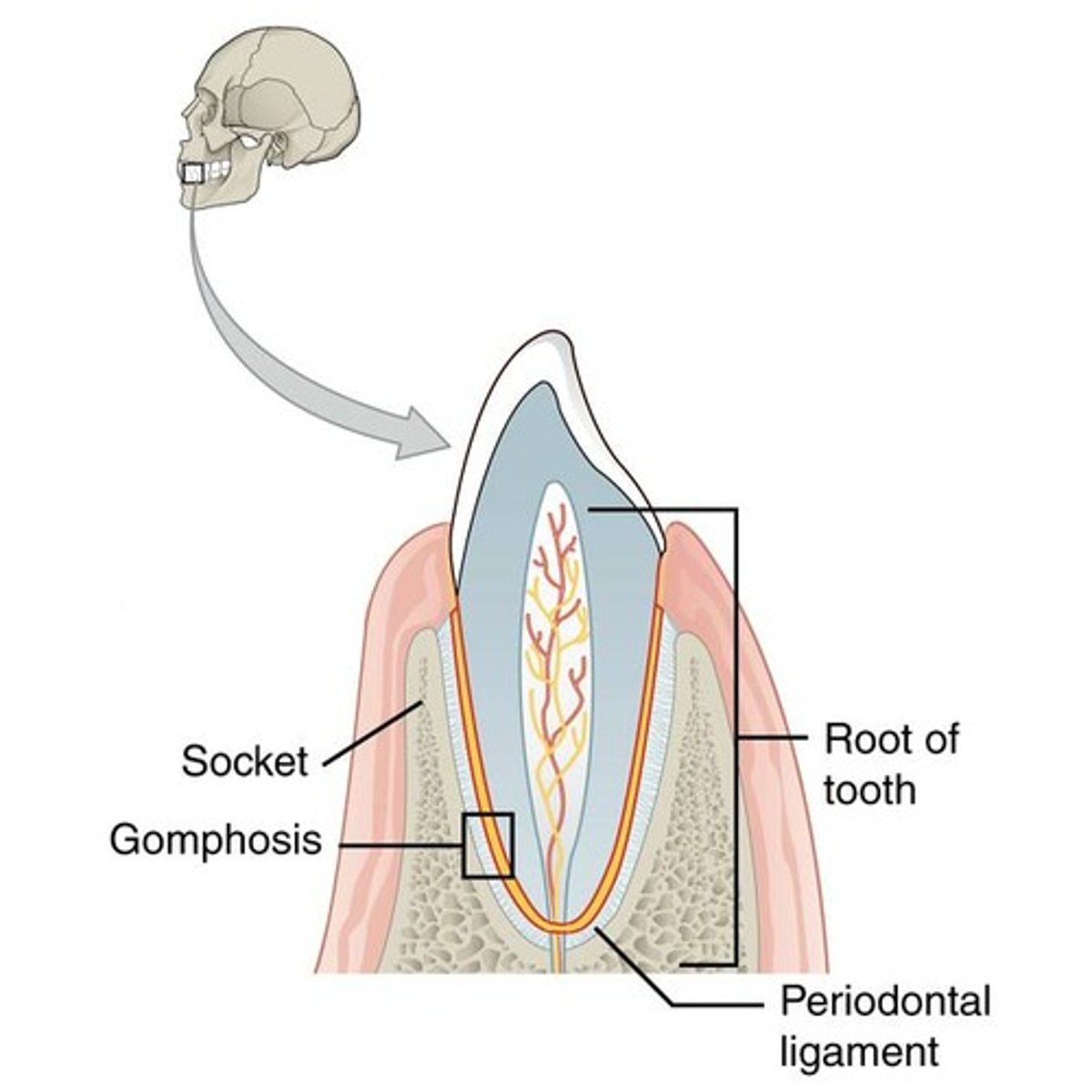
What is a gomphosis?
A fibrous joint that is a tooth in a socket.
What is a syndesmosis?
A fibrous joint in which the bones are connected by ligaments.
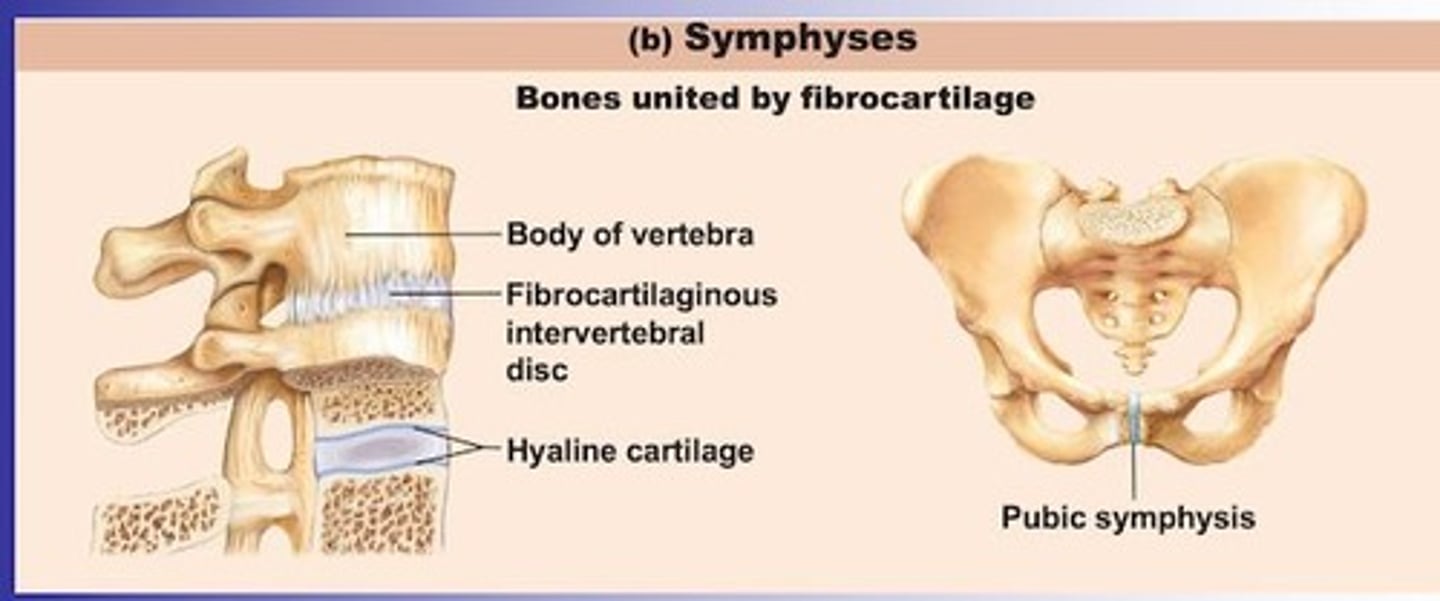
What type of cartilaginous joint is united by fibrocartilage?
Symphysis.
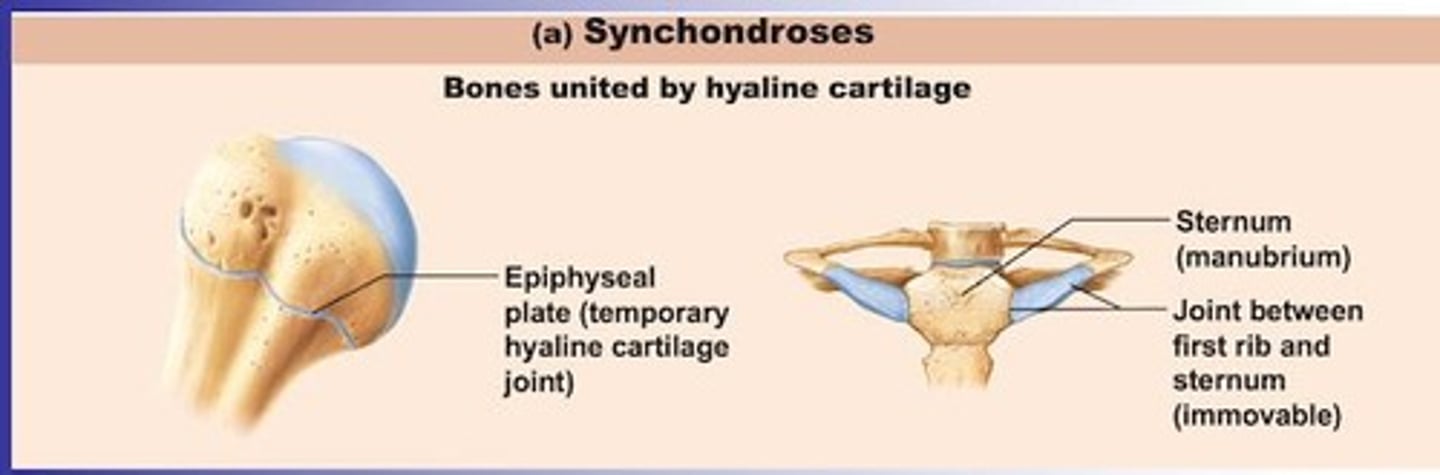
What is a synchondrosis?
A cartilaginous joint involving a bar or plate of hyaline cartilage that unites bone.
What are the two types of cartilaginous joints?
Synchondroses and symphyses.
What is an example of a synchondrosis?
Epiphyseal plate.
What is an example of a symphysis?
Pubic symphysis.
What are synarthroses?
Joints that do not move at all.
What are amphiarthroses?
Joints that have only slight movement.
What are diarthroses?
Joints that are freely movable.
What are examples of synarthroses?
Sutures of the skull and gomphoses.
What is an example of an amphiarthrotic joint?
Distal tibiofibular joint.
What type of joints are all synovial joints?
Diarthrotic or freely movable.
What are menisci?
Wedges of fibrocartilage that partially or completely divide the synovial cavity.
What are tendon sheaths?
Synovial fluid-filled structures wrapped around tendons to reduce friction.
What is the articular capsule?
A structure with two layers, a tough fibrous layer and a synovial membrane.
What are bursae?
Connective tissue sacs lined with synovial membrane that act as cushions.
What is synovial fluid?
Thick fluid that lubricates cartilage surfaces and is secreted by the synovial membrane.
What is the role of ligaments at synovial joints?
To unite bones and prevent undesirable movement.
What is rheumatoid arthritis?
A chronic inflammatory disorder where the body's immune system attacks its own tissues.