Basics of Immunity
 Call Kai
 Learn
Learn Practice Test
 Spaced Repetition
 Match
Match Flashcards
 Knowt Play
1/27

There's no tags or description
Looks like no tags are added yet.
Name | Mastery | Learn | Test | Matching | Spaced | Call with Kai |
|---|
No analytics yet
Send a link to your students to track their progress
28 Terms
What are the reaction times of the innate and adaptive immune system?
innate respones: 1-12 hours ; adaptive response 1-7 days (memory of cells)
What are the 3 immunological components in the blood, lymph and tissue?
White blood cells (leukocytes): lymphocytes+ granulocytes
Plasma proteins: complement, antibodies
Lymphatic system: circulates immune cells and connects lymphoid organs
Distinguish between the primary and secondary lymphoid organs.
primary: development of the adaptive immmune cells (b-cells → bone marrow, t-cells → thymus)
secondary: activation of the adaptive immune cells (spleen and lymph nodes)
What are the different progenitors of the immune cells?
myeloid progenitors: granulocytes, macrophages, dendritic cells
lymphoid progenitors: b-cells, t-cells, adaptive NK cells
→ note some lymphocytes cells can also be innate
What are the 3 lines of defense in immune system?
physical barrier - skin (first line of defense)
innate immunity - quick response by production of inflammation by cytokine and chemokine signalling for actiavtion and migration.
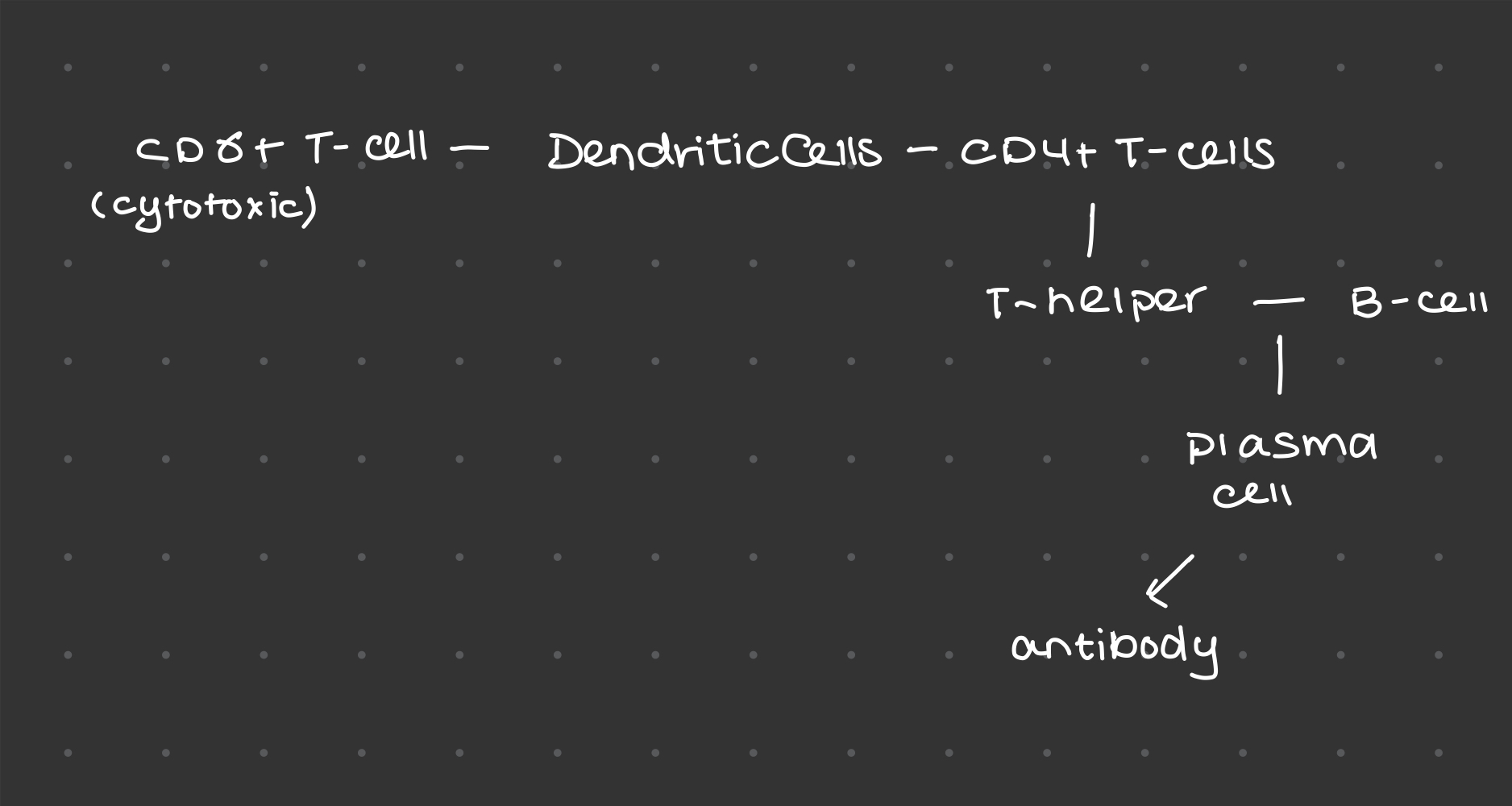
adaptive immunity - dendritic cells activate CD4 and CD8 T-cells and also B-cells in the secondary lymphoid organs during inflammation.
What are 4 characteristics of innate immunity?
rapid within a few hours
fixed response
limited number of specificities
constant during course of response
Adaptive immune system is …
slow and adaptable
How does an immune response go from being innate to being adaptive?
pathogen uptake → innate immune respone → chemokines, cytokines, macrophages → inflammation → activation of dendritic cells → migration of DCs to secondary lymphoid organs → activation of B/T-cells for adaptive immunity
Show the interactions between immune cells during adaptive immunity?
Distinguish between B/T-cells?
T-cell: cellular response, interaction with other cells, effect will be on interacting cell
B-cell: differentiation into plasma cells that produce antibodies with effector functions.
What are some antibody effector functions?
neutralisation
opsonisation
complement activation
Innate Immune Receptors
pattern recognition receptors → can recognise major pathogenic species
binding of associated molecular patterns → pathogens or danger signals
Adaptive Immune Receptors
T/B-cell receptors
Specificty is different per cell - can differentiate within major pathogen species
Can recognise antigens (peptides recognised by receptors)
How do B/T-cells express receptors with the correct specificity?
T/B-cells express mant TCR and BCR but only have one specificity per cell
When an ongoing infection happens the antigens are recognised and the T-cells are activated in the secondary lymphoid organs
Those cells will proliferate and become clones with all the same specificity (for one epitope)
→ clonal expansion (takes a week) - creates memory
What are macrophages?
Big eaters (phagocytosis) is the innate immune system and alert the system upon infection
Present in the tissue
Receptors distinguish between self and non-self
What are the two modes of interaction with macrophages?
C-Type lectin receptors: belong to the family of scavenger receptors
non-self pathogens have carbohydrate residues so the entire pathogen binds extracellularly to the CTL of the macrophage
results in phagocytosis and degradation
Toll-like receptors
recognise pathogen specific structures (peptides, RNA, DNA)
ligands are highly preserved and essentiatl to pathogen survival
intracellular/extracellular
results in activation and cytokine secretion
What are neutrophils and when are they activated?
during a bacterial infection macrophages can recruit neutrophils from the bone marrow to collaborate and clear the bacterial infection through phagocytosis
Recruited to infection site from bone marrow
Signature multi-lobular nucleus
Express scavenger receptors
efficient killers with short life span
What is the accute phase response?
macrophages induce the acute phase response upon bacterial infection for systemic responses
the acute phase response induces production of proteins that enhance inflammatory etector functions
What do macrophages do upon a viral infection?
Macrophages activate NK cells to kill virally infected cells.
Virally infected cells secrete cytokines such as IFN alpha and beta which ensure the activation of the recruited NK cells
These NK cells have receptors which can distinguish between self and non-self
Explain the ligand receptor interaction for NK cells.
target cells express inhibiting (always expressed) and activating (only in stress) ligands
NK cells have ligands which can distinguish between healthy and un-healthy and we have a combination of activating and inhibiting receptors being expressed.
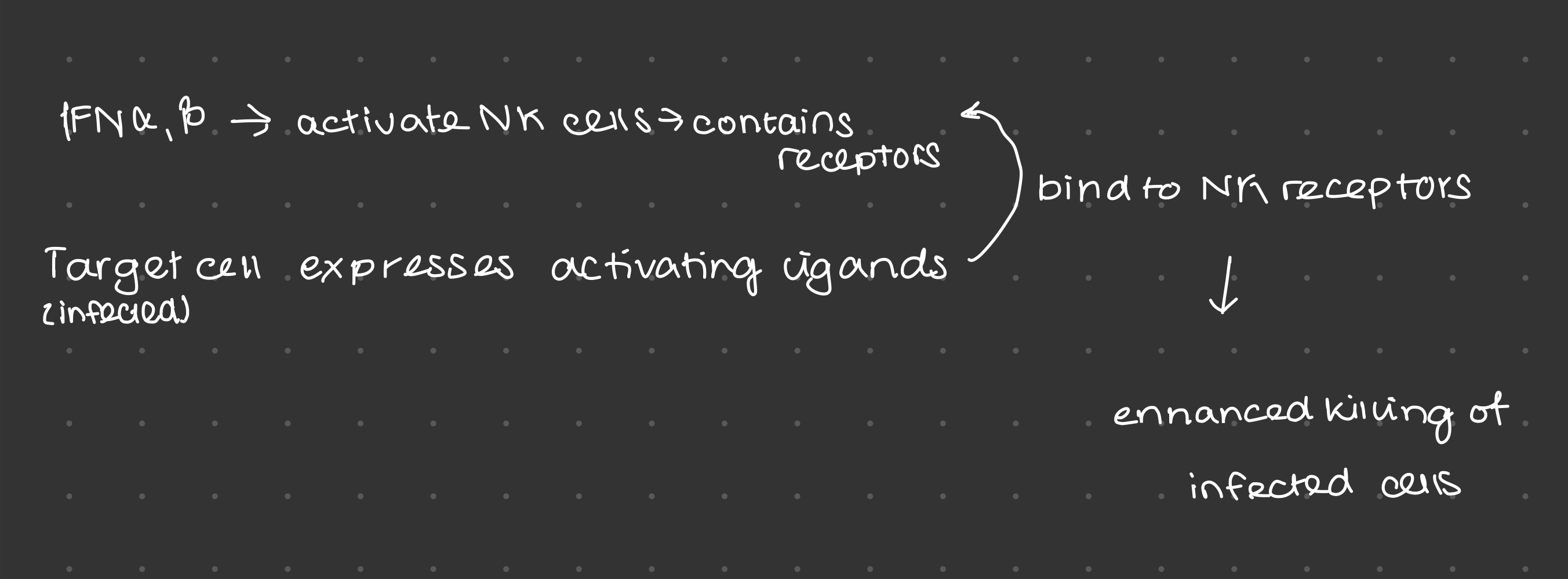
Interferons alpha/beta activate NK cells
When a target cell gets infected → expresses activating ligands → ligands bind to receptors on NK cells and cells can enhance the killing of those infected cells
So what are the main functions of interferons?
reduce viral replication and activate NK cells
What is the complement pathway?
complements inflammation
C3 is key component which is cleaved for tag and recriutment
C3 → C3a anaphylatoxin (inflammation and immune cell recruitment) & C3b opsonin (complement fixation)
What does C3a do?
enhance inflammation within minutes by activation of endothelium and immune cell recruitment
What does C3b do?
complement fixation
recruited immune cells like macrophages express CR receptor which C3b, bound to pathogen, can bind to
CR-C3b binding causes phagocytosis of the pathogen and degradation by acidic lysosomes.
formation of the memrane attack complex for lysis of pathogen
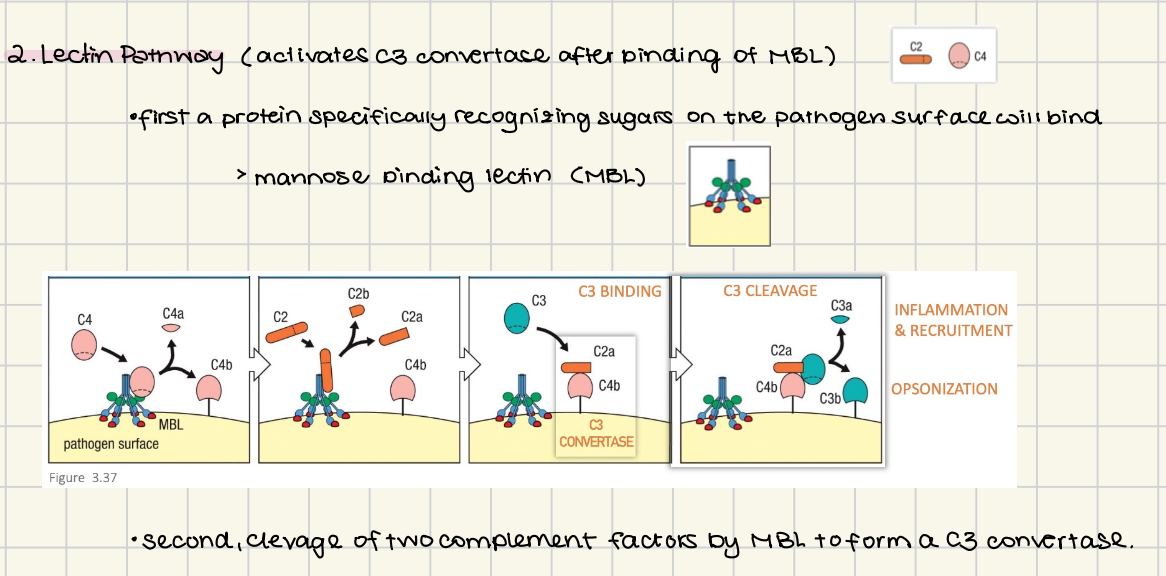
What are the 3 pathways that can form C3 convertase and start complement fixation?
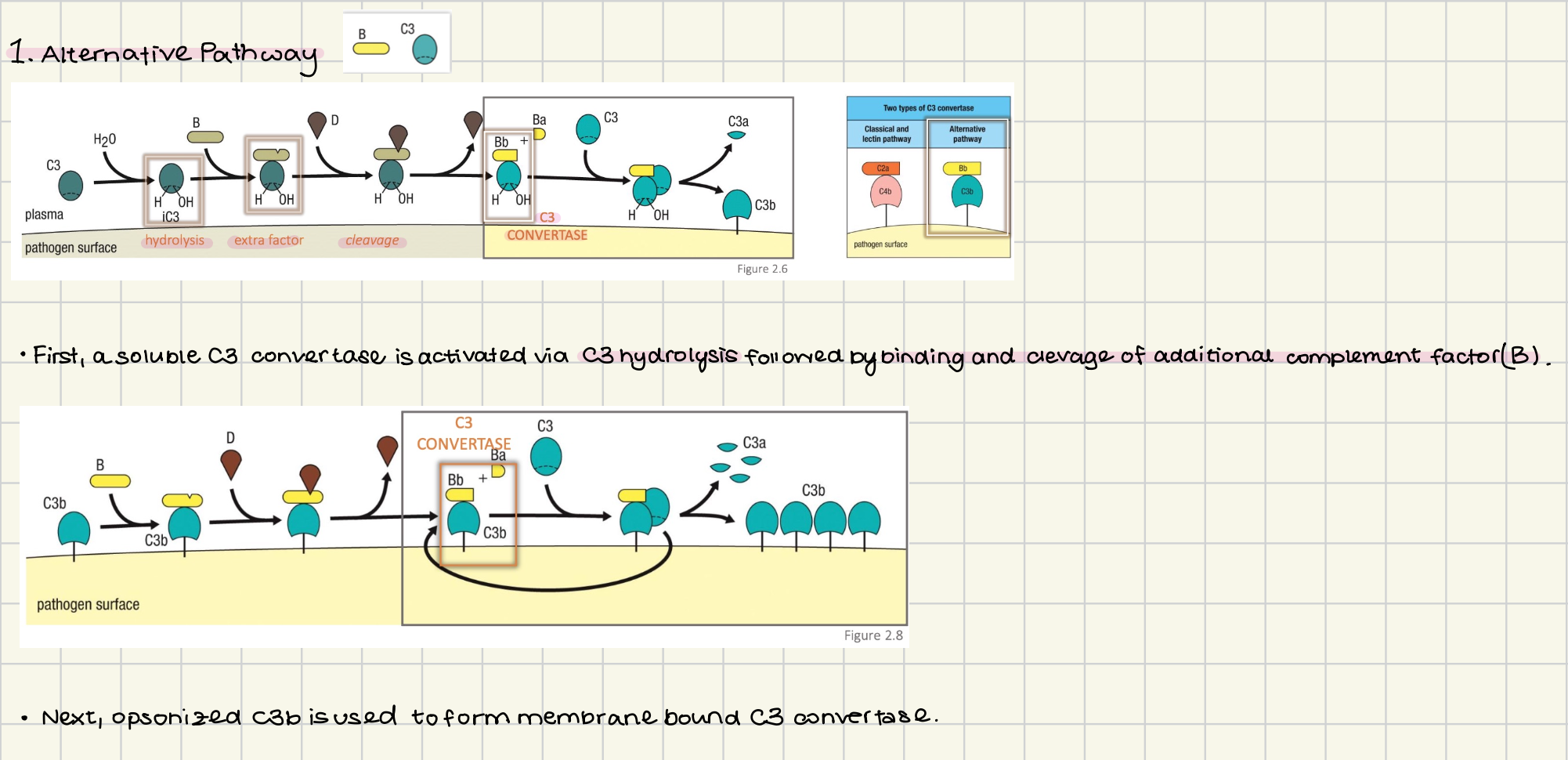
alternative pathway, lectin pathway, classical pathway

Alternative Pathway
Lectin Pathway
in liver
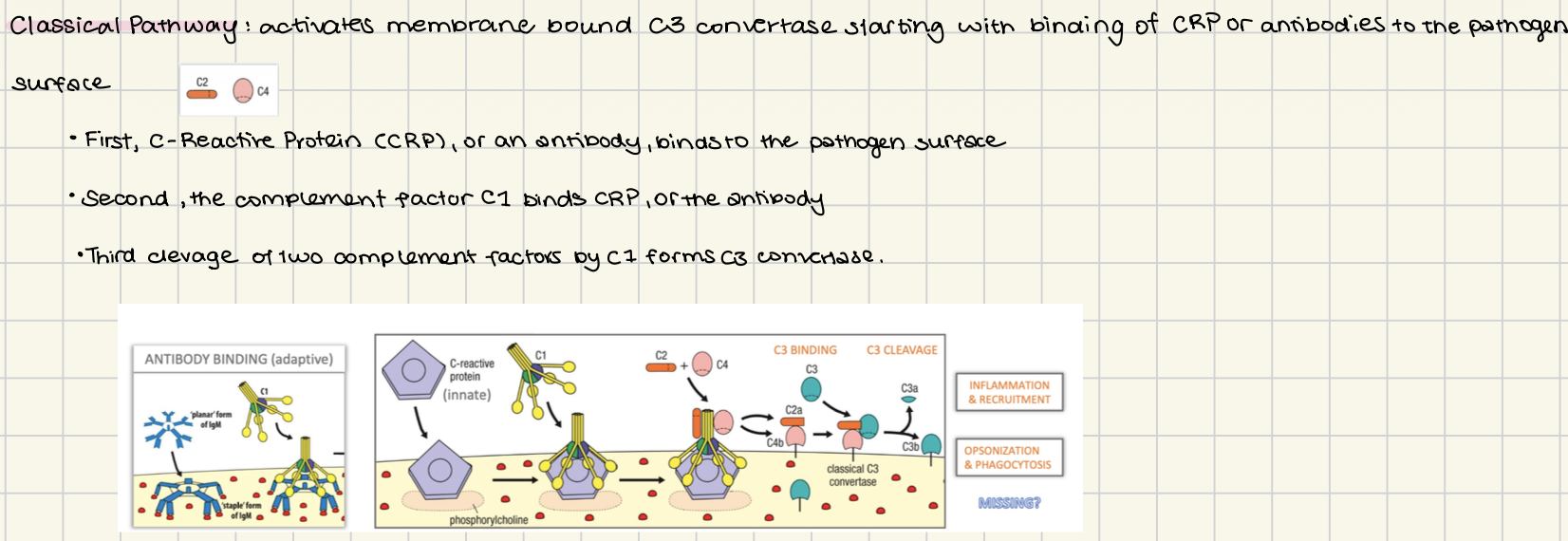
Classical Pathway
in liver