3 Secondary structure of DNA
 Call Kai
 Learn
Learn Practice Test
 Spaced Repetition
 Match
Match Flashcards
 Knowt Play
1/36

There's no tags or description
Looks like no tags are added yet.
Name | Mastery | Learn | Test | Matching | Spaced | Call with Kai |
|---|
No analytics yet
Send a link to your students to track their progress
37 Terms
what are primary structures in sequences stabilized by
1o structure is the sequence of nucleotide residues
Stabilized by phosphodiester bonds - major one
what are higher order structures formed by and what does DNA form
Higher order structures are formed by chains of nucleotides
DNA forms a double helix - Each chain is connected through hydrogen bonds between the bases
what did erwin chargaff do
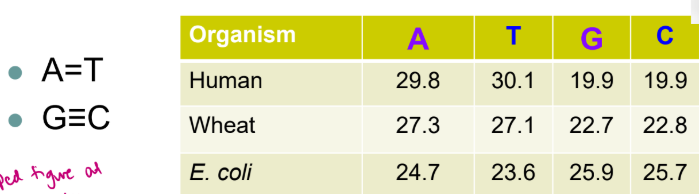
Base composition varies from organism to organism
Helped Watson and Crick deduce the double helical structure of DNA
Chargaff’s rule is only true for dsDNA
number of purines = number of pyrimidines
what are some properties of H bonds
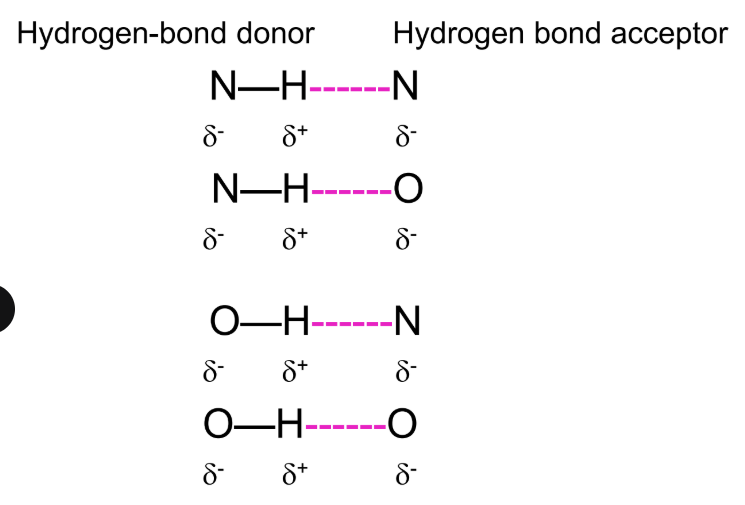
Polar interactions - electrostatic interactions
Hydrogen atom in a H-bond is shared by two electronegative atoms - Nitrogen, Oxygen, Sulphur
Much weaker than covalent bonds - help stabilize the structure because of their large numbers, fewer number of ionic
stronger than dd forces and has partial overlap of electrons
what to H bonds need to form between marcomoelcules
For H-bonds to form between or within biochemical macromolecules they must be shielded from water
Note: When groups hydrogen bonded to one another they are less polar - less likely to H bond with water
where do the hbonds form in DNA
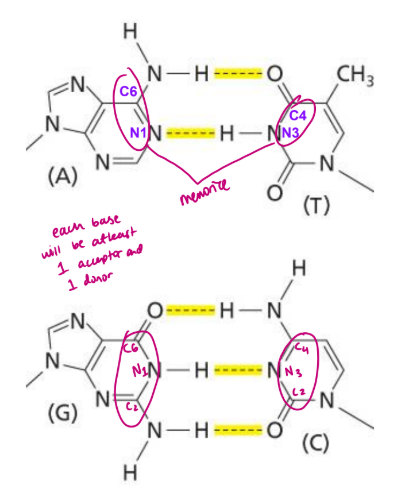
between nucleotides
The amino and carbonyl functional groups on the four bases found in DNA allow for specific hydrogen bonding interactions between the bases.
Not all parts of the bases that can hydrogen bond are involved in Watson-Crick base pairing, other groups can h bond with proteins when they interact
what are the different forms of DNA
B form - most common, always assume its this one, secondary structure, strands are anti parallel with right handed twist, has major groove where proteins interact with it and sometimes in minor
A form - dehydrated so theres less water, right handed twist, shorter
Z form - very rare, left handed twist
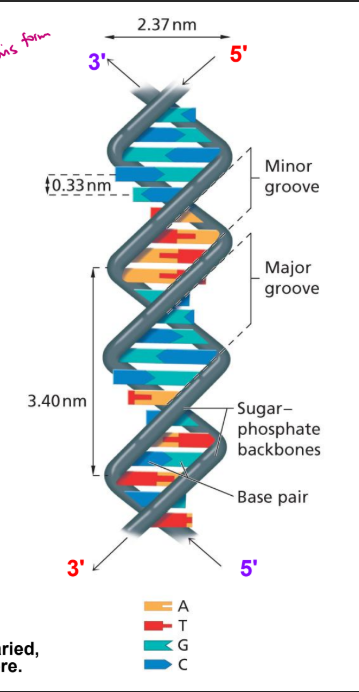
what is DNA stabilized by
Stabilised by base stacking interactions and hydrogen bonds
Base stacking interactions - you dont get this with proteins and very specific nucleic acids
• Major stabilising force of secondary structure - double stranded is more stable than single
• van der Waals
• hydrophobic forces - so when you stack them you get more hydrophobic forces
what parts of DNA are polar
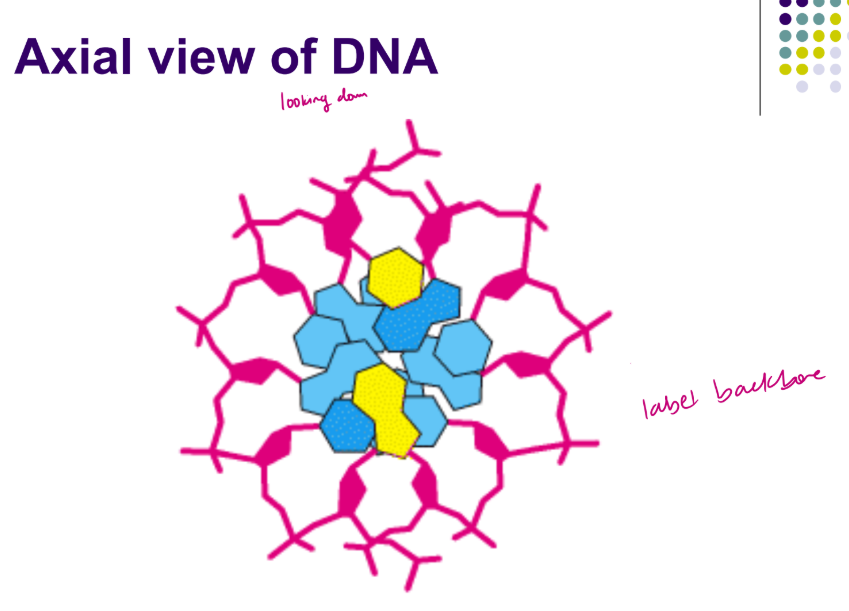
Hydrophobic core/polar exterior
Bases largely excluded from H2O - H-bonds in pairing interactions, Stabilizes H-bonds
Ribose/deoxyribose and phosphates exposed to H2O
what are the complementary strands in DNA
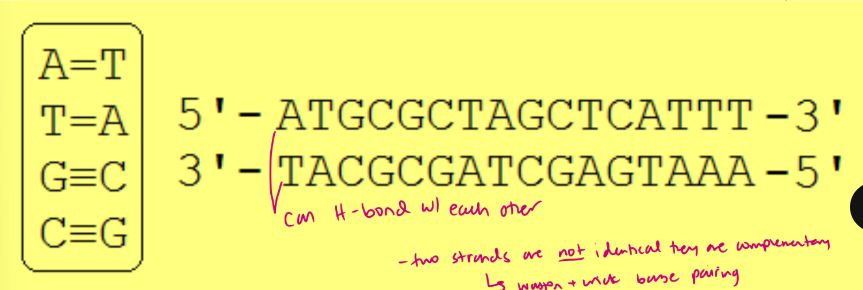
# A’s in one strand = # T’s in complementary strand
# G’s in one strand = # C’s in complementary strand
they can H bond with each other, the two strands are not identical they are complementary (watson and crick base pairing)
Complementarity involves the ability to H-bond when the strands are antiparallel.
what does chargaffs rule not apply to
doesnt apply to SS DNA or RNA
if a 28 base pair of double stranded DNA and 7 adenine how many guanine resides?
21
why do nucleic acids have a sense of direction
covalent bonds are always formed in the same direction because the ends are geometrically/structurally distinct from each other, not identical
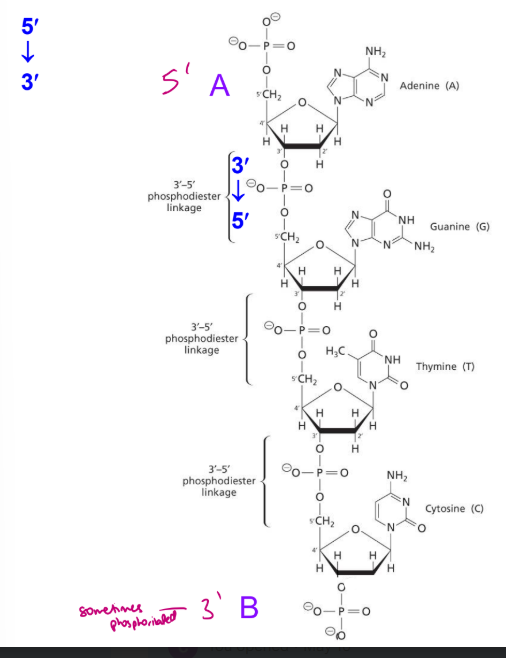
Is the dinucleotide pU-p-A the same as the dinucleotide pA-p-U?
no
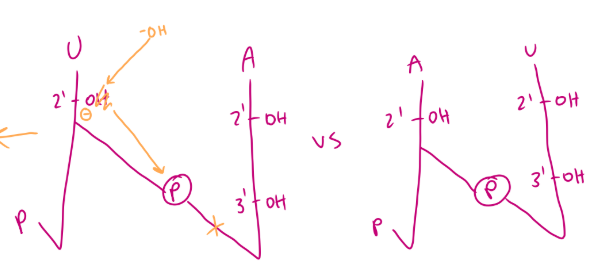
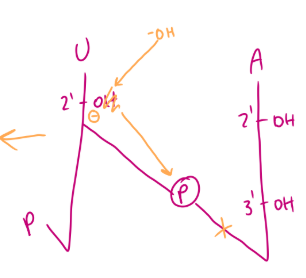
what are the alkaline hydrolysis products of this dinucleotide
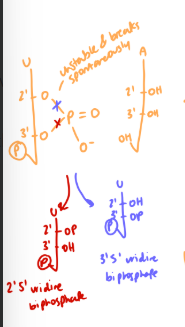
how do you name the phosphates in a nucleotide
Phosphates attached to a single carbon/OH groups are typically identified using mono- /di-/tri- prefixes
Phosphates attached to multiple carbon/OH groups are described using bis-/tris- prefixes
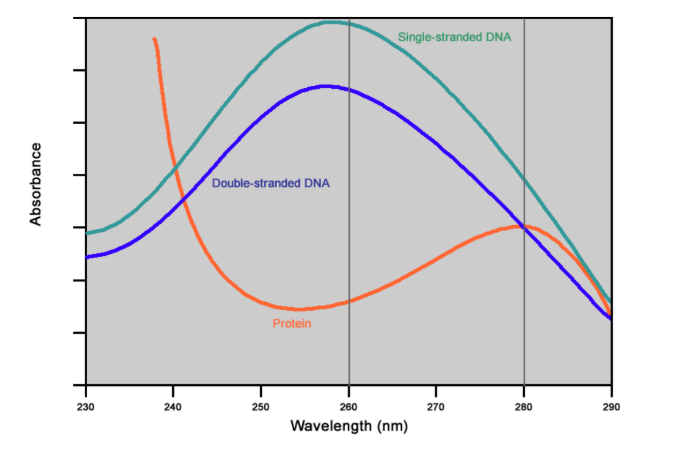
what is the absorption of free nucleotides in relation to DNA
A260nm of free nucleotides > ssDNA > dsDNA
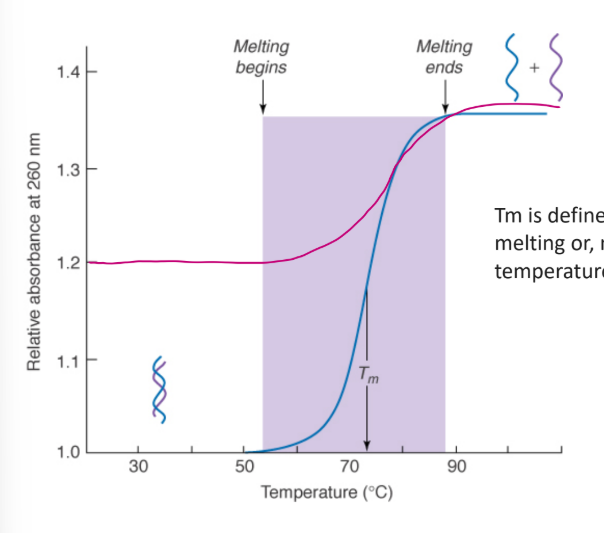
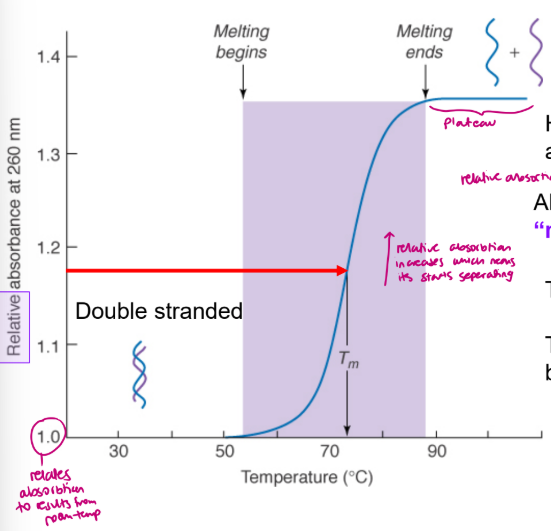
what is DNA melting
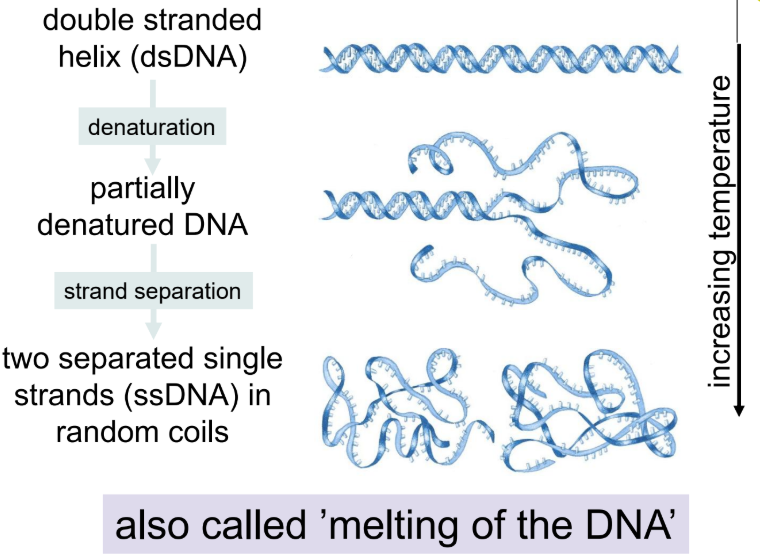
goes from DS to two single stranded
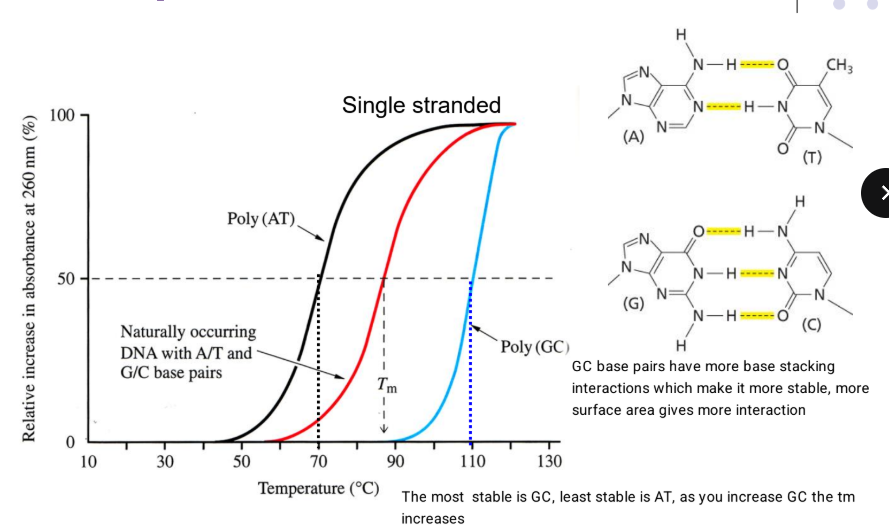
starts around 50 degrees, increases then plateaus at the top
relative absorption increases which means it starts separating
H-bonds and base-stacking are weak forces
Absorbance changes as DNA “melts” – base stacking changes
what is Tm
midpoint of melting
characteristic of the base composition, diff bases affect how much heat you need
an index of the thermal stability of a nucleic acid
Dependent on many conditions which include but are not limited to
Base number - The longer the nucleic acid strands the greater the Tm
Base composition and sequence
Solvent conditions - Salt, pH
what are DNA melting curves and the different shifts that can happen
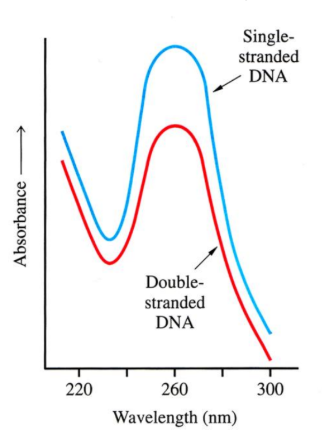
DNA melting curves can be measured because single stranded DNA has a higher absorbance than double- stranded.
Hyperchromic shift - Shift from low to high absorbance, DS to SS
Hypochromic shift - Shift from high to low absorbance, SS to DS
what is hyper/hypochromicity
“Hyperchromicity” is a (relatively) high absorbance, SS DNA
“Hypochromicity” is a (relatively) low absorbance, DS DNA
what bonds do you break when you denature DNA
Denaturation = strands separate (no covalent bonds broken) - breaking H bonds between bases and base stacking
Degradation = DNA is cut apart (covalent backbone bonds broken) - phosphodiester bonds are broken
how can you renature DNA
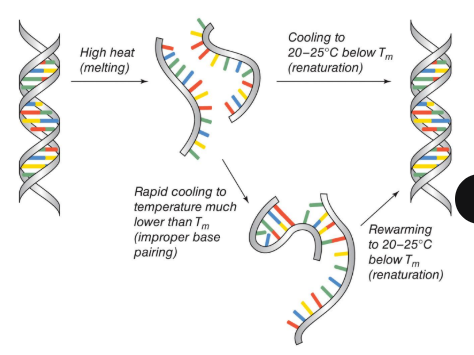
slower than denaturation, 2 components slow and fast
slow - depends on the complexity of DNA and involves nucleation, trying to line up 2 ends correctly, the more complicated the slower, drop temp slowly
fast - zippering, regain native conformation (proper base pairing)
you can never renature genomic DNA after you denature it
what does renaturation require and involve
Reformation of dsDNA so it regains its native conformation
requires proper base pairing
involves nucleation and zippering
heat it to break and cool it slowly to nucleate properly, if not you have to re heat it and re cool it so it goes back
degradation vs denaturation
degradation - alkaline hydrolysis, breakdown of biomolecules into smaller pieces usually irriversable, covalent bonds broken
denaturation - losing 3D shape without changing its primary chemical sequence, dna strands separating, reversible
both can happen to DNA
what does the melting curves look like with different base compositions
GC base pairs have more base stacking interactions which make it more stable, more surface area gives more interaction
The most stable is GC, least stable is AT, as you increase GC the tm increases
Tm is linearly related to GC content of DNA, higher Tm = higher stability
what regions of DNA are rich in AT base pairs
DNA starts separating, genomic DNA, these regions have more AT base pairs transport
transcription initiation bubble and DNA replication origins are often AT rich
what is pKa
An index used to express the strength of an (weak) acid
The smaller the pKa value, the stronger the acid
refers to molecule in solutions
what is pH
An index used to express the [H+] in solution
pH measures the acidity of a given solution
lower pH = more hydrogen ions
![<p>An index used to express the [H+] in solution</p><p>pH measures the acidity of a given solution</p><p>lower pH = more hydrogen ions</p>](https://assets.knowt.com/user-attachments/94156c6c-b2fb-476e-ae1d-0888ee18a45e.png)
what are 3 rules to apply to pH and pKa
At a pH below the pKa, the acid exists predominately as AH Protonated form/acid - lots of H in it
At a pH above the pKa, the acid exists predominately as A- Deprotonated form/conjugate base - easy to offload H
When the pH of the solution = pKa of the group [AH] = [A- ] i.e. exactly half dissociated
see slides 87 - 88
![<p>At a pH below the pKa, the acid exists predominately as AH Protonated form/acid - lots of H in it</p><p>At a pH above the pKa, the acid exists predominately as A- Deprotonated form/conjugate base - easy to offload H </p><p>When the pH of the solution = pKa of the group [AH] = [A- ] i.e. exactly half dissociated</p><ul><li><p>see slides 87 - 88</p></li></ul><p></p>](https://assets.knowt.com/user-attachments/93d95945-1ab0-4492-8ea7-f055c1496bf7.png)
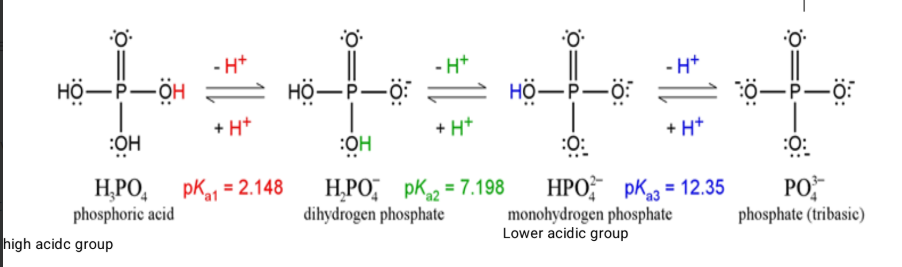
what are the different pKa values for phosphate groups
pKa values of the –OH groups will likely change if the phosphate is part of a molecule.
You can have the same functional group but depending on the structure of the molecule the pKa varies
see slide 90 - 91
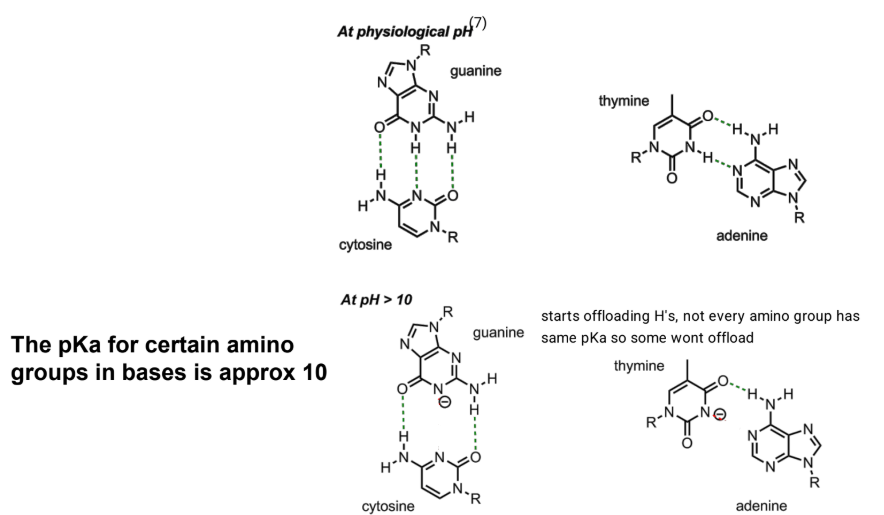
what effect does pH have on denaturing
Changing pH will affect Tm - Affects protonation state of DNA and ability to H-bond, pH > 10 certain groups are deprotonated
higher pH = lower Tm
what effect does pH have on salt concentration
Changing salt concentrations - Ions shield negative charges on phosphate backbone
add these to reduce negative charges
Mg2+
Positively charged proteins (histones)
Low salt decreases Tm - Destabilizes double helix
Increased salt elevates Tm - Stabilizes double helix
what are the conditions to denature and hybridize
Conditions to denature? Increase temp, decrease salt, increase Ph which allows
strand to separate easily
Conditions to hybridize? Low temp, high salt, low pH to around 7
The method was used to identify similar sequences in different species
what are properties of RNA
A pairs with U
Often single-stranded but not always
Like DNA, stabilised by hydrogen bonding and base stacking interactions, smaller than dna, most important to stabilize
Intrastrand base pairing - base pairing with bases in the same strand
DNA also has Interstrand base pairing
what can complementary RNA form
can form double stranded helix
not the same structure as B-DNA bc of the 2’ hydroxyl group
right handed, stabilized primarily by base stacking interactions
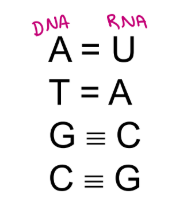
what does the melting curve for RNA look like compared to DNA
Tm is defined as temperature of
melting or, more accurately, as
temperature of mid-transition.
see slide 100