Cellular Respiration (intro)
 Call Kai
 Learn
Learn Practice Test
 Spaced Repetition
 Match
Match Flashcards
 Knowt Play
1/21

Earn XP
Description and Tags
SBI4U - Birrell
Name | Mastery | Learn | Test | Matching | Spaced | Call with Kai |
|---|
No analytics yet
Send a link to your students to track their progress
22 Terms
Why do we need energy?
many biochemical processes in our cells require energy
What is the main fuel source in animals?
Glucose
Can glucose be used as a primary energy source? Why?
NO: it has too much energy to be used as a primary energy source
Overall equation for cellular respiration
C6H12O6 + 6 O2 --> 6 CO2 + 6 H2O + 38 ATP
Cellular respiration
the release of energy through the oxidation of fuel molecules
Oxidation in biology
usually the removal of hydrogen, because they have 1 electron
The ultimate goal of cellular respiration
to extract energy from nutrient molecules and store it in a form that the cell can actually use (ATP)
4 parts of cellular respiration
Glycolysis
Pyruvate Oxidation
Kreb’s Cycle (aka citric acid cycle)
Electron Transfer Chain
5 kinds of chemical reactions involved in cellular respiration
Phosphorylation: sticking a phosphate on (energizes the molecule)
Dephosphorylation: taking a phosphate off
Decarboxylation: removal of a carboxyl group
Redox: transfer of electrons and of potential energy
Isomerization: rearrangement
What reaction is especially important in respiration?
redox!
Redox reactions allow _______ from glucose to be _________ a little bit at a time and thus minimize loss of _____ _________
energy, extracted, free energy
ATP
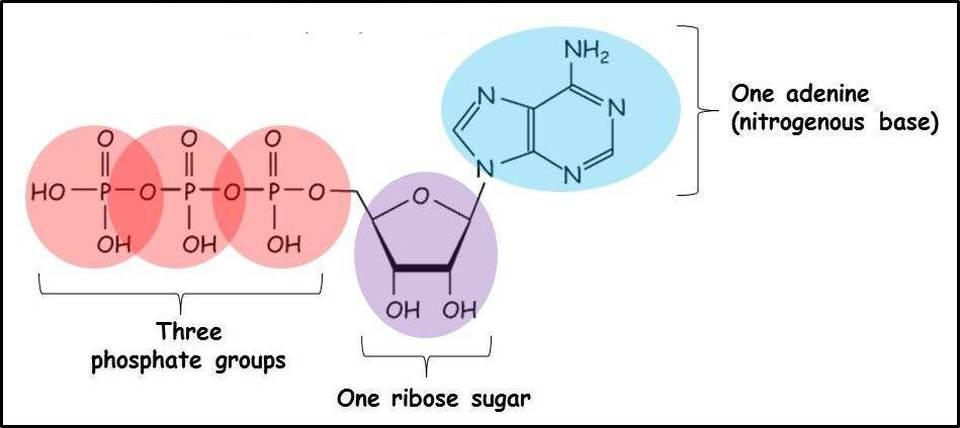
Adenosine triphosphate:
3 phosphates
1 adenine nitrogenous base
1 ribose pentose sugar
ATP synthesis
the phosphorylation of an ADP molecule; can be made directly or indirectly
2 kinds of ATP synthesis
Substrate lvl Phosphorylation: an enzyme catalyszes the rxn of adding Pi to ADP
Oxidative Phosphorylation: a proton pump coupled to a facilitated diffusion channel catalyzes the synthesis of ATP
Substrate level phosphorylation occurs in __________ and _____, forming ATP _________ (in one step)
glycolysis, krebs, directly
Oxidative phosphorylation occurs in ___________, after the ________ ___________ ______. It forms ATP _________.
mitrochondria, electron transport chain, indirectly
purpose of ATP hydrolysis
releases energy to power many life processes
ATP hydrolysis equation
ATP + H2O → ADP + Pi + Energy
ATP hydrolysis is a _________ rxn, which means:
reversible: the ADP can be recharged during cell. resp.
Energy Coupling in ATP hydrolysis
when ATP loses a phosphate, it gives it to another substance
this secondary substance is provided w energy needed to do its job
allows for life processes that are usually non-spontaneous to proceed
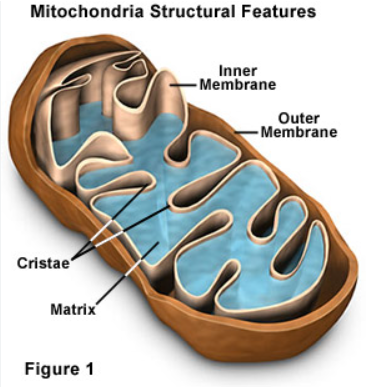
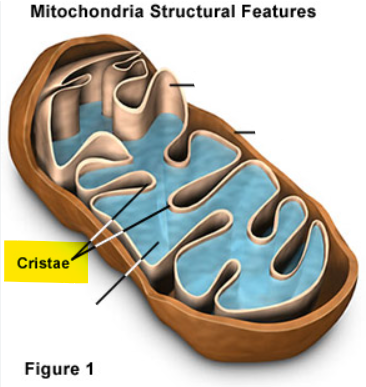
cristae
the folds in the inner membrane of the mitochondria
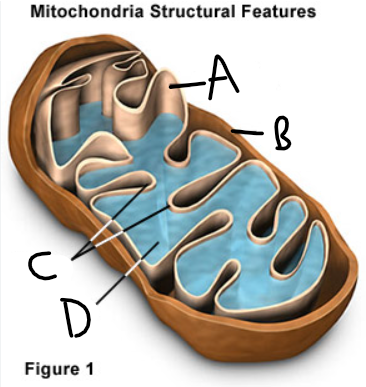
identify the parts of the mitochondria
A: inner membrane
B: outer membrane
C: cristae
D: mitochondrial matrix