Week 7 - Vertical Curve Geometry
 Call Kai
 Learn
Learn Practice Test
 Spaced Repetition
 Match
Match Flashcards
 Knowt Play
1/24

There's no tags or description
Looks like no tags are added yet.
Name | Mastery | Learn | Test | Matching | Spaced | Call with Kai |
|---|
No analytics yet
Send a link to your students to track their progress
25 Terms
When the profile line increases from level terrain, what is it called?
Positive (plus) grade
When the profile line decreases from level terrain, what is it called?
Negative (minus) grade
What are the two main categories of vertical curves?
Crest curves and Sag curves
What type of vertical curve is shown when grades go from +g₁ to −g₂?
Crest vertical curve
What type of vertical curve is shown when grades go from −g₁ to +g₂?
Sag vertical curve
What does PVI stand for?
Point of Vertical Intersection
What does PVC stand for?
Point of Vertical Curvature
What does PVT stand for?
Point of Vertical Tangency
Where are vertical curves typically centered?
At the PVI
What shape are vertical curves?
parabolic
What assumption is made about tangent lengths in vertical curves?
Equal tangent length
What is usually the controlling factor for crest vertical curves?
Stopping sight distance (SSD)
What does SSD determine for crest curves?
Minimum curve length based on grades and design speed
What is A in vertical curve equations?
=G1−G2
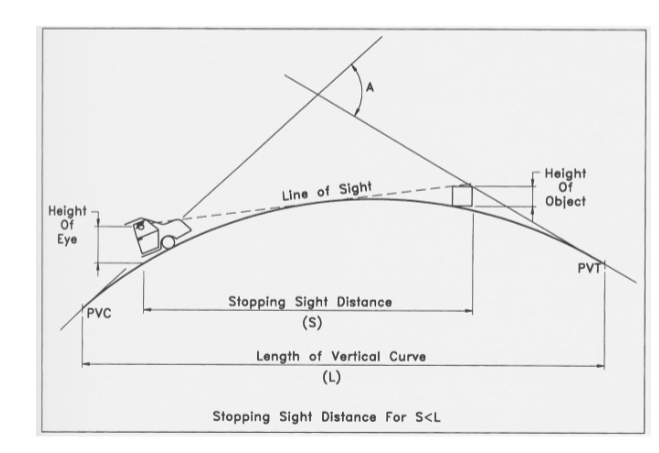
What condition defines Case 1 for crest curves?
S < L
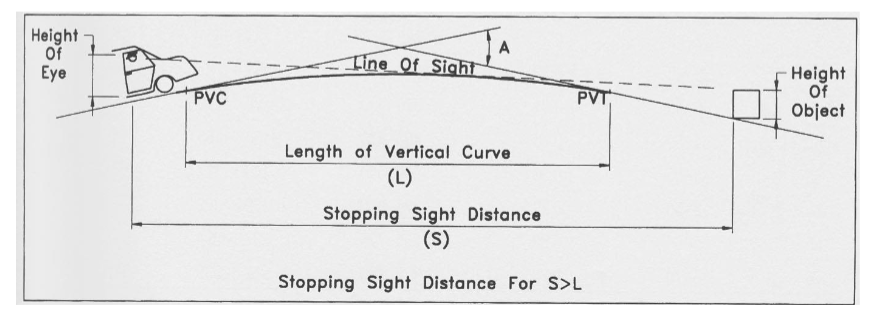
What condition defines Case 2 for crest curves?
S > L
What does SSD stand for?
Stopping Sight Distance
What is the standard driver reaction time used?
2.5 seconds
What is G often assumed in SSD equations?
0
Why is G often assumed to be 0 in SSD for vertical curves?
Because stopping could occur on positive grade, negative grade, or within the curve
What is the controlling factor for sag vertical curves?
Headlight projection distance
What condition defines Case 1 for sag curve?
S < L
What condition defines Case 2 for sag curves?
S > L
Given G₁ = 7% and G₂ = −3%, what type of curve is this?
Crest curve
Given G₁ = −7% and G₂ = 3%, what type of curve is this?
Sag curve