Using Blood Lactate to Evaluate Sports Performance
 Call Kai
 Learn
Learn Practice Test
 Spaced Repetition
 Match
Match Flashcards
 Knowt Play
1/19

Earn XP
Description and Tags
Semester 1, week 5
Name | Mastery | Learn | Test | Matching | Spaced | Call with Kai |
|---|
No analytics yet
Send a link to your students to track their progress
20 Terms
What does glycolysis provide?
ATP at 2x rate of oxidative from carbohydrates and >3x rate of oxidative from fat
What is lactate dependent on?
The rate of energy demand, it is not independently produced in hypoxia
What is lactate reflected of?
Fatigue mechanisms. H+ causes a decrease in pH, ADP, and Pi concentrations and reflects elevated glucogen utilisation and depletion
What is LDH?
Lactate dehydrogenase
What is the only measurable thing we see in the body (in the pyruvate, LDH, lactate conversion)?
Lactate
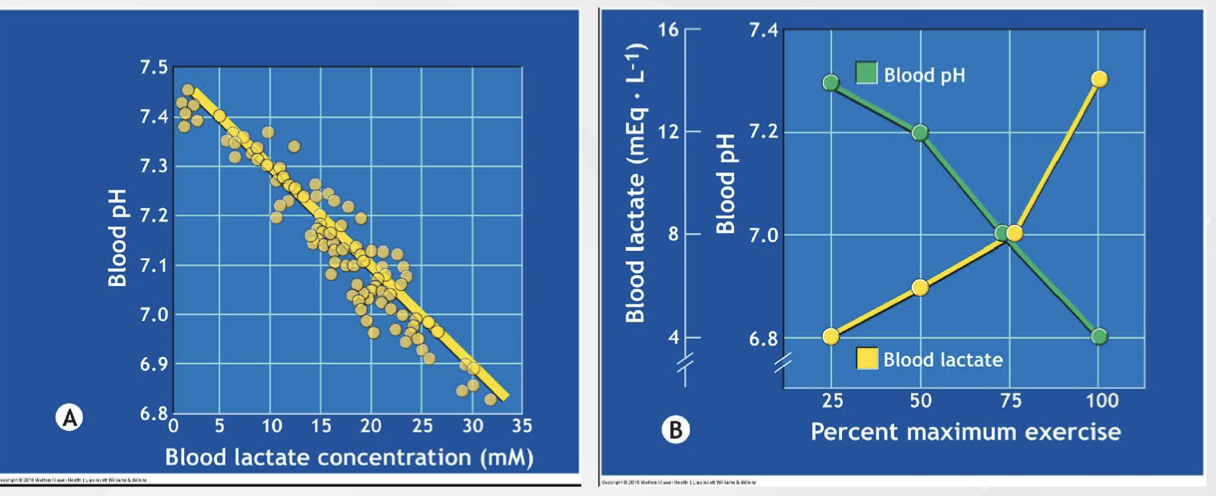
What is the correlation between lactate and pH?
During intense exercise, H+ ions are produced alongside lactate, which lowers blood pH. As lactate is metabolised during recovery, H+ ions are used up, helping blood pH return to normal
What determines blood lactate concentration?
Rate of lactate clearance in other tissues (type 1 muscle tissue and cardiac muscle can use lactate as a fuel source, and can go to the liver where it is converted to glucose, metabolised in brain tissue keeping neurons healthy)
Rate of lactate production (in other muscles)
Where is the site of blood lactate removal?
Most is oxidised in working muscles
Liver and kidneys: ~20-25%
Cardiac muscle: ~10%
How is muscle a consumer of lactate?
Lactate is not just a waste product. It is a valuable fuel, especially for oxidative tissues like slow-twitch muscle fibres and the heart. During exercise, lactate is continuously produced, transported, and consumed. This is called the lactate shuttle.
Where is lactate produced by fast twitch fibres oxidised?
Only ~50% of produced lactate appears in vascular bed. Lactate produced by fast twitch fibres are oxidised in slow twitch fibres (diffusion).
Is lactate that enters the bloodstream waste?
Lactate that enters the bloodstream is not waste either. Shuttling through vasculature (inter-tissue shuttle): reperfusion (blood flow increases to) of heart and active muscle
How is lactate used as fuel?
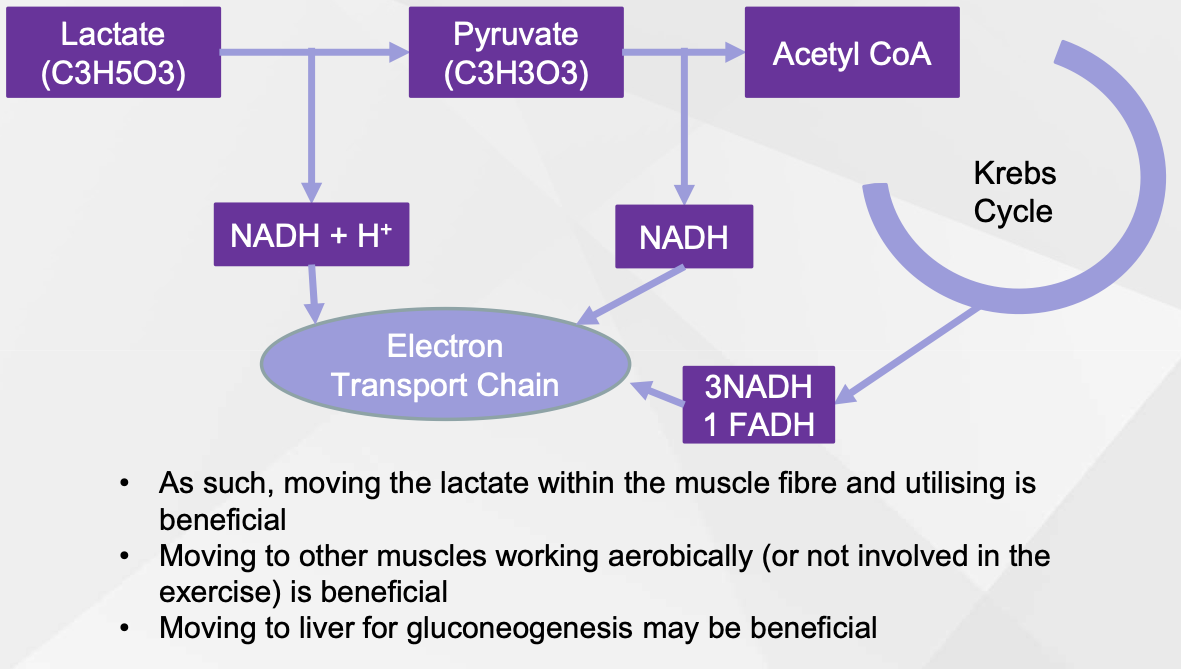
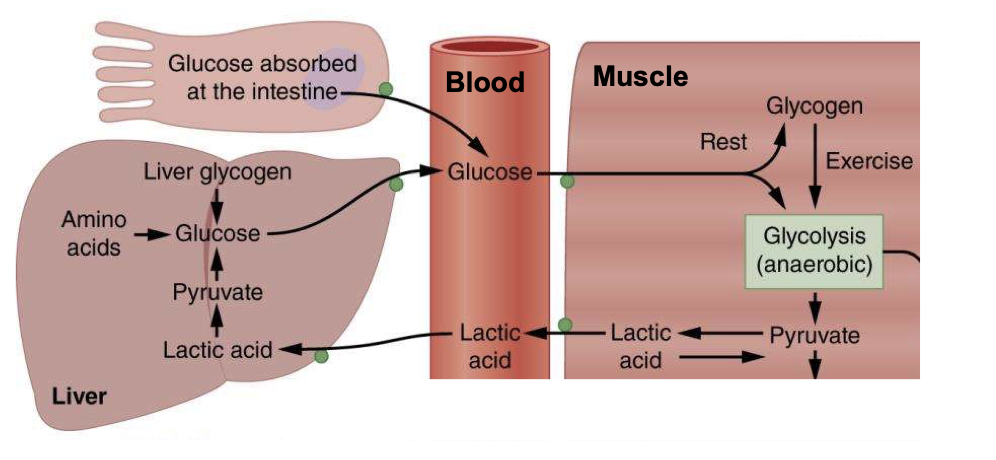
How does the Cori Cycle work?
Cori cycle shows the lactate is not a waste product. The process is gluconeogenesis
Why measure blood lactate (BLa)?
Can use BLa to predict endurance performance, indicate submaximal fitness and as a tool for exercise prescription and monitoring training intensity
Once BLa exceeds a certain concentration during steady state exercise, exercise duration become finite
How many different threshold concepts are there?
~25
What is lactate threshold?
0.2mmol/L above resting concentration
0.5mmol/L above resting concentration
First significant elevation of lactate level (~2mmol/L)
What is lactate turnpoint?
The second lactate increase of at least 0.5mmol/L from the previous value (in a step test protocol)
Dmod: maximal distance from BLa curve to the line formed by the point before the first rise in BLa and the value at cessation of exercise
What is maximum lactate steady state (MLSS or MLaSS)?
The highest blood lactate concentration that can be maintained over time without a continual blood lactate accumulation
When determining the lactate turnpoint, we really want to estimate MLSS
The lactate turnpoint/MLSS is NOT the point where metabolism "switches" from aerobic to anaerobic
Aerobic and anaerobic processes always occur concomitantly
At intensities higher than the lactate turnpoint/MLSS, anaerobic processes lead to a gradual build-up of H+ and other metabolic products in muscle, ultimately leading to fatigue
What are the training zone exercise domains?
Low intensity domain = below the LT = BLa<~2mmol/L = <~70% VO2max
Moderate domain = between the LT and the MLSS = BLa elevated but stable at ~2-8 mmol/L = ~70-90% VO2max
Severe domain (interval) = above the MLSS = BLa > ~2-8mmol/L = >90% VO2max
What is a summary of using blood lactate to evaluate sports performance?
The lactate threshold reflects an exercise intensity at which blood lactate levels begin to increase from baseline
The lactate turnpoint represents the highest intensity at which exercise can be sustained (maximum lactate steady state, MLSS)
Lactate threshold and turnpoint are widely used to monitor endurance performance and adaptations to endurance training
Training to improve endurance performance also improves (= lowers) the blood lactate response to exercise