PUBH final Actual questions and answers with 100% accuracy(VERIFIED BY PROFESSOR)
 Call Kai
 Learn
Learn Practice Test
 Spaced Repetition
 Match
Match Flashcards
1/88

There's no tags or description
Looks like no tags are added yet.
Name | Mastery | Learn | Test | Matching | Spaced | Call with Kai |
|---|
No analytics yet
Send a link to your students to track their progress
89 Terms
determinants of health (4)
social & environmental factors
health care
genetics
individual behavior
who is john snow
father of epidemiology
- Was convinced cholera was waterborne disease -> everyone ignored him
- Went into the outbreak in London to try and convince people it was the water supply not the air
PH timeline
ancient greece
roman empire
middle ages
birth of modern medicine
great sanitary awakening
modern PH
ancient greeks
personal hygiene → important to bathe, wash hands
physical fitness → olympics
hippocrates
Father of Western medicine
believed that diseases resulted from imbalance of person & environments
roman empire
adopted greek health values
- great engineers → sewage systems
- administration → public baths, water supply, markets
middle ages
fall of roman empire
- rise of christianity (esp. catholic church) in europe
- belief that disease is a punishment for sin
- begining of quarantine of ships//isolation of sick individuals
The plague // black death
1346-53 pandemic: W. Asia, N. Africa & Europe
75-200 million worldwide died
25 million died in europe ~40% of population
renaissance
global exploration
- Disease (ex; smallpox, measles, flu) spread by traders & explorers
- Indigenous people in Americas had never experienced these illness → killed 90%
Age of reason and enlightment
birth of modern medicine
- used dissection
- advanced understanding of human anatomy
Industrialization and Urbanization
"New" and worse PH problems
- Poverty & disease
- 1840: 57% of the working class children of Manchester died before their fifth birthday (compared w/ 32% in rural districts)
- Factory worker in Liverpool had an average age death of 15
Great Sanitary Awakening
Growth in scientific knowledge
Humanitarian ideals (ex: value of human life, alleviate suffering, impartiality)
Connection between poverty and disease
Water supply & sewage removal
Monitor community health status
U.S. Sanitary Reform
1850 "Report of the Sanitary Commission of Massachusetts"
1869 MA State Board of Health
Health records, vital public health statistics as tools to fight disease
System of sanitary inspection.
Vaccination programs
Epidemiology
distribution & determinants of disease
10 great achievements in PH (1900-1999)
1. vaccination
2. MV safety
3. safer workplaces
4. control of infectious diseases
5. decline in deaths from coronary heart disease & stroke
6. safer and healthier foods
7. Healthier mothers & babies
8. family planning
9. fluoridation of drinking water
10. Recognition of tobacco use as a health hazard
primary secondary tertiary
Primary - limit early exposure
Secondary - ex: going to dermatologist
Tertiary - treatment/ prevention from further damage
Describe conditions that existed before the advent of modern public health
- sewage ran in streets
- no clean water systems
- no understanding of germs
- overcrowded cities
- extremely high child mortality
- life expectancy very low (factory workers)
- disease outbreaks
Louis Pasteur
germ theory
opened the first ph lab in france
coined term vaccine
Robert Koch
Identified bacteria causing cholera and tuberculosis
Describe P.E.R.I.
P - The PH problem
E- Etiology → what are the contributory cause(s)
R - Recommendations for reducing/eliminating the PH problem
I - Implement → what steps do we take?
Explain the socio-ecological model
Individual level (knowledge, skills, behavior)
interpersonal level (family, friends, soc.networks)
Organizational level (schools, workplace)
community level (neighborhood, environment)
policy level (laws, regulations)
Describe the 4 conditions used to strengthen contributory cause
1. Strength of association
relative risk - strong relationship btw exposure & outcom
2. Dose-response relationship
more exposure = greater risk
3. Consistency
4. Biological plausibility
Explain the behavioral causes of premature death in the U.S., change over time
tobacco deaths somewhat decreased
obesity and physical inactivity increased
drug related deaths increased
BEHAVIOR IS THE BIGGEST DRIVER OF PREMATURE DEATH
Describe the U.S.'s response to PH problems
assessment - collect data
policy development
assurance - make sure services are provided
Identify strategies used by U.S. governments to influence the health status of their citizens
laws & regulations (seatbelts, smoking ban laws)
funding
PH campaigns - anti smoking ads
surveillance systems - track disease
policy dev.
environmental regulation
Explain the role of Federalism in relation to PH laws
Federalism = division of power between federal & state governments
- The 10th amendment gives states police power to regulate health & safety
- States have primary authority over PH laws (quarantine, licensing)
Federal gov. steps in when:
- Issues cross state lines
- National coordination is needed
- States lack resources
Explain the basic principles of health equity
Health equity means - everyone has a fair opportunity to achieve their highest level of health
Requires:
- Addressing social determinants
- Reducing disparities
- Valuing all populations equally
- Ensuring equal access to opportunities
Explain how levels of government/organizations/entities work together within the PH system
PH systems:
- Health departments
- Community partners
- Healthcare systems
- Nonprofits
- Schools
- Private sector
Coordinate through:
- Core functions
- Ten essential PH services
Explain some general public health responsibilities of the federal government
set nation goals (healthy people)
funds research
provides leadership & standards
responds to multi-state emergencies
supports states during disaster
Identify approaches to organizing health responsibilities the state government
varies by state
- free standing health department
- combined health & human services agency
- shared across multiple agencies
Explain how SC's state health dept. is structured
- SC department of PH
- State-level administration
- Regional & local health offices
Identify some general responsibilities of the U.S. state/local health departments
Conduct inspections
Monitor disease outbreaks
Provide immunizations
Issue permits
Enforce health code
Provide community programs
Ten essential PH services
Monitor health
Investigate
Communicate
Strengthen community partnership
Create & implement policies
Utilize legal & regulatory actions
Ensure equitable access
Improve & innovate
Maintain infrastructure
Explain the term: social determinants of health
social determinants of health are conditions in the environment where people are born, live, play, worship, and age that affect health, functioning, and quality of life
Recognize how social determinants can impact other social determinants & ultimately population health outcomes
Social determinants do not act alone, they build on each other
EX:
- lower education can limit job opportunities, which can lower income, which can reduce access to insurance, healthy food, safe housing, etc.
- That chain can lead to delayed care, more chronic disease, lower life expectancy, and worse population health outcomes
Provide examples of social determinants
- Economic stability, healthcare & education access/quality, environment, social community are major categories of this
- Slides connect poverty in the south with higher levels of diabetes and heart disease, which is a good example of how place and economic affect health
Describe the Tuskegee Study and its lasting impacts on research & practice
- Conducted by the US PH service w/the Tuskegee instiitute from 1932-72
- 600 black ment, 399 with syphilis and 201 without
- They were told they were being treated for bad blood but they did not receive proper treatment, and the study was conducted without informed consent
- Lasting impacts included a $10 million settlement, the tuskegee health benefit program, 1974 National Research Act, the relmont report, use of Institutional Review Boards (IRBs)
Explain what ACEs are and how they can impact health outcomes
- ACEs = adverse childhood experiences
- common experiences measured in a large CDC-Kaiser study where almost ⅔ of people reported at least one ACE
- important because toxic stress can directly affect brain development & alter decision-making, learning and growth, and the ability to for healthy relationships
Describe the approximate level and components of national expenditures for all health activities (ex: where is the money coming from, where is it going)?
Comes from 3 main sources:
- Health insurance (73%)
- Out of pocket spending (10%)
- investments/third-party payer (16%)
- Gov insurance ~43%
- Private insurance ~30%
Money mostly GOES to hospitals, doctors, and prescription drugs
Medicaid vs Medicare
Medicaid:
- Major safety net program for low-income populations
- Low-income families, Pregnant women, Children, People with disabilities, Elderly individuals that need long-term care
-In SC - covers 60% of all births
- 90% teen births
- 20% of population
Medicare
- Fed program mainly for 65+
- Some younger people with certain disabilities
Divided into:
- Part A - covers inpatient hospital care & some skilled nursing
- Part B - outpatient services, doctor services, supplies, preventative care
- Part C - medicare advantage though private companies
- Part D - covers prescription drugs
Explain how PPACA expanded access to health care (explain the coverage gap)?
Patient protection affordable care act expanded access to healthcare mainly by increasing access to health insurance
- Medicaid expansion & creation of health insurance marketplaces
- Originally required people to have insurance or pay a penalty
- After ACA more people under the age of 65 could gain coverage either through their
- Coverage gap refers to people in states that did not adopt medicaid expansion who earn too little to afford marketplace coverage but do not qualify for traditional medicaid
Leaves them without realistic access to coverage
Explain important trends related to utilization of the healthcare system
important trends are that use of healthcare systems varies a lot y age, diversity, income/insurance status & specific chronic conditions
Who is using the healthcare system? (demographic trends)
increasingly used by an older population
~46 million older adults in 2010 & projected to be 90 million by 2050
Older tends to use more care because of chronic disease
What is the general impact/consideration related to trends?
- Means more pressure on medicare, providers, hospitals etc
- Low income populations may continue to experience barriers to care, including affordability, access, & distrust of providers
- Health policy still tends to support disease treatment rather than prevention which affects cost outcomes
- Shortage of physicians, growth of APRNs and PAs and a push toward value, quality, home-based care, and telemedicine
Explain basic outcomes of ACA after 10 years?
Increased the number of americans with health insurance, largely through medicaid expansion
- After 10 years, the ACA did not stop high and rapid rising healthcare costs
- Widening gap between what medicare & private insurers pay, along with only limited success from some system reforms focused on quality
- ACA improves access to coverage but affordability & cost problems remained
Identify common characteristics of other country's healthcare systems?
- They generally have broader or more universal coverage than the US
- US spends more but gets worse outcomes while other countries often spend less & perform better on measures like life expectancy
- Still consider population characteristics & other determinants because healthcare systems do not operate in isolation from social & demographic factors
National Research Act
Required researchers to get voluntary informed consent from ALL persons taking part in studies
escape fire 7 themes
1.) Paying more, getting less - spending more and more money at a population and individual level
Patient getting expensive heart surgeries when they were not necessary
2.) Treating the whole person - (not just isolated parts)
They won't treat you for root cause - quantity over quality
Bandaid to cover it up but want you to keep coming back
3.) Preventing disease -
A lot of money is spent on treating diseases that could have been stopped
Revolving door → treating preventable diseases (chronic) but no one gets well
4.) Overmedication -
Heavily rely on prescription drugs/drug dependency
Military
Per capita compared to other countries - WAY more prescription drug use
We allow pharmaceutical commercials/marketing
Demand from consumers
"Quick fix"
5.) Overtreatment -
patients often receive unnecessary test, procedures, etc. more care does not equal better care
6.) An Entrenched System -
Stuck system
Businesses (pharmaceuticals, insurance, etc.) do not want to change because they profit off healthcare
Companies are structured that they answer to board of directors - goal is to return a profit
7.) Reimbursement -
Fee for service model → perform a service & get paid a fee
Fee for a stent is $15,000 vs nutrition help is $15
System is structured in a way for doctors to do what they may think is best for their health outcomes
The gap
Why are we spending more?
1.) We have more chronic disease - Constantly getting treatment
2.) Uninsured/Under-insured
3.) Misuse of emergency department
- No health care insurance → they go to emergency department
4.) Reward doing more, rather than efficiency/outcomes
Incentivises more treatment, tests, etc.
5.) Inappropriate care/tests & Defense medicine & Malpractice costs
Medical errors common → robust malpractice insurance
Defensive medicine - providers will do extra to defend diagnosis but the extra cost money
6.) Greater use of high cost technology, procedures
Have more hip/knee replacements compared to around the world
We receive more treatment - have to pay for it
7.) More use & cost of prescription drugs
8.) High US cost for R&D
Develops most of the world's drugs/research
High paying salaries (also higher compared to other countries)
9.) Price variations/lack of transparency
A doctor won't tell you an exact $ - "what is your insurance"
A surgery with the same doctor at different hospitals will all be different costs
10.) High administrative cost
Highest administrative cost in the world
Front desk & back rooms (paper/computer work)
"Middlemen" organizations
Jobs, insurance companies, pharmacists
11.) Higher wages for providers
12.) Limited competition
We don't have a lot of competition → no pressure to drive down prices
13.) Profit driven system
Specialists, insurance companies, pharmaceutical companies all profit from this system - why they don't want any change
Describe major issues that make the health system a PH concern?
- Major issues include that it is complex and poorly understood, has continuity of care issues, and is geared more toward treatment than prevention
- Very expensive but the US still has the worst outcomes in areas like life expectancy compared with other industrialized countries
- Other major problems: burden of chronic disease, uninsured and underinsured populations, misuse of emergency departments, high prescription drug costs, high administrative costs, price variation and lack of transparency, limited competition, and a profit-driven system
Explain why the U.S. healthcare system costs so much compared to the rest of the world
- Multiple cost drivers
- High burden of chronic disease
- Many under/uninsured people - contributes to delayed care & expensive emergency care
- System rewards more test, procedures, and treatment through reimbursement structures rather than prevention or efficiency
- Costs are driven by high-priced technology and procedures, greater use and higher cost of prescription drugs, high administrative expenses, lack of transparency, limited competition
Describe characteristics of the non-elderly uninsured population
- The non-elderly uninsured population is made up of people under age 65 who DO NOT have health coverage
- Emphasize that lack of insurance is often connected to employment & affordability
Common reasons people are uninsured:
- Coverage is not affordable
- Not eligible
- Do not want/think they need it
- Lost their job
individual mandate
a government rule that required everyone to have insurance coverage or they will have to pay a penalty - this is now repealed (2018)
Explain how insurance works, including the terminology used
- Health insurance helps pay for healthcare costs by sharing financial risk across many people
- People pay into the system (premium) so money is available when care is needed
- Insurance does not mean care is free since insured people may still have to pay part of the cost through deductibles, copays, or coinsurances
Explain the basic trends over time related to the cost of health insurance?
- Health insurance has become more expensive
- Premiums & deductibles have made insurance products less attractive
- Growth in high-deductible health plans and HSAs over time meaning more people are being shifted into plans where they pay more out-of-pocket before insurance starts helping
- ACA increased number of people with insurance but did not stop high, rapidly rising costs
infectious disease
Dz caused by different classes of pathogenic organisms commonly called germs
- DZ producing "germ"/agent such as virus or bacteria
non-infectious disease
any Dz NOT caused by a pathogen (asthma, obesity, etc.)
communicable disease
- an infectious disease that may be passed from individual to individual
- All communicable diseases are infectious diseases, but not all infectious diseases are communicable
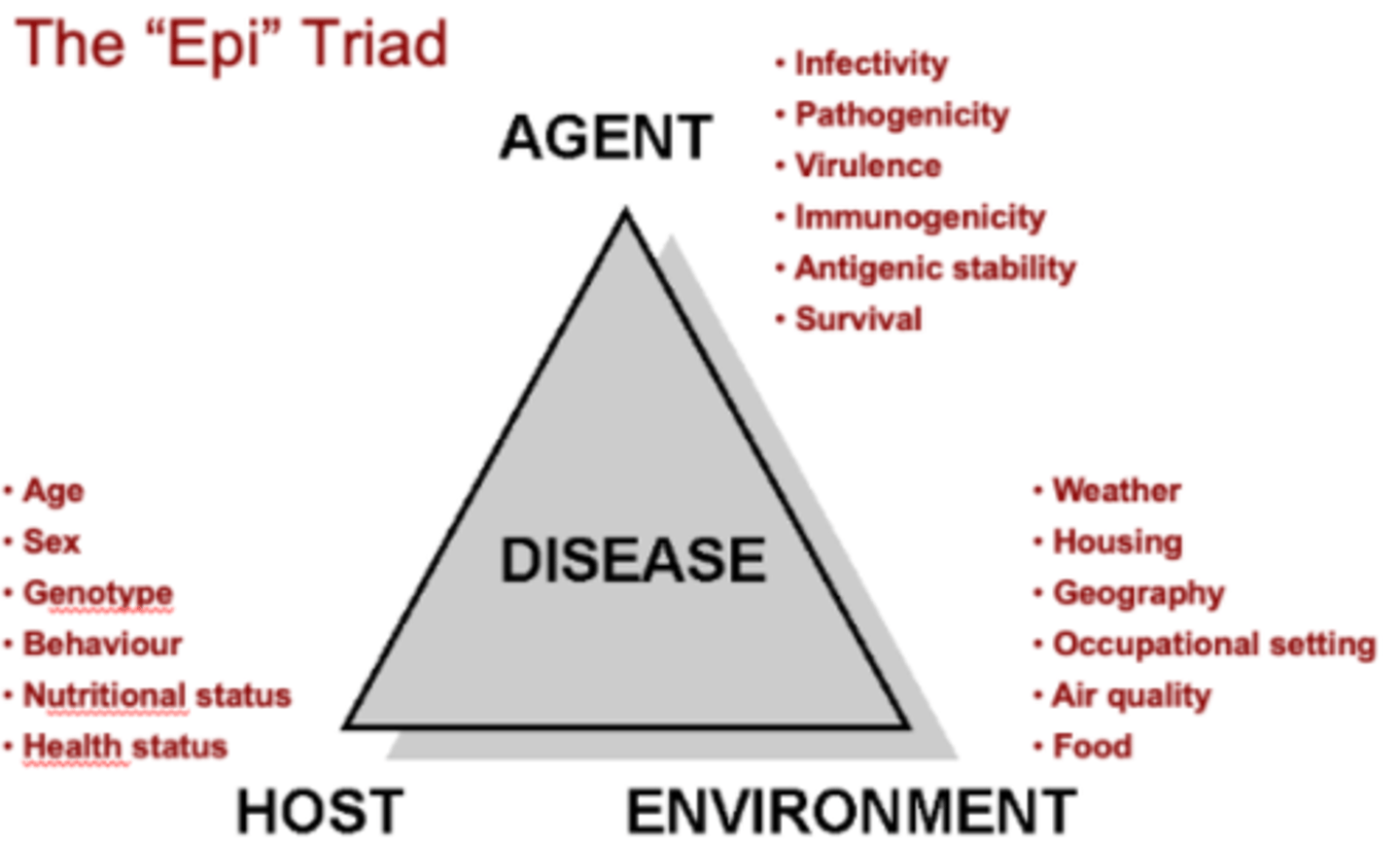
Epi Triad
Agent - Is the cause of the disease; the organism or infectious factor itself; pathogen characteristics
Host - the person/animal that can become infected.
Environment - includes outside conditions that affect whether disease spreads
Eradicated
Permanent reduction to zero of the worldwide incidence of infection caused by a specific agent as a result of deliberate efforts; intervention measures are no longer needed
explain one health
- One health means recognizing that the health of people, animals, plants, and the environment are connected
- "Achieving optimal health outcomes recognizing the interconnection between people, animals, plants, and their shared environments
- This matters because many emerging infectious diseases are zoonotic, meaning they move between animals & humans
List and define direct & indirect routs of infectious dz transmission
Direct - straight from one person/host to another w/out needing an intermediate object or vehicle
- Skin-to-skin: herpes type 1
- Mucous-mucous: STIs
- Across the placenta: rubella, HIV
- Thorough breast milk - HIV
- Sneeze-cough - influenza, TB
Indirect - pathogen uses an intermediate route
- Food-borne - salmonella
- Water-borne - cholera
- Vector-borne - malaria
- Air-borne - chickenpox, colds
Explain conditions that increase the risk of infection
- Land use changes → like deforestation or outdoor exposure
- Infrastructure issues → poor air filtration, no window screens, or lack of clean water
- Food production and handling changes
- Use of antibiotics in animal farming
- Increased immunosuppressive/antibiotic use
- Global air travel
- Ownership of exotic pets or close interaction w/animals
- Natural disasters
Connects to epi triad - more vulnerable hosts, more exposure opportunities, better survival/spread of the agent
Describe 3 methods for prevention infection at the community/population level
Water treatment
- Safe water reduces water-borne disease transmission.
Vector control
- Controlling mosquitoes, ticks, flies, and other vectors reduces vector-
Borne transmission
- Screening, case finding, & treating contacts
Why can some diseases be eradicated and others cannot?
Only humans are the reservoir
The pathogen can't survive outside the body easily vs when they can survive in water, soil, etc.
2014 ebola outbreak
Primarily affected three countries in West Africa (Guinea, Liberia, Sierra Leone)
- Approx. 28,504 cases & 11,298 deaths
- 4 patients treated for Ebola in the US, one died in October 2014; two of the survivors treated the patient in TX who died
The Road to zero (video)
- CDC's response to the West African ebola epidemic
- Ebola reached the US
- US sent ebola experts to africa to help
What is Disease X?
Unknown disease that represents the knowledge that a serious international epidemic could be caused by a pathogen currently unknown to cause human disease
Identify priority infectious diseases which pose a PH threat
Covid
SARS
Zika
Ebola
Lassa fever
Zika Virus
Mosquito-borne virus linked to birth defects.
Identify infectious diseases of "on-going" concern
STIs
HIV/AIDS
influenza
TB
Malaria
cholera
spillover : zika, ebola video
Main idea: many dangerous diseases come from animals → called zoonotic diseases
"Spillover" = when a virus jumps from animals to humans
Why spillover is increasing:
- Deforestation →More contact w/animals → higher risk of disease transmission
- Urbanization →Crowded cities allow diseases to spread quickly
- Global travel
- Climate change → Expands habitats for disease-carrying animals
like mosquitoes
Common reservoirs:
- Bats → ebola, nipah
- Mosquitoes → Zika
Human behaviors that increase risk
- Cutting down forests
- Expanding agriculture into wild areas
- Wildlife markets/trade
- Poor public health systems
- Lack of disease surveillance
PH Challenges
- Outbreaks often happen in low-resource
- Limited healthcare access slows response
- Diseases are often detected too late
Prevention & Solutions
- Early detection systems
- Studying viruses in wildlife before they spread
Ebola
Spread through contact with infected bodily fluids
High death rate
Linked to human interaction w/infected animals (often bats)
Nipah Virus
Spread from bats → pigs → humans
1918 flu pandemic video
In 1918 - a new influenza virus emerged, infecting 300 million people
- ⅓ of the world's population, causing a flu pandemic
Killed an estimated 675,000 Americans and at least 50 million worldwide
There was a shortage of medical personnel in the US because of how many doctors/nurses were serving in WW1
There were no flu vaccines, antibodies, or medical ventilators
Healthcare-Associated Infections in the US - video
In any given day ~ 1 in 25 patients have an infection caused by their medical care
- About half are 65+
- Lungs & site of surgery most common places where
1 in 9 patients will die from infection during hospitalization
Top causes of death from environment:
1. Ischaemic heart disease - air pollution & extreme temps.
2. Chronic respiratory diseases
3. Cancers
4. Unintentional injuries
5. Respiratory infections
Explain the concept of toxicology
Toxicology is the study of effects of poisons & how they can cause harm in the body
Explain: Dose makes the poison:
"All substances are poisons: there is none which is not a poison. The right dose differentiates a poison from a remedy"
Paracelsus → "father of modern toxicology"
Identify PH issues associated w/environmental determinants
environmental exposures can lead to:
- death
-organe damage (brain, lungs, liver, etc.)
Provide historical examples of occupational risk
Radium girls
Miners - lung disease from inhaling metal vapors
Chimney sweeps - cancer from soot exposure
What efforts have been taken to reduce risk
Workplace safety regulations
Monitoring toxic exposures
Safer water standards
Research on toxic substances
Reducing harmful exposures in environment & jobs
Ramazzini
first to link work exposures to disease
Paul Ehrlich
studied effects of toxicants
Rachel Carson
silent spring - raised awareness
exposed dangers of pesticides
Stephen Palumbi - following the mercury trail - video
Mercury trail = mercury & other toxins enter the ocean from industry, pollution, waste
- These toxins move through the food chain
- Smaller organisms absorb toxins
-Bigger fish eat them → toxins increase
Explain the difference between qualitative & quantitative methods/data
quantitative
- numbers based
- broad general information
- measures rates, cases
qualitative
- text/words-based
-deep/detailed understanding
- focuses on experiences, beliefs & context
Identify & briefly explain qualitative methods
Interviews
Focus groups → group discussion to explore options
Case studies → in-depth look at one situation
Community meetings → gather community input
Observation → watching behaviors
Define health promotion
the combination of educational & environmental supports for actions & living conductive to health
Explain how health promotion and health education are related
health education is one part of health promotion
promotion is broader (macro)
education focuses on individual behavior (micro)