History - Ancient Rome
 Call Kai
 Learn
Learn Practice Test
 Spaced Repetition
 Match
Match Flashcards
 Knowt Play
1/63

There's no tags or description
Looks like no tags are added yet.
Name | Mastery | Learn | Test | Matching | Spaced | Call with Kai |
|---|
No analytics yet
Send a link to your students to track their progress
64 Terms
When did Mount Vesuvius erupt?
79 AD
What cities were affected by the eruption of Mount Vesuvius?
Pompeii and Herculaneum
What happened to the cities of Pompeii and Herculaneum after the eruption?
They were covered in volcanic ash and lava and were essentially “frozen in time”
What did the discovery of Pompeii and Herculaneum’s ruins teach us about life back then?
It provided evidence for how Romans lived at that time, including their houses, streets, shops, animals and entertainment.
When was Rome established?
753 BCE
Where was Rome established?
It was formed by 7 villages on 7 hills on the banks of the River Tiber joining together
In what year had the Roman Empire conquered all of Italy
250 BCE
Eventually the Roman Empire stretched from (…) to (…)
Hadrian's Wall to Turkey
When did the Roman Empire collapse
476 AD
Give a short recap on the legend of Romulus and Remus
Romulus and Remus were brothers who had been left to die near the River Tiber, the story goes that a she-wolf raised them. They decided to build a city at the spot where they were found, but while having a dispute over the placement of a wall, Romulus killed Remus and named the city after himself.
When did Rome become a republic
509 BCE
Forum
A town marketplace
Amphitheatre
A circular or elliptical “stadium” with a space in the middle for gladiatorial contests
Public baths
Places were Roman bathed daily and met with friends
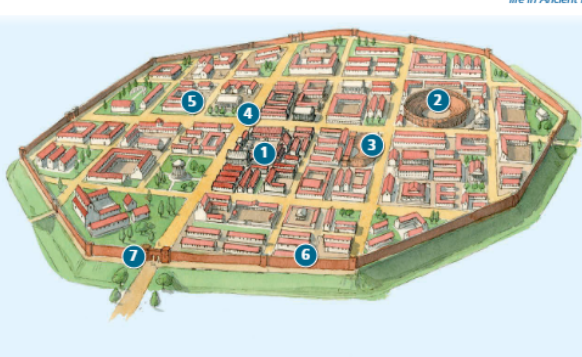
Layout of Roman Towns
Grid pattern
Paved streets (North-South and East-West
Town walls for defence
Main gates
Patricians
Wealthy and Powerful Romans that controlled the senate
Domus
Private, city houses
Villas
Country houses with farms and beaches
Features of a Domus
Walls around the house
A shop at the front
Peristylium
Atrium
Dining room
Bedrooms
Atrium
A courtyard at the centre of the house with a pool to catch rainwater
Peristylium
A walled garden at the back of the domus with exotic plants
Patrician families
Large family group
Father fully in charge
Mother’s ran the household and ordered the slaves
Patrician marriages
Marriages were often arranged to increase a families’ wealth and influence. Girls were allowed to marry at 12 years of age and boys at 14
Tunics
Short-sleeved, knee-length garments that were the base of any Romans clothing, rich or poor
Togas and Stolas
Wealthy men wore togas over an undertunic while wealthy women wore stolas over an undertunic
Meals
Romans usually ate two simple meals for breakfast and lunch before eating their biggest meal known as Cena
Cena
Main meal of the day for all Romans (richer families had three courses)
Patrician foods
Eggs, sea urchins, oyster, pork, exotic fruits and dormice, which were rare and expensive.
Entertainment during meals for Patricians
Patricians lay on couches around a large central table. Slaves served the food and musicians entertained during the meal. Sometimes people ate so much that they deliberately got sick so that they could begin again.
Plebeians
The average Roman lower-class person, Plebeians included those who produced or sold anything, right down to the very poor.
Jobs for Plebeians
Poorer Plebeians were labourers while some were better off as craftsmen, such as bakers, glassworkers or carpenters
Insulae (pl.)
Apartment blocks that were 5-6 stories tall. Better off families rented lower, well-furnished floors, while poorer families had to live in the upper floors which were in bad condition. The rooms at street level were rented out as shops
Toilet situation for Plebeians
There was usually no toilets in insulae, so people had to use public toilets. There was also no direct water supply so Plebeians had to draw water from public fountains which were supplied by aqueducts
Plebeian food
Plebeians ate bread and wheat biscuits for breakfast and lunch. They also ate a kind of porridge made from wheat and barley.
Thermopolia
Take-away shops which served hot food
Dole
A free supply of grain from the Empire given to the poor (200,000)
Roman Women
A woman's place was in the home. She was under the control of her husband.
The ideal Roman woman was hard-working and obedient to her husband.
She gave orders to the slaves who did the work, the only traditional work that richer women did was spinning or weaving.
Poorer women worked in the markets, the shops and the baths.
When was Julius Caesar born?
100 BCE
When Caesar returned to Rome, what did he work as?
An Orator (speaker)
What areas did Caesar add to the empire?
Belgium and Britain
How many soldiers did the Roman Army have?
150,000 - divided into 30 legions
Legion
A group of 5,000 soldiers, called legionnaires
Century
Legions were further divided into centuries, a group of 100 men, led by a Centurion
How did soldiers obtain their uniforms?
They paid for it out of their own wages
What training did soldiers go through
Running, javelin-throwing and sword fighting, they also sometimes went on 30km marches
What equipment did soldiers have?
2 spears
a dagger
a short sword
a shield
All the equipment weighed nearly 40kg
Who did Caesar defeat to make him the Dictator of Rome?
He defeated Pompey in a Civil War in 49 BC
When and how did Caesar die?
Caesar was assassinated on the 15th of March (Ides of March) 44 BC by the Senate, as they feared he would try and overthrow them
How many slaves were there in Italy
Between 1.5-2 million, which was around 20% of the population
Who owned slaves?
The government or patricians owned slaves
Where were slaves from and where were they sold?
Many slaves were brought back from foreign war and they were bought and sold at markets
Education for Plebeians
Most poor children did not receive education and couldn’t read or write because they had to work
Education for Patricians
Sons and daughters of rich families went to Ludus. Boys went to secondary school where they learned History, Philosophy, Geometry and the writings of Greek and Latin scholars. Rich girls ended their education at 12-14 to get married off
Ludus
Roman primary school
What forms of entertainment were available?
Chariot racing
Gladiatorial fights
Public baths
Theatres and Plays
Gladiators
Slaves or criminals trained to fight. They usually fought each other or a wild animal using swords, nets, tridents, shields and daggers
Colosseum
One of the largest amphitheatre’s in the Roman empire. Seats up 80,000 people
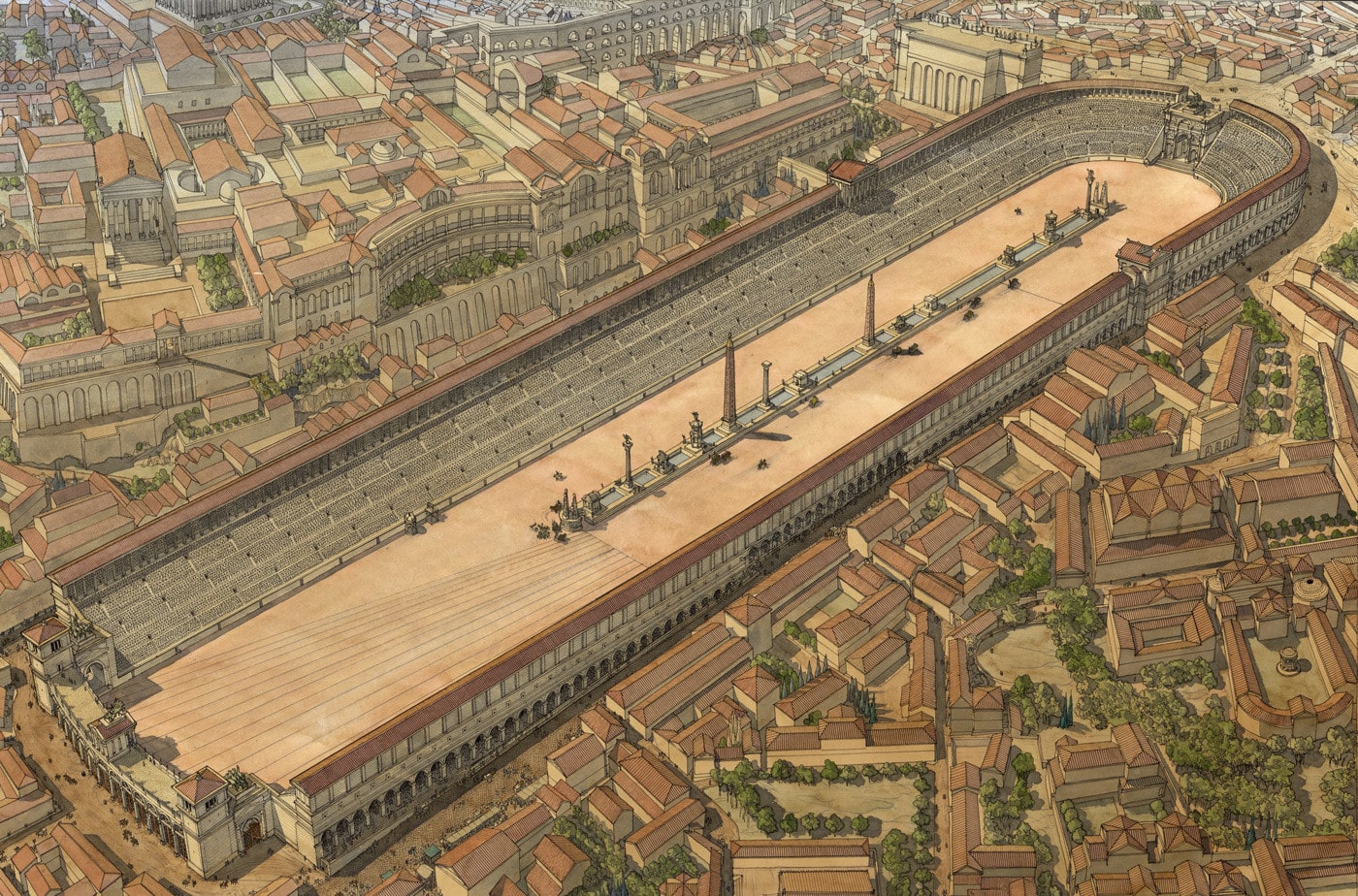
Chariot racing
Races between men on chariots pulled by horses, usually takes place in the Circus Maximus between 4 teams
Circus Maximus
Can hold 250,000 spectators, long oval-shaped stadium
Public Baths
Romans went to the baths each day in the early afternoon. They went to the baths, not just to wash themselves, but also to meet friends and discuss business. There were about 1,000 private baths and 11 public ones. Romans used oil to clean their bodies
Tepidarium (sounds like timid)
Warm room
Caldarium (sounds like scald)
Hot room
Frigidarium (sounds like fridge)
Cold room
Strigil
A curved instrument used to scrape oil and dirt off the body