chromatography
 Call Kai
 Learn
Learn Practice Test
 Spaced Repetition
 Match
Match Flashcards
 Knowt Play
1/43

There's no tags or description
Looks like no tags are added yet.
Name | Mastery | Learn | Test | Matching | Spaced | Call with Kai |
|---|
No analytics yet
Send a link to your students to track their progress
44 Terms
mobile phase
liquid or gaseous fluid percolated through the stationary phase which the mixture is dissolved into
stationary phase
a column consisting of a porous solid matrix
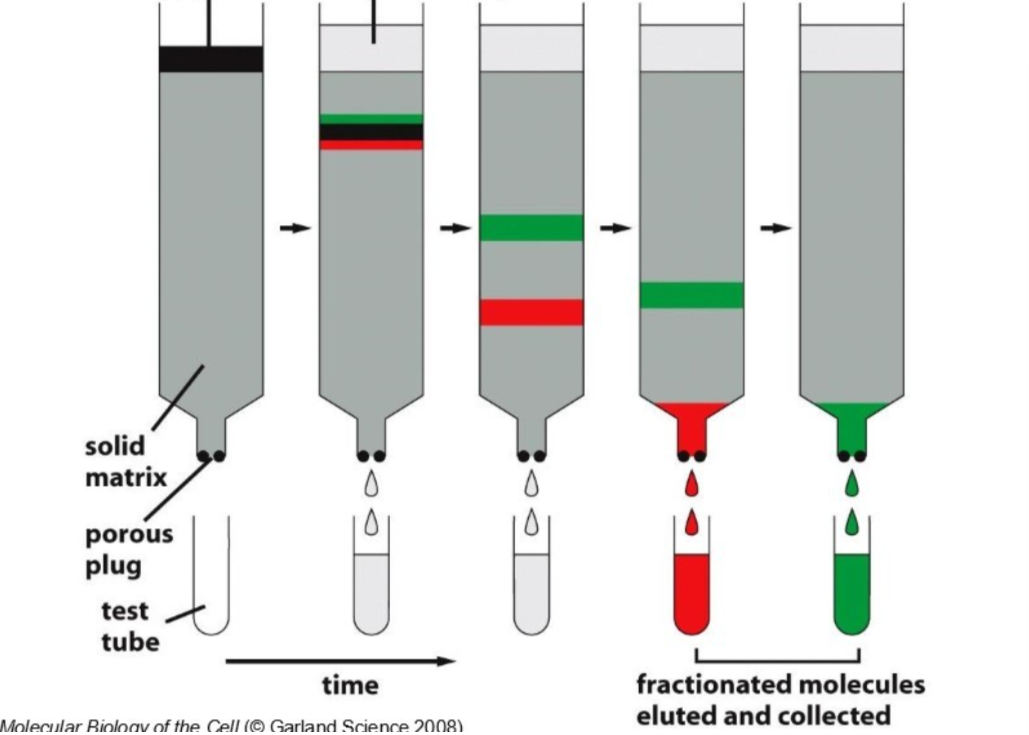
column chromatography
solvent continuously applied to the top of column from a large reservoir of solvent, sample loaded onto the top of the column, as the mobile phase moves down, compounds with a weaker affinity for the stationary phase move down faster and exit the column first where they are collected
stationary phase: solid pourous absorbant materia, usually silica gel or alumina
mobile phase: liquid solvent
how would you separate a mixture by its components’ solubility?
salting in
salting out
how would you separate a mixture based on its components’ ionic charge?
ion exchange chromatography
electrophoresis
isoelectric focusing
how would you separate a mixture based on its components’ polarity
adsorption chromatography
paper chromatography
reverse-phase chromatography
hydrophobic interaction chromatography
how would you separate a mixture based on its components’ molecular size?
dialysis and ultrafiltration
gel elctrophoresis
gel filtration chromatography
ultracentrifugation
how would you separate a mixture based on its components’ binding specificity?
affinity chromatography
ion exchange
ions that are electrostatically bound to an insoluble and chemically inert matrix are reversibly replaced by ions in solution
R+A- + B- ⇌ R+B- + A-
R+A- is an anion exchanger
R-A+ + B+ ⇌ R-B+ + A+
R-A+ is a cation exchanger
ion exchange chromatography
liquid mobile phases is passed through a charged stationary phase, different proteins have different affinity for the ion exchanger depending on their net charges
what factors dictate the affinity of a protein (polyelectrolyte) to an ion exchanger and why
identity and concentration of other ions in solution causing competition
pH because the net charges of acid-base groups vary with pH - when pH<pI +ve, when pH>pI -ve
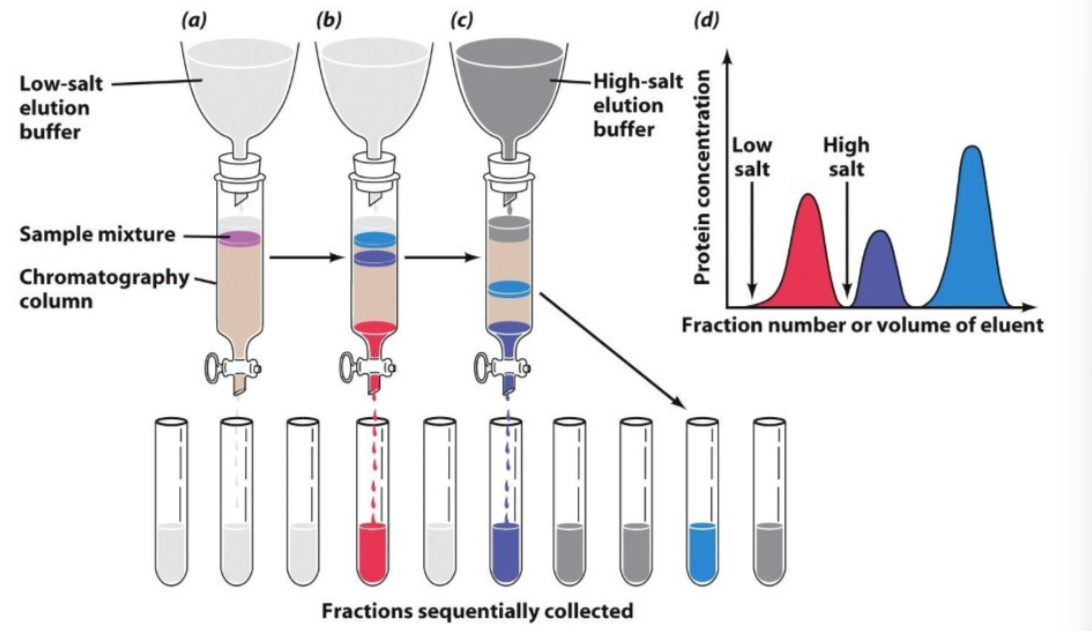
stepwise elution
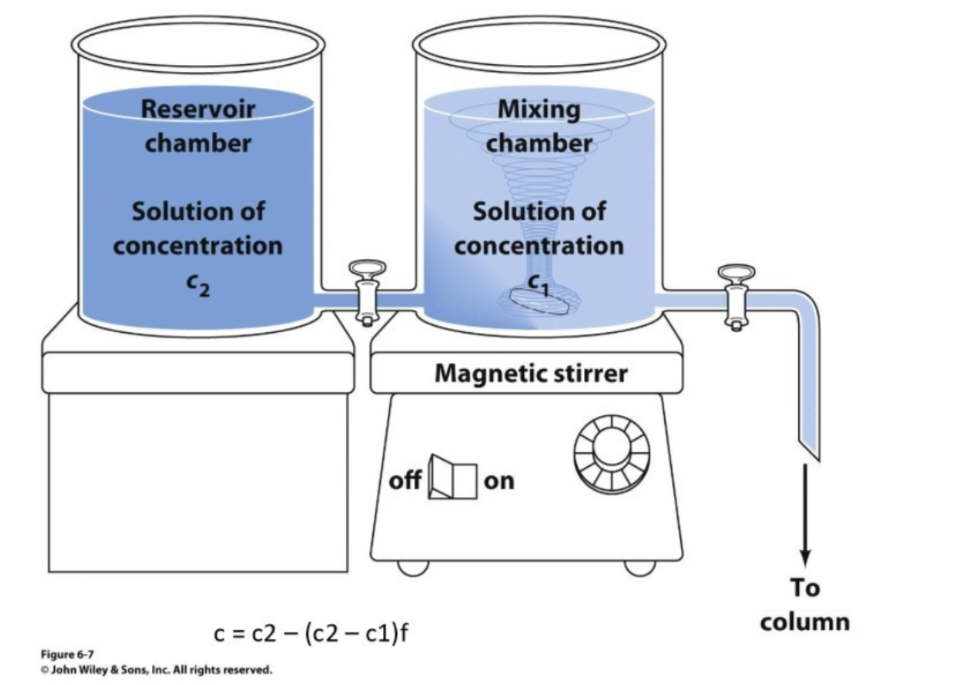
gradient elution
gel filtration/size exclusion chromatography
molecules are separated according to their size and shape, smaller molecules enter the pores of the gel beads of the column and large molcules are eluted in a smaller eluant volume
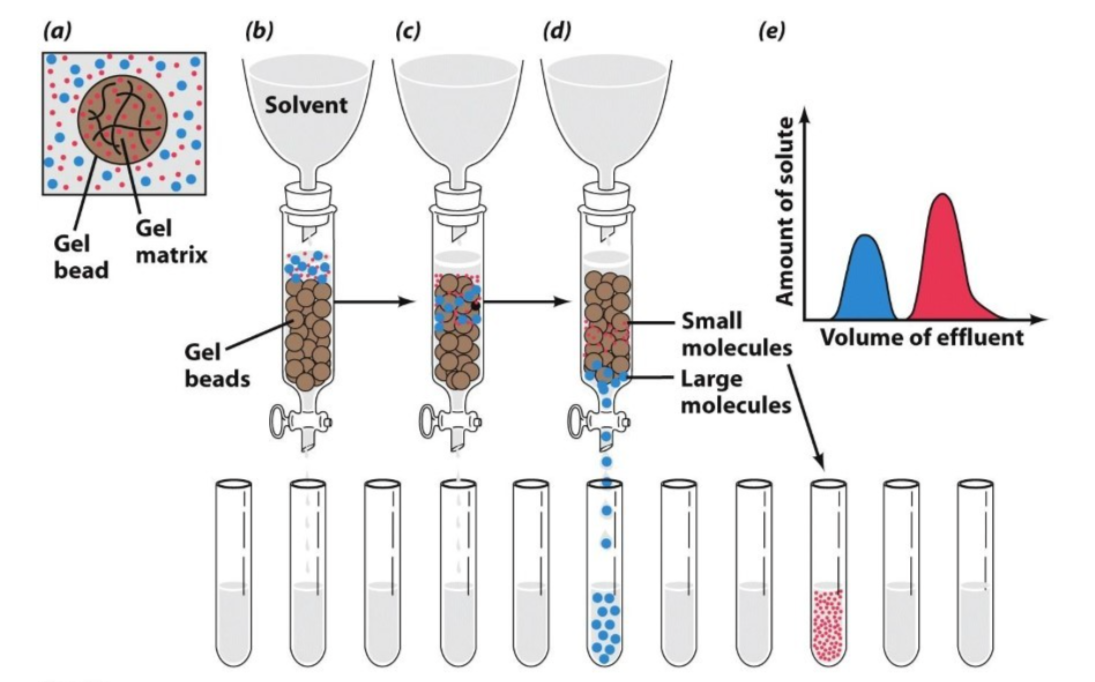
gel filtration/size exclusion chromatography
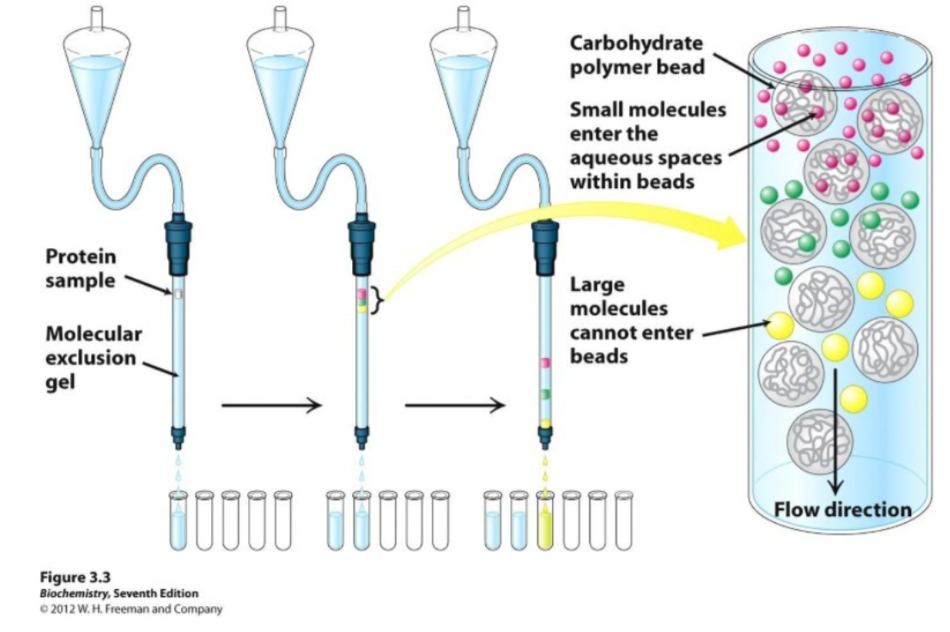
size exclusion chromatography
gel exclusion limit
the smallest molecule unable to penetrate the pores of a given gel
elution volume of a given solute (Ve)
the volume of solvent required to elute the solute from the column
void volume (V0)
the volume of solvent space surrounding the beads - can be easily measured
relative elution volume, what can it be used to estimate?
elution volume/void volume
used to estimate molecular masses of each solute
affinity chromatography
a ligand that binds specifically to a protein of interest is attached covalently to a resin, an impure protein solution is passed through and the desired protein non-covalently binds to the ligand and the others are washed away
the desired protein is then released changing elution conditions
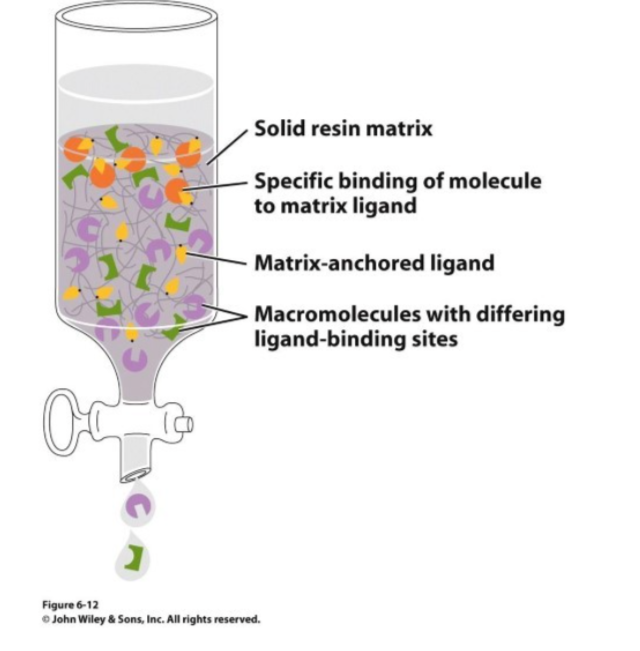
affinity chromatography
immunoaffinity chromatography
type of affinity chromatography, uses antibodies
glutathione-S-transferase
type of affinity chromatography, uses glutathione
insulin affinity chromatography ligand
insulin receptor
glucose affinity chromatography ligand
glucose binding protein
metal chelation affinity chromatography ligand
His-tag and divalent metal ions (Ni2+, Co2+, Zn2+)
reverse phase chromatography
liquid-liquid, used to separate non-polar substances
stationary phase: liquid immobilised on silica beads substituted with C8 and C18 alkyl chains (non-polar)
mobile phase: MORE polar liquid
eluting mixture: less polar liquid
retention time
time at which a compound emerges from the column
factors which effect retention time
hydrophobicity, number of carbon atoms, branched or unbranched, saturated or unsaturated, functional groups
what affect on retention time does hydrophobicity have?
more hydrophobic longer time
what affect on retention time does the number of carbon atoms have?
longer C chain longer time
what affect on retention time does branched/unbranched have?
unbranched takes longer
what affect on retention time does saturated/unsaturated have?
saturated takes longer
what affect on retention time do functional groups/charges have?
neutral polar and charged species elute earlier, then acidic compounds
how can we increase retention time?
add salts to the mobile phase
add more water to mobile phase
lower pH of mobile phase
hydrophobic interaction chromatography (HIC)
separates native proteins by surface hydrophobicity
stationary phase: hydrophilic lightly substituted with hydrophobic groups (octyl or phenyl residues)
how does hydrophobic interaction chromatography work?
hydrophobic amino acid side chains on the surface of proteins will interact with the column, resulting in weak interactions that maintain the native fold of the protein
how is elution achieved in hydrophobic interaction chromatography
progressivey weakening the hydrophobic reactions, e,g. aqueous solutions with decreasing salt concentrations
how is hydrophobic interaction chromatography different to reverse phase chromatography?
ligands in reverse phase chromatography are much more hydrophobic than HIC ligands
therefore we can use more moderate elution conditions in HIC that do not disrupt the sample as much
high performance pressure liquid chromatography
use pumps to apply sample under high pressure, not reliant on gravity
columns made of smaller adsorbent particles (2-50um) giving superior resolving power
pros of HPLC
can use smaller sample amounts
not reliant on gravity and automated
small adsorbent particles give superior resoling power
high speed and sensitivity