2.8-price elasticity of supply
 Call Kai
 Learn
Learn Practice Test
 Spaced Repetition
 Match
Match Flashcards
 Knowt Play
1/24

Earn XP
Description and Tags
Name | Mastery | Learn | Test | Matching | Spaced | Call with Kai | Chat |
|---|
No analytics yet
Send a link to your students to track their progress
25 Terms
Definition of price elasticity of supply
Responsiveness of quantity supplied of a product followiing a change in its price Elasticity of Supply = % change in Quantity supplied/ % change in Price

why is PES positive when price increases?
Due to the law of supply which dictates that the relationship between price and supply is positive.
Firms will increase production as price increases.
what happens when the price of a good rises or falls?
it leads to an extension in supply-movement up or down the supply curve
inelastic meaning
quantity supplied doesn't change much price changes more. Firms find it difficult to change production in a given time period due to a change in the market price.
what is elastic supply?
when the percentage change in quanitity supplied is greater than the percentage change in price (supply changes more than price) eg producers can quite easily increase supply without a time delay if there is an increase in the price of the product. This can help usch firms gain a competitive advantage as they are able to respond to changes in price.
factors affecting elasticity of supply
-ease of storage-if stores of a product can be kept easily supply will be more elastic
-time to train workers-if more time taken to make product mroe inelastic
-time to order machines
-Number of producers in the industry
-harvesting
-Degree of spare productive capacity
-are goods perishable-if can be kept for longer periods of time than more elastic
-Level of stocks and supply of raw materials
-cost of increasing supply-the less constantly it is to increase supply,the more elastic supply will be
-ease and cost of factor substitution:
how does degree of spare productive capacity affect elasticity of supply?
if a firm has plenty of spare capacity it can increase supply with relative ease,without increasing its cost of production-supply would be relatively price elastic. In general supply is highly elastic during an economic recession when there are spare (unused) resources such as land,capital and labour
how does level of stock affect supply elasticity?
If a firm has unused raw materials,components and finished products (collectively known as stocks or inventories) that are available for use, then the firm is more able to respond quickly to a change in price as it can supply these stocks on to the market. Raw amterials and componenets can also be used in the production process. If the stocks are easy to store and not perishable it will be easier to icnrease hteir supply if hteri price increases. The higher the levels of stocks of finished goods ready for sale, the more elastic supply tends to be.
how does number of producers in the industry affect elasticity of supply?
the more suppliers of a product there are in an industry the easier it tends to be for firms to increase their output in response to a price increase. eg there is plents of competition in the restaurant trade so suppliers will be highly responsive to increases in price. Teh greater the number of firms in an industry the more price elastic supply tends to be. The greater the barriers to entry in an industry means few suppleirs so supply price inelastic.
how does time affect ealsticity?
if a product is hard to produce quickly (eg book) it will be perfectly inelastic supply at a moment in time. In the short term it may not be possible to increase supply as they cant change factor input quickly like size of work force or fixed amount of capital equiptment they employ -relatively inelastic.In the longer term it may be possible to increase supply further by aquirign mroe machinery and equitment-elastic. The longer the period of time the more elastic supply is in response to a price change-supply inelastic in short run but mroe elastic in long run
How does ease and cost of factor substitution affect elasticity of supply?
This refers to the extent to which it is possible to introduce factor resources to the production process. If capital and labour are occupationally mobile, they can be subsitited easily in production process. Ease of factor subsitititon makes supply hgihly price elastic eg capital in publishign company.If capital and labour cant be switched as the produciton process is inflexible PES will be very low.
hwo does elasticity affect consumers and producers?
when elasticity of supply is relatively high producers will be able to icnrease supply quickly when prices rise.When supply is relatively inelastic consumers won't be able to access extra supplies in times of high demand and so will experience rising prices. An increase ind emand can lead to supply shortages.
what do stocks/inventories mean?
Stocks (or inventories) are the raw materials, components and finished goods (ready for sale) used in the production process
how does an icnreas ein price affect producers?
the riased price gives producers incencitives to increase supply
PES=infinity
represents perfectly price elastic. The quantity supplied can change without any corresponding change in price. eg software developer selling products online can very easily increase supply to match higher levels of demand, without any impact on the rice level. Due to the spare capacity that exists, suppliers are able to raise output at the current price level. Any decrease in the price would cause supply to fall to zero.
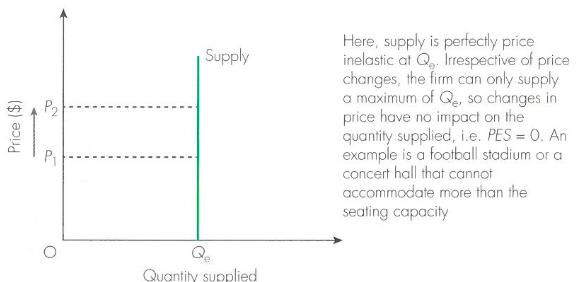
PES=0
represents perfectly price inelastic.Quantity supplied will remain constant regardless of the change in price. Suggests there is absolutely no spare capacity for suppliers to raise output,irrespective of increases in price.
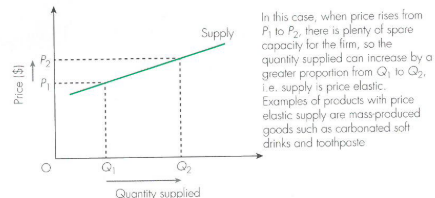
1 PES> (more than 1)
represents relatively elastic supply. This means that supply is heavily responsive to a change in price, and as price increases firms can quickly and easily start supplying more. % chnage in quantity supplied greater then the % change in price.
Supply tends to be mroe elastic at lower prices
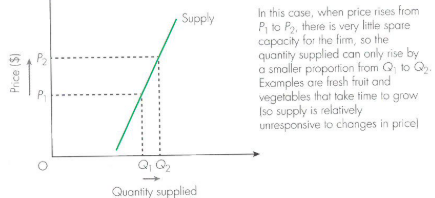
1 PES< (less than 1)
represents relatively inelastic supply. This means supply is relatively unresponsive to a change in price, and firms find it difficult to quickly increase supply if price increases. This is because %change in quantity supplied is less then % change in price
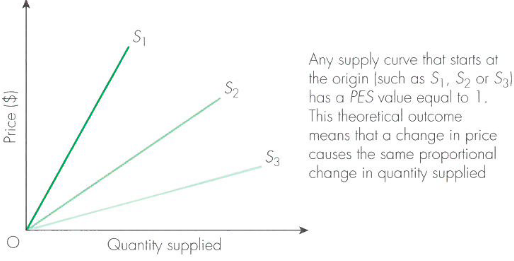
PES=1
Supply is unitary elastic. The percentage change in price will equal the same percentage change in quantity supplied. Any upward sloping supply curve that starts at the origin will have unitary price elasticity.
Examples Perfectly Elastic Supply
Usually non necenessary goods liek gum and 5KD note
Examples Perfectly Inelastic Supply
Eg agricultural products from plants are perfectly inelastic in supply for a year quantity doesn't change,price changes.Seats for a show as quanitty cant change
Why is it preferable for firms to have high PES?
Firms want to have a high PES as this means they can respond quickly and benefit from changes in price.
This will make the firm more competitive and generate more sales revenue and profit.
How can firms become more responsive to changes in market price?
-Creating spare capacity.
-keeping large volumes of stock
-Improving storage systems to prolong the shelf life of products
-Using latest technology.
-Developing and training workers to improve labour occupational mobility (to perform a range of jobs)
-Imporving distribution/delivery systems (how the product gets to the customer)
why is inelastic PES bad for economy?
Inelastic PES means that higher demand for a product simply causes a significantly higher increase in price, as producers can’t respond immediately by supplying more on the market. This increases profit margins but does not necessarily benefit the economy if there is competition (alternative suppliers) form overseas firms.
Why is the government interested in PES?
-The government may want to know who is going to be effected by taxes. If PED is higher than PES, then producers will pay more of the tax. If PES is higher than PED, then consumers will pay more of the tax.
-Governemnts are interested in PES in labour market which helps explain differences in wages. They can also decide to reduce regulation on hiring/firing workers; this makes it easier for firms to be flexible. Governemnt may also seek to encourage an inflow of migrant workers, to help relive shortages of labour and improve the PES int eh labour market.
-if PES of a necessity such as housing eq higher property taxes due to inelastic supply of houses whihc widens the wealth gap between those who can afford to own a hosue but those who cant. Teh governemnt may then need ot intervene in the market to ensure everyone has access to affordable housing.