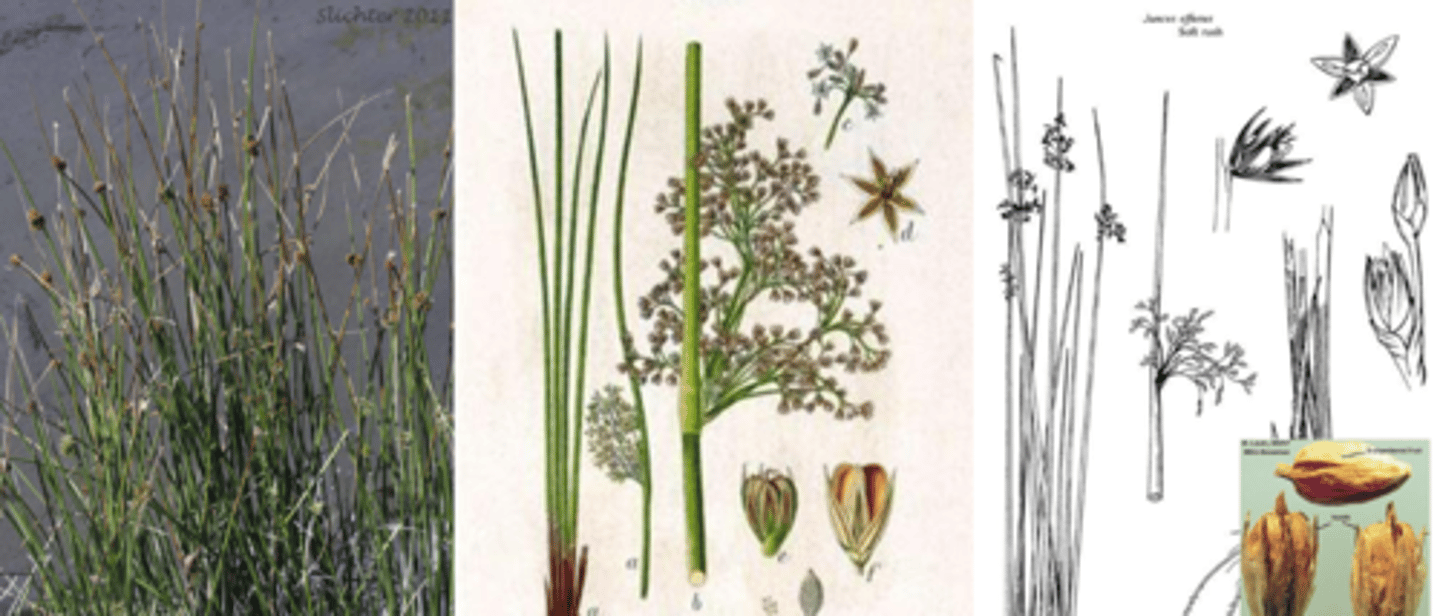
RMF Exam 3 General Families/Genus to Know
 Call Kai
 Learn
Learn Practice Test
 Spaced Repetition
 Match
Match Flashcards
 Knowt Play
1/45

There's no tags or description
Looks like no tags are added yet.
Name | Mastery | Learn | Test | Matching | Spaced | Call with Kai |
|---|
No analytics yet
Send a link to your students to track their progress
46 Terms
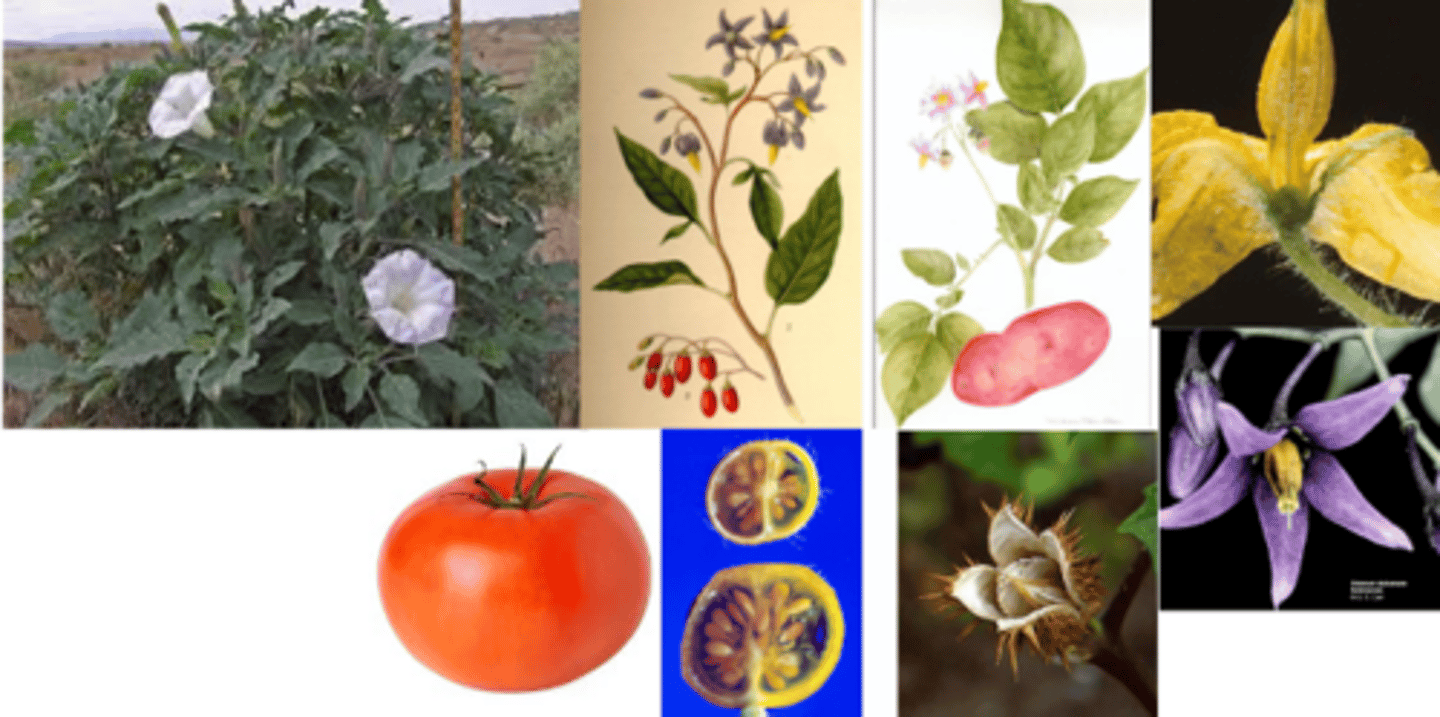
Solanaceae - Nightshade or Potato family
(contains genus Solanum)
What family has these characteristics?
1) Alternate
2) Regular
3) Variable
4) Berry or Capsule
Food crops (economic importance):
- tomato, potoato, etc...
Has specialized anti-herbivore compounds (glycoalkaloids)
Gynoecium:
2, connate => 1 style
ovary superior
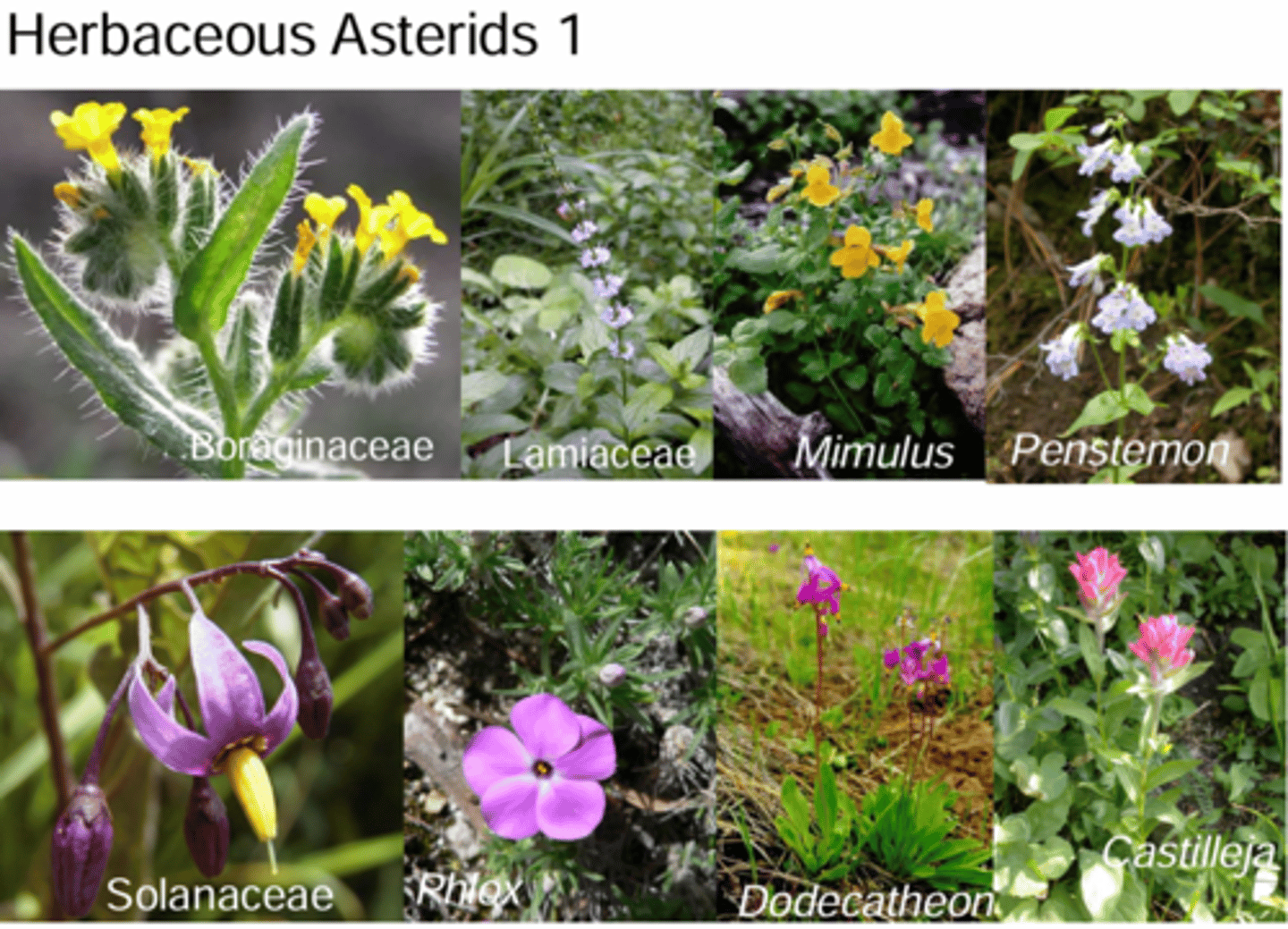
Shared Features:
- 5-parted tubular corollas
- 4-5 stamens (often epipetalous)
What are the Shared Features of the First Group of Herbaceous Astrids?
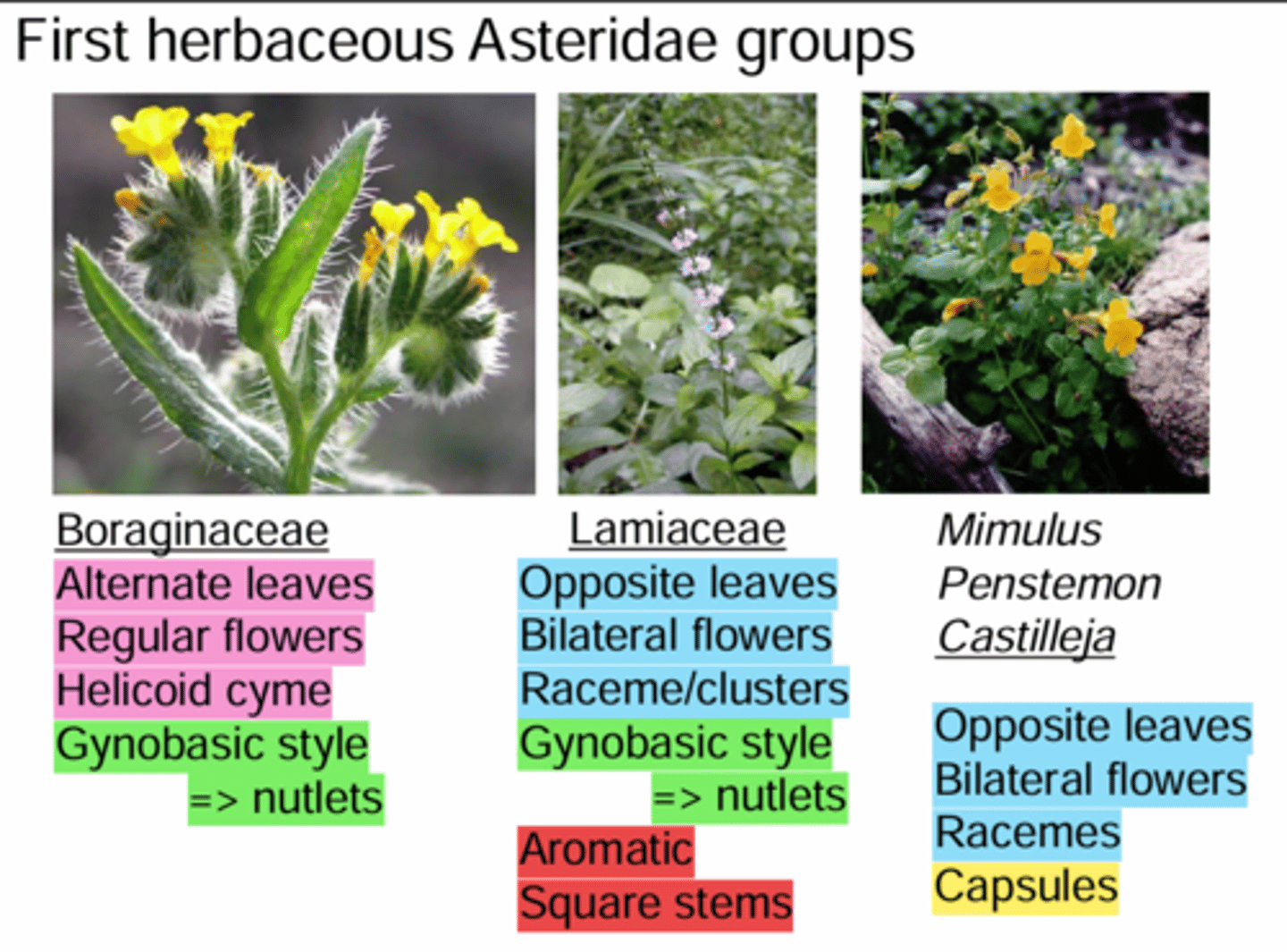
Distinguishing Features useful for ID:
- opposite vs. alternate
- bilaterally vs. radially symmetric
- fruit types (nutlets, capsules, berries)
- inflorescence types shape (sometimes...)
- distinctive traits (e.g., beardtongue, square stems, etc.)
What are the Distinguishing Features of the First Group of Herbaceous Astrids?
Former "Scrophulariaceae" include these genera:
- Mimulus
- Penstemon
- Castilleja
What former family has these characteristics?
What genera used to belong in this family?
1) Opposite Leaves
2) Bilateral Flowers
3) Racemes
4) Fruit = Capsules
Often Epipetalous Stamens
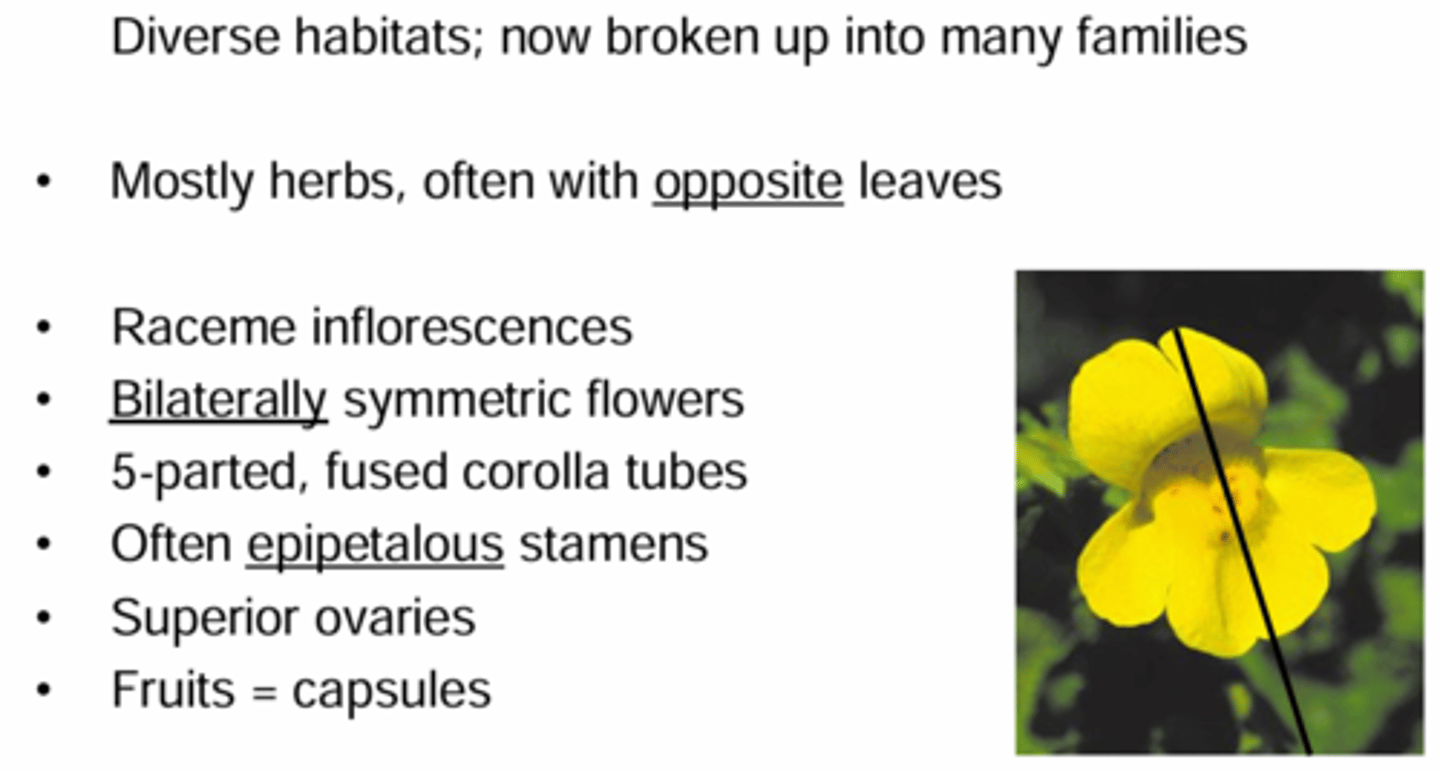
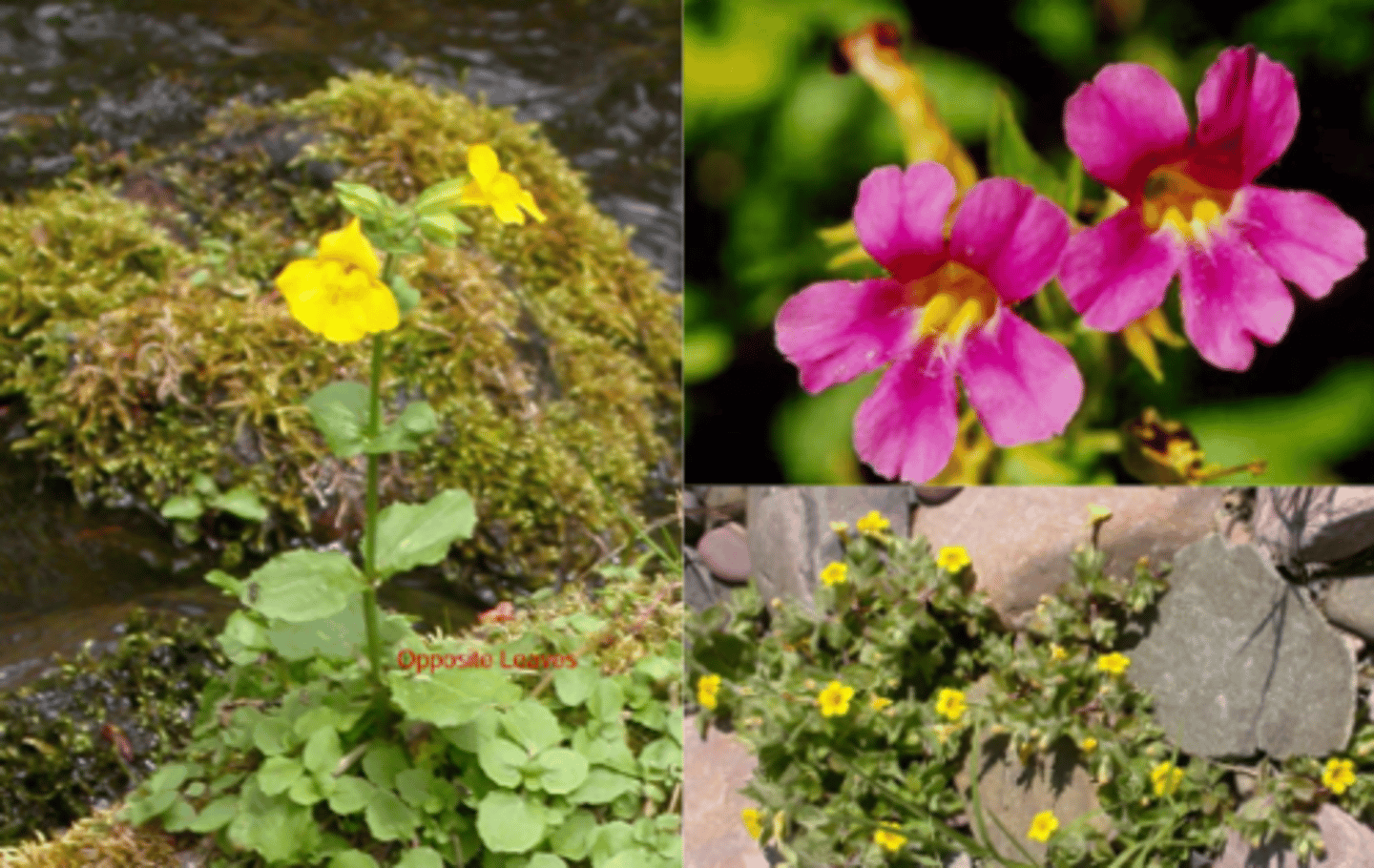
Mimulus – Monkeyflowers
(Former genera within Scrophulariaceae, now in Phrymaceae)
What gennus has these characteristics?
Mostly found in very wet areas
Model system for adaptation genomics (has life history and mating system variation)
Touch-sensitive Stigmas
1) Opposite Leaves
2) Bilateral Flowers
3) Racemes
4) Fruit = Capsules
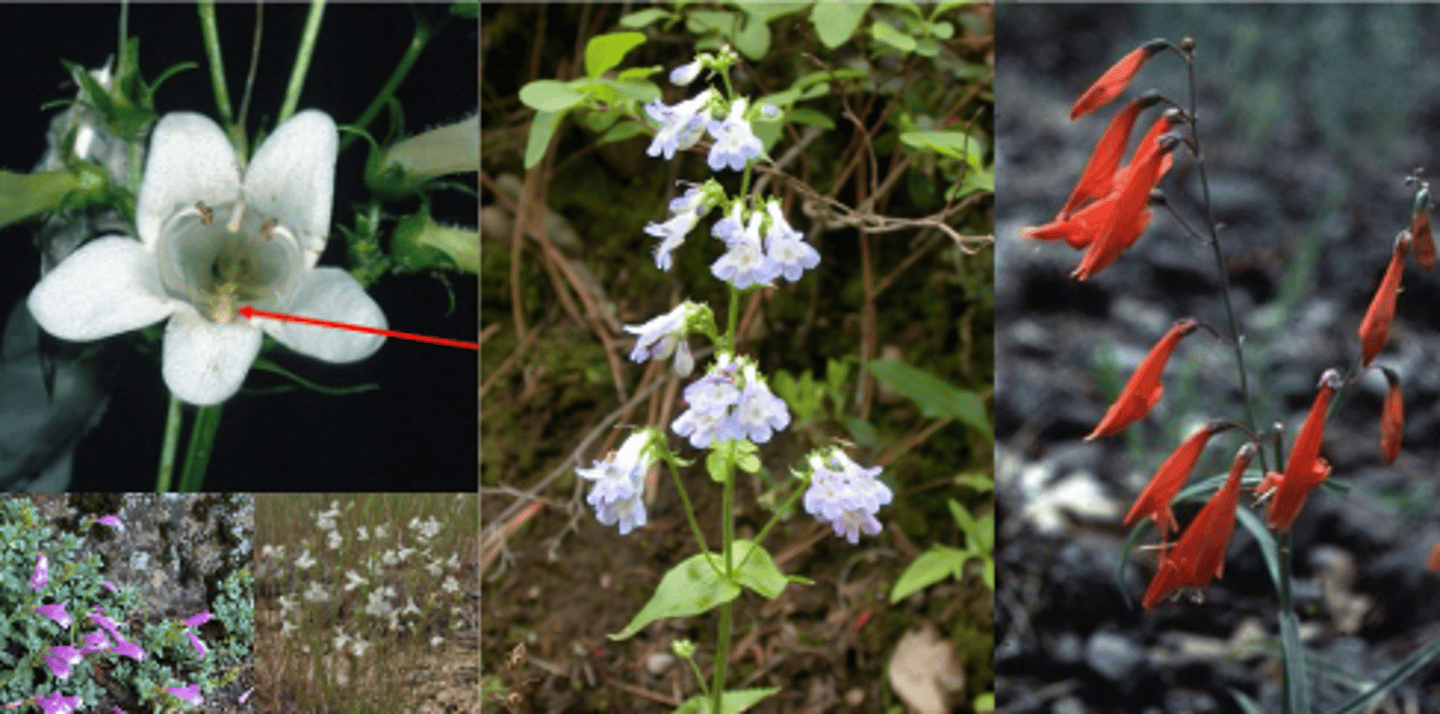
Penstemon – Beardtongue
(Former genera within Scrophulariaceae, now in Plantaginaceae)
What gennus has these characteristics?
Found in Drier or Alpine areas
Sterile Filament with Hairs = Beardtongue
1) Opposite Leaves
2) Bilateral Flowers
3) Racemes
4) Fruit = Capsules
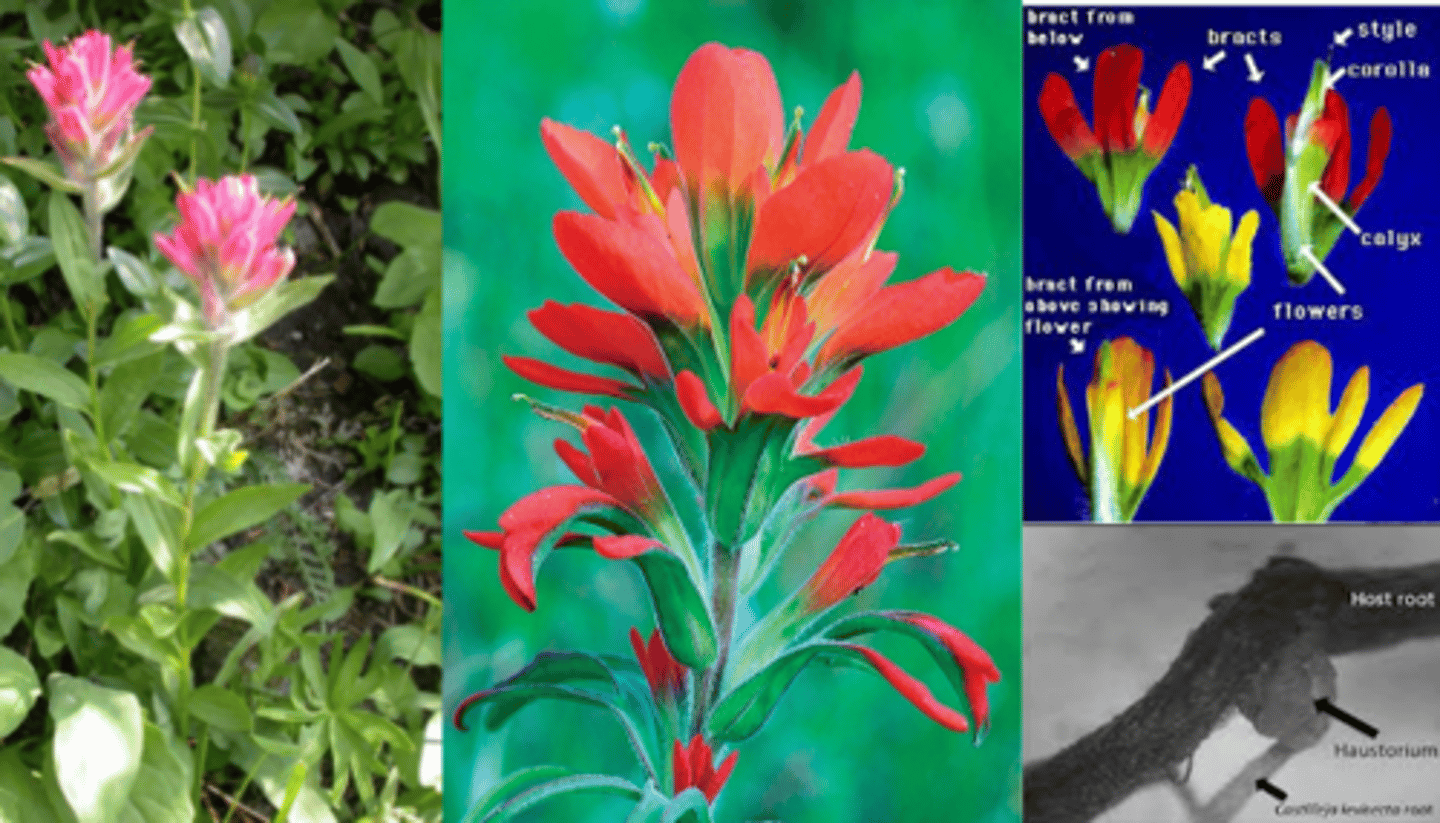
Castilleja - Paintbrush
(Former genera within Scrophulariaceae, now in Orobanchaceae)
What gennus has these characteristics?
Hemi-parasitic perennial herbs - steal sugars from host plants by attaching to roots
Colorful Bracts and Reduced Flowers (petals not showy/colorful)
Linear or pinnately divided leaves
Leaves may be opposite or alternate - distinguishing from rest of former Scrophulariaceae
1) Alternate or Opposite Leaves
2) Bilateral Flowers
3) Racemes
4) Fruit = Capsules
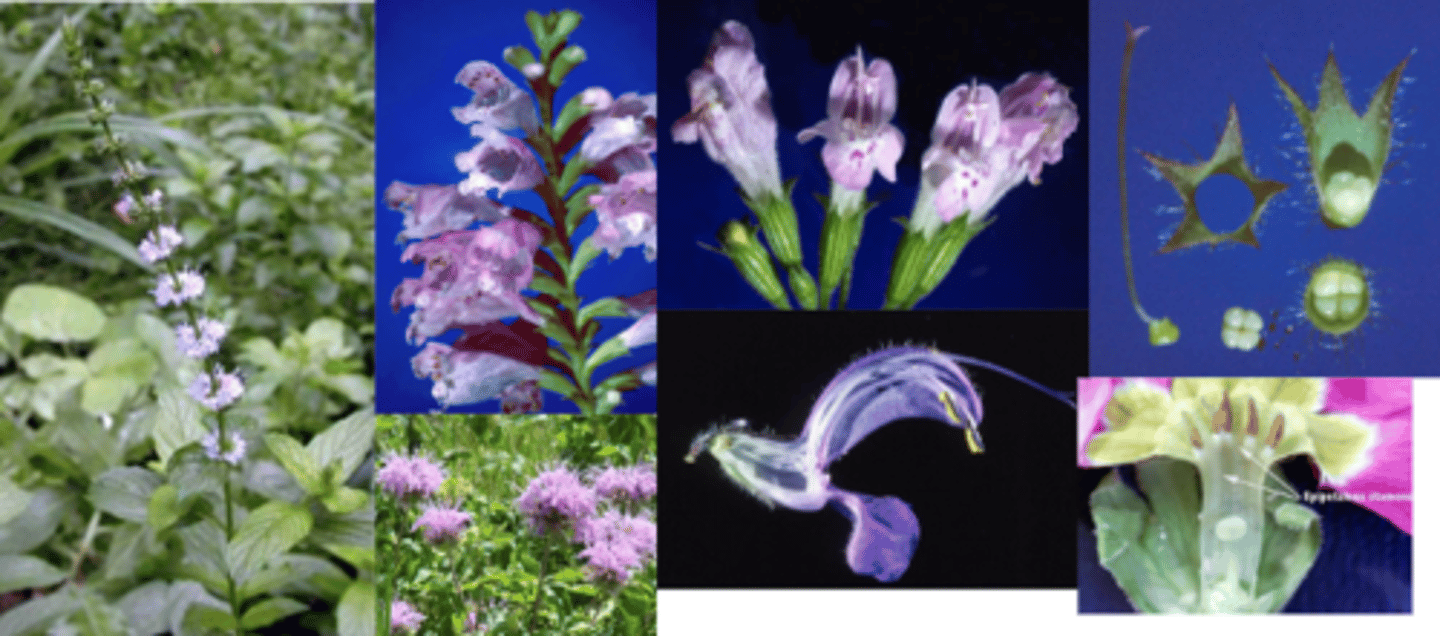
Lamiaceae - Mint family
(contains genus Agastache)
What family has these characteristics?
1) Opposite Leaves
2) Bilateral Flowers
3) Racemes/Clusters
4) Gynobasic Style (Fruit = Nutlets)
6) Aromatic (often minty)
7) Square Stems
Gynobasic Style = 2 fused carpels, but it looks like there are 4 (it is 4 segments made from 2 carpels)
Epipetalous stamens: filaments adnate (fused) to the inside of the corolla tube
Corolla 5-lobed, often 2-lipped (has landing pad)
(5,5, 4)
Leaves are often Dentate
Racemes that are often Tired
Axillary Clusters w many flowers per node
Petals and Sepals Connate
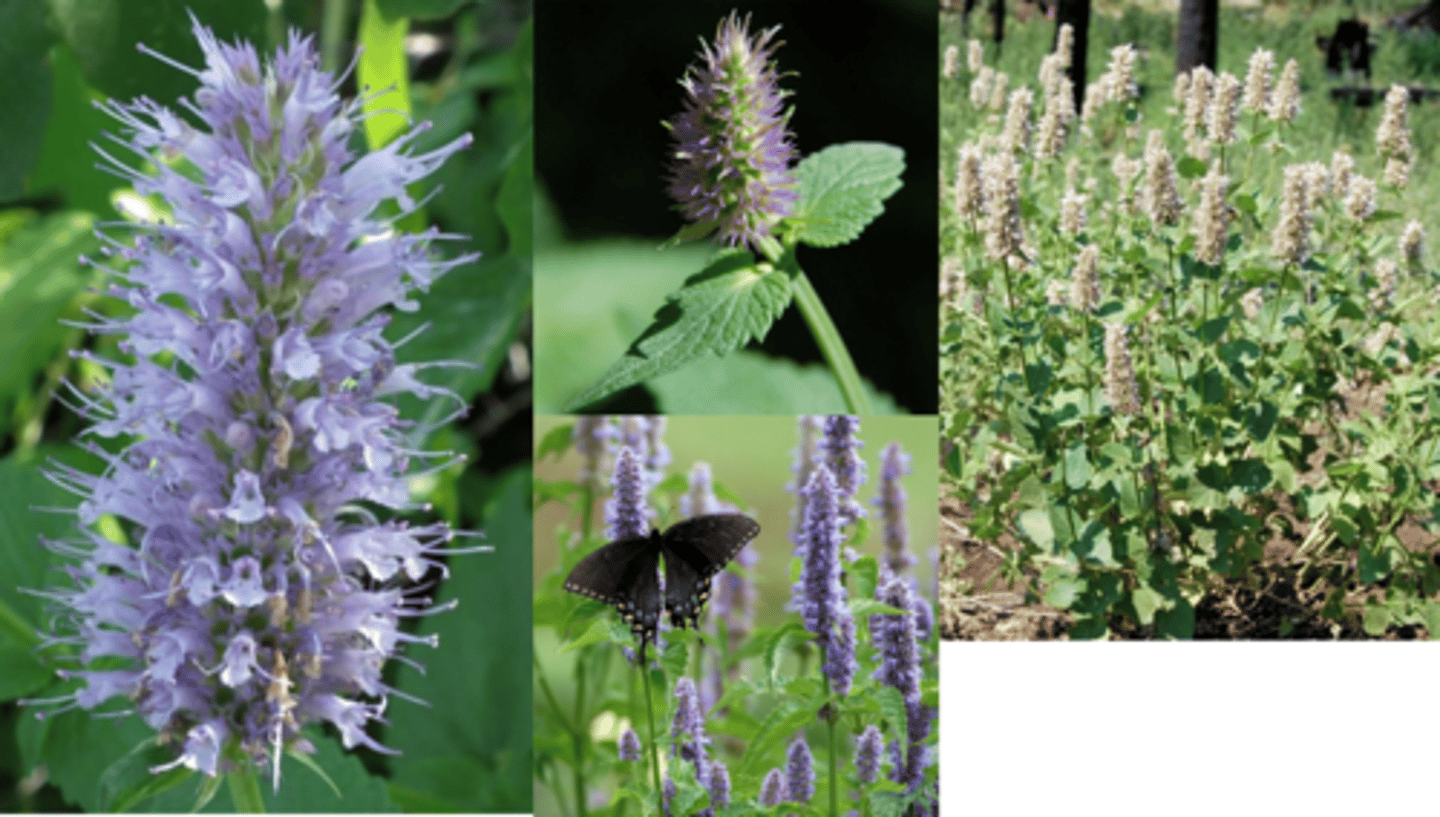
Agastache - Hyssop
(genus within Lamiaceae)
What genus has these characteristics?
Flowers in Terminal Spike (whorled)
Aromatic skunky rather than minty
Vegetative and floral characteristics typical of Lamiaceae family...Epipetalous stamens and Gynobasic Style
1) Opposite Leaves
2) Bilateral Flowers
3) Racemes/Clusters
4) Gynobasic Style (Fruit = Nutlets)
6) Aromatic (shunky)
7) Square Stems
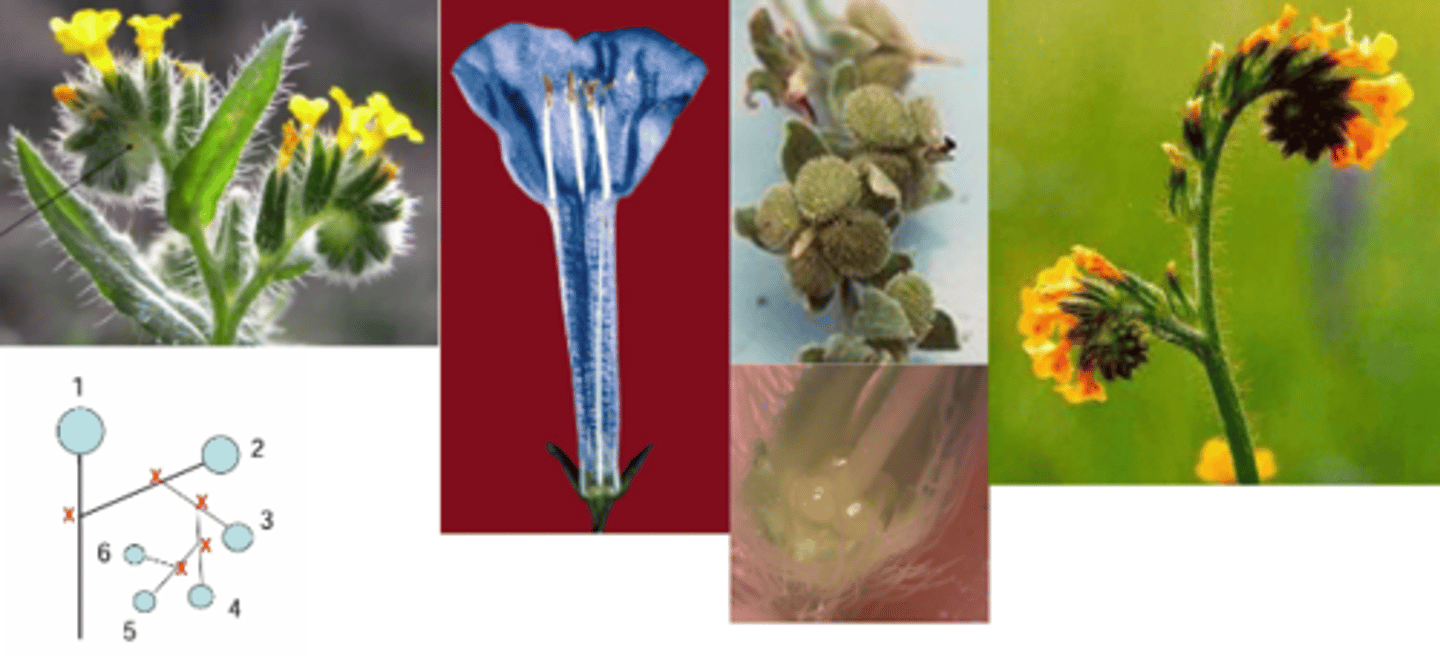
Boraginaceae - Borage family
(contains genus Myosotis)
What family has these characteristics?
1) Alternate Leaves
2) Regular Flowers
3) Helicoid Cyme
4) Gynobasic Style (Fruit = Nutlets)
Gynobasic Style = 2 fused carpels, but it looks like there are 4 (it is 4 segments made from 2 carpels)
(5, 5, 5, 2)
Lives in Wet areas
Hairy Leaves
Connate petals
Tube Type Variable
Epipetalous Stamen
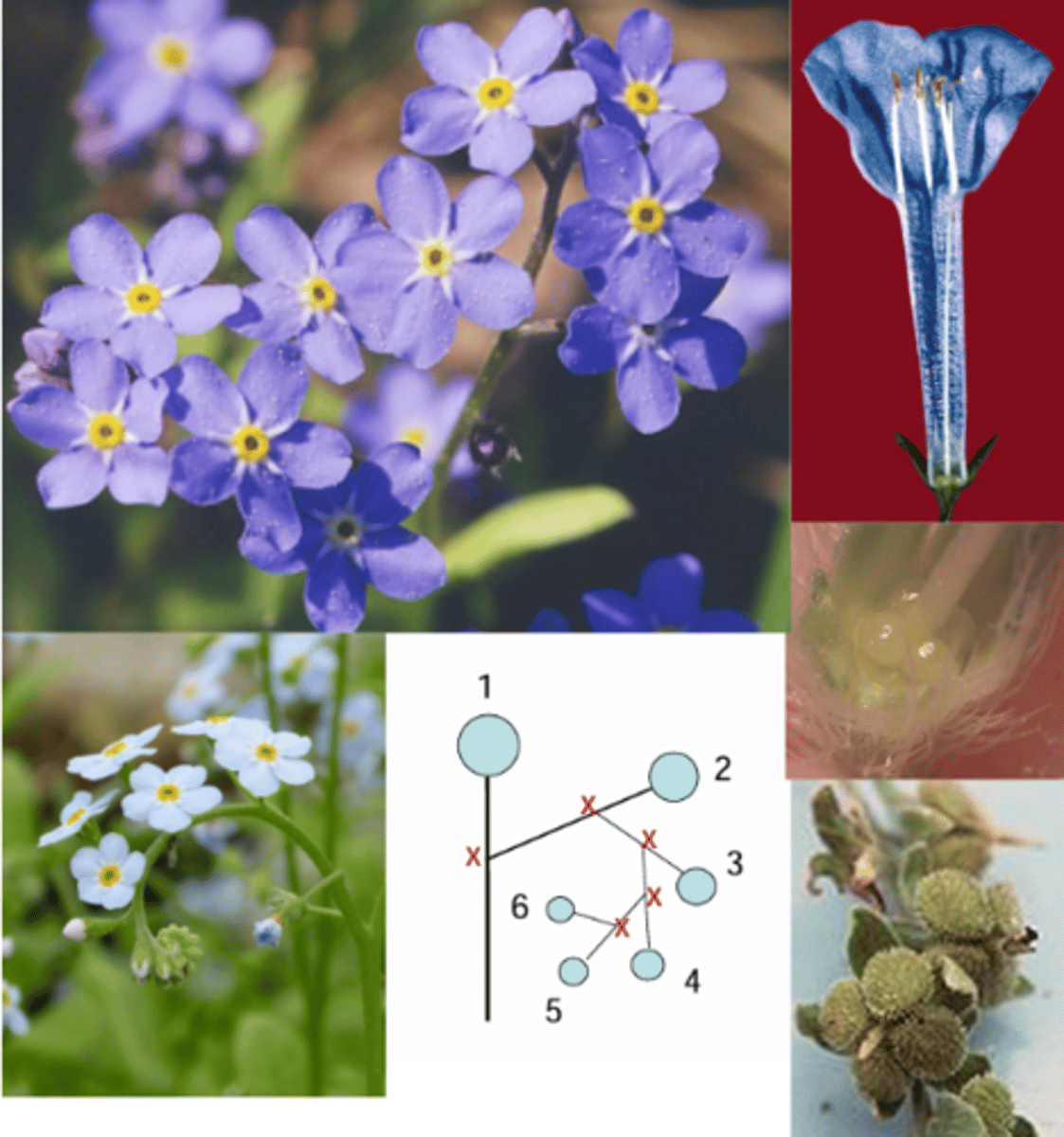
Myosotis - Forget-me-not
(genus within the Boraginaceae family)
What genus has these characteristics?
salverform flowers < 1/2 inch across
usually blue w/ contrasting eye
Often grows in wet areas (even right in streams)
1) Alternate Leaves
2) Regular Flowers
3) Helicoid Cyme
4) Gynobasic Style (Fruit = Nutlets)
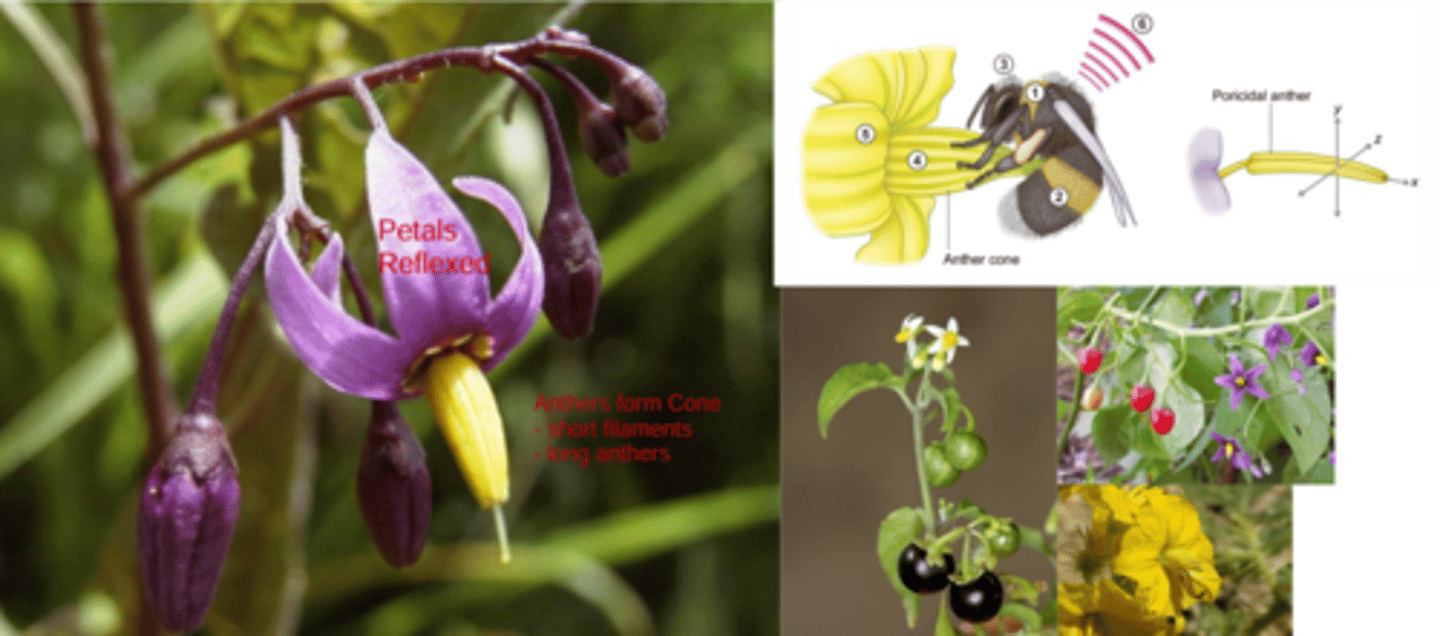
Solanum - Nightshades
What genus has these characteristics?
Reflexed Petals
Anthers form a cone (short filaments, long anthers)
Buzz Pollination (pollen only released from pores when anthers are “buzzed” or vibrated at right frequency by native bees)
The rest of the characteristics are typical of family:
1) Alternate
2) Regular
3) Variable
4) Berry
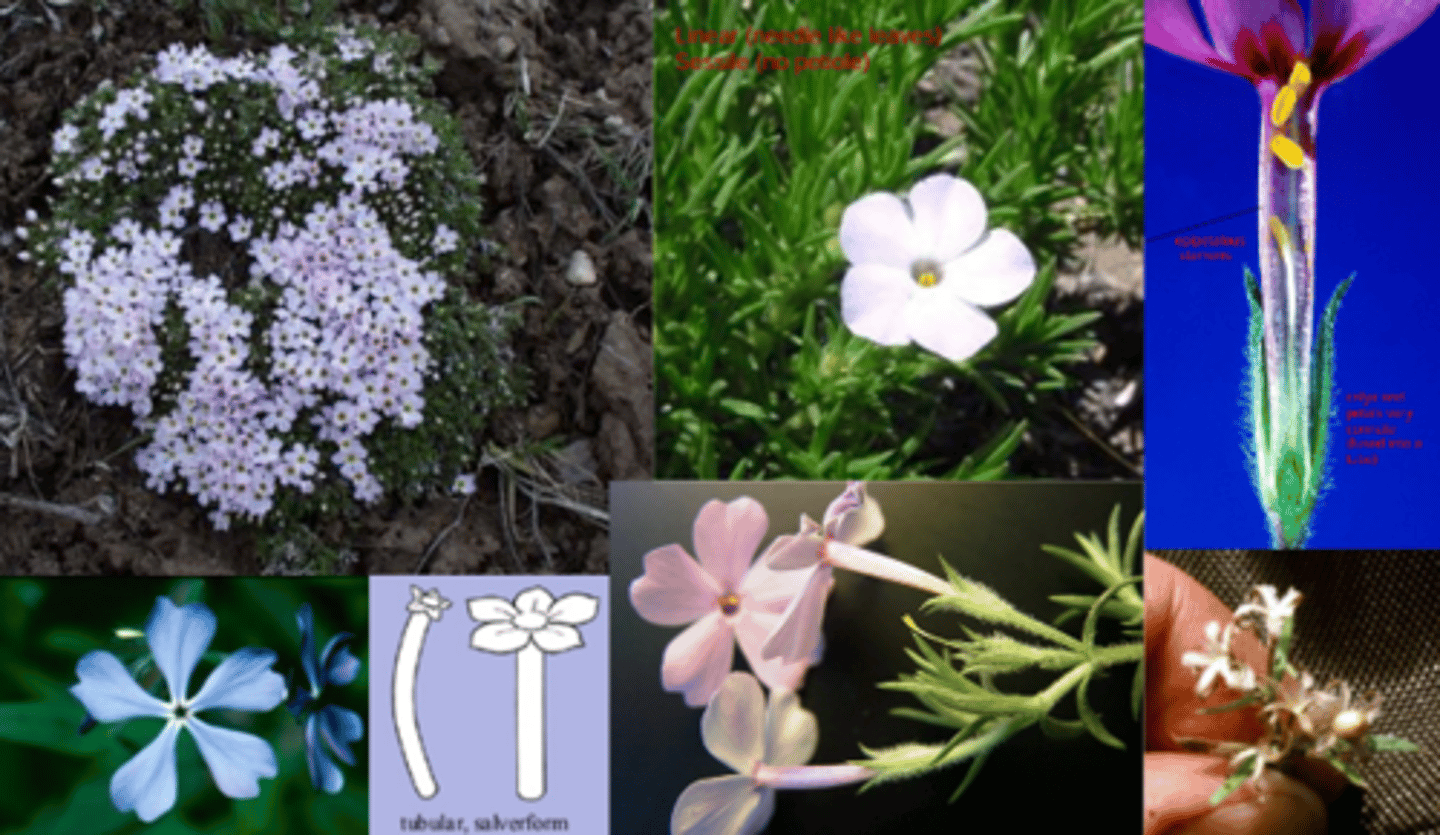
Phlox:
(within the family Polemoniaceae)
What genus has these characteristics?
mat-forming herbs “cushion plants”
Leaves: opposite, simple, often linear (needle-like), often sessile (no petiole)
Corolla tube long and narrow
Corolla salverform = straight then sideways
Corolla Convolute (twisted) in buds
3 fused carpels, 1 style
Fruit = Capsule (often explosively dehiscent)
Infl: solitary or raceme
Radially Symetric, Bisexual
(5, 5, 5, 3)
Epipentulous Stamen
Found in grasslands or alpine rocky areas
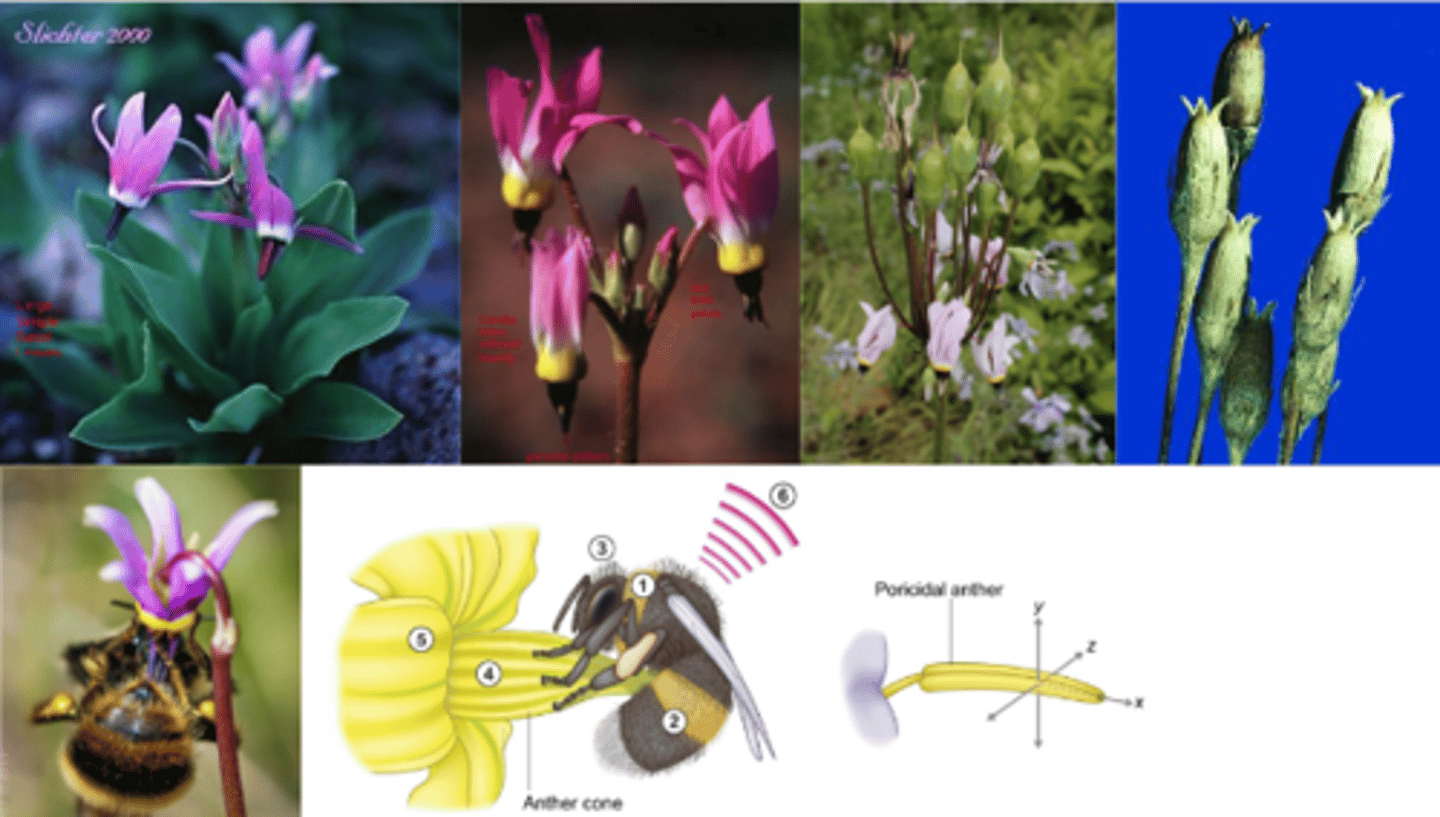
Dodecatheon - Shooting Star
(Genus within Primulaceae)
What genus has these characteristics?
Leaves: large, simple, entire, basal
Inf: solitary or umbel (small clusters/umbels)
Radially Symmetric Flower
Flower often two-toned
Corolla Lobes Reflexed and Poricidal Anthers adapted for Buzz Pollination (convergently evolved like Solanum)
(5, 5, 5, 5)
5 fused carpels
Fruit = Capsule
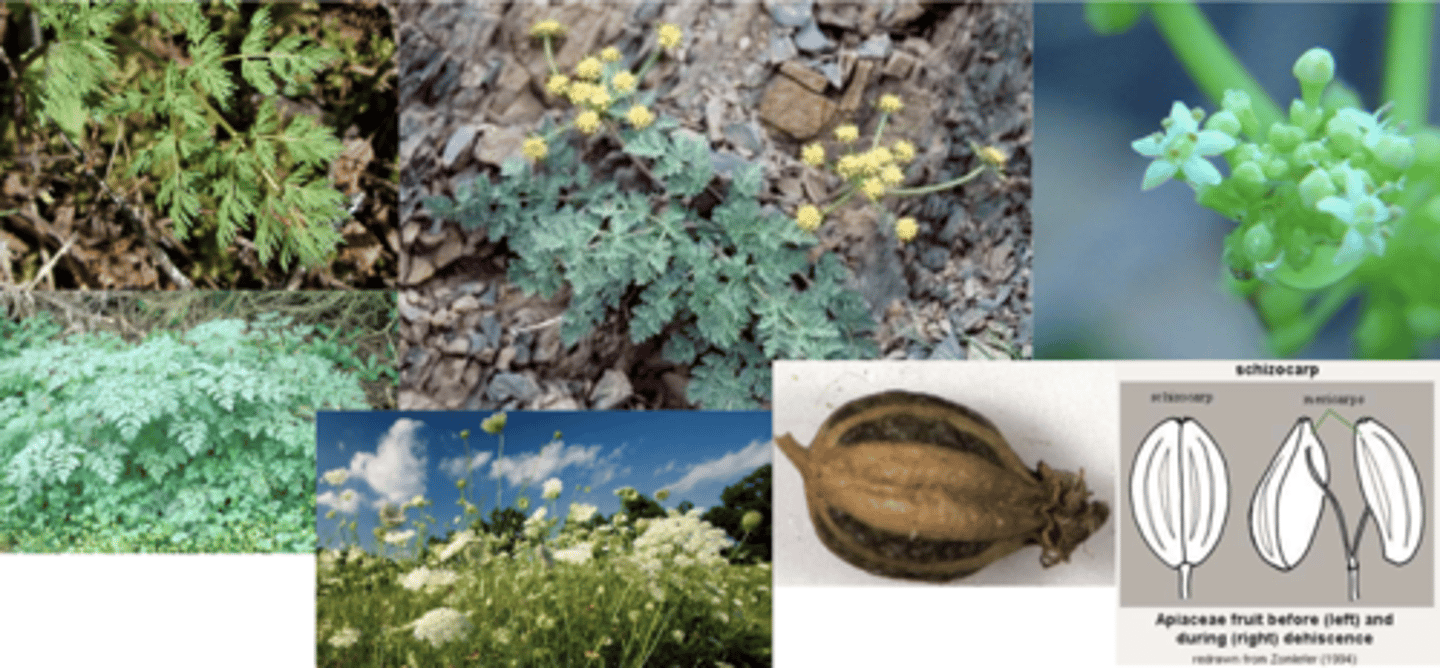
Apiaceae - Carrot Family
(contains genus Lomatium)
What family has these characteristics?
Has specialized anti-herbivore defensive compounds – furanocoumarins
Pinnately Compound Leaves (often 2-3x => 'ferny')
Flowers Tiny, not very showy individually
Always have Umbel (often compound)
1) Alternate or basal
2) Regular
3) Umbel
4) Fruit = Schizocarp
Fruit = Schizocarp
(splits into two 1-seeded achene-like fruits/two achenes
Lomatium - Biscuitroot
(genus within Apiaceae)
What genus has these characteristics?
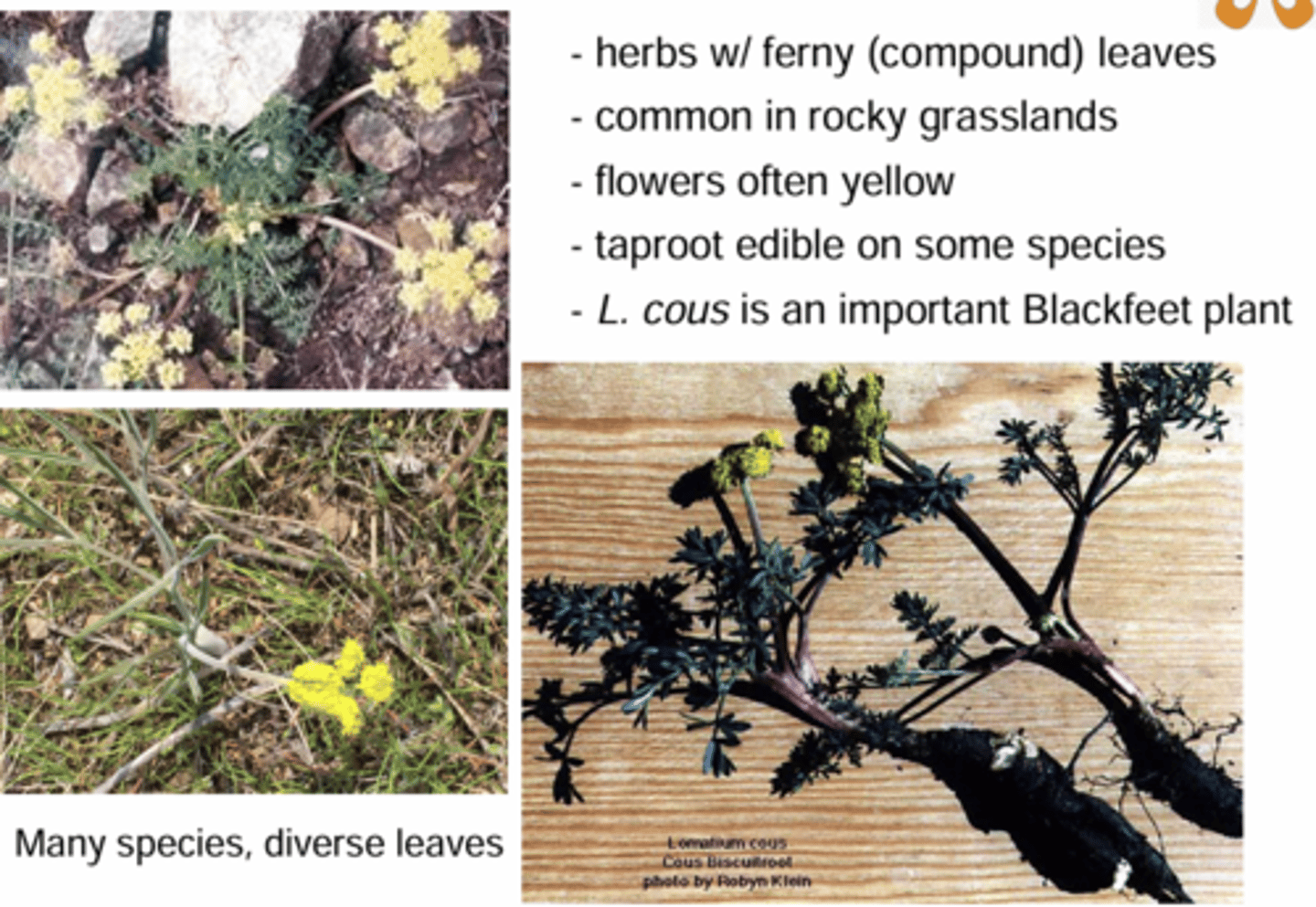
- herbs w/ ferny (compound) leaves
- common in rocky grasslands
- flowers often yellow
- taproot edible on some species
- L. cous is an important Blackfeet plant
- often low growing
Apiaceae Characteristics:
1) Alternate or basal
2) Regular
3) Umbel
4) Fruit = Schizocarp
Asteraceae - Aster or Composite family
(contains genera: Balsamorhiza, Centaurea, and Artemisia)
What family has these characteristics?
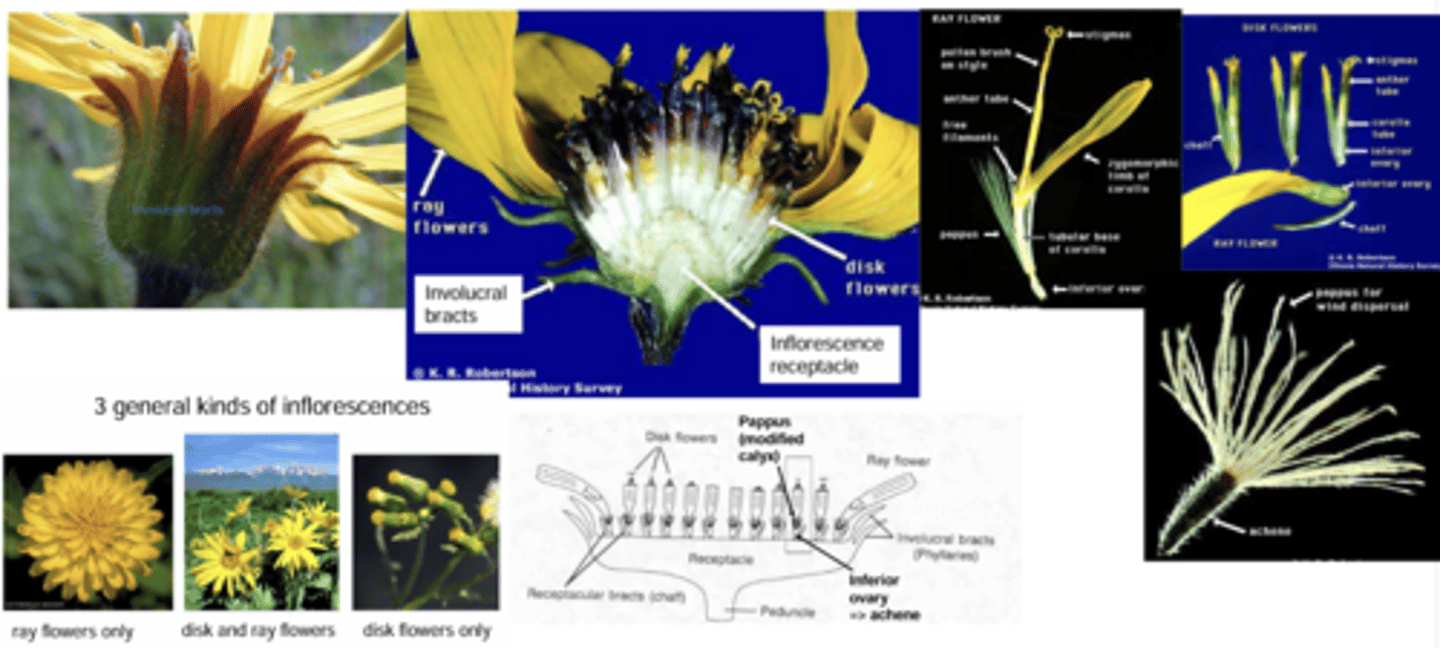
Inflorescence = a head with involucral bracts (head made up of many flowers, bracts on bottom).
3 kinds of inflorecences:
- Ray flowers only
- Disk and Ray Flowers
- Disk flowers only
2 general kinds of flowers within composite heads:
- disk flowers (radially symmetric, in center)
- ray flowers (irregular, often sterile Involucral bracts = “petals” but an entire flower)
Fruit = Achene
(often a achenes per flower with many pappus)
Balsamorhiza - Balsamroot
(genus within Asteraceae)
What genus has these characteristics?
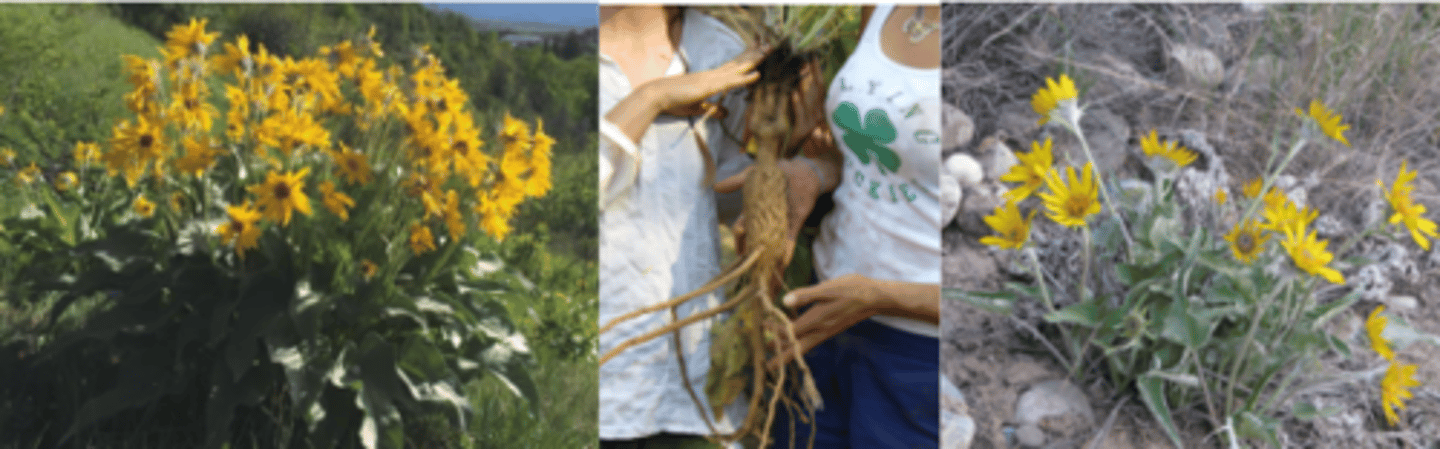
Long-lived perennial herbs w/ big taproots
Leaves: simple, arrow shaped
Inflorescence: Disk and Ray flowers (daisy…)
General Asteraceae Traits:
- A Composite head with involucral bracts (head made up of many flowers, bracts on bottom).
- Fruit: Achene (often a achenes per flower with many pappus)
Centaurea - Knapweed/Star-thistle
(genus within Asteraceae)
What genus has these characteristics?
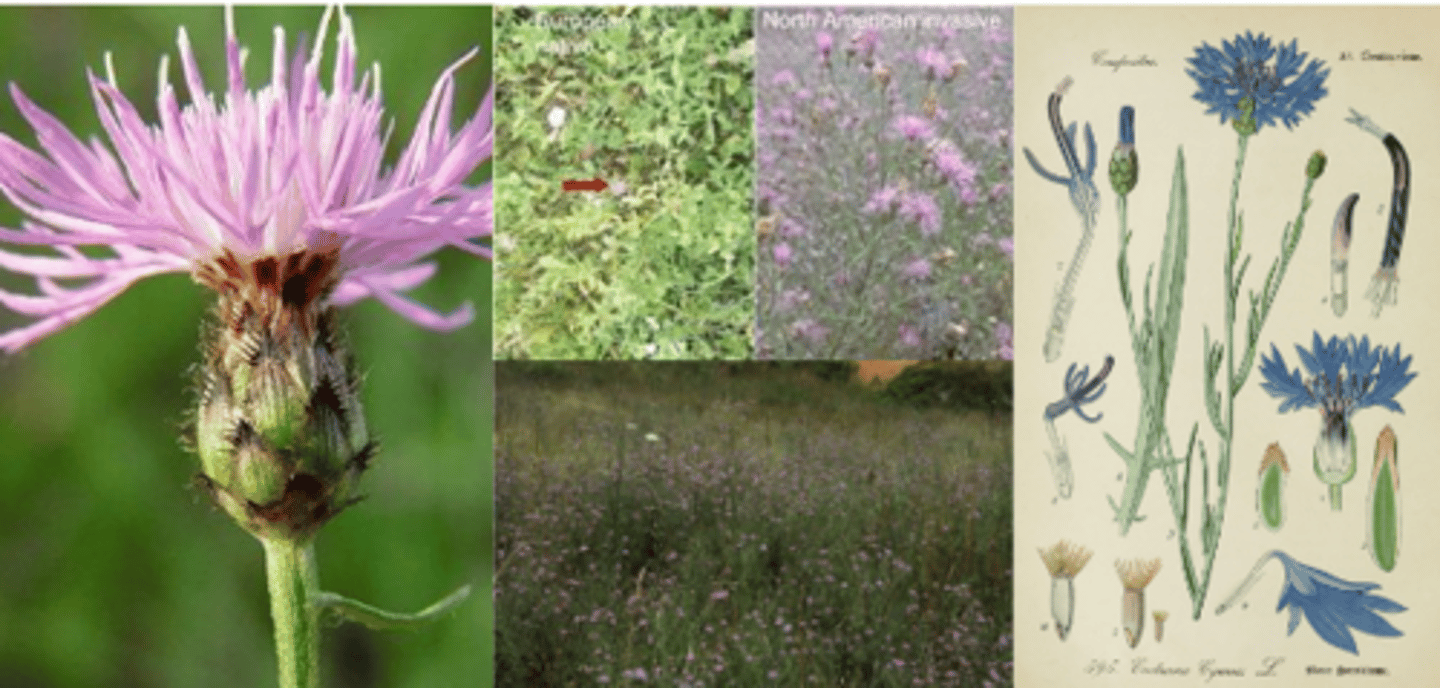
Inflorescence: all petaled (but disk...) flowers
Leaves: simple, lobed, compound
perennial herbs w/ taproot
Pants Spiny
5 non-native (Noxious) weeds:
- Noxious weeds are plants that legally must be managed (threats to native communities)
- Invasives damage local plant communities (or agriculture), whereas non-native naturalized necessarily plants don’t.
- Probably lots of reasons for invasiveness, including allelopathy, polyploidy, distinct phenology, loss of predators…
General Asteraceae Traits:
- A Composite head with involucral bracts (head made up of many flowers, bracts on bottom).
- Fruit: Achene (often a achenes per flower with many pappus)
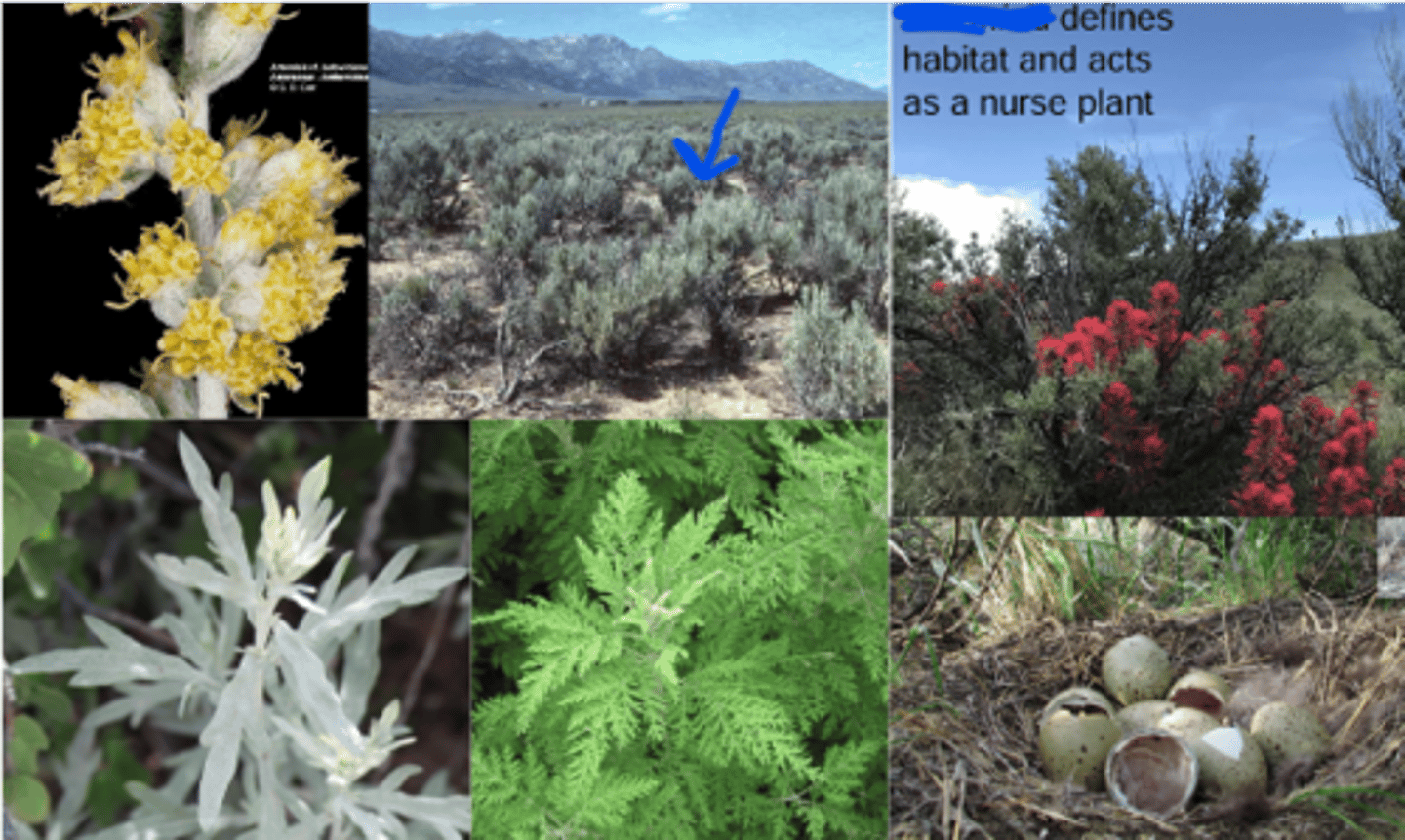
Artemisia - Sagebrush
(genus within Asteraceae)
Dryland shrub
Leaves: simple or lobed; hairy
Flower: disk flowers only (not showy)
Many Artemisia species are medicinal and culturally important.
Artemisia defines habitat and acts as a nurse plant.
Artemisia creates key habitat & food for wildlife (including sagegrouse)
Plants aromatic (sage-y)
General Asteraceae Traits:
- A Composite head with involucral bracts (head made up of many flowers, bracts on bottom).
- Fruit: Achene (often a achenes per flower with many pappus)
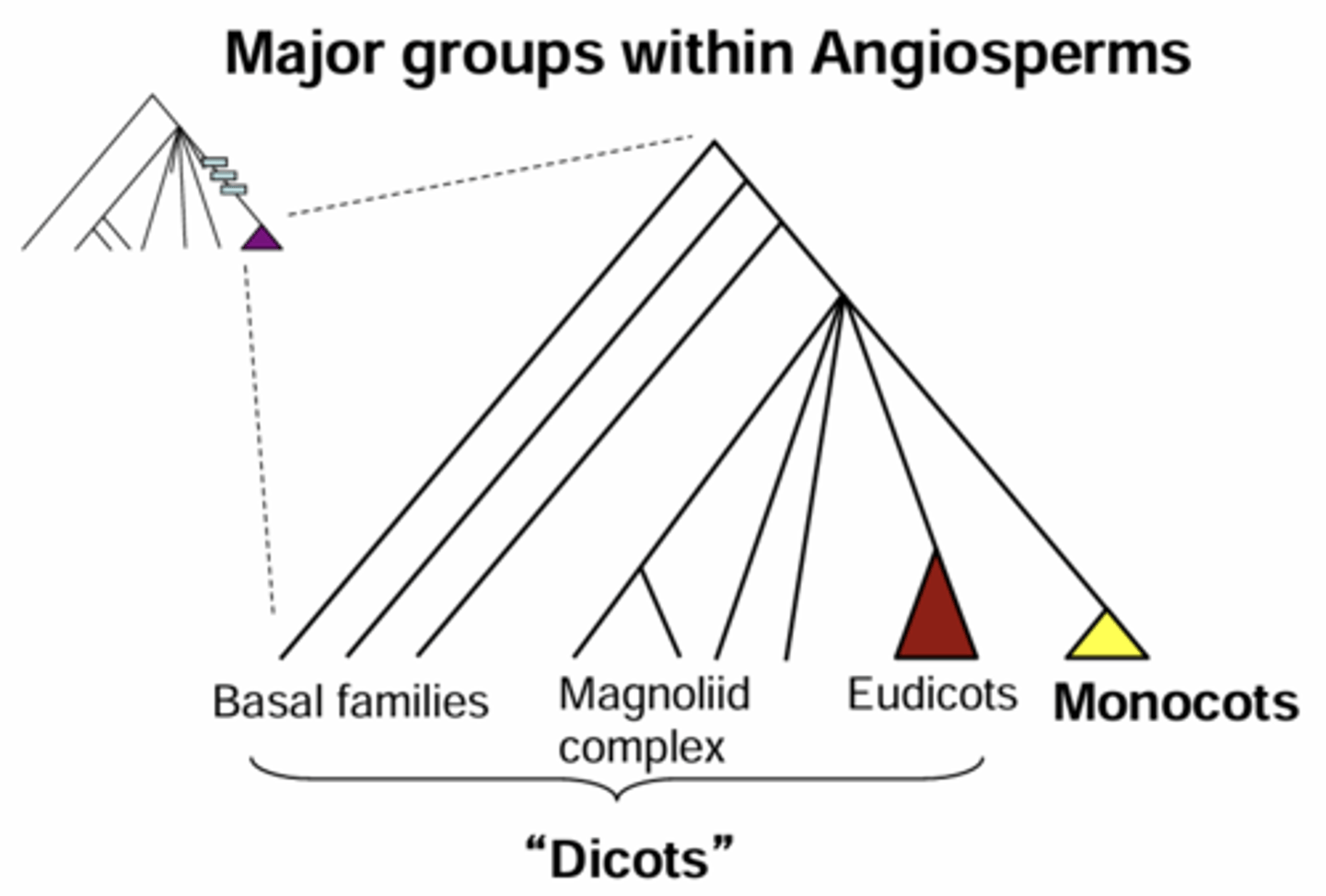
What are the 2 Major groups within Angiosperms?
Monocots and Dicots
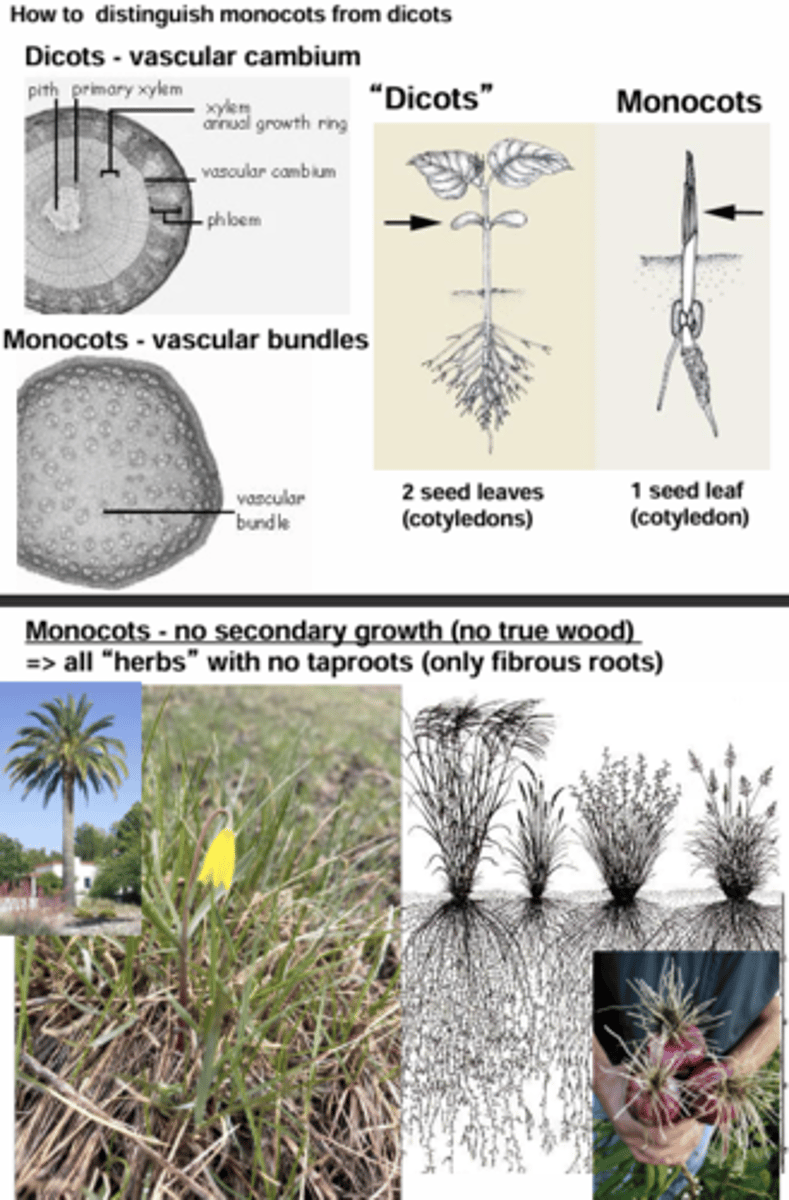
How do you distinguish Dicots from Monocots?
Dicots - 2 seed leaves (cotyledons)
Monocots - 1 seed leaf (cotyledon)
Dicots - vascular cambium
Monocots - vascular bundles
Monocots have no secondary growth (no true wood) they are all “herbs” with no taproots (only fibrous roots)
Dicots - reticulate venation Monocots - parallel venation
Monocot flowers = 3-merous
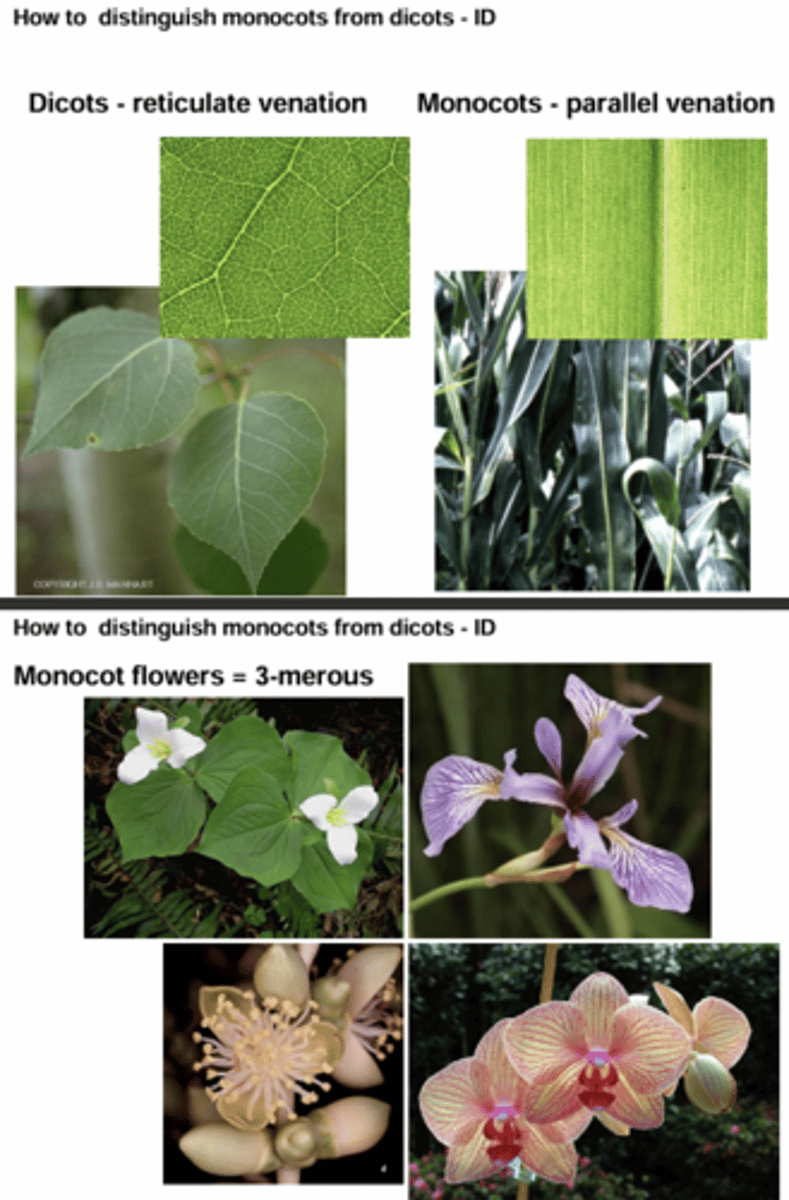
How do you visually ID Monocots from Dicots?
Dicots - reticulate venation Monocots - parallel venation
Monocot flowers = 3-merous
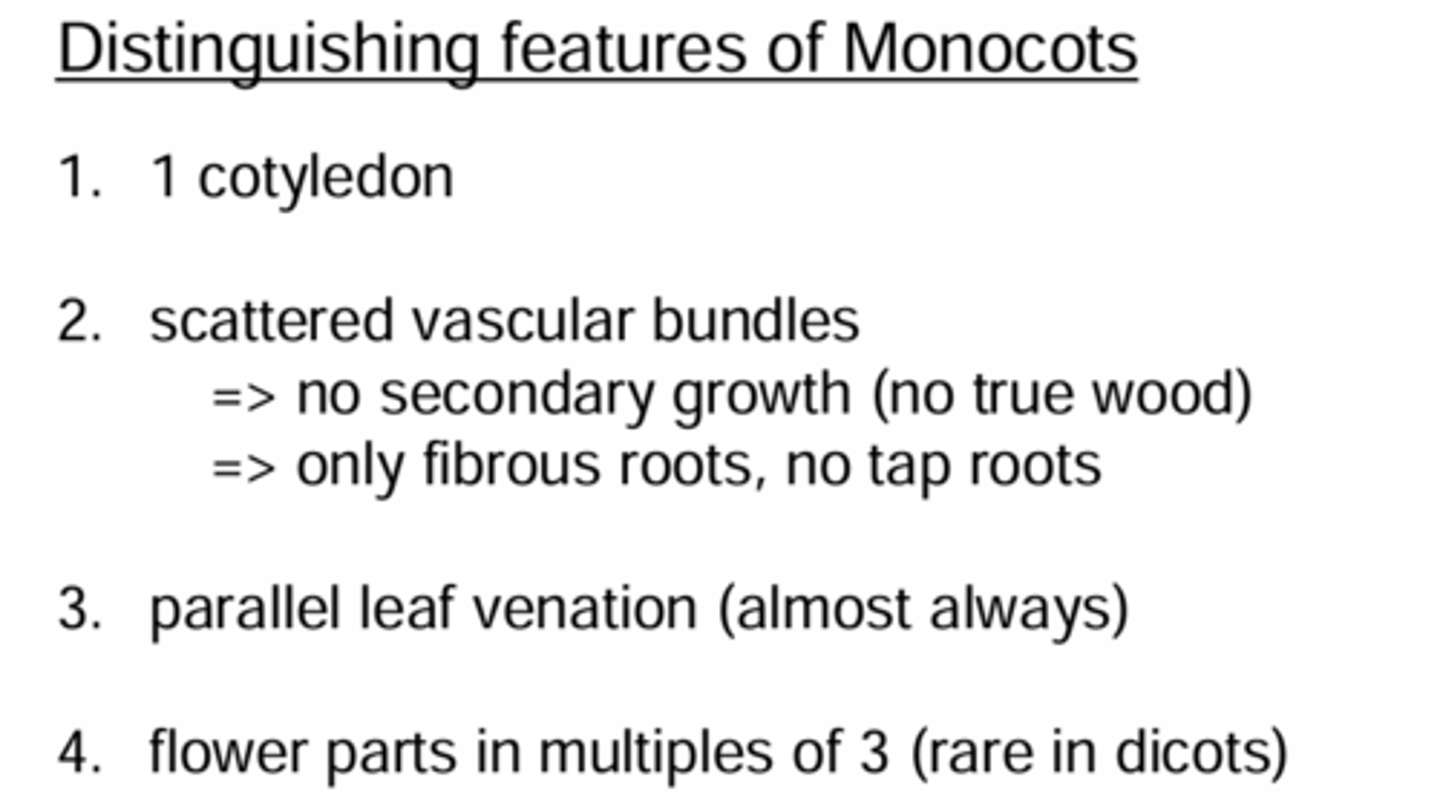
What are the distinguishing features of Monocots?
1. 1 cotyledon
2. scattered vascular bundles
=> no secondary growth (no true wood)
=> only fibrous roots, no tap roots
3. parallel leaf venation (almost always)
4. flower parts in multiples of 3 (rare in dicots)
What are all of the Monocot families we will need to know?
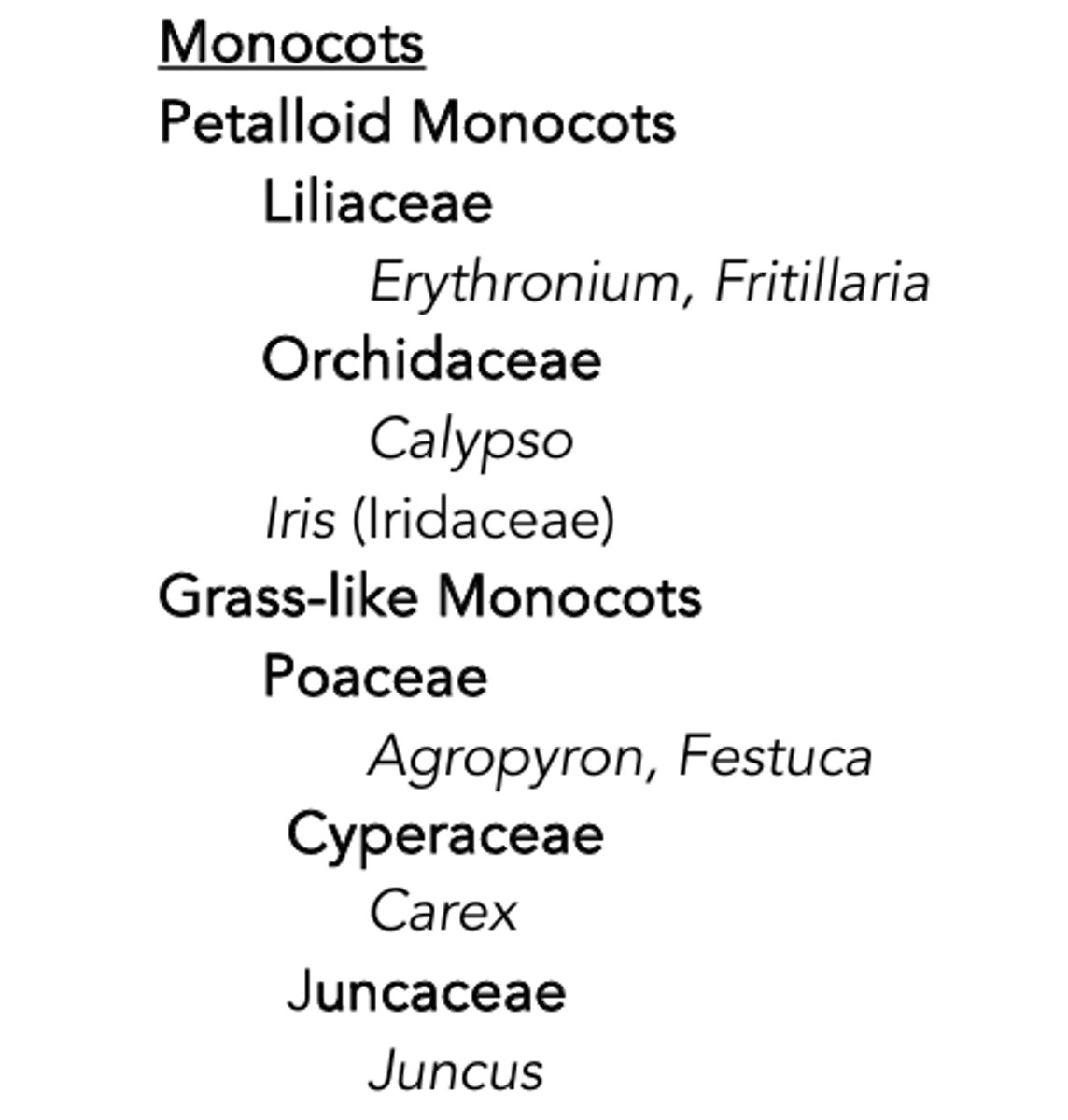
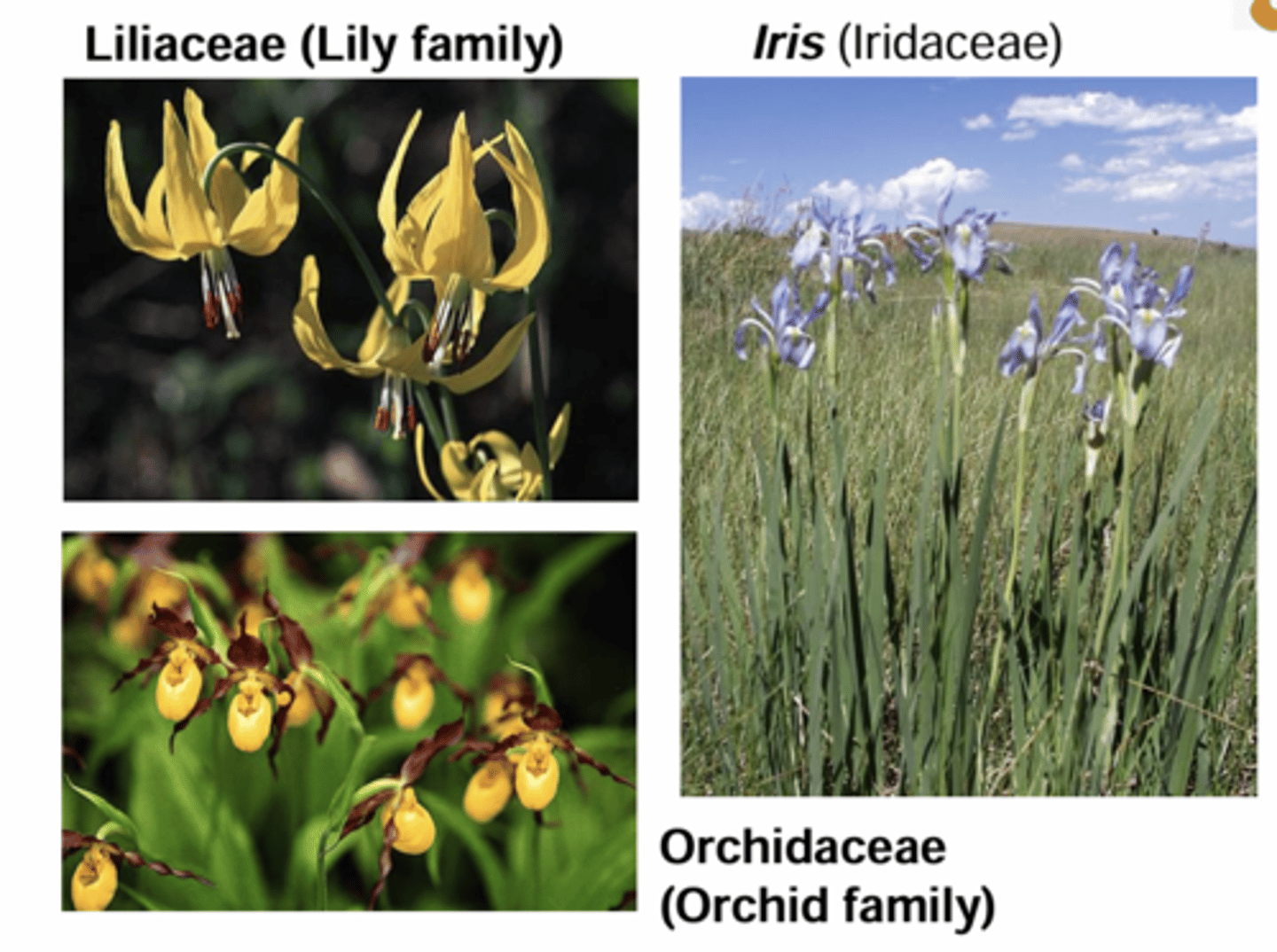
The Petalloid monocots (showy flowers)
What group do these belong in?
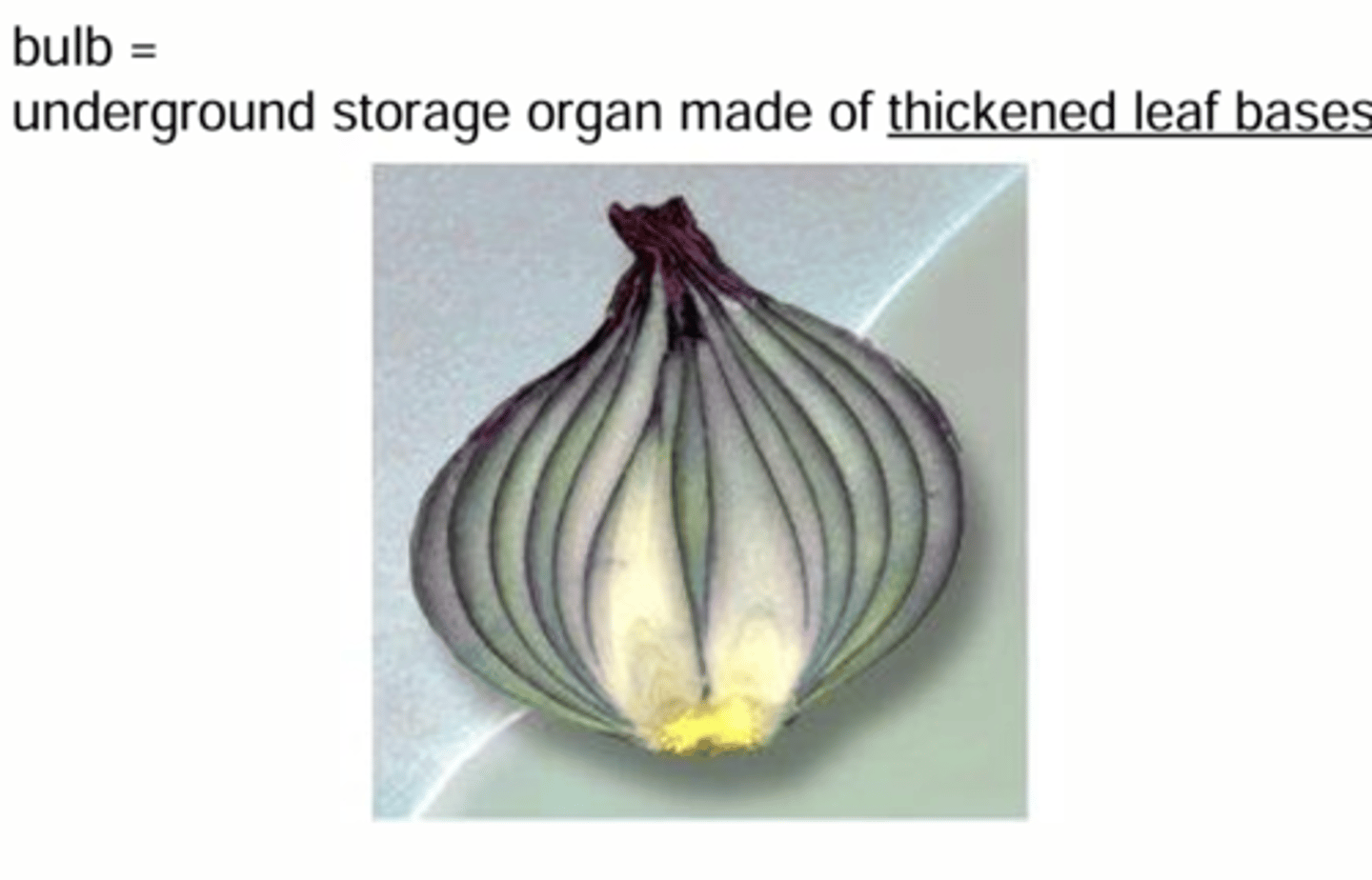
Bulb:
An underground storage organ made of thickened leaf bases
Corm:
vertical stem thickened into below-ground storage organ
Rhizome:
horizontal stem thickened into below-ground storage organ
Liliaceae - Lily family
(contains genera Liliaceae and Erythronium)
What family has these characteristics?
Perennial Herb with Bulbs
Leaves:
- simple
- usually linear
- stems often circular and hollow
- no petiole
Inflorescences: variable
Flowers: Regular, Perfect
(6, 6, 3)
Sepals + Petals (Tepals): 6 (all showy usually) usually unfused
Stamens: 6 distinct
Gynoecium: 3 fused carpels, 1 style superior ovary
Fruit: capsule (most common) or berry
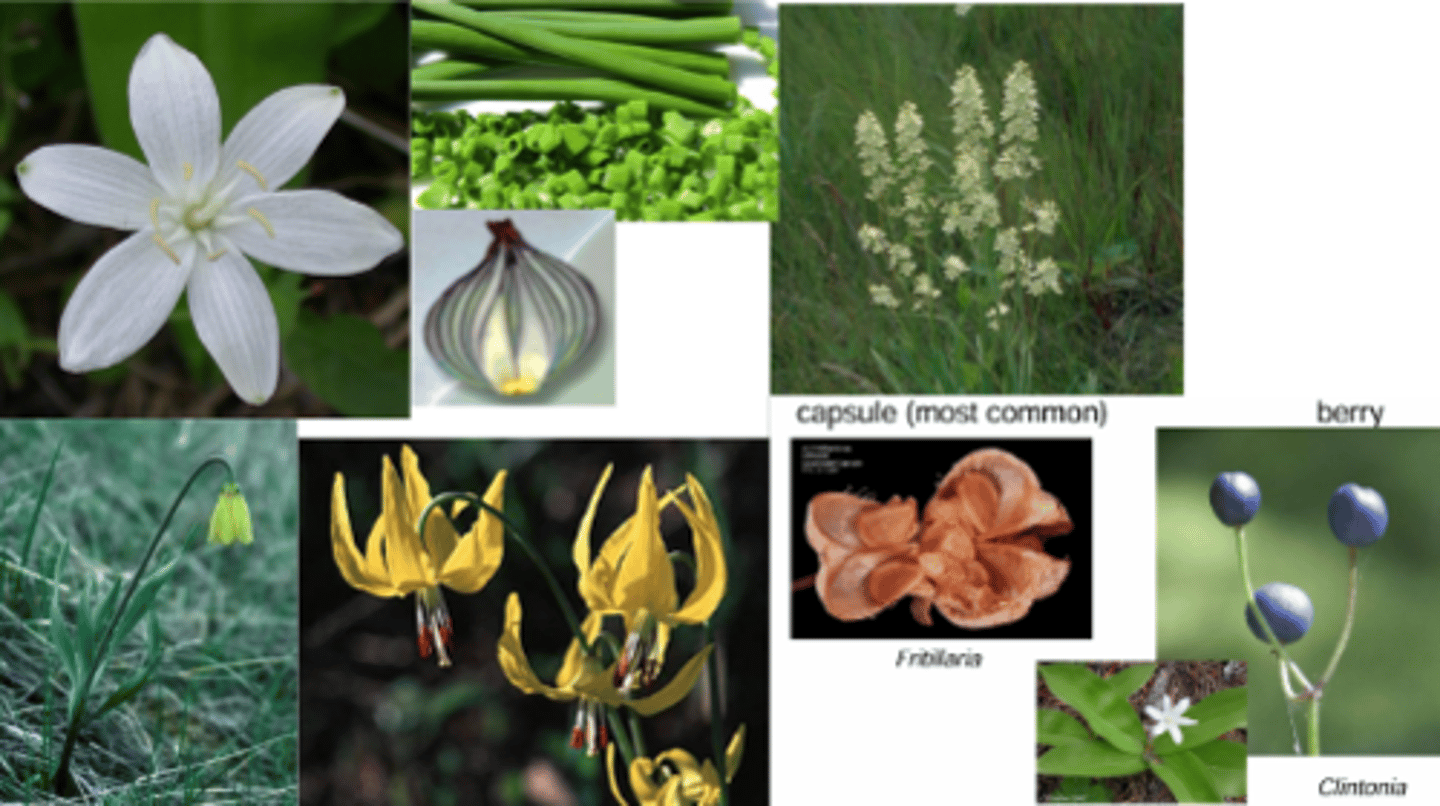
Fritillaria - Fritillaries
(genus within Liliaceae)
What genus has these characteristics?
Fruit = capsule
flower bell-like
Typical Liliaceae:
Flowers: Regular, Perfect
(6, 6, 3)
has bulb
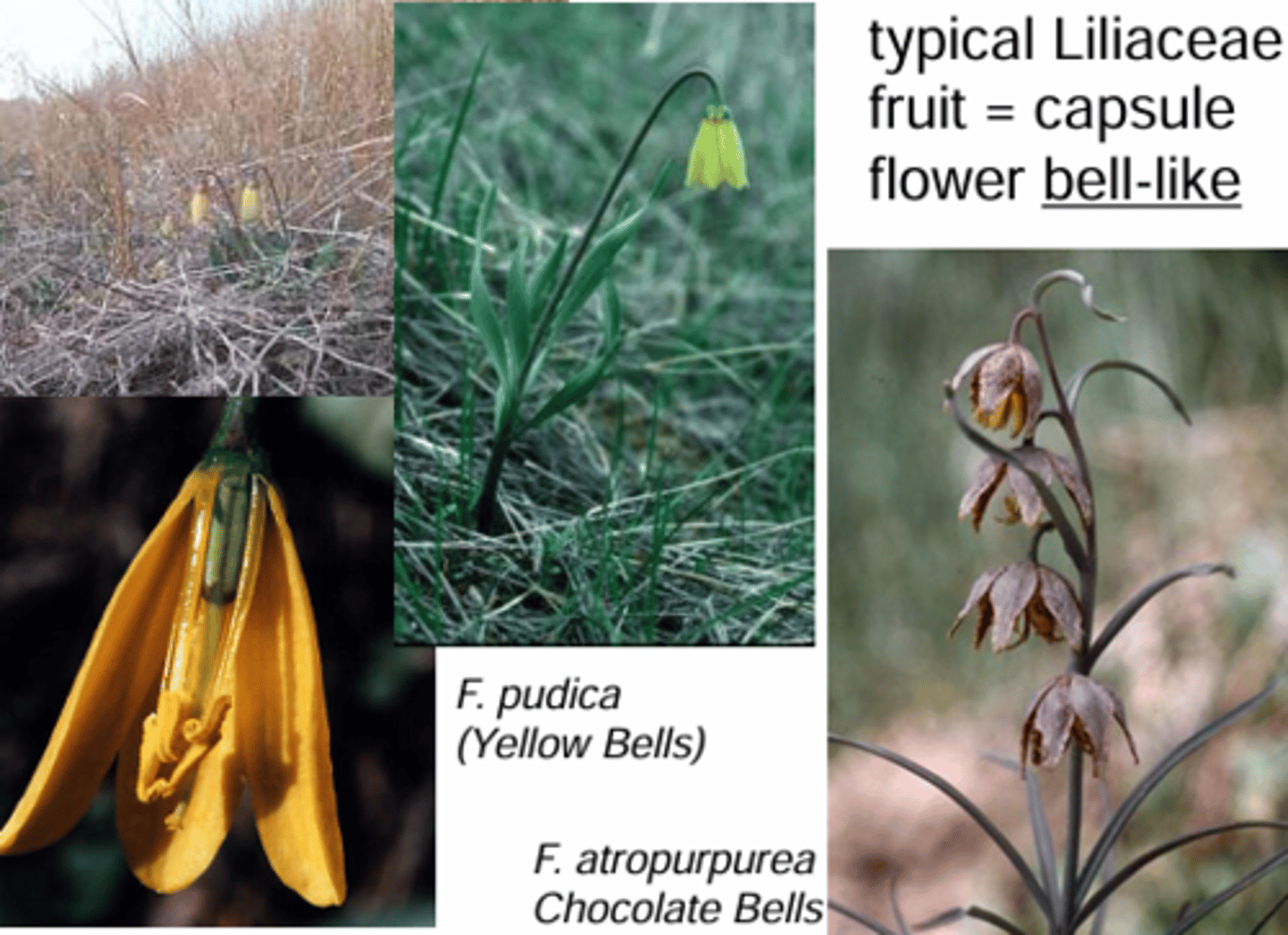
Erythronium - Glacier Lily
(genus within Liliaceae)
What genus has these characteristics?
fruit = capsule
petals long & often reflexed
bulbs important food for wildlife
Typical Liliaceae:
Flowers: Regular, Perfect
(6, 6, 3)
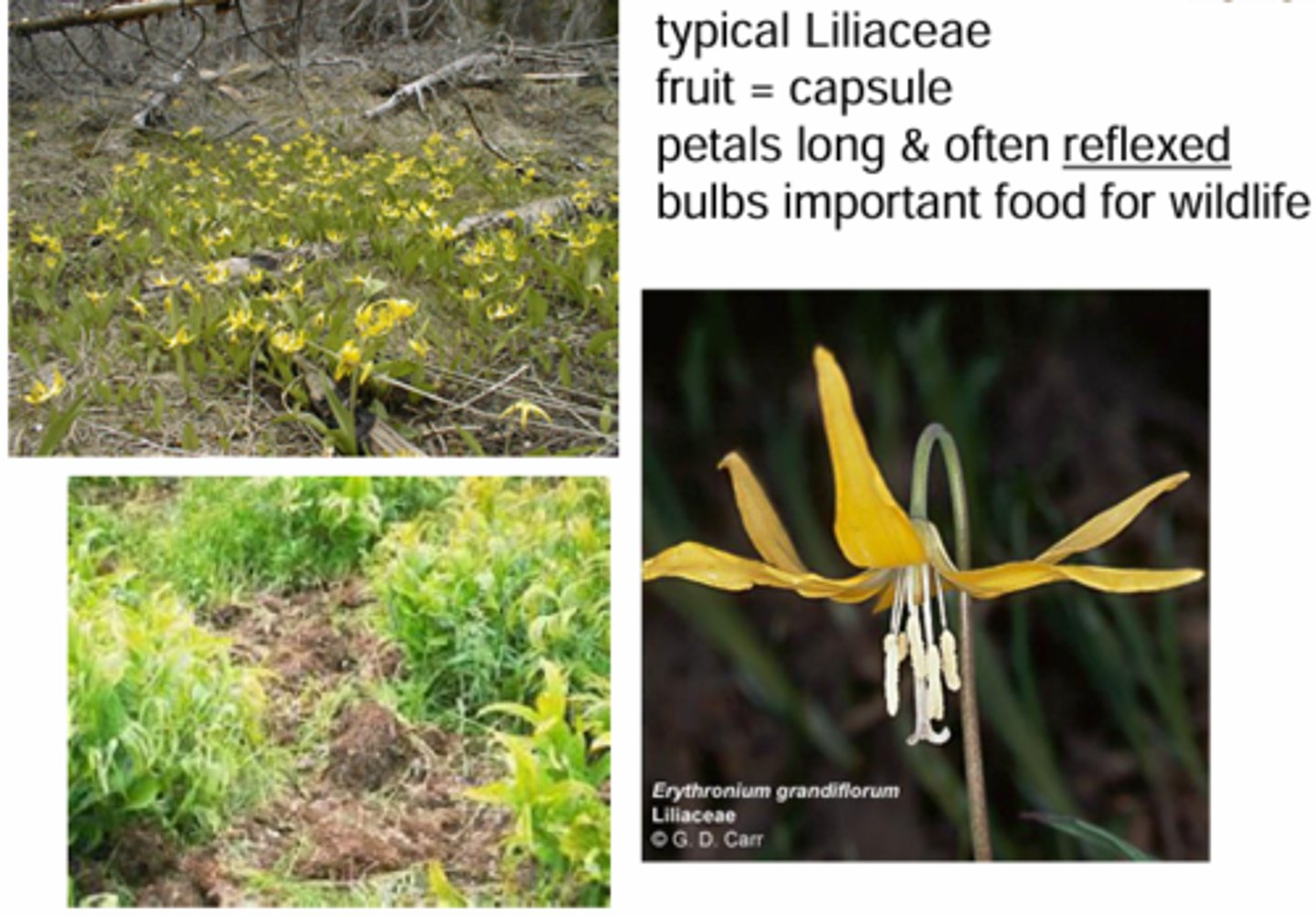
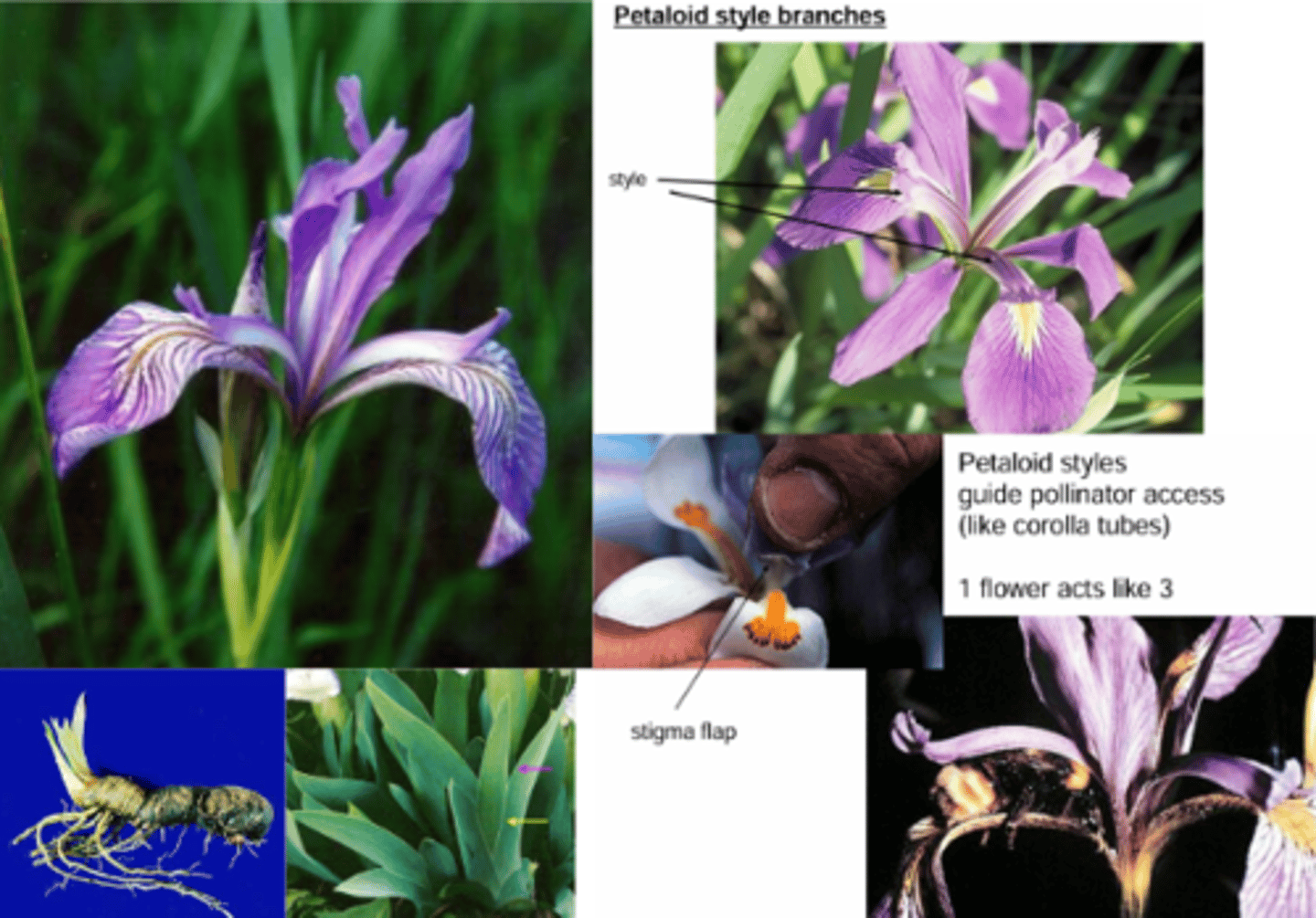
Iridaceae - Iris family
(contains genus Iris)
What family has these characteristics?
Growth habit/Life history perennial herbs with bulbs, corms, or rhizomes
Leaves:
- simple, linear
- sheathing bases equitant (folded)
Inflorescence: determinate Cyme
Flowers: regular, perfect (bisexual)
Sepals + Petals (Tepals) 6 (all showy usually) often fused at base
Stamens: 3, distinct
Gynoecium:
3 fused carpels
1 style with 3+ branches (petaloid in Iris)
inferior ovary
Fruit = capsule (seeds sometimes w/ fleshy arils)
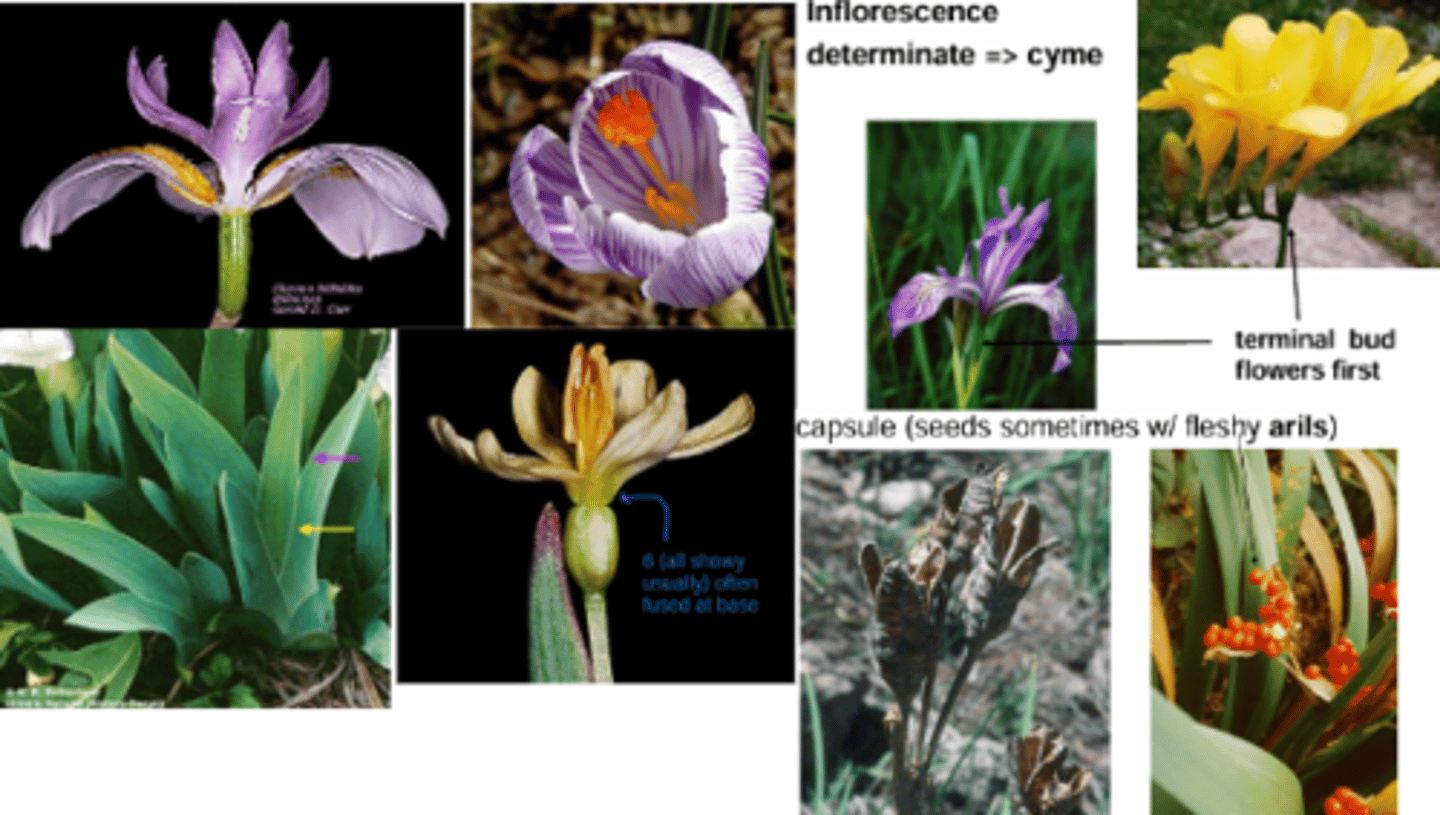
Iris - Iris
(genus within Iridaceae)
What genus has these characteristics?
Petaloid style branches:
- Petaloid styles guide pollinator access (like corolla tubes)
- 1 flower acts like 3
Has Rhizome
Normal Iridaceae characteristics:
- sheathing bases equitant (folded)
- capsule
- 1 style with 3+ branches (petaloid in Iris)
- 3 stamens
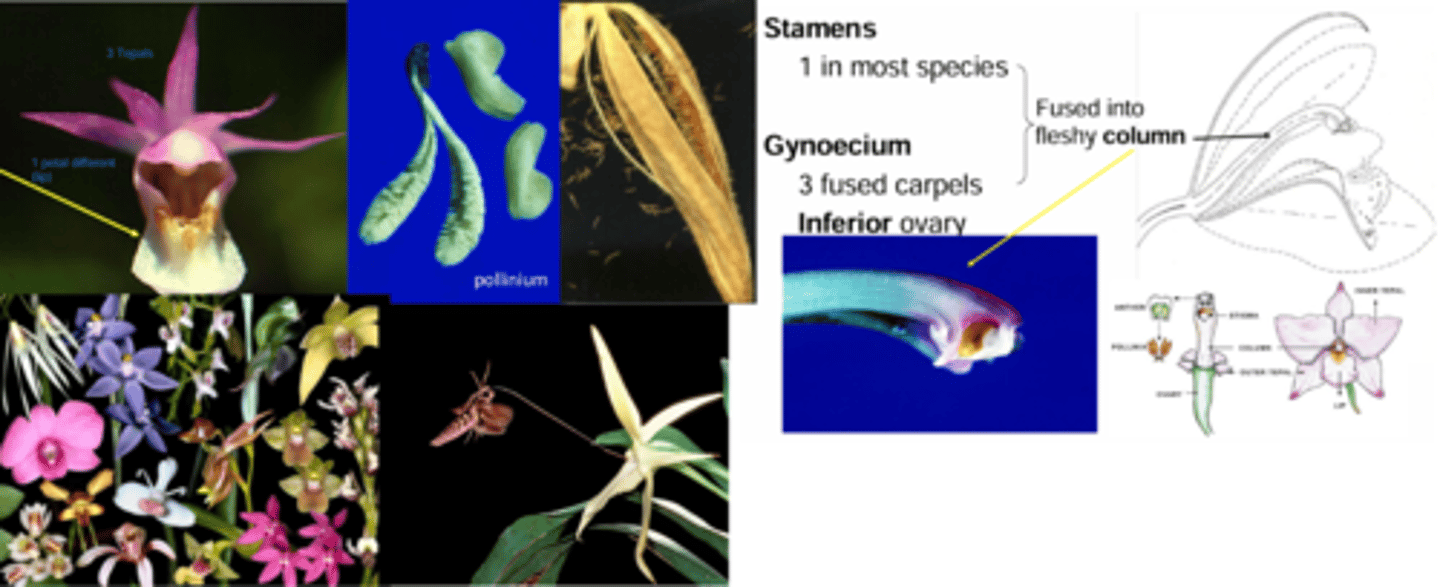
Orchidaceae - Orchid family
What family has these characteristics?
Perennial herbs
Usually grown with Corm or Rhizome
Leaves:
- Oval leaves, not grass-like, basal rosette
- venation often not parallel
Flowers:
- Infl. solitary, raceme, or spike
- bilaterally symmetric (irregular)
- Teapals = 3 + 3
- All tepals showy, 1 petal different = lip
- Stamen and gynoecium fused into fleshy Column
- Stamens = 1
- Gynoecium = 3
- Fruit = Capsule with 1000s of tiny seeds, splitting along sides
All pollen of each flower is packaged into a waxy mass or pollinium, which is dispersed by pollinators as a unit. All the pollen gets moved at once.
Mycorrhizal fungi necessary for seed germination.
Very diverse:
Rewards: (Nectar and Pheromone)
-Deceit pollination: (Visual and Scent Mimics)
- Epiphytic (in tropics)
- Terrestrial (in temperate zone) orchids
- Some parasitic taxa
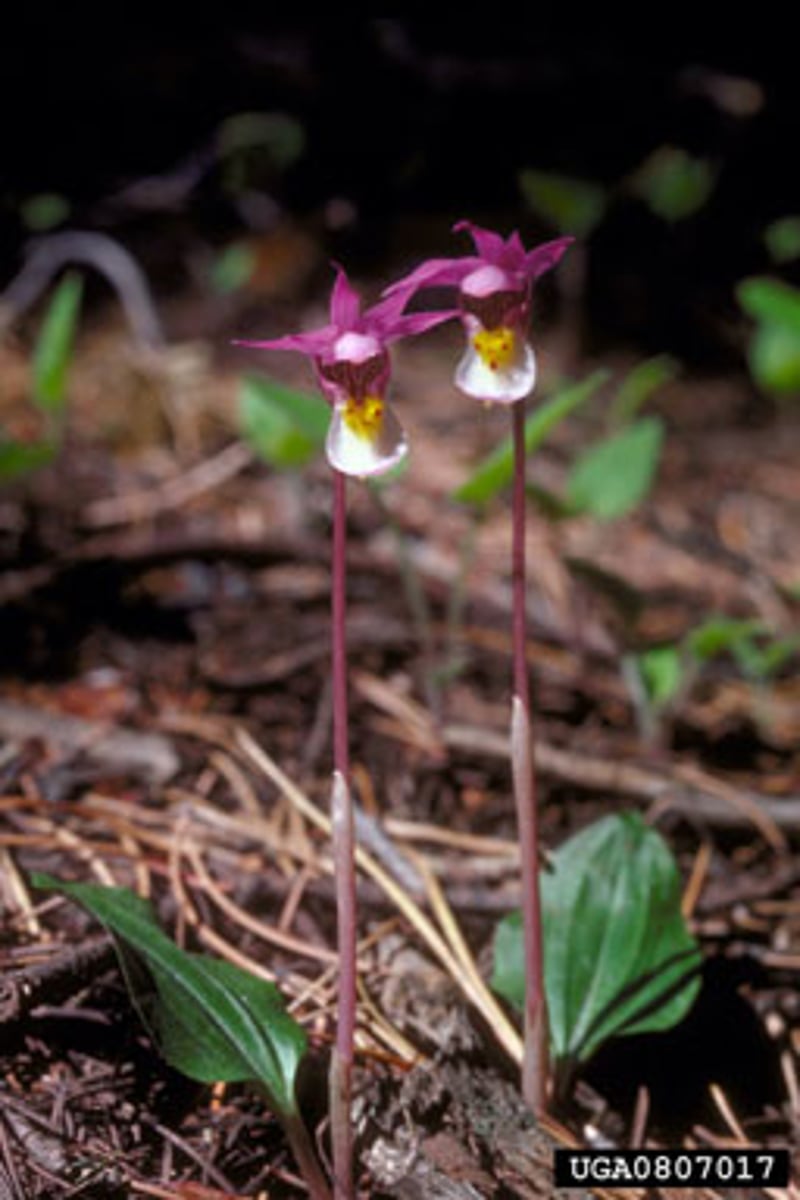
Calypso
What genus has these characteristics?
- “typical” orchid flower
- solitary flower rising from single leaf
- deceit pollination by hopeful queen bumblebees (early spring, no reward)
- color variable
Poaceae (Grass family)
Cyperaceae (Sedge family)
Juncaceae (Rush family)
What are the Graminoid (grass-like) monocots?
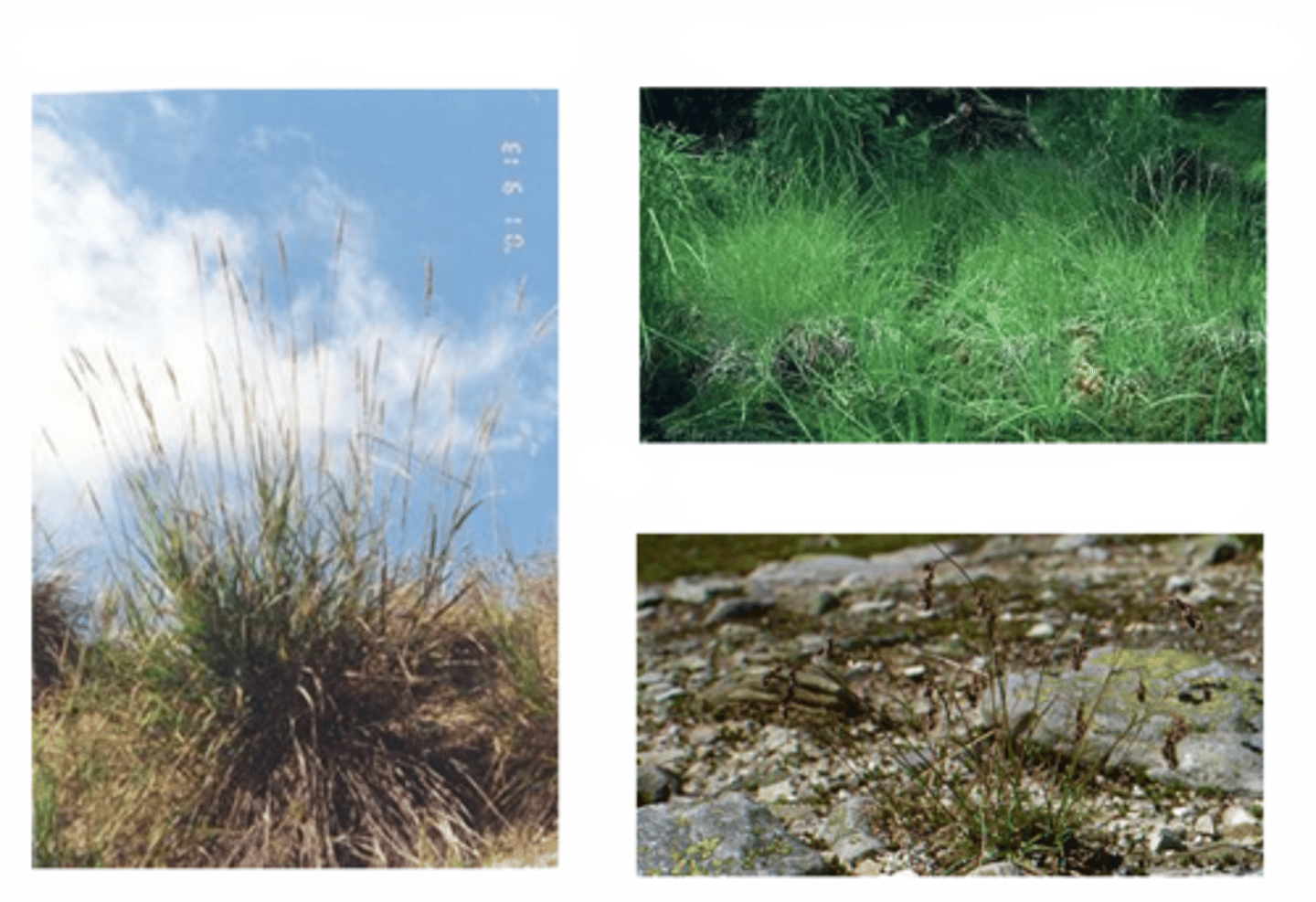
All herbs (a few “woody” like bamboo), like all monocots
Simple linear leaves, often sheathing at base (grass-like)
Flowers very reduced (not showy) and often wind-pollinated
What are the shared features of the Graminoid (grass-like) monocots (grasses, sedges and rushes)?
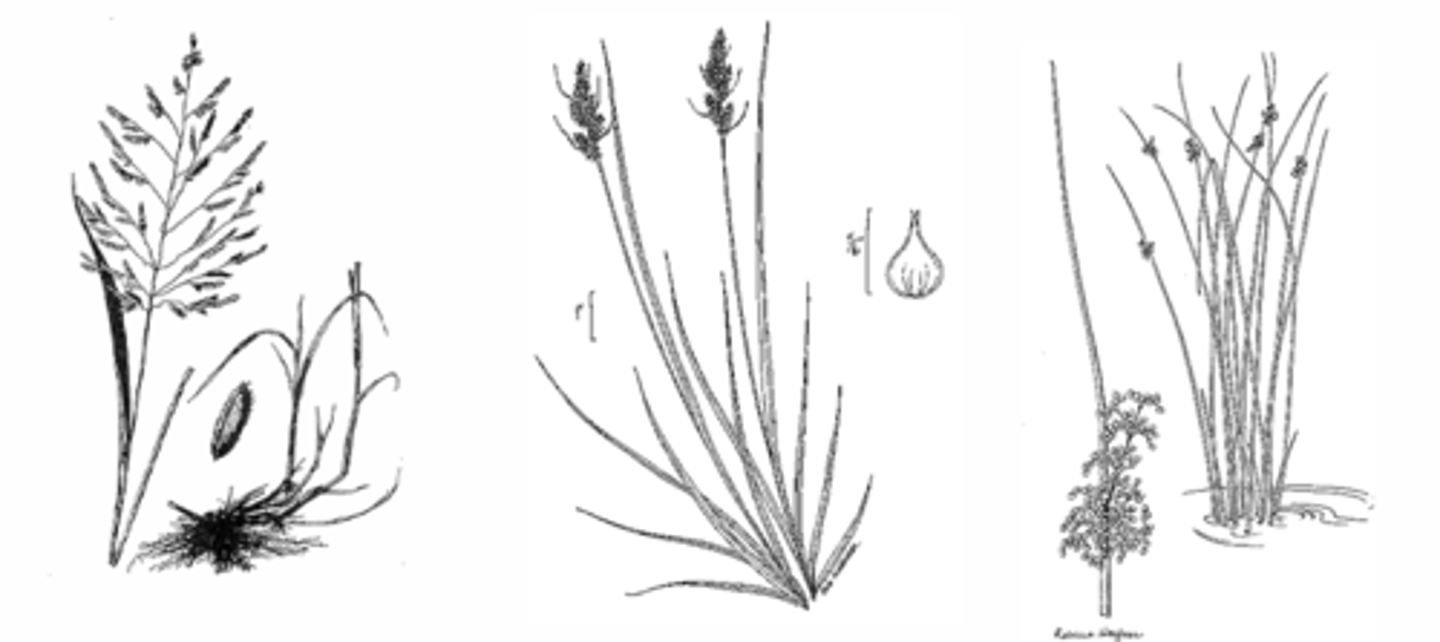
Cyperaceae (sedges)
- triangular solid stems (usually)
- spikelets florets with 1 bract
Juncaceae (rushes)
- round, solid stems
- flowers with 6 tepals and 6 stamens
Poaceae (grasses)
- round, jointed hollow stems
- spikelets with glumes florets with 2 bracts - lemma & palea (no tepals)
- 3 stamens, 2 carpel
What are the different features of the Graminoid (grass-like) monocots (grasses, sedges and rushes)?
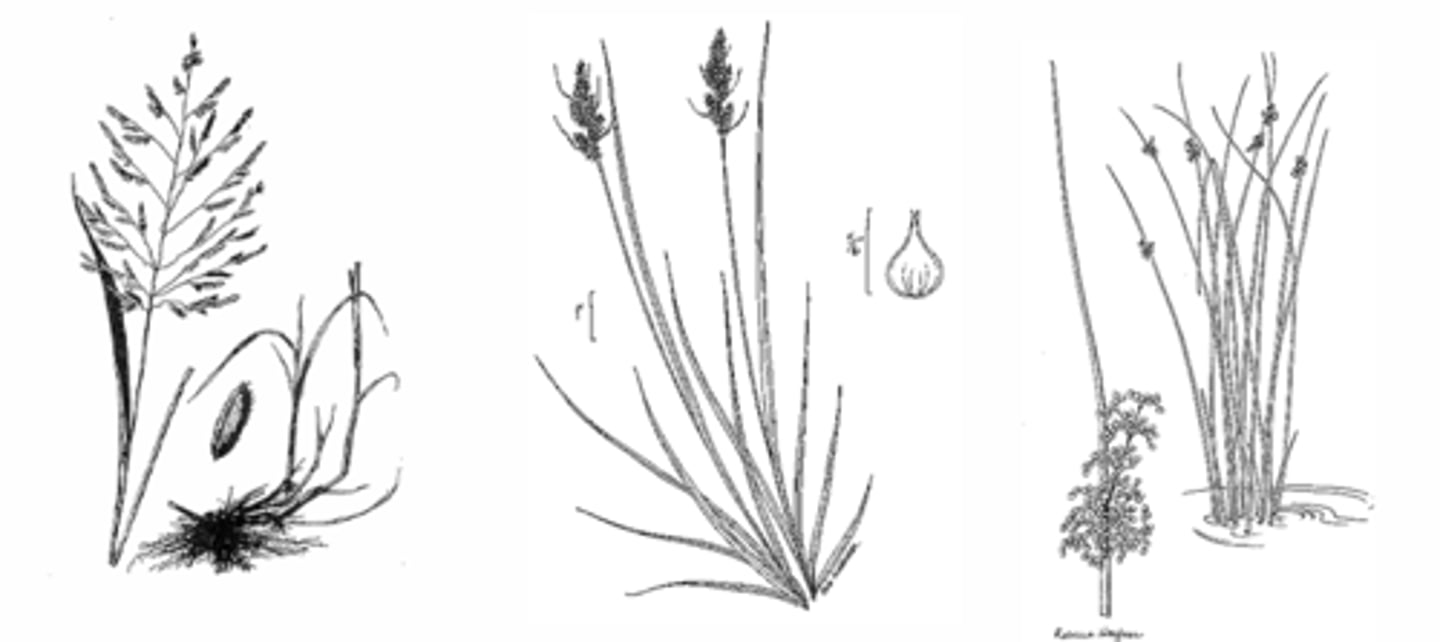
Poaceae - Grass Family
(contains genra Agropyron and Festuca)
What family has these characteristics?
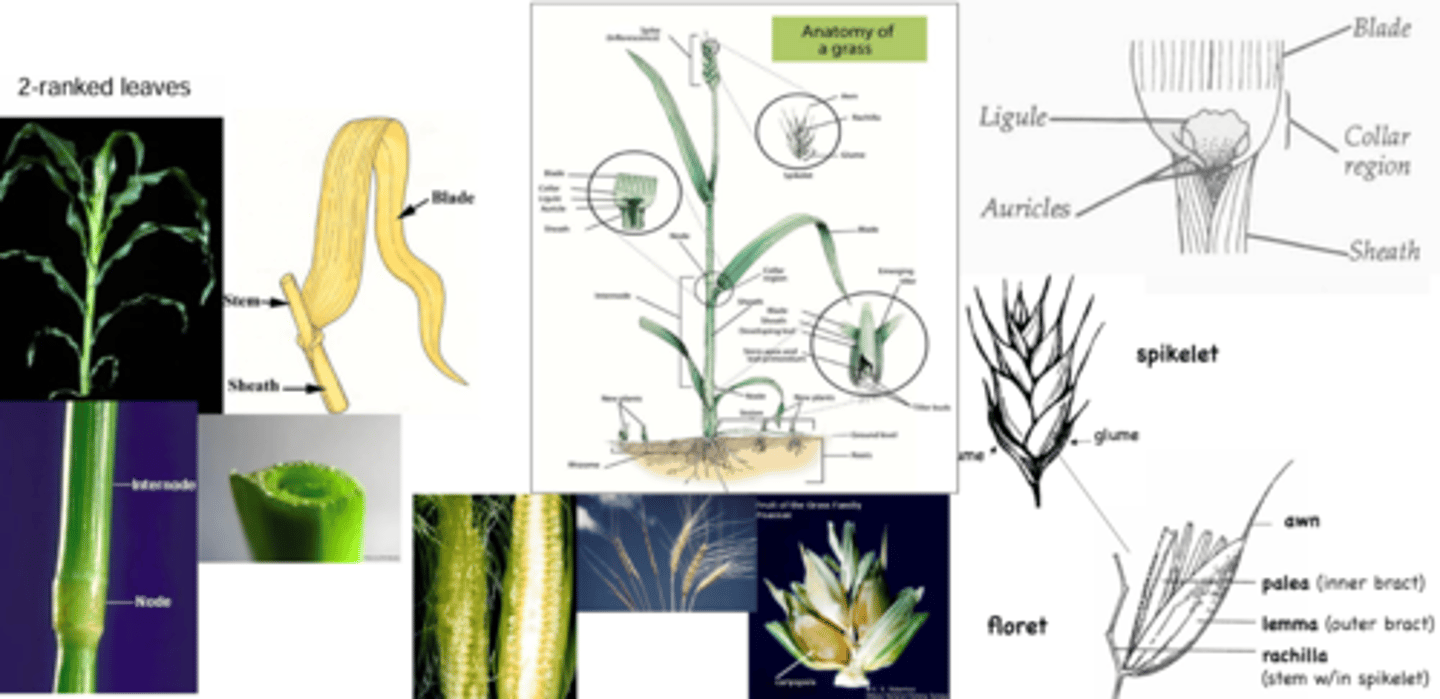
Vegetative growth:
- Tiller (from 1 apical meristem)
Leaves:
- simple entire, linear
- alternate and/or basal
- leaf base sheathes the stem, but is not sealed shut (unlike Cyperaceae/sedges)
- 2-ranked leaves
- Round, hollow stems, with swollen nodes
- Useful ID characters at junction of blade and sheeth (Auricles, Ligule, Collar Region)
Inflorecences:
- complex arrays (“panicles”) of tiny spikelets
- each spiklet contains multiple florets and glumes
- each floret contains 1 flower and 2 bracts (palea and lemma)
Flower:
- Superior
- (0, 0, 3, 2)
- Stamens have long filaments
- Stigmas often feathery
- 0 petals or 3 modified into scale-like lodicules at base of ovary
Fruit:
- Caryopsis (grain)
- similar to an achene or nutlet but ovary wall is fused to seed
Life History:
- 10,000 species
- Dominant in grassland ecosystems (regions of low total rainfall and high seasonal water stress)
Agropyron/Elymus - Wheatgrass
(genus within poaceae)
What genus has these characteristics?
- spikelets held close to stem
- spikelets spaced out along spike
- ligule and auricles obvious
- stems clearly jointed
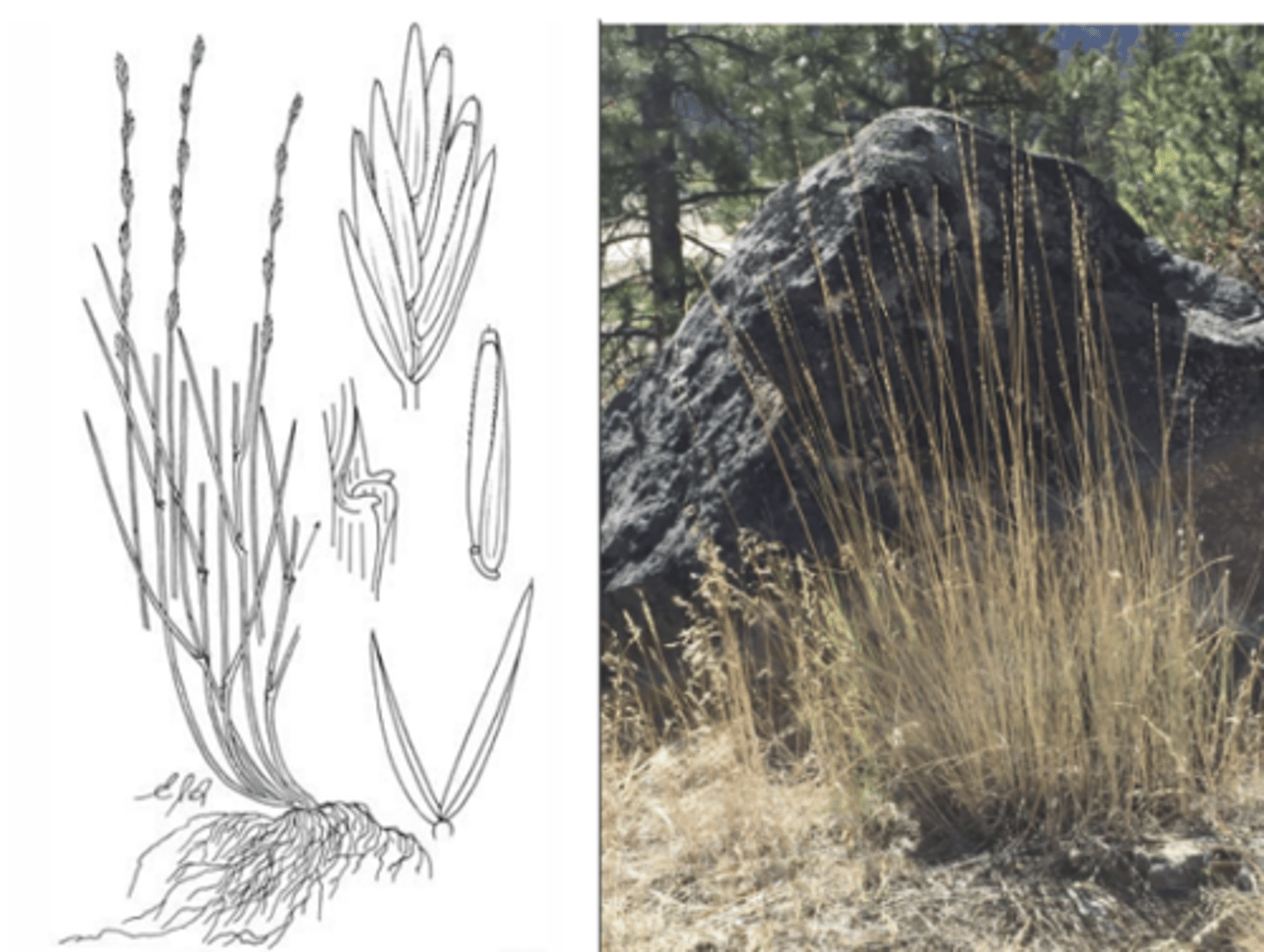
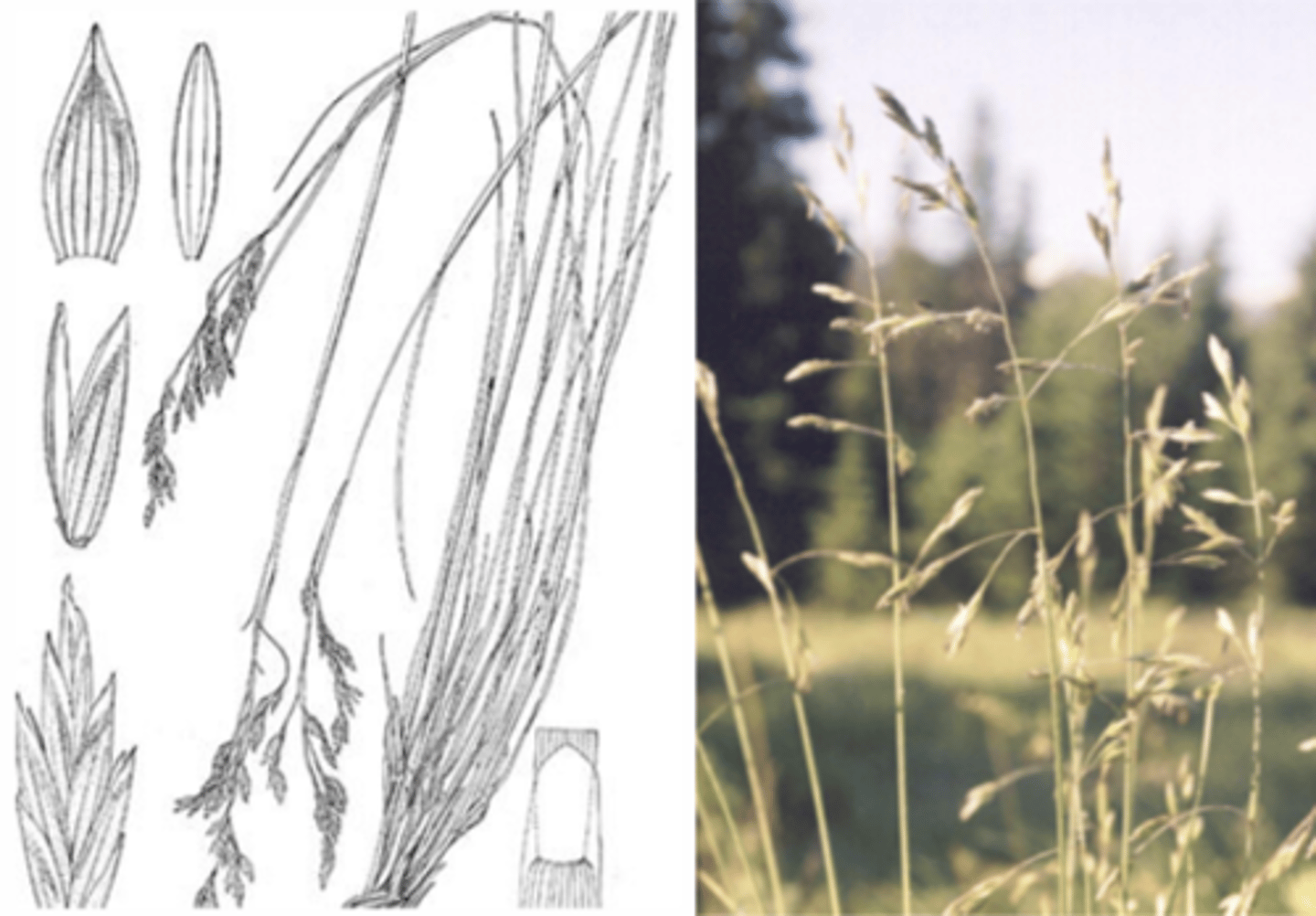
Festuca - Fescue
(genus within poaceae)
What genus has these characteristics?
- thread-like (rolled) leaves
- loose panicle of spikelets
- no auricles
- stem joints (often) not apparent
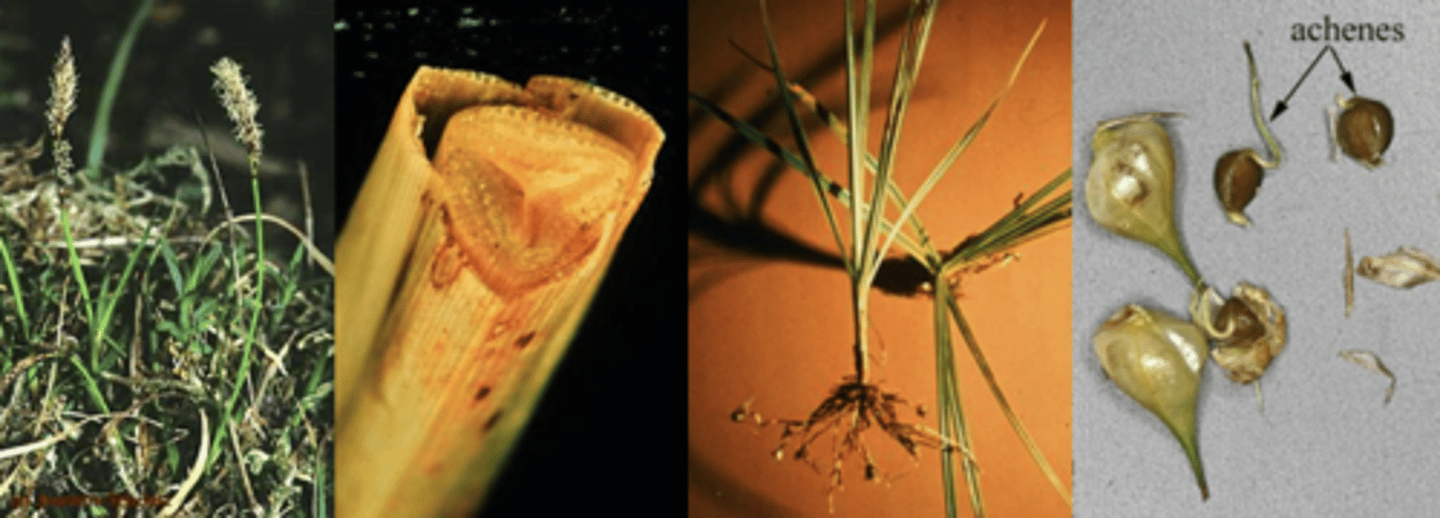
Cyperaceae - Sedge family
(contains genus carex)
What family has these characteristics?
Habit:
- Important in wetlands (not exclusive to)
- growth form perennial herbs w/ corms or other underground storage
Leaves/stems
- Often triangular stems “sedges have edges"
- leaves 3-ranked
- leaf sheath sealed/closed
Inflorescences:
- various arrangements of spikelets/spikes
- no glumes, but often subtended by 1 large (leafy) bract
Flowers:
- each flower subtended by 1 bract
- Perianth lacking or reduced to 6 bristles/scales
- 3 Stamens
- 1 superior ovary
Fruit: Achene
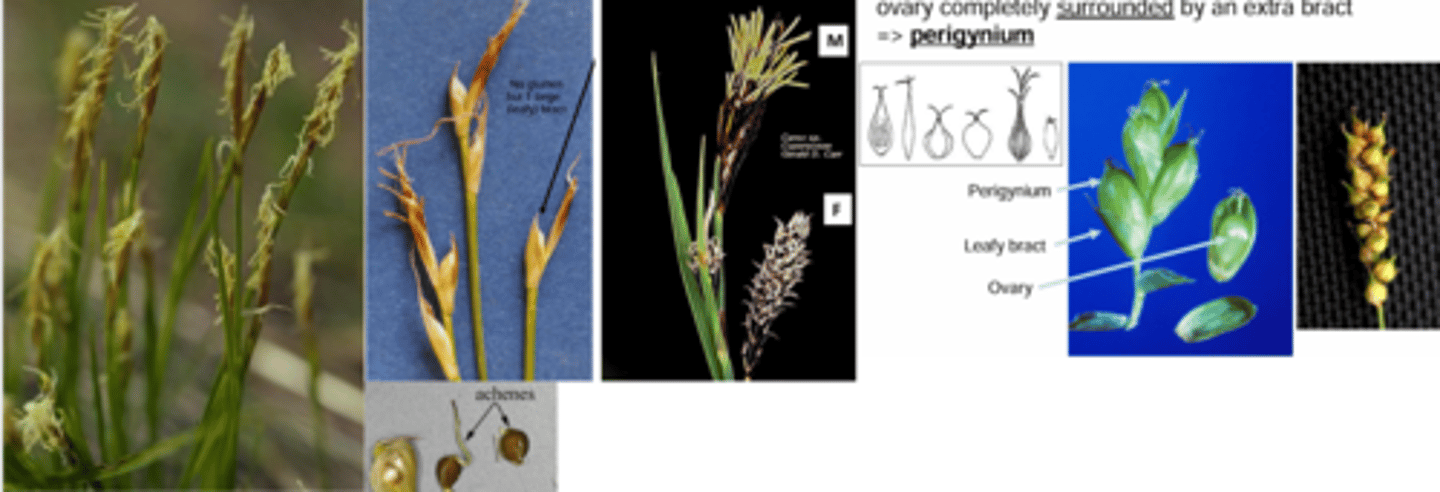
Carex - Sedges
(genus within Cyperaceae)
What genus has these characteristics?
- diverse inflorescences
- flowers always unisexual (male OR female)
- plants monoecious (same plant)
- diverse habitats (wet & dry
- ovary completely surrounded by an extra bract - Perigynium (like a vase/pod around the flower)
Juncaceae - Rush family
(contains genus juncus)
What family has these characteristics?
- Wetlands
- Stems round and solid (never hollow , open sheath)
- perfect (bisexual), radially symmetric
- (6, 6, 3)
- 3 fused carpels -> capsule
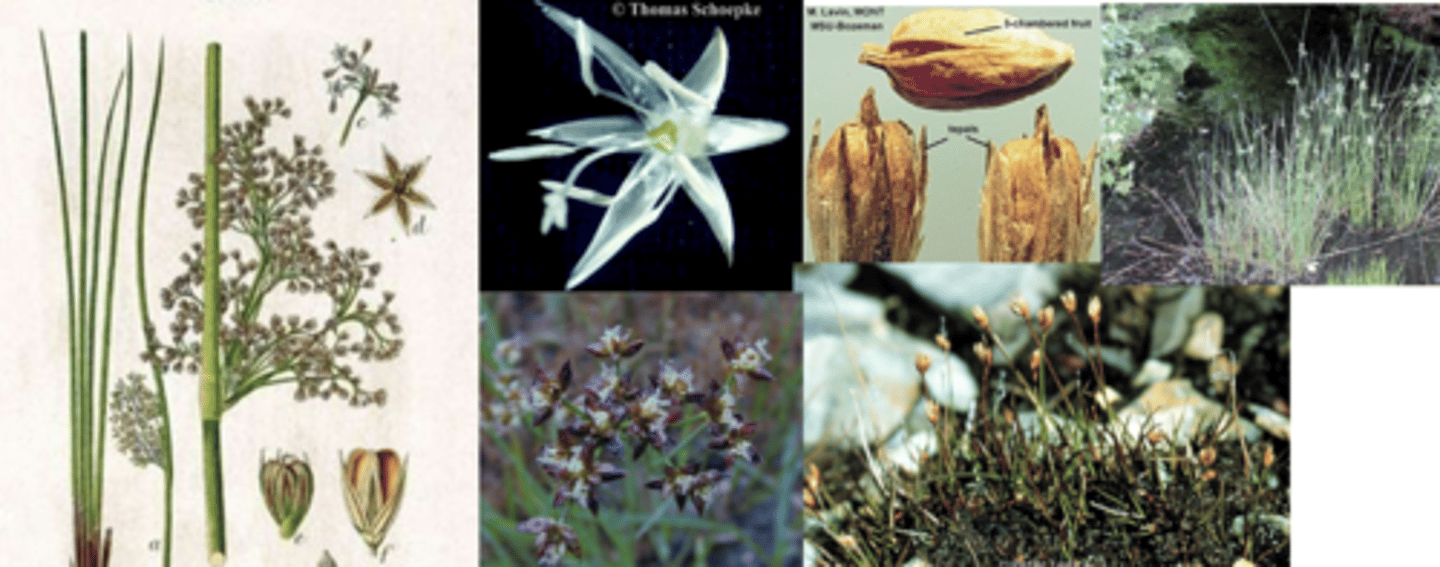
Juncus
(genus within Juncaceae - Rush Family)
What genus has these characteristics?
- round pithy leaves
- very reduced flowers
- bract below (and often beyond) inflorescence