Psych 381 Ch 8
 Call Kai
 Learn
Learn Practice Test
 Spaced Repetition
 Match
Match Flashcards
 Knowt Play
1/42

There's no tags or description
Looks like no tags are added yet.
Name | Mastery | Learn | Test | Matching | Spaced | Call with Kai |
|---|
No analytics yet
Send a link to your students to track their progress
43 Terms
Stimulus Control
• Performing behaviours at appropriate times
• i.e., when certain stimuli are present
• For Example,
• Wear bikini to beach, not to class
• Forage when there is no predator, but not when there is a
predator
• Drink beer when you are at a bar, not at church service
How to Measure Stimulus Control
•How do we “ask” animals (or human infants) if two
stimuli are different from one another?
• Differential responding
Stimulus discrimination
differential responding
• Variation in responding that corresponds to a variation in
stimuli
• Remember the habituation to visual patterns in infants?
stimulus discrimination
• Responding differentially to two or more stimuli
How to Measure Stimulus Control
• Reynolds (1961) Asked the question: “what is the pigeon paying attention to?”
• In other words, “what about this stimulus is controlling the responding by the pigeon?”
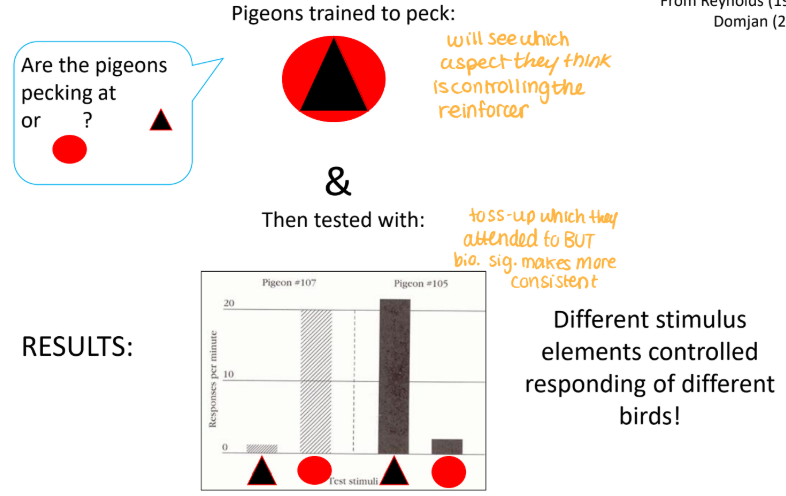
Research Example: Discrimination Task
• Stimulus discrimination: respond differentially to two
or more stimuli
• E.g., operant Go/no-go procedure
chickadee in box with sound of call: male call, are they responding the right way?
Stimulus Generalization
• Failure to discriminate between two similar stimuli
• e.g., Baby Albert generalized his response to anything that
was white, and furry (like the white furry rat he was
conditioned to fear)
ex: chickadees: a NEW male call but still treated as a male call
Generalization Gradient
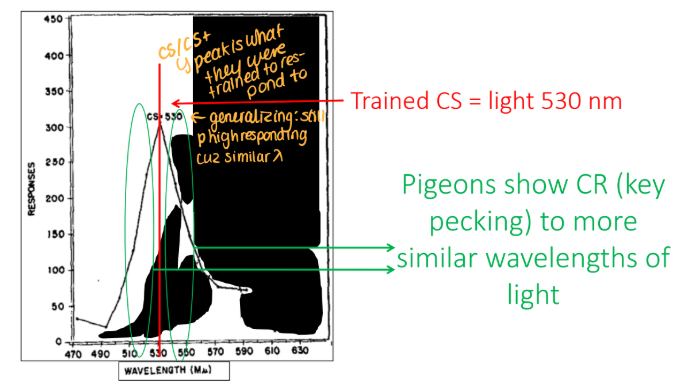
What if there was no stimulus control?
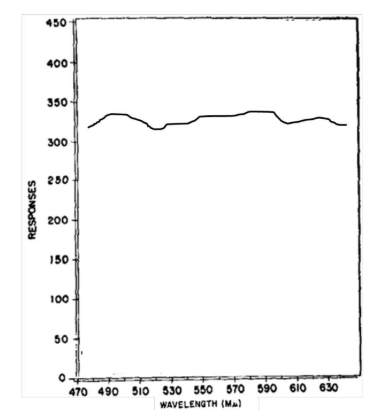
Measuring the Degree of Control
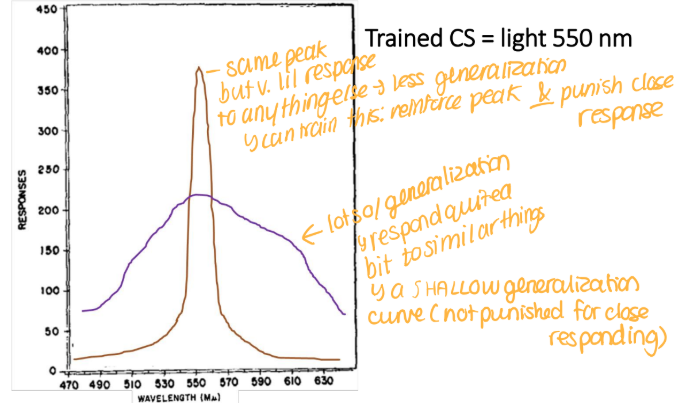
comparing discrimination and generalization
D=different responses
G=same responses for different stimuli
Factors in Stimulus Control
Sensory capacity
Orientation
Ease of conditioning (overshadowing)
Type of reinforcement
Type of response
Sensory Capacity
Stimulus control can ask questions about what animals perceive:
• Can an animal see colours?
• Train to discriminate between colours
• What is an animal’s hearing range?
• Train to discriminate between presence and absence of acoustic cue
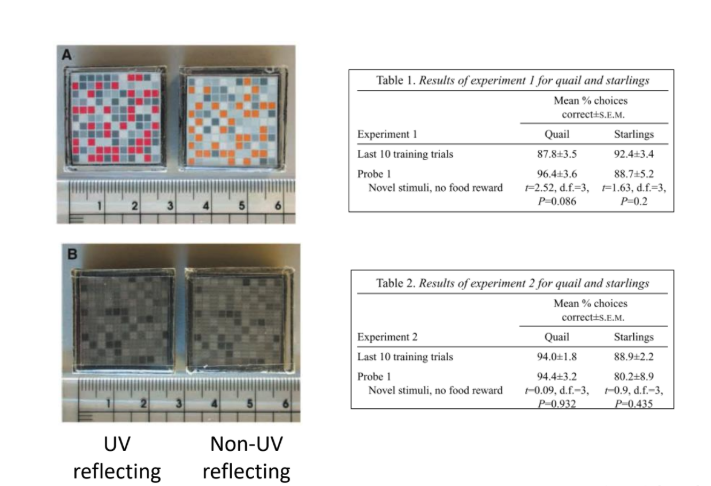
Sensory Capacity Example
•Japanese quail and European starlings trained to
discriminate between two different visual stimuli
Orientation
• What are you looking at?
• Animal needs to be oriented towards the stimulus
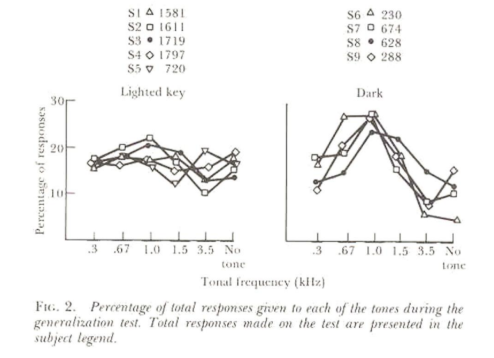
Ease of conditioning (overshadowing)
•Interference with conditioning of a stimulus because of the simultaneous presence of another stimulus that is easier to condition
• Competition among stimuli for access to learning processes
•Higher intensity stimulus more easily conditioned
graph: overshadowing of tones by light
Overshadowing in Landmark Learning (Spetch, 1995)
• Pigeons & undergraduates
• Touch screen task to study landmark learning
• Tested for stimulus control of landmarks and potential factors controlling overshadowing
• Trained to peck or touch goal location, which was relative to different landmarks
• “Overshadow” (OV) landmark
always appeared with two other
landmarks
• A close one (CL)
• A far one (FAR)
• “Non-overshadowed” landmark
always appeared with only one
other landmark
• A far one (FAR)
How Do Animals Treat Compound Stimuli?
• Stimulus Elements vs. Configural Cues
• Stimulus-element approach
configural-cue approach
• Stimulus-element approach
Organisms treat stimulus
elements as distinct and separate features of the
environment
• Configural-cue approach
Assumes that organisms treat
stimuli as integrated wholes
Not All Stimuli Are Discriminated Equivalently
• Some stimuli are more easily used as discriminative
stimuli than others
• For example, Training songbirds to discriminate
natural stimuli occurs more quickly than training with
synthetic stimuli
Type of reinforcement
effect of different reinforcers
•Degree of stimulus control also depends on the type
of reinforcement used
• Some stimuli work better when contingent with
positive reinforcement (APPETITIVE), others with
negative reinforcement (AVERSIVE)
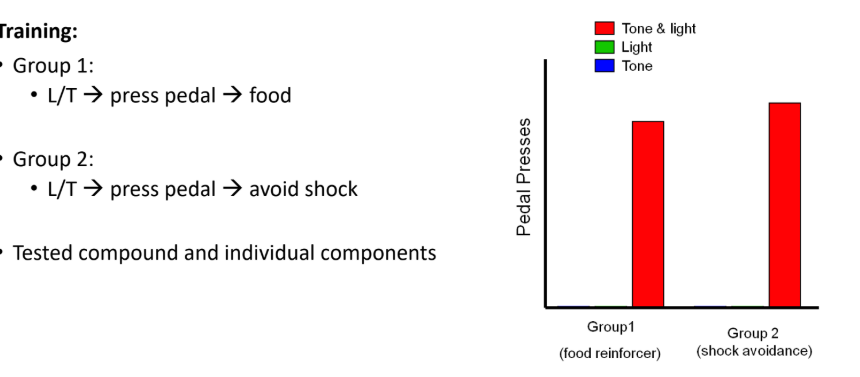
• Foree and LoLordo (1973) tested this idea in pigeons...
Foree & LoLordo (1973)
• Belongingness & behavioural systems
Food-activated feeding system
Visual cues “go” with food
Shock-activated defense system
Auditory cues “go” with predators
Instrumental Response Factors
•Nature of the response required for reinforcement can
affect stimulus control
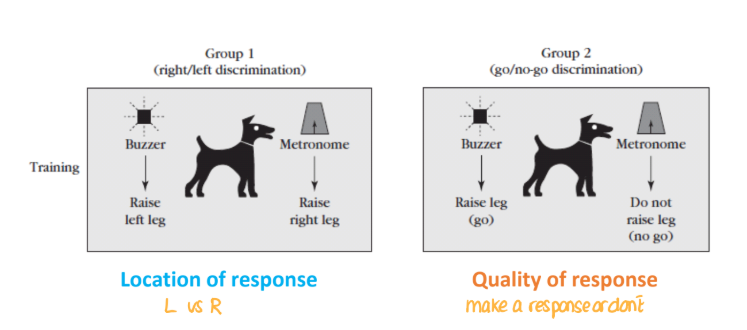
Quality-Location Effect
Dobrzecka et al. (1966), from Domjan (2010) Q: Which of two features would control behaviour?
Quality of stimulus
Metronome or Buzzer
Location of stimulus
In front or behind animal
Quality-Location Effect Test
positions of metronome and buzzer were reversed
Quality-Location Effect Predictions
• If quality of the stimulus was controlling behaviour; then
they will perform the behaviour that goes with each
sound, regardless of where the sound is located
• If location of stimulus was controlling behaviour, then it
should not matter what sound is in what spot
Quality-Location Effect Results
• Spatial responses (Left vs. right leg) come under the
control of spatial location of cue
•Quality responses (go/no-go) come under control of
the quality of the cue
Learning & Stimulus Control
Can have Stimulus Discrimination Training in both classical and instrumental conditioning:
Classical Conditioning: CS+ or CS-
Instrumental Conditioning: S+ (SD) or S- (SΔ)
Stimuli explicitly associated with other stimuli or outcomes
•Different views about why generalization exists...
• Pavlov: Generalization caused by similarity of a
stimulus to the original CS
• Lashley & Wade (1946): Generalization reflects the
absence of learning
Discrimination Training Effects on Stimulus Control
•Use generalization gradient to determine degree of
stimulus control
•Need to determine the feature(s) of the discrimination
procedure that controls the gradient
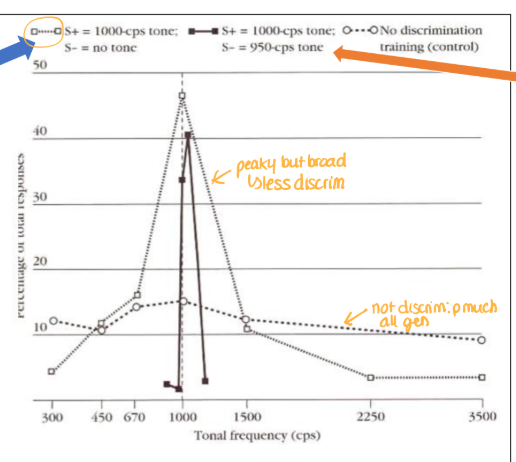
Jenkins & Harrison (1962)
interdimensional discrimination (blue)
BETWEEN
tone vs no tone (like R vs L leg)
discrim within tones is not learned
intradimensional discrimination
WITHIN
both tones BUT diff frequencies
faster discrim dropoffs cuz learning abt 1 stimulus
Range of Discriminative Stimuli
• Wide range of stimuli have been used in
discrimination studies
• Music, auditory frequencies, painting styles, geometric
shapes, medical slides, etc.
• We can use these discrimination studies to assess the
sensory capability of species
Can You Discriminate?
picasso vs monet
can pigeons?
show novel images, shift other properties (ex: contrast, line weight, etc.) to see what they are attending to
what if we introduce a new artist?
pigeons good as long as artists distinct enough from each other
base rule for generalizing & rule sets
Spence, and Discrimination Learning
• Spence (1936) thought that animals learned both
about S+s and S-s
• S+ = excitation
• S- = inhibition
•Different generalization gradients for different training
regimes
• Test with stimuli that vary systematically
•...we’re going to come back to this!
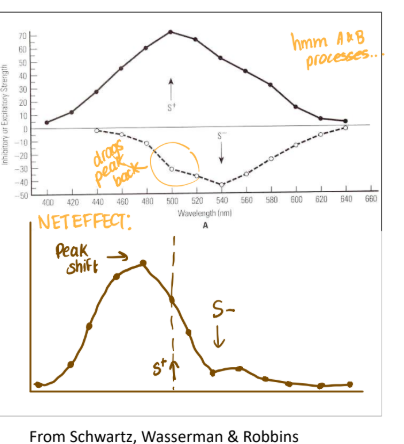
Hanson (1959): Results
excitatory generalization gradient!
intradimentsional discrimination
very little responding to S+ wavelength
peak-shift effect!
Peak-Shift Schematic
What Spence thought:
• Excitation developed around the S+
• Inhibition developed around the S-
• Peak-shift was the net effect of these
two generalization gradients
Equivalence Training
•Opposite to discrimination training
• Train animals to treat dissimilar stimuli as similar –
Stimulus equivalence
• Train animals to generalize, not discriminate among
stimuli
The Big Picture: Contextual cues
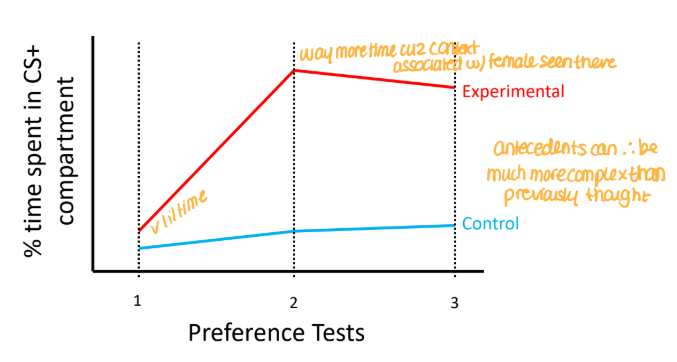
• Male quail sexual conditioning (Akins, 1998)
• Arena with two compartments (OR ‘CONTEXTS’):
• Sand floor, orange walls & ceiling
• Wire-mesh floor, green walls & ceiling
• Individual subjects allowed to move back and forth in baseline
• Less preferred compartment made CS+
• Conditioning:
• Experimental group: CS+ paired with sexually receptive female (US)
• Control group: US only in home cage, never in CS+ compartment
Akins (1998): Results
came to prefer context that was associated with female!
Modulators overview
• Modulator: a third event (in addition to CS/US or
Response/Reinforcer)
• Assists in determination of the binary relation
• e.g., Context of rooms in male quail sexual conditioning
experiment
• e.g., S+s and S-s (discriminative stimuli) in operant
discrimination tasks are modulators
• Modulators are facilitators or occasion setters in
Pavlovian conditioning experiments
modulator
a third event (in addition to CS/US or
Response/Reinforcer)
ex: population affects how a hockey team is supported whether they are winning or losing
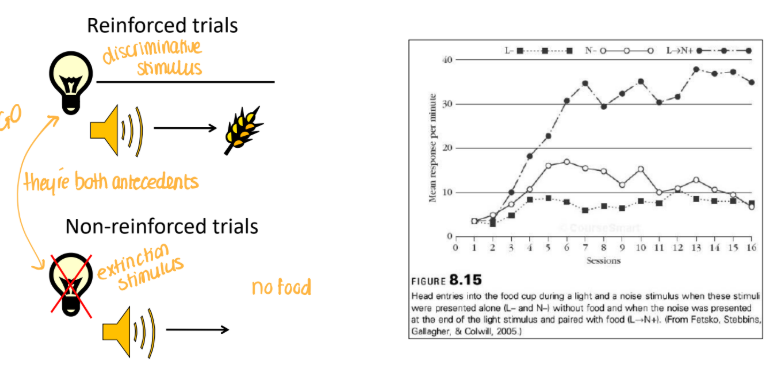
conditional control
pavolvian conditioning
light and no light are both antecendents
no light: extinction stimulus bc it means no food
light: discriminative stimulus bc it means food