Commercial Real Estate Investing 101
 Call Kai
 Learn
Learn Practice Test
 Spaced Repetition
 Match
Match Flashcards
 Knowt Play
1/27

Earn XP
Description and Tags
Break into CRE Academy
Name | Mastery | Learn | Test | Matching | Spaced | Call with Kai |
|---|
No analytics yet
Send a link to your students to track their progress
28 Terms
Commercial property layouts
Made up of suites or units and common areas; typically measure based on square footage
Gross building area (GBA)
Total interior floor area of the building including all suite interiors, shared common areas, stairwells, hallways or mechanical rooms
Net leasable area (NLA)
Total floor area the can be rented to tenants for their exclusive use; generally excludes common areas, mechanical rooms, etc. It is basically the actually sq footage used by the tenant
Floor area ratio (FAR)
Total gross building area divided by land area;
GBA= 20,000 SF
Land area= 4,000 SF
FAR= 5
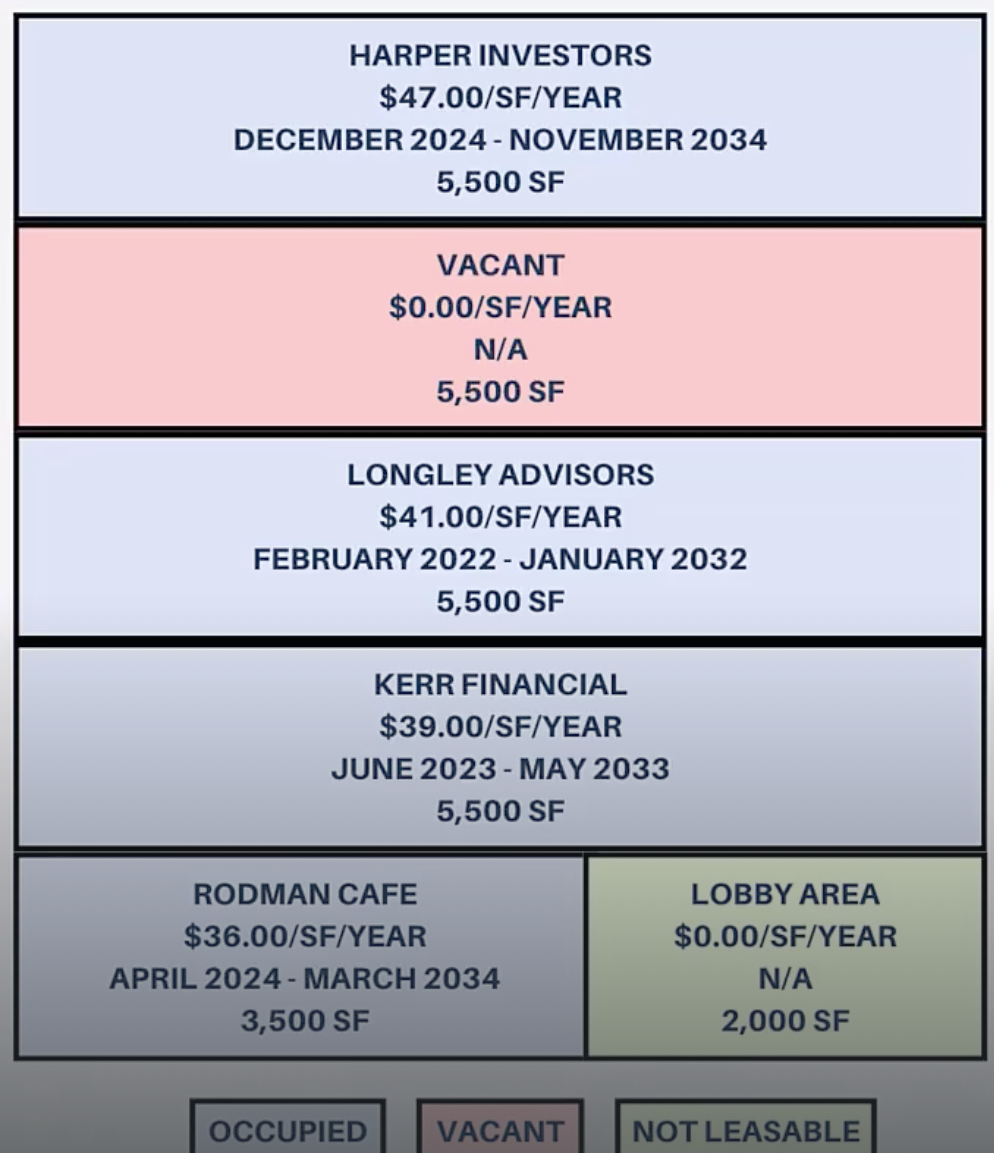
Stacking plan
Shows leasing info by floor in a multi story building; typically includes tenant names, base rent, lease terms, and suite size
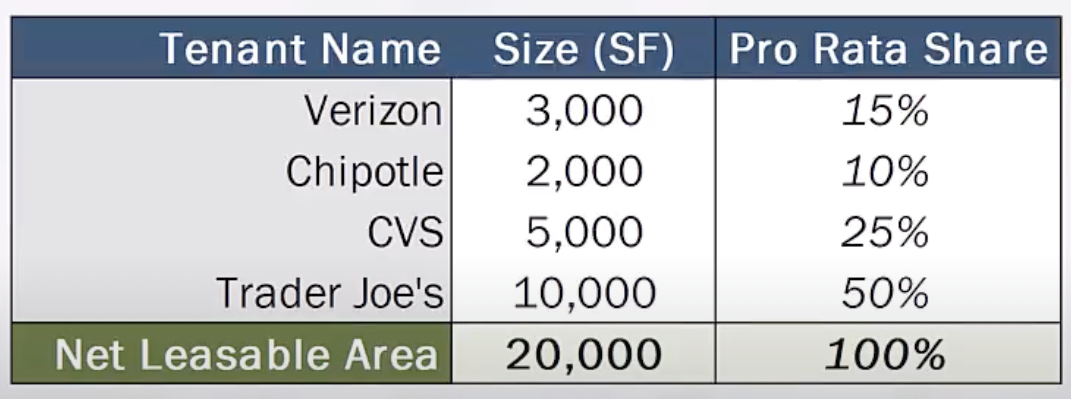
Pro rata share
Percentage of net leasable area occupied by each tenant
CRE leases
Contractual terms that drive income generated by the property. Main economics include:
Lease term
Base rent
operating expense reimbursement
tenant improvement allowances
Lease term
Typically 3-10+ years for commercial properties; larger footprint longer the lease
Often options to renew at predetermined terms
Typically exclusive to the tenant at a predetermined rent for an exact $ amount
Fair market value (FMV): no less than (X%) increase over prior year; Amount usually decided by a 3rd party
Escalation schedules
Shows starting base rent, when rent will change and by how much
Regular fixed % increases: Annual 3% increases
Irregular fixed % increases: 15% increases every 5 years
Increase tied to consumer price index (CPI): Base rent to keep up with/ inflation
Rent abatement
Period of time over which base rent will not be owed (free rent period) usually in the beginning of the lease; tenants typically required to reimburse landlord for operating expenses during that time
Operating expense reimbursement
Tenant reimburses property owner for a % of operating expenses incurred based on pro rata share
Tenant improvement allowances
Landlord reimburses up to a maximum allowable amount to build out their suite to help tenant get up and running; Typically expressed per sq ft ($20 SF)'; Generally paid up front as a one time cost before lease begins
Gross potential rent (GPR)
Total rent income that could be generated at a property if all suites/units were leased at current market rates
Loss to lease
Difference between market rent and actual lease rents
Market rent - actual rent =
Gain to lease
Exists when market rents have fallen below actual lease rents
Physical vacancy
Measures actual space that’s currently not physically occupied
100 unit property
5 vacant units
5% physical vacancy
Economic vacancy
Incorporates model units and rent abatement
100 unit property
5 units vacant
2 model units
7% economic vacancy
Triple net (NNN)
tenants responsible for reimbursing their pro rata share of all operating expenses with the property
Full service gross (FSG)
landlord’s responsible for all operating expenses at the property
Modified gross (MG)
Tenants responsible for reimbursing their pro rata share of only a select operating expenses associated with the property; % of agreed upon items
Base year stop (BYS)
tenants responsible for reimbursing their pro rata share of the overage above one other more “base year” rent
Controllable expenses
operating expenses that a property owner can directly influence/control
Repairs/maintenance, admin costs, payroll, marketing/advertising, contract services
Non controllable expenses
operating expenses a property owner has little to no control over
Property taxes, insurance, utilities
Property management fee
Provides day to day operational oversight, communication w/ onsite staff/contractors, property level bookkeeping and accounting services
Fees are typically calculated as a % of effective gross revenue (EGR); typically 3-5%
Effective gross revenue
Base rent + other income + operating expense reimbursement
Utilities
generally paid by tenants directly, at some older buildings utilities are not separately metered
requires a RUBS billing system
Ratio utility billing system (RUBS)
Reimbursement to properrty owner for each tenants pro rata share of utility costs
Net operating income (NOI)
operating revenue - operating expenses
Used for property valuation and loan sizing